


This article was automatically translated from the original Turkish version.

Koyunbaba Bridge
Location | Osmancık Çorum Türkiye | ||||||||
|---|---|---|---|---|---|---|---|---|---|
Construction Date(s) | 1484–1489 | ||||||||
Length | Approximately 250 metres | ||||||||
Building Material(s) | Cut yellow stone | ||||||||
Number of Arches | 19 | ||||||||
Koyunbaba Köprüsü is located in the district of Osmancık, Çorum Province, spanning the Kızılırmak River. The bridge was commissioned by Ottoman Sultan II. Bayezid between 1484 and 1489. Due to its position at the intersection of major north-south and east-west routes, it has held a strategic importance for transportation and trade throughout history.
The bridge is approximately 250 metres long and 7 to 7.5 metres wide, consisting of 19 pointed arches. Although some arches became buried over time, restoration efforts have restored full visibility of all arches. The spans of the arches range from 9.20 to 16.35 metres, while the thickness of the piers measures between 3.40 and 4.15 metres. Constructed from cut yellow stone, the bridge features stone parapets 60 centimetres high on both sides. Its gently curved form contributes to an aesthetically pleasing appearance.
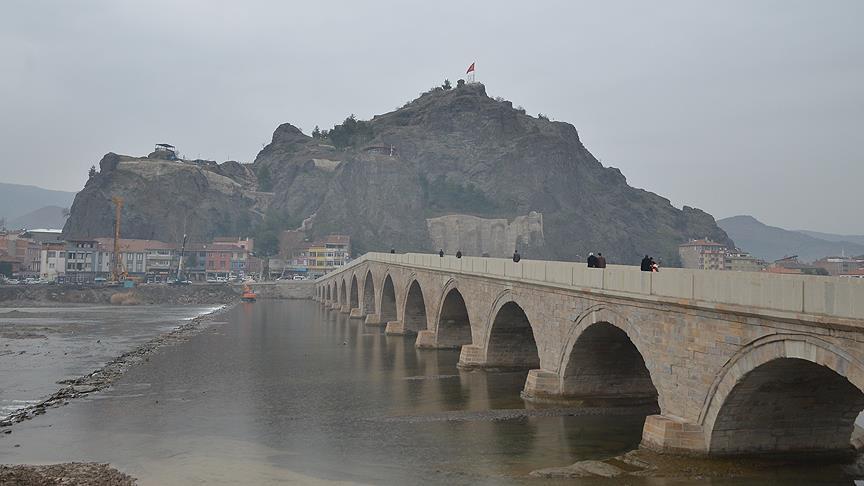
Koyunbaba Köprüsü (Anadolu Ajansı)
The bridge derives its name from a dervish known as Koyun Baba, believed to have lived in the 15th century and revered by the local population as a saint. The Koyunbaba Türbesi, bearing the same name, is located southwest of the bridge. According to tradition, during his time as a prince, II. Bayezid was unable to cross the Kızılırmak until he received assistance from Koyun Baba. After ascending the throne, he ordered the construction of this bridge out of respect for him. In this sense, the bridge is not merely an architectural work but also a spiritual symbol deeply intertwined with popular belief.
Koyunbaba Köprüsü held considerable importance during the Ottoman period as part of the Silk Road route. For centuries it was actively used by caravans, travelers, and merchants. It is also notable as one of the longest surviving stone-arched Ottoman bridges in Anatolia. The bridge has made significant economic and social contributions to the region.
Restoration work initiated in 2014 by the 7th Regional Directorate of Highways was completed in 2017. During this process, soil covering the bridge was removed, previously hidden arches were exposed, and the structure was restored in accordance with its original architecture. Additionally, a night lighting system was installed to enhance both safety and visual impact.
Today, Koyunbaba Köprüsü is open to both pedestrian and vehicular traffic. It is recognized as one of Osmancık’s cultural symbols and is visited by both domestic and international tourists. It is also regarded as one of the protected cultural heritage elements of the region.
Ceylan, Kemal. “5 Asırlık Koyunbaba Köprüsü Restore Edildi.” Anadolu Ajansı. Accessed June 15, 2025.https://www.aa.com.tr/tr/kultur-sanat/5-asirlik-koyunbaba-koprusu-restore-edildi/1348501
Osmancık Belediyesi. “Koyunbaba Köprüsü.” Osmancık Belediyesi Resmî Web Sitesi. Accessed June 15, 2025.https://osmancik.bel.tr/koyunbaba-koprusu
T.C. Kültür ve Turizm Bakanlığı. "Koyunbaba Köprüsü - Çorum." Kültür Portalı. Accessed June 15, 2025.https://kulturportali.gov.tr/turkiye/corum/gezilecekyer/koyunbaba-koprusu.
Çorum Ticaret Borsası. "Koyunbaba Köprüsü." Çorum Ticaret Borsası. Accessed June 15, 2025.http://www.corumtb.org.tr/kurumsal.php?s_id=10&kid=73.
Çorum İl Kültür ve Turizm Müdürlüğü. “Çeşmeler-Köprüler.” T.C. Kültür ve Turizm Bakanlığı. Accessed June 15, 2025.https://corum.ktb.gov.tr/TR-58715/cesmeler-kopruler.html.

Koyunbaba Bridge
Location | Osmancık Çorum Türkiye | ||||||||
|---|---|---|---|---|---|---|---|---|---|
Construction Date(s) | 1484–1489 | ||||||||
Length | Approximately 250 metres | ||||||||
Building Material(s) | Cut yellow stone | ||||||||
Number of Arches | 19 | ||||||||
Architectural Features
Origin of the Name and Cultural Context
Historical Significance
Restoration Process
Current Use