


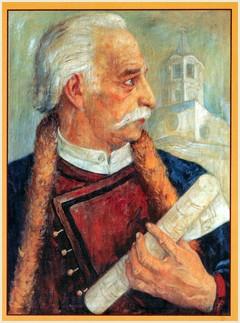
Kolyu Ficheto
Born | 1800 | ||||||||
|---|---|---|---|---|---|---|---|---|---|
Death | 1881 | ||||||||
Profession(s) | Architecture - Joiner | ||||||||
Kolyu Ficheto (Nikola Ivanov Fichev, 1800-1881), an Ottoman-era Bulgarian master craftsman and architect, is renowned for harmonizing aesthetics, functionality, and durability in his works. Active mainly in Tarnovo and its surroundings, Ficheto significantly contributed to the architectural heritage of the Ottoman Empire, creating structures that reflected the multicultural nature of the region while addressing both practical and artistic demands.
Nikola Ivanov Fichev was born in 1800 in Dryanovo, a village within the Ottoman Empire (modern-day Bulgaria). Born into a humble family, he displayed an early aptitude for craftsmanship and began his training in carpentry at the age of 10. He honed his skills under master carpenters in Trevna and later studied stonework, church, and bridge construction techniques from prominent builders in the Tarnovo region.
After a rigorous 26-year apprenticeship and journeyman period, Ficheto earned the title of "master" in the 1830s, marking the culmination of his extensive training and the beginning of his distinguished career as an architect.
Ficheto's professional journey began in the 1830s with notable contributions to the construction of the Preobrazhensky Monastery. Despite the challenges of the time, he demonstrated perseverance and skill. Later, he played a significant role in the construction of Saint Nicholas Church in the Varosh district of Tarnovo , earning recognition and trust as he successfully completed this prestigious project under the supervision of his master.
Ficheto's architectural style is a seamless blend of Ottoman architectural traditions and local elements. His hallmark features included double-curved roof structures, symmetrical designs, and decorative arches. He meticulously planned his projects using wax models and detailed blueprints, combining precision with an artistic vision that emphasized both form and function.
Akdere Bridge (1865-1867)
Lovech Covered Bridge
Saint Nicholas Church (Dryanovo)
Hacı Nikoli Inn (Tarnovo )
In his later years, Ficheto continued to serve the Ottoman Empire by producing remarkable projects, including a new inn in Tarnovo in 1872. This structure later became a symbol of political transformation when it hosted Bulgaria's first National Assembly in 1879. Kolyu Ficheto passed away in 1881 and was laid to rest in Tarnovo . His works remain integral to the Ottoman architectural legacy, reflecting the Empire’s multicultural identity. He is celebrated as a master craftsman whose contributions continue to inspire and highlight the artistic and functional brilliance of his era.
Monument to the Architect Nikola Fichev (Kolyu Ficheto), 1800-1881. Stone, bronze. SAHARA: The Color Film Emergency Project. SAHARA: Society of Architectural Historians Architecture Resources Archive. Accessed January 23, 2025. https://jstor.org/stable/community.31040536.
Pantheon. "Kolyu Ficheto." Accessed January 23, 2025. https://pantheon.world/profile/person/Kolyu_Ficheto.
Belenski Most. "Self-Taught and Brilliant." Accessed January 23, 2025. https://belenskimost.com/en/samouk-i-genialen.html.
Bulgaria Travel. "Kolyu Ficheto’s Bridge over the Yantra River, Byala." Accessed January 23, 2025. https://bulgariatravel.org/kolyu-fichetos-bridge-over-the-yantra-river-byala/.
Petkov, P. "Historical View of Some Objects from the Work of Master Kolyu Ficheto." Cultural and Historical Heritage: Preservation, Presentation, Digitalization (KIN Journal) 1, no. 1 (2015): 5–13. ISSN 2367-8038. Institute of Mathematics and Informatics – Bulgarian Academy of Sciences.
Bogdanova, Galina Todorova, Stefka Kancheva, and Galya Chohadzhieva. "Майсторът и времето (The Master and the Time)." Digital Presentation and Preservation of Cultural and Scientific Heritage, Special Issue (2013): 9–36. Published by: Institute of Mathematics and Informatics – Bulgarian Academy of Sciences.

Kolyu Ficheto
Born | 1800 | ||||||||
|---|---|---|---|---|---|---|---|---|---|
Death | 1881 | ||||||||
Profession(s) | Architecture - Joiner | ||||||||
Early Life and Education
Early Career
Architectural Style and Creativity
Major Works
Later Years and Legacy
This article was created with the support of artificial intelligence.