

This article was automatically translated from the original Turkish version.
+1 More
Region(s) | Troas | ||||||||
|---|---|---|---|---|---|---|---|---|---|
Period(s) | Roman Period (Late Roman) | ||||||||
Location | Ezine – Koçali (Yahyaçavuş) Village Çanakkale | ||||||||
Top Diameter | 135 cm | ||||||||
Base Diameter | 167 cm | ||||||||
Column Length | 11.50 m | ||||||||
Produced | Monolithic column | ||||||||
Building Type | Ancient granite column workshop | ||||||||
Koçali Column Quarries are ancient granite quarries located near the village of Koçali (Yahyaçavuş), in the Ezine district of Çanakkale province. These quarries, situated in the region of Troas, are understood to have been used for the production of monolithic granite columns, which were prepared for use in nearby ancient settlements, primarily Alexandria Troas.
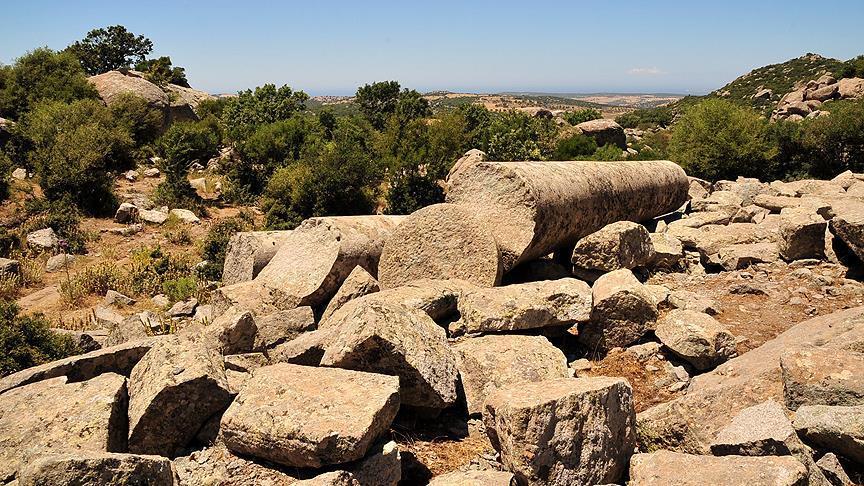
Koçali Column Quarries (DHA)
The Koçali Column Quarries are situated approximately 800 metres west of the village of Koçali in the Ezine district of Çanakkale province, on a rocky terrain composed of granite masses. The quarry lies within a narrow valley north of the road leading to the village of Kestanbol. The area is part of the Troas geological zone, which features extensive granite formations and provided abundant natural resources suitable for stone extraction in antiquity.
The granite formations around Koçali extend along a broad geological line reaching as far as the areas around Akçakeçili and neighbouring villages, forming a significant portion of the ancient granite quarries in the Troas region. It is understood that the granite extracted from these areas was used to produce large-scale columns for ancient architecture.
At the Koçali Column Quarries, the granite bedrock from which the columns were extracted and the large columns arranged in sequence in front of the quarry are particularly noticeable. Seven columns are identified as having been worked at the site; four remain intact while three are broken. It is noted that the columns were separated from the bedrock using flat-tipped wedges, and the wedge marks left during this process are clearly visible on the bedrock surface.
After extraction, the surfaces of the columns were smoothed and polished, but prolonged exposure to the elements has resulted in the formation of a natural patina. Additionally, wedge marks observed on other granite blocks at the site indicate that not only columns but also other architectural elements may have been cut here.
The presence of chisel and wedge marks on granite blocks surrounding the quarry demonstrates that intensive stone-working activity took place here in antiquity. These production traces reveal that the columns were shaped at the quarry before being transported to their final destinations.
The granite columns produced at the Koçali Column Quarries were worked as large monolithic blocks. All columns in front of the quarry exhibit the same form, tapering slightly toward the top. The lower diameter of the columns is approximately 167 cm, the upper diameter approximately 135 cm, and their length measured about 11.50 metres.
The lower sections of the columns are shaped into a base approximately 30 cm high with an inwardly recessed profile. The upper sections feature a two-step capital arrangement: the first step is approximately 7 cm high and the second approximately 28 cm high.
The lengths of the broken columns at the site are recorded as approximately 815 cm, 830 cm, and 595 cm respectively. These dimensions confirm that the columns were prepared for use in large-scale architectural structures.
The granite columns produced at the Koçali Column Quarries were intended for use in ancient settlements in the Troas region, primarily Alexandria Troas. Research in the region has identified examples with similar dimensions and characteristics within the Kestanbol plain and the ruins of Alexandria Troas.
Columns found broken in the middle near the Kestanbol thermal baths and in agricultural fields along the Gülpınar road are considered evidence of the transportation process of these columns from the production site. Column fragments discovered around the harbour of Alexandria Troas and at various points within the city further demonstrate that these columns were transported for use in ancient construction projects.
However, some column fragments found in and around the harbour and beneath the sea suggest that these columns may have also been prepared for shipment to other settlements beyond the immediate region. This indicates that the granite quarries of Troas served as major stone production centres supplying a wide geographical area in antiquity.
Anadolu Ajansı. “İhraç Edilemeyen 2 Bin Yıllık Dev Sütunlar İlgi Görüyor.” Accessed March 5, 2026. https://www.aa.com.tr/tr/kultur-sanat/ihrac-edilemeyen-2-bin-yillik-dev-sutunlar-ilgi-goruyor-/631933
Ay, Murat, and Veysel Tolun. “Troas Granit Sütunlarının Batı Anadolu Kıyılarındaki Dağılımı Üzerine Arkeometrik Bir Yaklaşım.” *Arkeoloji ve Sanat* 156 (2017): 119–130. Accessed March 5, 2026. https://acikerisim.comu.edu.tr/server/api/core/bitstreams/59992e6e-ae91-4af7-8504-2a765e3a5e92/content
Culture Heritage Protection Board. "Stone Quarry Area Located Within the Boundaries ofYahyaçavuş Köyü,Ezine İlçesi,Çanakkale İli." Accessed March 5, 2026. https://korumakurullari.ktb.gov.tr/Eklenti/52762,canakkale-ili-ezine-ilcesi-yahyacavus-koyu-sinirlari-ic-.pdf
DHA. "Koçali Sütun Ocakları." YouTube, Accessed March 5, 2026. https://youtu.be/EycuWHQJ5AA
Işık, M. Akif. “Çanakkale – Koçali ve Akçakeçili Köyleri Yakınındaki Granit Sütun Yatakları.” Accessed March 5, 2026. https://dergipark.org.tr/tr/download/article-file/2158939

Region(s) | Troas | ||||||||
|---|---|---|---|---|---|---|---|---|---|
Period(s) | Roman Period (Late Roman) | ||||||||
Location | Ezine – Koçali (Yahyaçavuş) Village Çanakkale | ||||||||
Top Diameter | 135 cm | ||||||||
Base Diameter | 167 cm | ||||||||
Column Length | 11.50 m | ||||||||
Produced | Monolithic column | ||||||||
Building Type | Ancient granite column workshop | ||||||||
No Discussion Added Yet
Start discussion for "Koçali Sütun Ocakları" article
Geographical Location
Structure of the Quarries and Production Traces
Technical Characteristics of the Columns
Usage and Distribution