


This article was automatically translated from the original Turkish version.
Kitâbü’l-İzz ve’l-Menâfiʻ, tam adıyla Kitabü'l-İzz ve'l-Menâfiʻ li'l-Mücâhidîn fî Sebili'llâh bi'l-Müdâfiʻ (The Book of Benefits and Values for Warriors Fighting in the Path of Allah with Weapons and Artillery), was authored by the Andalusian sailor and artillery master Al-Rais Ibrahim b. Ahmed Arribaş Al-Andalusi. This eser provides detailed information on artillery and military weapons.
Ibrahim Reis was born around 1550–1560 in the village of Nigüelas near Granada. After the expulsion of Muslims from Andalusia, he migrated from Granada to Seville, where he worked on galleons transporting valuable minerals from Spain to the Americas, gaining practical experience in navigation and artillery. He also attended meetings of artillery experts aboard ships and had the opportunity to study various written works on the subject.
Due to events involving Muslims and Christians in Spain, Ibrahim Reis was imprisoned for a period. After his release, he moved to Tunis. Appointed by the Bey of Tunis, he led a group of armed Andalusian sailors and participated in naval battles against Christians. Captured in one battle, he regained his freedom seven years later and returned to Tunis. While serving at Halkulvad Castle, he deepened his knowledge of artillery. Observing the difficulties involved in manufacturing and using cannons, he felt the need to write a book on the subject and completed his work in 1632 after beginning it in 1630.
The work was written in Aljamiado, that is, Spanish written in the Arabic alphabet. While composing Kitabü’l-İzz ve’l-Menâfiʻ, Ibrahim Reis drew upon the following important sources:
In his work, Ibrahim Reis meticulously combined information from these books with his own experiences and observations.
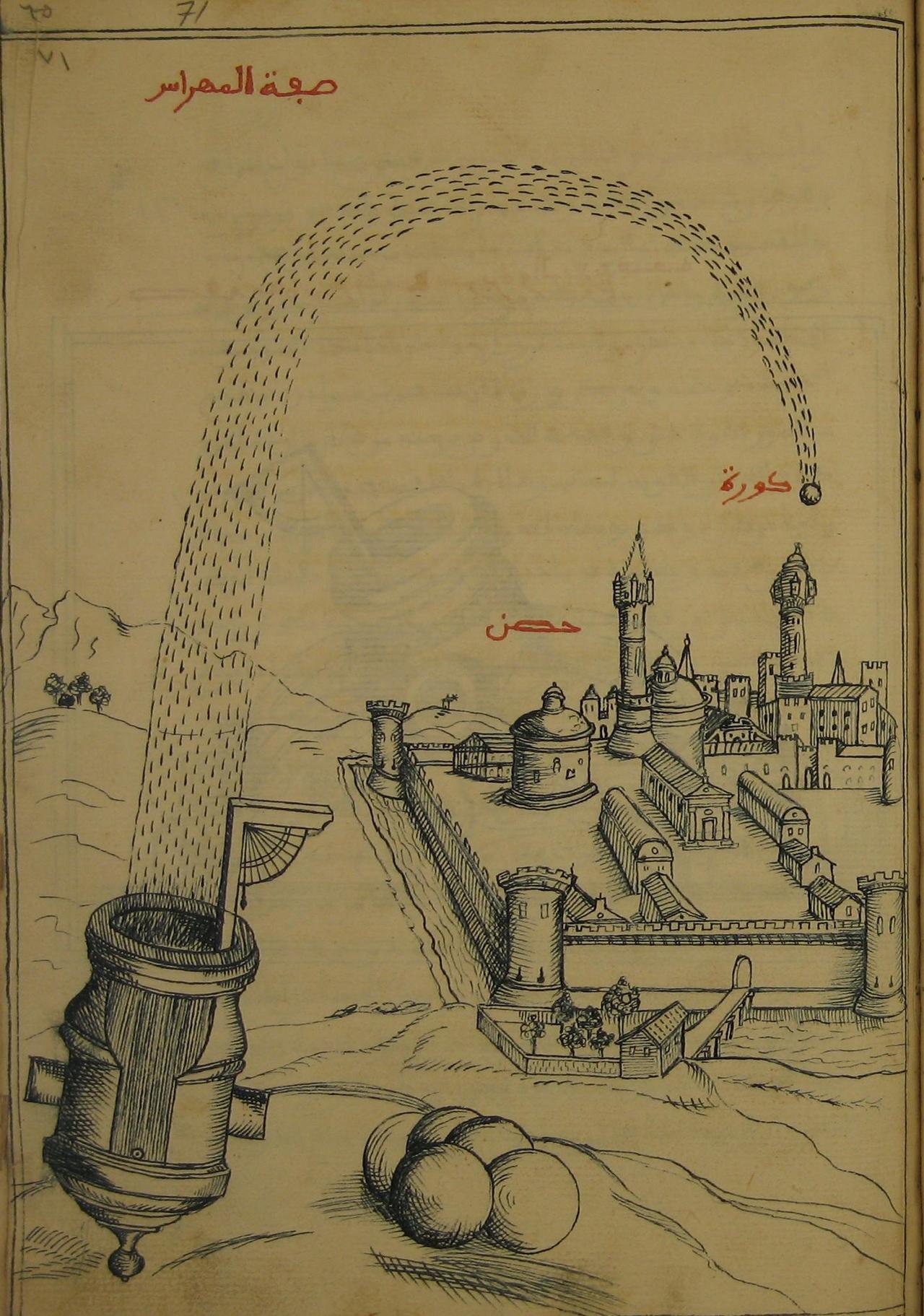
Illustrations of a howitzer from Ibrahim Reis’s work. (Source: Süleymaniye Ktb. Hafız Ahmed Paşa, nr. 1122, vrk. 71)
In 1638, the work was translated into Arabic by Ahmed b. Kasim b. Ahmed el-Fakıh Kasım b. el-Şeyh el-Hucri el-Endülüsî, translator to the sultans of Marrakesh. Arabic copies reproduced by the translator’s son Muhammed Hoca were distributed throughout the Islamic world, and one copy was presented to Ottoman Sultan IV. Murad. The work, consisting of fifty chapters, contains information on loading cannons, projectile trajectories, transportation, and deployment, as well as on the invention of gunpowder and the development of firearms. The original Aljamiado manuscript has not survived to the present day. This work was presented at the XIIIth Orientalist Congress in Hamburg in 1902 by the Cairo-based scholar Ahmed Zeki Paşa, after which it began to gain recognition in the scholarly world.
DOSAY GÖKDOĞAN, Melek- DEMİR, Remzi, "İslâm ve Türk Uygarlığında Makine Tarihi" Dört Öge (14), 2018, 1-19.
İHSANOĞLU, Ekmeleddin-ŞEŞEN, Ramazan-BEKAR, M. Serdar-GÜNDÜZ, Gülcan, Osmanlı Askerlik Literatürü Tarihi, c. I, İslam Tarih, Sanat ve Kültür Araştırma Merkezi (=IRCICA), İstanbul 2004, pp. 19.
İbrahim Reis, el-İzzu ve’l-Menâfi’ li’l-Mücâhidîn fî Sebîli’llâh, trc. Muhammed Hoca, Süleymaniye Ktb., Hafız Ahmed Paşa, nr. 1122.
İhsanoğlu, Ekmeleddin, "Endülüs Menşeli Bazı Bilim Adamlarının Osmanlı Bilimine Katkıları", BELLETEN 58/223 (December 1994), 565-606.

No Discussion Added Yet
Start discussion for "Kitabü'l-İzz ve'l-Menâfi" article