This article was automatically translated from the original Turkish version.
+1 More
Location | Muş | ||||||||
|---|---|---|---|---|---|---|---|---|---|
Culture/Period | Middle Iron Age (9th–8th centuries BCE) Urartu | ||||||||
Settlement Type | Military and administrative fortress | ||||||||
Prominent Structures | stele area walls pithos storage facilities rock tomb Temple | ||||||||
Excavations | 2018–2019 1965 | ||||||||
Kayalıdere Ancient Castle is located within the boundaries of the Varto district of Muş province in Eastern Anatolia, approximately 15–20 km from the district center. It is situated on a rocky ridge oriented northwest-southeast, 3 km west of Kayalıdere Village (formerly Hınzor), on the eastern bank of the Murat River. The region features a two-terrace topography, comprising two main settlement levels: the Upper Citadel and the North Slope Settlement (lower terrace).
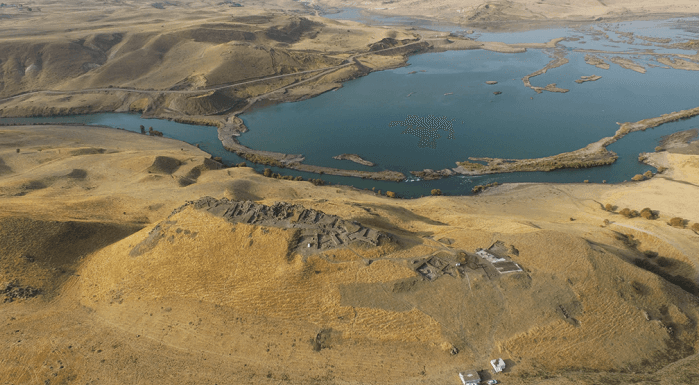
General View of Kayalıdere Castle from the East (Dergipark)
The castle was first identified during surface surveys conducted by C.A. Burney in 1956. In 1965, a single-season excavation was carried out under the joint leadership of Burney and Seton Lloyd with support from the British Institute of Archaeology at Ankara. These excavations yielded significant findings regarding the castle’s architecture, but the work was not completed. The second major archaeological activity at the site consisted of rescue excavations conducted between 2018 and 2019 under the direction of the Ahlat Museum Directorate and with scientific guidance from Sabahattin Erdoğan, prompted by the construction of the Alparslan II Dam.
Due to the absence of inscribed documents at the site, it has not been possible to determine definitively under which Urartian king the castle was constructed. However, based on architectural planning, construction techniques of the ramparts, and carbon-14 analyses, the castle is believed to date to the late 9th century BCE to the early 8th century BCE, placing its construction within the early phase of the Urartian Kingdom.
Kayalıdere Castle is evaluated within the framework of Urartian defensive systems and contains various architectural features. The site is broadly divided into three main zones: the Upper Citadel, the North Slope Settlement (lower terrace), and a southern stellate sacred area. In the Upper Citadel, remains of a square-plan tower-shaped temple, a stone-paved courtyard, storage rooms, and fragments of an administrative-palace complex have been identified. The external dimensions of the temple measure approximately 12.50 × 12.50 metres, with an internal cella measuring 5 × 5 metres. The temple’s entrance faces northeast and is preceded by a stone-paved courtyard.
In the storage structures located to the east and northeast of the temple, ceramic fragments with hieroglyphic signs and pictograms were found alongside baked-clay pithoi. The archaeological excavations in these storage areas remain incomplete, and the full extent of these structures has not yet been fully determined. At the southern end of the citadel lies a multi-chambered rock-cut tomb; excavations have revealed that it consists of at least eight chambers. In this regard, the Kayalıdere Rock Tomb is unique among Urartian rock tombs.
The castle is surrounded by ramparts averaging 3–4 metres in thickness. The total length of the ramparts is approximately 1,028 metres, and they follow the natural contours of the terrain, occasionally forming an ‘S’ shape to accommodate elevation changes and create terraces. The ramparts were constructed using the cyclopean technique, employing large stone blocks and smaller filler stones. Additionally, mudbrick infill has been identified along the eastern ramparts.
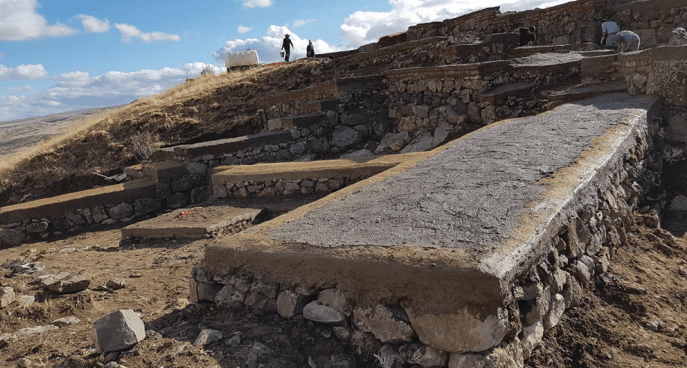
During the 2019 excavations, a new sacred area featuring stelae was discovered adjacent to the multi-chambered rock tomb, south of the citadel. Two stelae bases were identified—one intact and one broken. During cleaning operations in this area, various ceramic fragments dating to the Urartian period were recovered, including one vessel bearing hieroglyphic inscriptions and decorative motifs executed in incision technique. This area is significant for understanding stellate cult practices within Urartian religious traditions.
A total of 503 ceramic fragments from the Urartian period were identified during the 2018–2019 excavations, of which 185 were examined in detail using sampling methods. The assemblage includes bowls, jars, trays, pithoi, and miniature vessels. Ceramic groups include red-slipped Urartian wares, as well as coffee-brown, cream, and grey-glazed products. The ceramics are predominantly wheel-made and decorated with various techniques including incision, notching, grooving, relief, and pictograms. Some vessels bear stamp seal impressions depicting animals such as horses and mountain goats. The shapes of the rims, bodies, and bases of the vessels show similarities to those found at other Urartian centers such as Ayanis, Bastam, and Altıntepe. Certain vessels, particularly those with perforated bases, are notable and may have been used in cheese production.
Simultaneous with the excavations, temporary conservation measures were implemented, particularly involving the covering of wall tops with mudbrick material. Additionally, a total of 22 structures and 46 architectural remains in the Upper Citadel and North Slope Settlement were cleaned and their contours exposed. Survey and mapping work for these areas has been completed.
Kayalıdere Castle exhibits the characteristics of a typical Urartian settlement through its square-plan tower temple, multi-chambered rock tomb, stellate sacred area, rampart system, and ceramic finds. It also reflects local features characteristic of the Middle Iron Age in the Muş region. Due to its strategic location, it is regarded as an important military and administrative center along the Murat Valley route extending westward from the Urartian Kingdom.
Muş İl Directorate of Culture and Tourism. "Ören Yerleri." Accessed July 9, 2025. https://mus.ktb.gov.tr/TR-56140/oren-yerleri.html
Zeyrek, Şeref. “Kayalıdere Urartu Kalesi’nin Stratejik Önemi ve Korunması.” *Doğu Coğrafya Dergisi* 28, no. 49 (2023): 15–36. Accessed July 9, 2025. https://dergipark.org.tr/tr/download/article-file/2579393
Özgül, Musa. “Kayalıdere Kalesi ve Yerleşimi.” *Karaz: Erzurum Kültür-Sanat ve Arkeoloji Dergisi* 1, no. 1 (2020): 51–70. Accessed July 9, 2025. https://dergipark.org.tr/tr/download/article-file/1249992
“Kayalıdere.” Mus Çevre, Şehircilik ve İklim Değişikliği İl Müdürlüğü. Accessed July 9, 2025. https://mus.csb.gov.tr/sharp304-l-sharp304-m-sharp304-z-hakkinda-i-836
“Kayalıdere.” Urartular.com.tr. Accessed July 9, 2025. https://www.urartular.com.tr/alticerik/98/kayalidere.html

Location | Muş | ||||||||
|---|---|---|---|---|---|---|---|---|---|
Culture/Period | Middle Iron Age (9th–8th centuries BCE) Urartu | ||||||||
Settlement Type | Military and administrative fortress | ||||||||
Prominent Structures | stele area walls pithos storage facilities rock tomb Temple | ||||||||
Excavations | 2018–2019 1965 | ||||||||
No Discussion Added Yet
Start discussion for "Kayalıdere Ancient Castle – Muş" article
Archaeological Excavations and Dating
Architectural Structures and Site Layout
Rampart System
Stellate Sacred Area
Ceramic Finds
Conservation and Documentation Efforts