This article was automatically translated from the original Turkish version.
Location | Yozgat / Türkiye | ||||||||
|---|---|---|---|---|---|---|---|---|---|
Dating | 1883 | ||||||||
Period(s) | Late Ottoman Period | ||||||||
Type(s) | Konak (example of civil architecture) | ||||||||
Plan Type | rooms around an octagonal sofa Rectangular plan | ||||||||
Original Function | Residence (belonging to a Greek family) | ||||||||
Current Use | Assigned as an Archaeology Museum | ||||||||
Karslıoğlu Konağı is a three-story historical civilian architectural example located in the center of Yozgat province, built in 1883. The structure, dated to the Young Ottoman period, acquired its current name after being purchased by Yusuf Karslıoğlu, who served as Mayor of Yozgat from 1929 to 1936.
The mansion, constructed in 1883, is identified as a structure from the Young Ottoman period. Cross motifs carved into the door lintels and a Greek inscription on the triangular pediment of the southern sundial indicate that the building once belonged to the Greek community. The date 1883 inscribed on the text confirms the year of construction.
In 1925, the building began to be used as an official residence by the Yozgat Governorship and served as the guest accommodation during Mustafa Kemal Atatürk’s visit to Yozgat on 3 February 1934. It was later purchased by Yusuf Karslıoğlu, who served as Mayor of Yozgat between 1929 and 1936, and was used for many years as a private residence. For this reason, the building is known as the Karslıoğlu Konağı. Its use as a private residence continued from 1936 onward until it was expropriated by the Ministry of Culture and Tourism in 1977 and placed under protection for conversion into an Archaeology Museum.

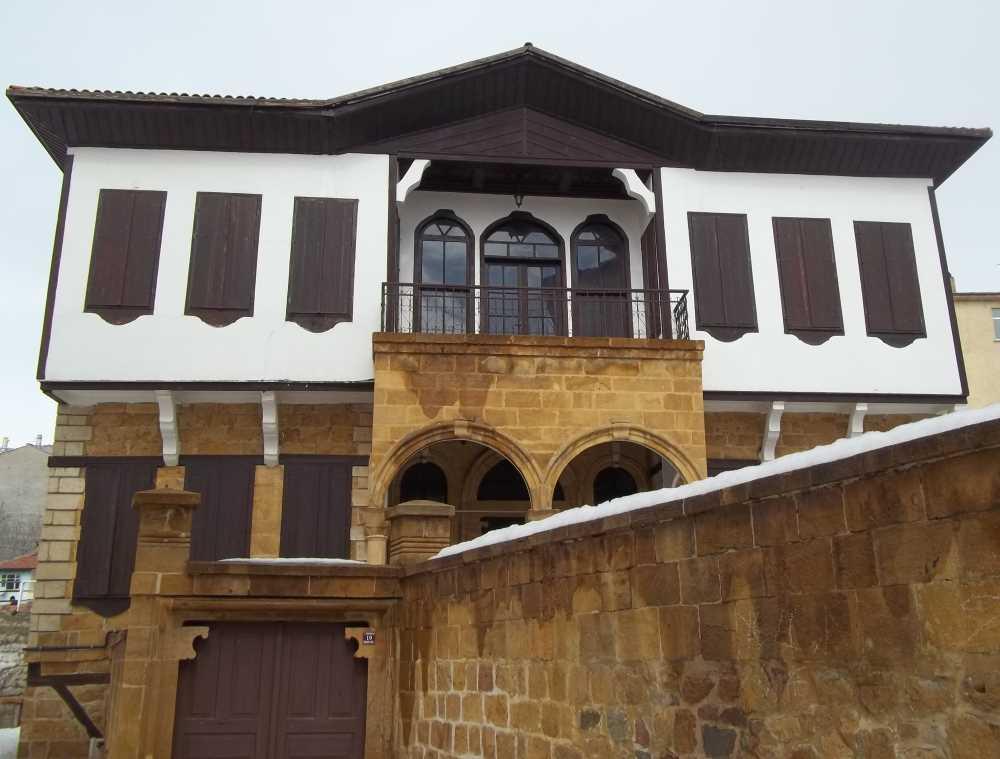
Karslıoğlu Konağı (Türkiye Culture Portal)
The building is three stories high including the basement, though some sources describe it as two stories excluding the basement. The rectangular-plan mansion is situated on a square or rectangular plot within a garden, with two facades facing the street. Its perimeter is enclosed by high stone walls to ensure privacy. The roof is covered with a traditional hipped roof type.
The foundations are constructed of rubble stone; the ground floor is built using easily workable yellow cut stone (similar to Nevşehir stone known as köfeki stone). The upper floors feature walls built using the bagdadi technique, with stone, helik stone, or adobe filling the wooden frame, and these surfaces are covered with plaster and stucco.
The main entrance is located on the southern facade and is accessed through a stone-framed, round-arched portico. Access to the first floor is via a five-step stone staircase through a small door on the eastern side. The first-floor entrance is designed with a round-arched portico supported by four columns. The portico columns are made of yellow cut stone and feature Ionic capitals. The carved vault above the portico was later covered with concrete in subsequent periods.
Inside, rooms are arranged around an octagonal sitting area. The ceilings of the salon and rooms feature finely crafted wooden paneling. Local woodwork is also evident on doors and cabinet fronts. In the southwest corner, a special room is believed to have been designated for important guests; its ceiling decorations are more detailed than those in other areas.
At the southern end of the salon, a feature resembling an eyvan is present, with a balcony in front. The second floor is arranged to project outward from the north-south facade. Its lower section is supported by S-shaped stone consoles; the balcony floor was later covered with concrete. The balcony windows are round-arched and framed in wood.
Since the second half of the 20th century, the Karslıoğlu Konağı has been recognized as a cultural asset requiring protection due to its historical and architectural value. In 1977, the Ministry of Culture and Tourism expropriated the building with the intention of repurposing it as an archaeology museum.
The first comprehensive restoration works were carried out in 1990. During this process, the structural system was reinforced, damaged wall surfaces on the ground and upper floors were repaired, and interventions on wooden ceilings and joinery were conducted using original materials and techniques. The building’s roof was restructured, and certain functional areas were reconfigured.
Throughout the restoration, care was taken to preserve the architectural uniqueness and material integrity of the mansion, with the goal of safeguarding its cultural heritage value. Today, the building continues to serve the public as a museum.
T.C. Ministry of Culture and Tourism. "Yusuf Karşlıoğlu Konağı." *Turkey Culture Portal*. Accessed June 21, 2025. https://www.kulturportali.gov.tr/turkiye/yozgat/gezilecekyer/yusuf-karslioglu-konagi
T.C. Yozgat Valiliği. “Konaklarımız.” T.C. Yozgat Valiliği Resmî Web Sitesi. Accessed June 21, 2025. http://www.yozgat.gov.tr/konaklarimiz
Özdemir, Destegül, and Kılıç, Murat. “Geleneksel Türk Konaklarının İncelenmesi, Yozgat Konakları.” *Online Journal of Art and Design* 9, no. 4 (2021): 1–13. Accessed June 21, 2025.
Location | Yozgat / Türkiye | ||||||||
|---|---|---|---|---|---|---|---|---|---|
Dating | 1883 | ||||||||
Period(s) | Late Ottoman Period | ||||||||
Type(s) | Konak (example of civil architecture) | ||||||||
Plan Type | rooms around an octagonal sofa Rectangular plan | ||||||||
Original Function | Residence (belonging to a Greek family) | ||||||||
Current Use | Assigned as an Archaeology Museum | ||||||||
History
Architectural Features
Conservation and Restoration Process