


This article was automatically translated from the original Turkish version.
Barak has been used throughout history both as a term denoting a type of furry hunting dog and as a tribal name in Turkish mythology. This concept holds an important place in the oral and written cultures of various Turk tribes, both linguistically and culturally.
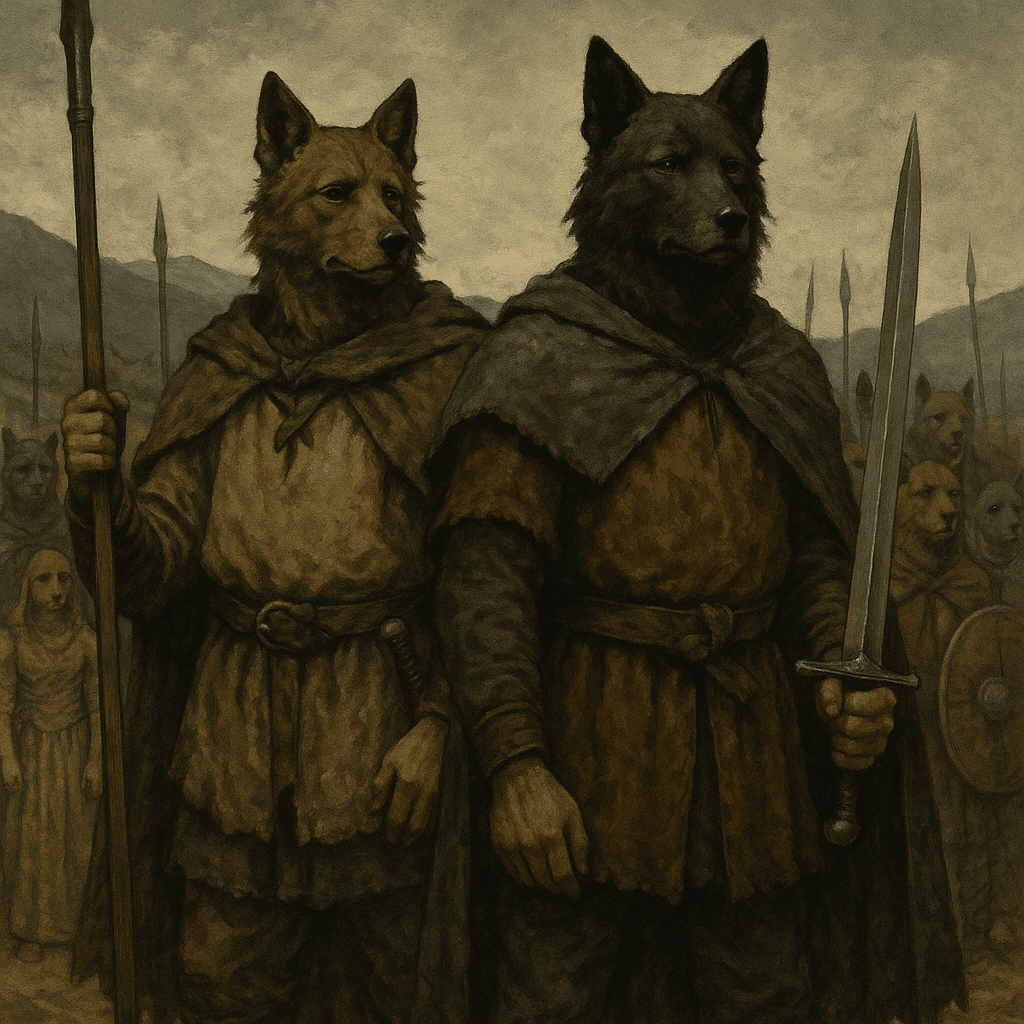
İt Baraklar Temsili (Yapay Zekâ ile Oluşturulmuştur)
Although there are various views regarding its origin, it is known that the word barak was used in Old Turkic to mean “furry dog.” In Kâşgarlı Mahmud’s work Dîvânu Lugâti’t-Türk, barak is recorded with the meaning “furry dog.” It carries similar meanings in Middle Turkic and various Turkic dialects:
According to Edward J. Dankoff, barak derives from an Avestan-origin Persian word. In Iranian languages such as Saka and Sogdian, forms like bāraa and bārak appear with meanings such as “pack animal,” “driver,” or “horseman.” In this context, it is believed that the word entered Turkic via Persian and gradually transformed into an image of a furry, powerful animal. In Middle Persian, bārak referred to a mythical mount and has also been associated with the Arabic Burāq, the sacred creature upon which Prophet Muhammad rode during the Miʿrāj.
The concept of Barak did not remain limited to a mere animal definition; in mythological and historical texts, it appears as a tribal name in expressions such as It Barak or Kıl Barak. In this context, the Baraks are described as a semi-legendary group found in the Oghuz Name, Ebü’l-Gazi Bahadır Khan’s Şecere-i Terakime, and Persian Oğuznâmeler.
The men of this group are described as having faces resembling dogs, while the beauty of their women is especially emphasized. Elements such as their martial prowess and the use of two-colored sticky liquids to paint their bodies, rendering them impervious to arrows, contributed to their perception as a semi-supernatural people. According to legend, Oghuz Khagan fought them three times: he was defeated in the first battle, victorious in the second, and in the third campaign he converted the people to Islam and brought them under his dominion.
Although these narratives are mythological, they also contain symbolic explanations regarding the origins of the Kipchaks. Statements suggesting that the Kipchak lineage emerged from unions between Oghuz Khagan’s warriors and It Barak women may have been constructed to explain ethnic mixing or historical close contacts between these groups.
The name Barak did not remain confined to legends; it also persisted as part of the names of various Turkic tribes. The Barak Turkmens, who settled in Anatolia, represent a living ethnographic extension of this name. However, there is no direct connection between this group and the mythological It Baraks.
The word barak and its associated mythological elements are among the symbolic motifs in Turkic culture used to describe relationships between humans and animals, or to depict supernatural enemies or neighboring peoples. The motif of dog-faced humans can be interpreted as a mythological image employed to either alienate or define a people closely integrated with nature. The narrative of the It Barak people, whose women’s beauty attracted warriors, has also been viewed as a mythologized reflection of historical cultural mixtures throughout history.
"Barak." Nişanyan Sözlük. Accessed May 14, 2025.https://www.nisanyansozluk.com/kelime/barak.
Barak. Kubbealtı Lügatı. Accessed May 14, 2025.
Dankoff, E. J. "The Concept of Barak in Central Asian Culture." Central Asiatic Journal 15 (1971): 105–117.
Ebü'l-Gazi Bahadır Han. Şecere-i Terakime. Hazırlayan Ahmet Zeki Velidi Togan. İstanbul: Enderun Kitabevi, 1972.
Ögel, Bahattin. Türk Mitolojisi: Kaynak ve Açıklamalarıyla Destanlar. 2 cilt. Ankara: Türk Tarih Kurumu Yayınları, 1971.
“Eski Türk Dili Ders Notları.” *Çukurova Üniversitesi Türkoloji Araştırmaları*. Accessed May 14, 2025.https://turkoloji.cu.edu.tr/ESKI%20TURK%20DILI/6.php.

No Discussion Added Yet
Start discussion for "It Barak in Turkish Mythology" article
Etymology and Linguistic Usage
Barak in Mythological and Historical Context
Baraks in History
Cultural Interpretation and Layers of Meaning