


This article was automatically translated from the original Turkish version.
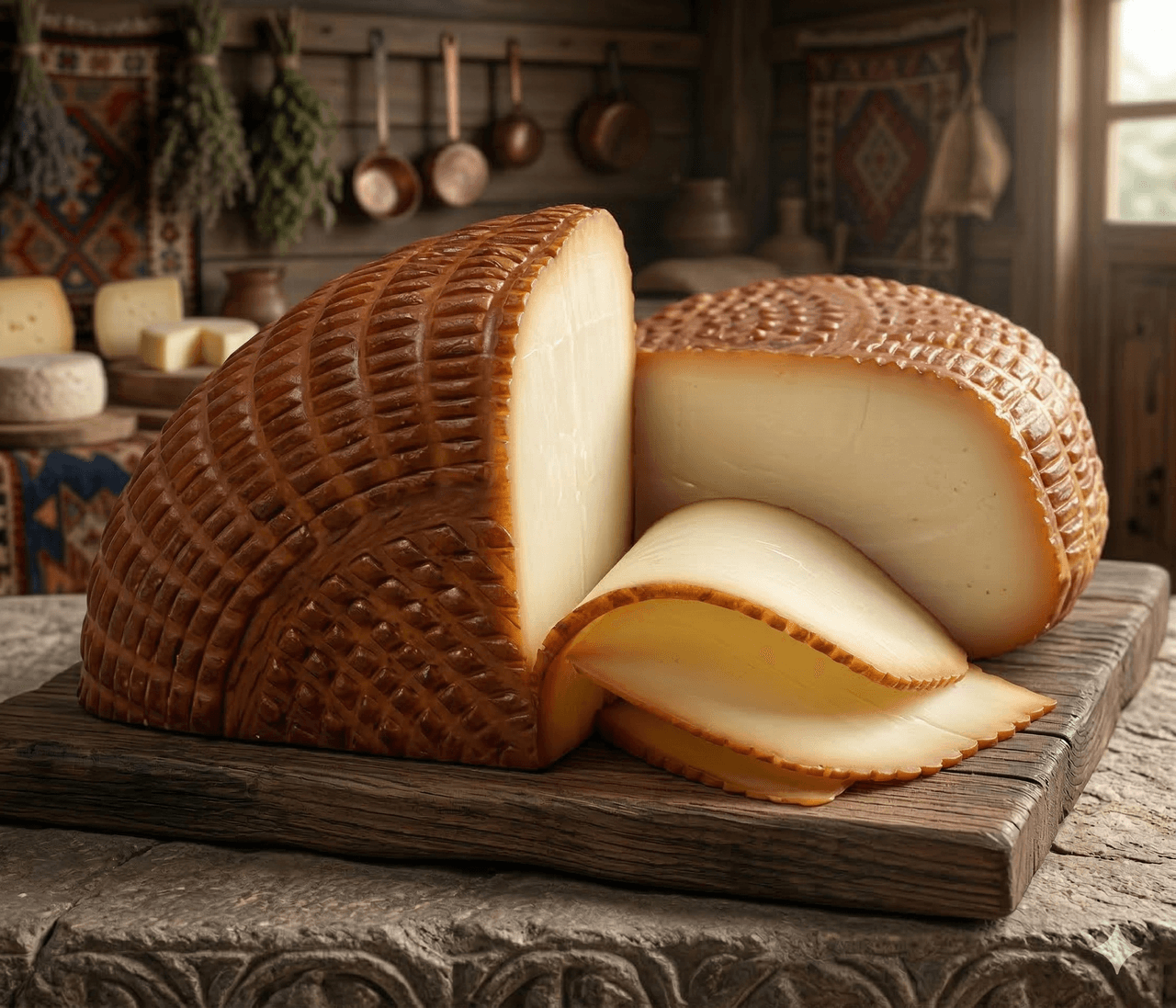
Islı Çerkes Sepet Cheese (generated with AI)
Storage and Shelf Life | Storage in cold environment, vacuum packaging, preservation by drying and smoking | ||||||||
|---|---|---|---|---|---|---|---|---|---|
Sensory Characteristics | Smoked and smoke aroma, low sugar content, characteristic milk odor | ||||||||
Physical Structure | Semi-hard texture, non-porous and smooth, milky white interior color | ||||||||
Smoking Source | Oak wood shavings, dried mulberry and acacia trees | ||||||||
Production Technique | Acid and heat coagulation, curd collection and draining, shaping in molds | ||||||||
Basic Materials | Raw cow's milk, old cheese whey (CW), table salt | ||||||||
Origin and Region | Northwest Caucasus, Düzce and Sakarya region | ||||||||
İsli Çerkes Sepet Peyniri is a regional cheese made primarily from cow, sheep, or goat milk, produced by coagulating milk through a combination of acid and high heat without the use of rennet or starter cultures. It has a semi-hard, full-fat, non-porous, and smooth internal structure. Its distinctive shape is derived from being pressed into woven baskets during production, while its characteristic brown crust and woody aroma result from smoking over smoke from oak, dried mulberry, or acacia wood.
This cheese variety was introduced to Anatolian culinary culture by the Circassian (Adige) people who migrated from the Caucasus to Anatolian lands during the wars and population displacements of the nineteenth century. To extend the shelf life of cheese during these difficult periods of war and migration, it was traditionally dried by hanging from trees or left to be exposed to smoke from kitchen chimneys, forming the basis of its smoky character. Today, it continues to be produced using traditional methods throughout Türkiye, especially in the Marmara Region and particularly in Düzce province and its surrounding areas.
Raw, unpasteurized cow, sheep, or goat milk is used as the primary ingredient. Instead of industrial coagulating enzymes, whey from previous cheese productions that has been allowed to sour is used as the acid source. During production, the milk is heated to near boiling point or to temperatures between 70°C and 90°C.【1】 Sour whey is slowly added to the heated milk, causing it to curdle; as the greenish whey separates, casein and serum proteins coagulate on the surface into a solid mass known as teleme.
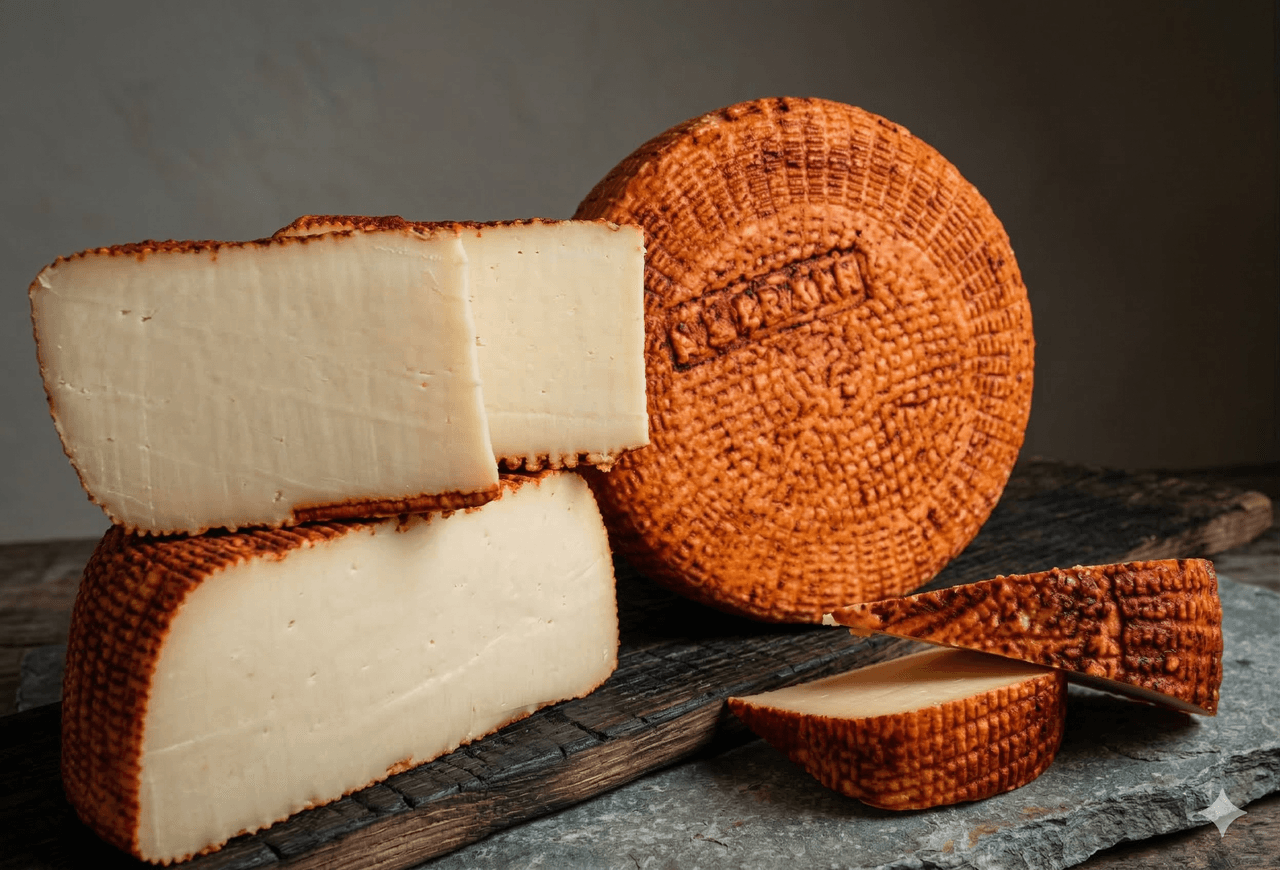
İsli Çerkez Sepet Peyniri (Görsel Yapay Zeka ile Oluşturulmuştur)
The curds that accumulate on the surface are gathered using a ladle and transferred into straining molds or traditional cheese baskets while still warm. When the hot teleme is pressed into the basket, it takes on the shape of the container and the woven pattern of the basket. The shaped cheese is then salted on its outer surface using a dry salting method and shortly afterward turned over to ensure salting of the opposite side. After salting, the cheeses are left to rest in cool environments until their outer surfaces harden and a rind forms.
After the resting phase, cheeses with hardened outer surfaces are subjected to smoking. Traditionally, this is done by placing the cheeses in special smoking rooms where they are exposed to smoke from burning oak, dried mulberry, or acacia wood, positioned away from direct heat. Phenolic compounds and organic acids generated by the thermal decomposition (pyrolysis) of the wood penetrate the cheese. This process reduces surface moisture, inhibits microbial spoilage, and significantly extends the product’s shelf life.
İsli Çerkes Sepet Peyniri exhibits a white, smooth interior structure, while its outer rind displays a color range from yellow to dark brown due to the effects of smoke. The smoking process reduces water activity and moisture content, thereby increasing the cheese’s dry matter ratio, physical density, and hardness. Sensory-wise, the cheese has a strong woody smoke aroma accompanied by a distinct milky scent. Despite its semi-hard texture, it has a non-porous, homogeneous structure that easily breaks down in the mouth.
Hastaoğlu, Emre, Melda Erdoğan, and Mustafa Işkın. "Gastronomi Turizmi Kapsamında Türkiye Peynir Çeşitliliği Haritası." *Atatürk Üniversitesi Sosyal Bilimler Enstitüsü Dergisi* 25, no. 3 (2021): 1084-1113. Accessed March 14, 2026. https://dergipark.org.tr/tr/download/article-file/1845073
Sıçramaz, Hatice. "İsli Çerkez Peynirinin Üretim Parametrelerinin Optimizasyonu." PhD thesis, Sakarya Üniversitesi, 2021. Accessed March 14, 2026. https://acikerisim.sakarya.edu.tr/bitstream/handle/20.500.12619/96612/T09576.pdf?sequence=1&
Türkiye Geleneksel Cheese Inventory. "Düzce (İsli) Çerkes Sepet Cheese." Türkiye Traditional Cheese Inventory. Accessed March 14, 2026. https://gelenekselpeynirler.tarimorman.gov.tr/Peynir/Detay/1059
Türkiye Kültür Portalı. "Çerkez İsli Peyniri - Düzce." kulturportali.gov.tr. Accessed March 14, 2026. https://www.kulturportali.gov.tr/turkiye/duzce/nealinir/cerkez-isli-peyniri
[1]
Hatice Sıçramaz, “İsli Çerkez Peynirinin Üretim Parametrelerinin Optimizasyonu,” (Doktora Tezi, Sakarya Üniversitesi, 2021), Erişim tarihi: 14 Mart 2026. https://acikerisim.sakarya.edu.tr/bitstream/handle/20.500.12619/96612/T09576.pdf?sequence=1&isAllowed=y

Islı Çerkes Sepet Cheese (generated with AI)
Storage and Shelf Life | Storage in cold environment, vacuum packaging, preservation by drying and smoking | ||||||||
|---|---|---|---|---|---|---|---|---|---|
Sensory Characteristics | Smoked and smoke aroma, low sugar content, characteristic milk odor | ||||||||
Physical Structure | Semi-hard texture, non-porous and smooth, milky white interior color | ||||||||
Smoking Source | Oak wood shavings, dried mulberry and acacia trees | ||||||||
Production Technique | Acid and heat coagulation, curd collection and draining, shaping in molds | ||||||||
Basic Materials | Raw cow's milk, old cheese whey (CW), table salt | ||||||||
Origin and Region | Northwest Caucasus, Düzce and Sakarya region | ||||||||
No Discussion Added Yet
Start discussion for "Islı Çerkes Sepet Peyniri" article
History and Geographic Distribution
Raw Materials and Coagulation Process
Shaping and Resting
Smoking Process
Physical and Sensory Properties