This article was automatically translated from the original Turkish version.
The Moon’s gradual recession from Earth by centimeters each year reveals the universe’s constant motion as a fascinating consequence of interplanetary dynamics.
The Moon is one of the most striking objects in Earth’s sky. Yet the light we see fixed in place each night is, in reality, moving away at an average rate of 3.8 centimeters per year. This slow but continuous recession is not merely an astronomical curiosity; it also holds vital clues about the history and future of our planet.
The primary reason for the Moon’s recession from Earth is the combination of universal expansion and tidal interactions. Earth’s oceans bulge and recede due to the Moon’s gravitational pull—a phenomenon we experience as tides. But this is not merely a coastal natural event. The motion within the oceans creates a continuous exchange of energy between the Earth and the Moon.
As Earth rotates, the tidal bulge caused by the Moon’s gravity does not align exactly with the Moon’s position but lies slightly ahead of it. This forward mass excess exerts a gravitational pull on the Moon. The Moon is effectively “tugged” by this bulge, causing it to be pushed outward into a higher orbit. This interaction increases the Moon’s angular momentum, while simultaneously slowing Earth’s rotation. In short: as Earth slows, the Moon moves farther away.
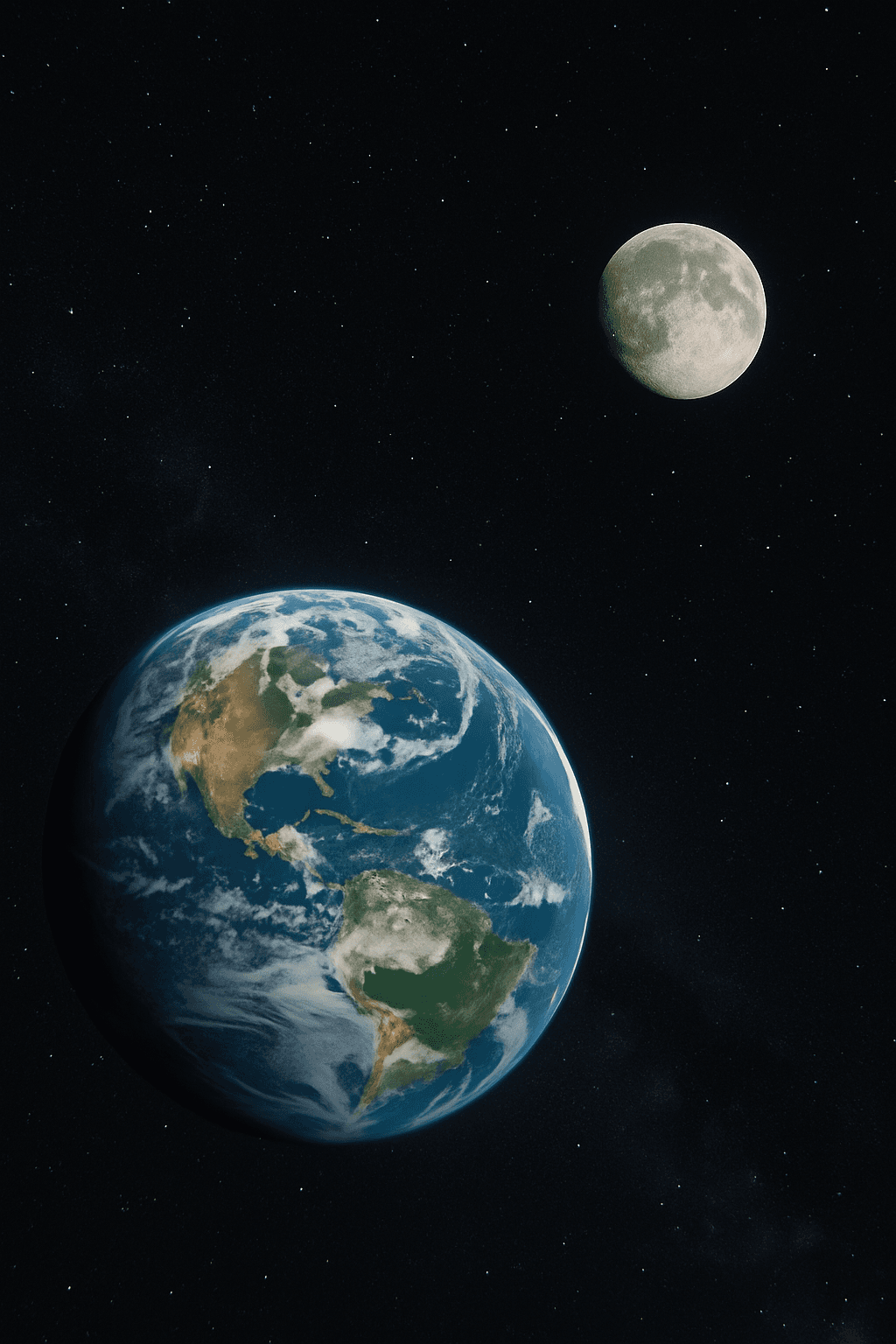
Earth and the Moon (Generated by Artificial Intelligence)
This phenomenon is not merely theoretical. Laser reflectors placed on the Moon’s surface during the Apollo missions have provided definitive proof of its recession. By measuring the round-trip time of laser beams fired from Earth, scientists have confirmed that the Moon is receding at a rate of approximately 3.8 cm per year.
Computer simulations and geological evidence indicate that when the Moon first formed, it was only about 22,500 kilometers from Earth. Today, that distance has grown to 402,336 kilometers. This means the Moon is nearly 20 times farther away than it was at its origin.
This increase in distance has also affected the passage of time on Earth. For example, days were significantly shorter hundreds of millions of years ago because Earth rotated faster. As the Moon receded, Earth’s rotation slowed, lengthening the day. Similarly, changes in the Moon’s orbit may indirectly influence the strength of tides, ocean currents, and even certain climate processes.
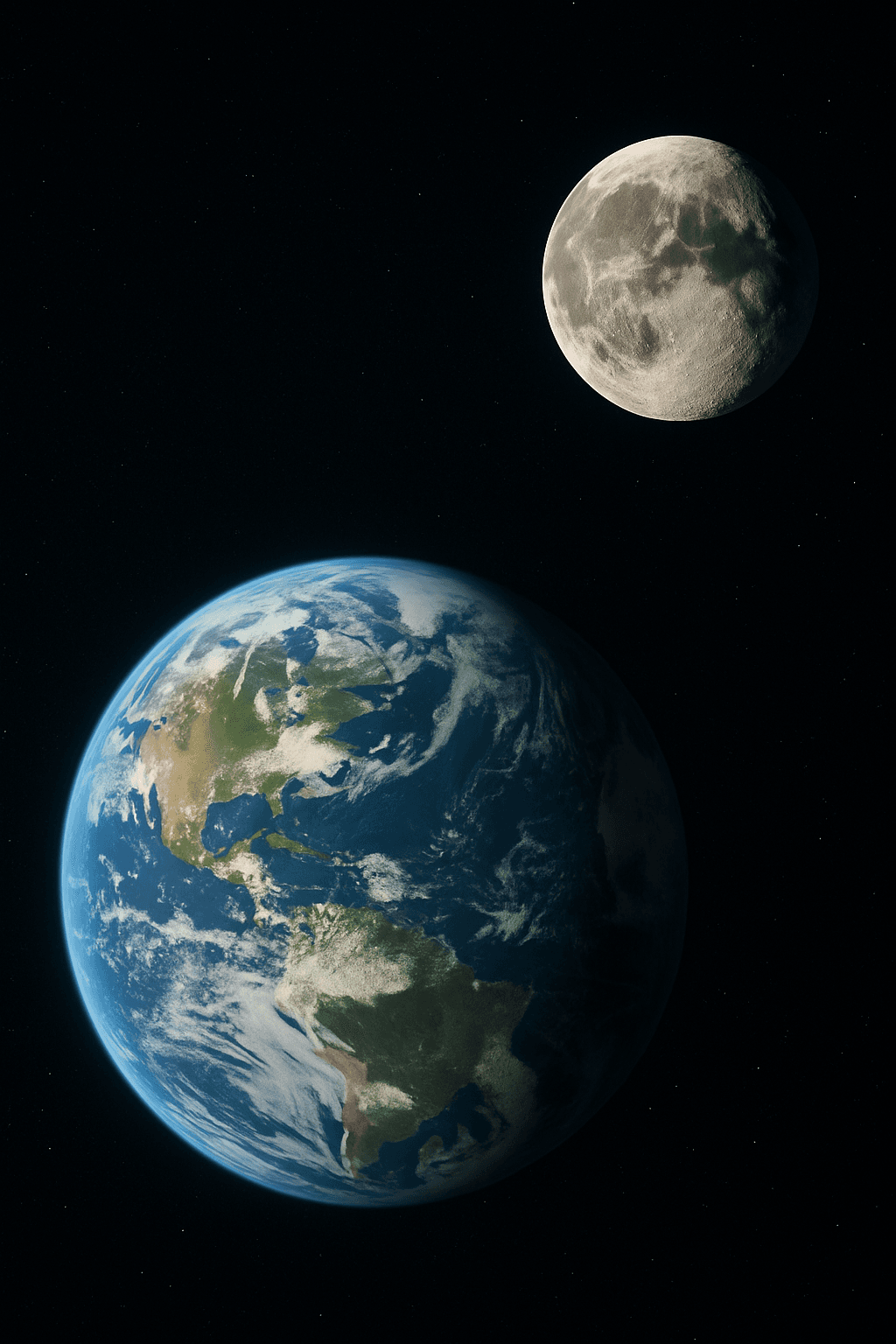
A Moon Closer to Earth (Generated by Artificial Intelligence)
The Moon’s recession is not merely the behavior of a distant celestial body; it is the mechanism of our planet’s transformation clock. Many aspects of Earth’s past—including rotation rates, tides, climates, and the evolution of life—are tied to this clock. The Moon’s slow retreat serves as a quiet yet powerful indicator of how both Earth and the universe have changed over time.
The Moon moves away from us each year by an imperceptibly small amount. Yet over billions of years, this tiny recession carries immense significance, shaping the structure, timekeeping, and future of our planet. When you look up at the Moon in the night sky, you are not gazing at the past—you are witnessing the present moment of ongoing change.
Bilim Genç. "Evrenin Genişlemesi Ne Anlama Geliyor?" TÜBİTAK Bilim Genç. Accessed July 14, 2025. https://bilimgenc.tubitak.gov.tr/makale/evrenin-genislemesi-ne-anlama-geliyor.
Sarıgül, Tuba (Dr.). “Ay’ın Dünya’dan Uzaklaştığı Doğru mu?” TÜBİTAK Bilim Genç, July 7, 2017. Accessed July 16, 2025. https://bilimgenc.tubitak.gov.tr/makale/ayin-dunyadan-uzaklastigi-dogru-mu.
The Moon Is Moving Away: The Light We See at Night Is Slowly Drifting from Us
Universal Expansion and Tides: A Silent Cosmic Influence
Observations and Measurements
How Close Was the Moon Once?
A Cosmic Time Machine