


This article was automatically translated from the original Turkish version.
+2 More
Sometimes a word is not just a word. It is a mirror of an era. Recently, while chatting with my grandmother, I used an expression we use frequently in daily life. She looked at me, smiled, and asked, “What does that mean?” At that moment I realized that even though we speak the same language, we are not living by the same words.
In the past, our elders taught us words we did not know. Now the roles seem to have reversed. They are trying to learn the meanings of new words from us. “Story,” “cringe,” “ghostlamak,” “link atmak,” “random,” “cancellemek”… These expressions we use unconsciously every day have no equivalent in their world. The problem is not that these words are foreign; it is that the world from which they emerged is foreign to them.
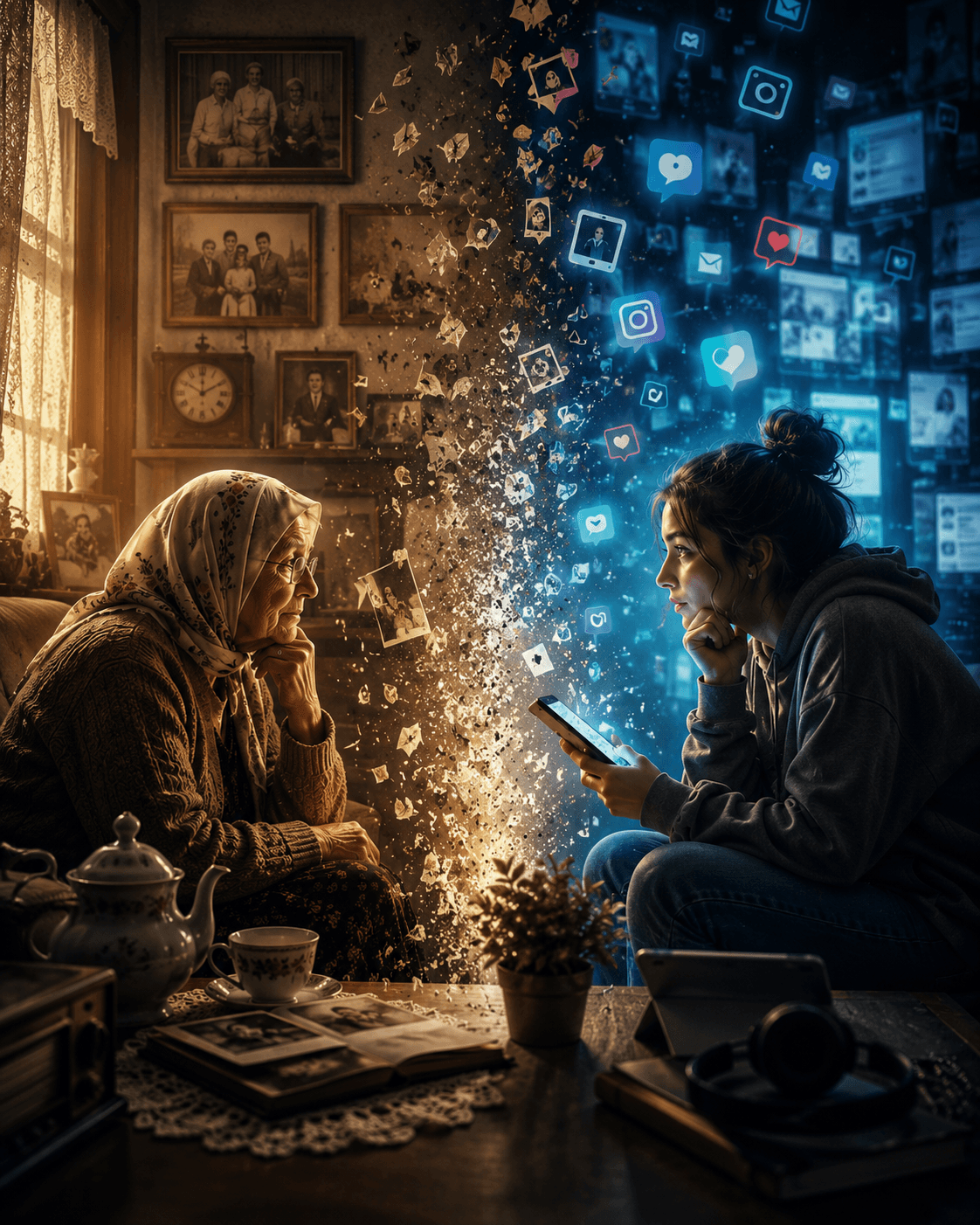
Büyükannemin Bilmediği Kelimeler (Yapay zeka ile oluşturulmuştur)
Understanding a word is not merely knowing its dictionary definition. It means understanding the emotion with which it is spoken, the habit it belongs to, and the lifestyle it represents. My grandmother may learn the word “story,” but she may struggle to understand why people first record their moments on their phones and then show them to others. In her world, memories were valuable even without being shared.
Sometimes I wonder: will we too experience the same confusion years from now? Perhaps we will hear the words our grandchildren use and be unable to make sense of them. Perhaps they too will say, as we do today, “It’s perfectly normal, everyone talks like that.” Clearly, the issue is not merely a generational gap; it is that time continuously rewrites its own language.
I once thought the greatest divide between generations was technology. But over time I realized it is felt far more through language. Because language also changes the way we think. New words bring new habits; new habits create a new way of life.
In the past, letters were awaited; now even “görüldü atmak” has become an emotion in itself. Previously, not being able to reach someone was normal; now, if there is no reply within minutes, we invent scenarios. It is not only the tools of communication that have changed, but also the meaning of communication itself. As a result, each generation struggles to understand why the other behaves the way they do.
Perhaps the distance between generations lies less in age and more in vocabulary. We sit at the same table, yet sometimes we speak from entirely different dictionaries. Yet if we pause and listen to each other’s worlds, we discover that behind the words we do not know lie familiar emotions.
My grandmother may not know some of today’s words; I too have never encountered many of her sayings, proverbs, and life experiences. She tells me the language of the past; I tell her the words of today.
Perhaps what will strengthen the bond between generations is not trying to change each other, but being curious about each other’s words. Because sometimes a single question—“What does that mean?”—opens the door to a long conversation. And in those conversations we realize that although the words change, what we are trying to express remains the same: to be understood, to share, and to feel close to one another.

No Discussion Added Yet
Start discussion for "Intergenerational Disconnection: Words My Grandmother Did Not Know" article
Different Worlds in the Same Home