


This article was automatically translated from the original Turkish version.
Illness Anxiety Disorder is a condition in which an individual experiences uncontrollable beliefs and intense anxiety that they have or will develop a serious illness, resulting from the misinterpretation of physical symptoms. This concept was first defined by Salkovskis and Warwick and consists of two core constructs: illness belief and illness phobia. 【1】Illness belief refers to a strong conviction that one currently has an illness, while illness phobia involves fear of contracting an illness in the future.
This psychiatric disorder, previously referred to as hypochondriasis in earlier psychiatric diagnostic manuals, is now classified under the category of Somatic Symptom and Related Disorders in current diagnostic systems. Health anxiety is generally examined through four fundamental dimensions: alienation, reassurance seeking, absorption, and anxiety:
The lifetime prevalence of Illness Anxiety Disorder in the general population ranges between one and five percent. Among patients presenting to medical clinics such as cardiology, neurology, and internal medicine with various physical complaints, the prevalence of this disorder is significantly higher than in the general population.

Visual Representing Illness Anxiety Disorder (Generated by Artificial Intelligence)
Although the disorder can emerge at any age, clinical symptoms most commonly begin in the twenties and thirties. No statistically significant difference in prevalence has been found between genders, although some academic studies report higher levels of health anxiety in women compared to men. In addition to publications indicating higher prevalence among individuals with higher education levels, studies have also examined differences based on marital status.
The development of Illness Anxiety Disorder involves a complex interaction of biological, environmental, and psychological factors rather than a single cause. The major theories and factors in its etiology are detailed as follows:
Studies on twins have demonstrated a low but present genetic and hereditary influence on excessive physical preoccupation and heightened bodily sensation perception. Additionally, neuroanatomical differences such as reduced weight of the frontal cortex and pituitary gland and increased thalamus weight may be associated with this disorder.
A core mechanism involves individuals’ tendency to magnify bodily sensations and catastrophize benign physical changes as signs of serious illness. The misperception of ordinary bodily sensations at the cognitive level is termed somatosensory amplification, or the tendency to over-amplify bodily sensations. High anxiety sensitivity also plays a critical role in the development of this process.
Growing up in environments where family members excessively focus on illnesses and physical complaints provides a foundation for learning illness-related behaviors. Receiving attention and affection through adopting the sick role reinforces these behaviors through social learning mechanisms.
An important etiological factor involves individuals internalizing unexpressed anger and aggressive impulses and converting them into physical symptoms through defense mechanisms such as displacement and repression. This process can provide secondary gains for the patient.
Traumatic experiences during childhood, such as physical and sexual abuse, have been shown to significantly increase the risk of developing illness anxiety in adulthood.
The clinical presentation of the disorder encompasses multiple dimensions that affect the patient’s mental processes and behaviors:
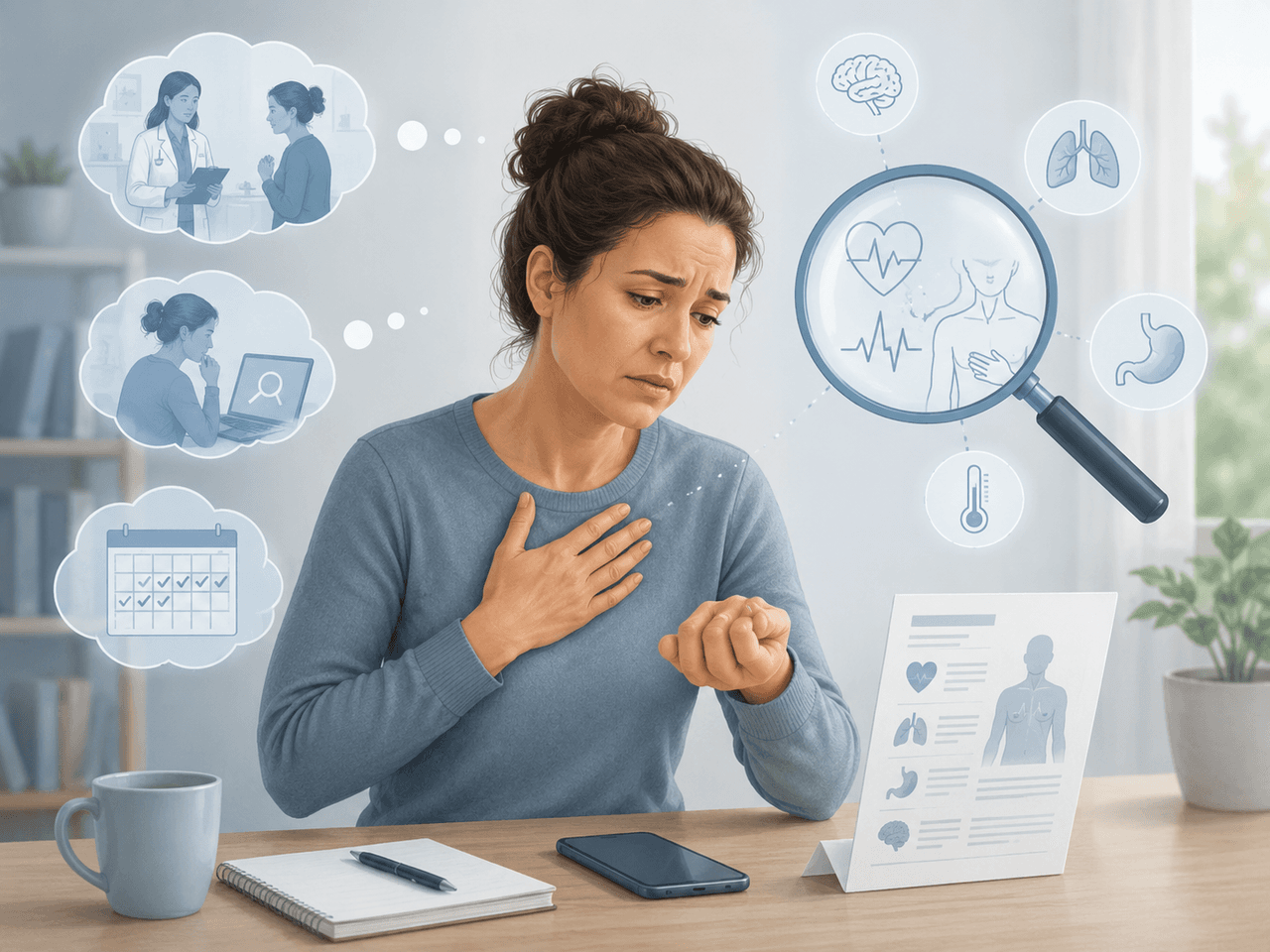
Visual Representing Illness Anxiety Disorder (Generated by Artificial Intelligence)
Cognitive Symptoms: Patients persistently maintain their belief in having an illness even after medical examinations confirm their health, often believing physicians have made incorrect diagnoses. Their minds are constantly preoccupied with the idea of having a life-threatening illness.
Physical Symptoms: Often, no concrete physical symptom is present, or any existing symptoms are mild and non-threatening, such as gas, bloating, palpitations, or fatigue—common bodily sensations of daily life. However, patients interpret these sensations as indicators of serious illnesses like cancer or heart attack.
Behavioral Symptoms: Two primary subtypes are recognized:
According to current psychiatric diagnostic standards, the diagnosis of Illness Anxiety Disorder requires the fulfillment of specific criteria:【2】
For accurate diagnosis, organic diseases—particularly neurological and endocrine disorders—must be thoroughly ruled out through detailed medical evaluation. Illness Anxiety Disorder rarely occurs in isolation; comorbid conditions are common.
The patient’s complaints should not be confused with Somatic Symptom Disorder; in the latter, the patient complains of concrete pain or discomfort, whereas in Illness Anxiety Disorder, the primary issue is fear of the illness itself. A strong association exists between Panic Disorder and Illness Anxiety Disorder. During panic attacks, patients fear they are having a heart attack and will die immediately, whereas in Illness Anxiety Disorder, the focus is on prolonged illness scenarios such as cancer. Additionally, depression, Generalized Anxiety Disorder, and various personality disorders frequently co-occur with this condition.
The disorder typically follows a chronic, persistent, and fluctuating course. New stressors in life may trigger symptom exacerbation. Poor prognosis is associated with cognitive distortion of physical symptoms and the presence of secondary gains.
Cognitive Behavioral Therapy is recognized as the most effective first-line treatment. This therapeutic approach aims to identify and correct the patient’s tendency to catastrophize bodily sensations, modify maladaptive behavioral patterns, and eliminate reassurance-seeking behaviors. Group therapy and psychoeducational interventions serve as supportive therapeutic approaches.
Psychopharmacological medications are often incorporated into treatment plans, particularly when comorbid conditions such as anxiety or depression are present. Antidepressants from the selective serotonin reuptake inhibitor and serotonin-norepinephrine reuptake inhibitor classes have demonstrated efficacy in this area.
Combined approaches that integrate cognitive behavioral therapy with pharmacological treatment most effectively reduce symptoms and improve quality of life. A structured single-physician care model is also a critical component of management, helping to prevent patients from being worn down by unnecessary medical testing within the healthcare system.
Warning: The content in this article is provided solely for general encyclopedic informational purposes. The information here should not be used for diagnosis, treatment, or medical advice. Always consult a physician or qualified healthcare professional before making any decisions regarding health. Neither the author nor KÜRE Encyclopedia assumes any responsibility for consequences arising from the use of this information for diagnostic or therapeutic purposes.
Durak Batıgün, Ayşegül. “Kaygı Bozuklukları.” TÜBİTAK Ansiklopedi. Accessed June 18, 2026. https://ansiklopedi.tubitak.gov.tr/ansiklopedi/kaygi_bozukluklari
French, Jennifer H. and Sajid Hameed. “Illness Anxiety Disorder.” In *StatPearls*. StatPearls Publishing, 2024. Accessed June 18, 2026. https://www.ncbi.nlm.nih.gov/books/NBK554399/
Güz, Hatice, and Nesrin Dilbaz. “Sosyal Kaygı Bozukluğu ile Panik Bozukluğu Olgularının Demografik ve Bazı Klinik Özellikler Açısından Karşılaştırılması.” Klinik Psikiyatri Dergisi. Accessed June 18, 2026. syf 32-38 https://pdf.journalagent.com/kpd/pdfs/KPD_6_1_32_38.pdf
Ilıcak, Aslı. “Hastalık Kaygısı Bozukluğu ile Panik Bozukluk Arasındaki İlişkinin İncelenmesi.” Master's thesis, Fatih Sultan Mehmet Vakıf Üniversitesi, 2020. Accessed June 18, 2026. https://acikerisim.fsm.edu.tr/server/api/core/bitstreams/b2d0dd4d-ccc5-404f-945a-8e7b37b3104a/content
Karaçadır, Vahap, and Rukiye Çelik. “Üniversite Öğrencilerinin Sağlık Kaygı Düzeylerini Belirlemeye Yönelik Bir Çalışma.” *Avrasya Uluslararası Araştırmalar Dergisi*. Accessed June 18, 2026. pp. 225–238. https://dergipark.org.tr/tr/download/article-file/677910
Yılmaz, Özlem. “Yetişkinlerde Anormal Hastalık Davranışları ve Yaşam Kalitesi ile İlişkili Faktörler: Sağlık Kaygısı, Kaygı Duyarlılığı, Sağlıkla İlgili İşlevsel Olmayan İnançlar ve Aleksitimi.” Master's thesis, Dokuz Eylül Üniversitesi. Accessed June 18, 2026. https://www.proquest.com/openview/b493089135fb1107be04b3aa27a06d22/1.
[1]
Vahap Karaçadır and Rukiye Çelik, “A Study to Determine Health Anxiety Levels Among University Students,” Eurasian International Research Journal 7, Access Date: June 18 2026, p. 225 , https://dergipark.org.tr/tr/download/article-file/677910
[2]
Aslı Ilıcak, “Examining the Relationship Between Illness Anxiety Disorder and Panic Disorder,” Fatih Sultan Mehmet Vakıf University p. 24, Access Date: June 18 2026, https://acikerisim.fsm.edu.tr/server/api/core/bitstreams/b2d0dd4d-ccc5-404f-945a-8e7b37b3104a/content.

No Discussion Added Yet
Start discussion for "Illness Anxiety Disorder" article
Epidemiology and Prevalence
Etiology and Developmental Factors
Biological Factors
Cognitive Factors
Social Learning Theory
Psychodynamic Factors
Traumatic Experiences
Clinical Features and Symptom Dimensions
Diagnostic Criteria
Differential Diagnosis and Comorbid Disorders
Treatment Approaches
Psychotherapy
Pharmacological Treatment