Hydraulic systems are one of the power transmission technologies that hold an important place in modern engineering and industry. These systems utilize the incompressibility of liquids to convert energy into mechanical motion and are frequently used in applications requiring high power. The fundamental principle of hydraulic systems is based on Pascal’s Law: pressure applied to a liquid in a closed system is transmitted equally to every point in the system.
A system hydraulic is a mechanism that transfers energy through liquids, typically oils. The system moves the liquid via a pump, and this liquid is then converted into mechanical energy through actuators such as cylinders or motors. The primary purpose of hydraulic systems is to apply large forces over a small area. For example, a hydraulic press machine can lift tons of weight, while the power source enabling this may be a relatively small pump.
The origins of hydraulic systems trace back to the 17th century to Blaise Pascal’s discoveries regarding pressure transmission in liquids. However, the development of modern hydraulic systems gained momentum during the 19th century with the Industrial Revolution. Today, hydraulic technology is used in both simple machines and high-technology demanding systems.
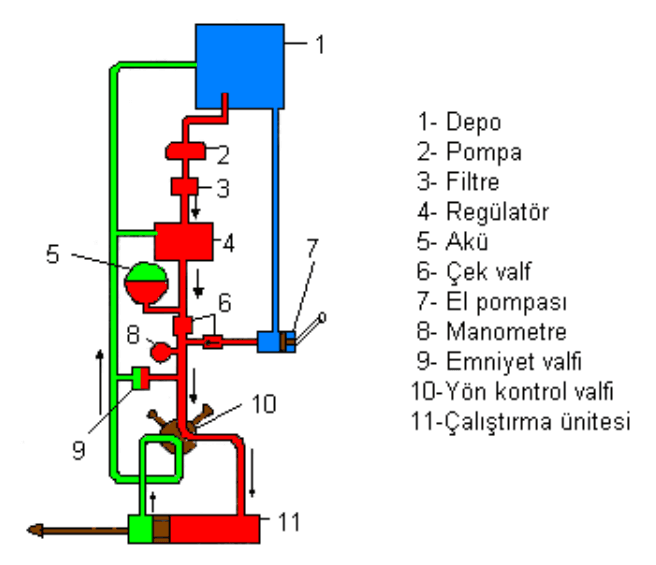
The main components of hydraulic systems include pumps, liquid reservoirs, valves, actuators (cylinders or motors), and piping. Each of these components plays a critical role in ensuring the efficient operation of the system. The working principle of the system relies on the incompressibility of liquids to minimize energy loss.
How a Hydraulic System Works
Hydraulic systems are technologies that transmit mechanical energy with great force by utilizing the incompressibility of liquids. The fundamental principle of these systems is based on Pascal’s Law, formulated by Blaise Pascal in the 17th century: pressure applied to a liquid in a closed system is transmitted equally to every point in the system. This property enables hydraulic systems to generate massive output forces from a small input force. The operation of a hydraulic system consists of multiple stages occurring in a cycle, requiring the coordinated functioning of its components.
The step-by-step operation of a hydraulic system is as follows:
1. Energy Generation: The Role of the Pump
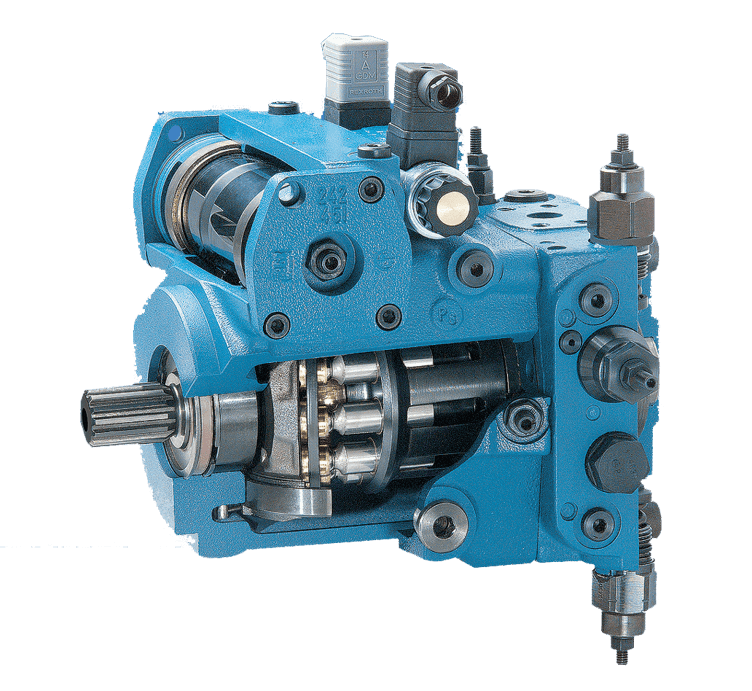
The operation of a hydraulic system begins with the activation of the pump. The pump is considered the heart of the system and converts mechanical energy into hydraulic energy. Typically driven by an electric motor, internal combustion engine, or manual mechanism, the pump draws hydraulic fluid from the reservoir and delivers it into the system under pressure.
- Pump Types and Operating Principle: For example, gear pumps move fluid by compressing it between interlocking gears, while piston pumps generate high pressure through the reciprocating motion of pistons. In an industrial application, a piston pump can deliver several liters of fluid per second at a pressure of 200 bar.
- Flow Rate and Pressure: The flow rate (fluid velocity) and pressure generated by the pump are adjusted according to system requirements. For instance, an excavator requires high flow rate for rapid bucket movement and high pressure to lift heavy loads.
The pump initiates the energy cycle by moving fluid from a low-pressure environment (reservoir) to a high-pressure environment (system). However, for the pump to operate efficiently, the fluid must be clean and have the appropriate viscosity.
2. Fluid Transmission: Pipes and Valves
Pressurized fluid exiting the pump is transported throughout the system via pipes and hoses. In this stage, the direction, pressure, and volume of the fluid are controlled by valves.
- Pipes and Hoses: Rigid pipes are typically used for fixed lines, while flexible hoses are employed between moving parts. For example, in a crane, hoses adapt to the movement of the arm to deliver fluid to the actuators. A smooth inner surface of pipes reduces friction losses.
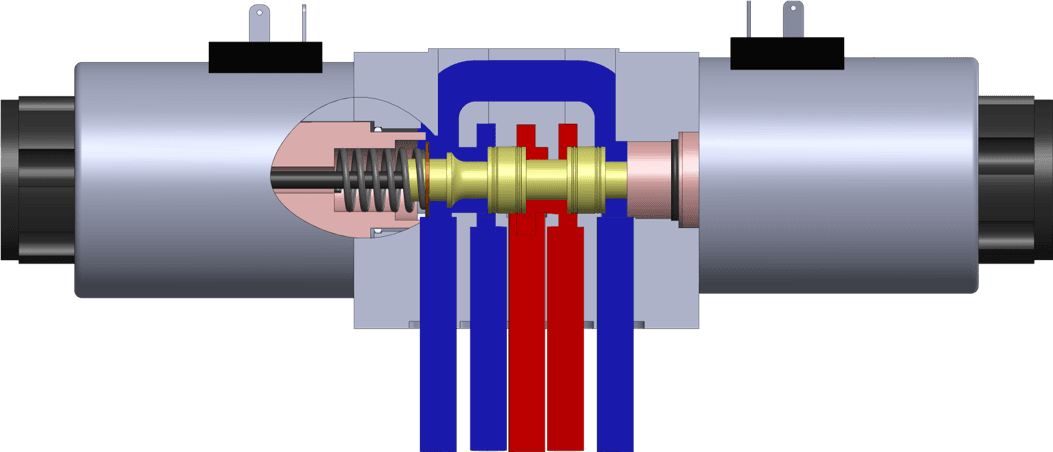
- Valve Control Mechanism: Directional control valves determine which actuator the fluid will reach; for instance, changing the valve position directs hydraulic fluid to move a cylinder forward or backward. Pressure control valves prevent system overloading; a relief valve returns excess fluid to the reservoir when pressure exceeds a set level.
- Application of Pascal’s Law: At this stage, the incompressibility of the fluid comes into play. The pressure generated by the pump reaches the actuators without loss along the pipes. For example, applying 100 bar of pressure to a piston area of 10 cm² generates a force of 10,000 Newtons (approximately 1 ton).
Preventing leaks during fluid transmission and ensuring proper valve adjustment are critical for system efficiency.
3. Mechanical Motion: The Role of Actuators
When pressurized fluid reaches the actuators, hydraulic energy is converted into mechanical motion. Actuators are the components that produce work in the system and come in two main types:
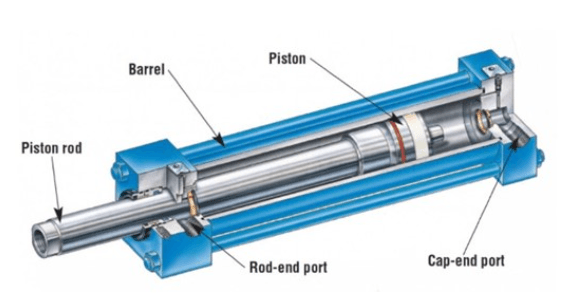
- Hydraulic Cylinders: Provide linear motion. In a double-acting cylinder, fluid enters one side while exiting the other, causing the piston to move back and forth. For example, the blade of a bulldozer is raised or lowered in this manner. Seals inside the cylinder maintain pressure by preventing leaks.
- Hydraulic Motors: Generate rotary motion. Fluid rotates gears or pistons inside the motor to produce torque. In a mining machine, hydraulic motors can drive conveyor belts.
- Force Multiplier: Pascal’s Law remains in effect here. Pressure generated on a small input area is multiplied over a larger output area. For example, a pressure of 100 bar on a 1 cm² pump piston can produce a force of 5 tons on a 50 cm² cylinder.
The motion of actuators is precisely controlled by valve positioning, enabling hydraulic systems to be both powerful and flexible.
4. Fluid Return: Completing the Cycle
After completing its task, the fluid returns to the reservoir via a return line, restarting the cycle. This stage ensures continuous operation and maintains energy efficiency.
- Return Line: Low-pressure pipes or hoses carry fluid back to the reservoir. This line is typically equipped with filters to remove dirt and particles from the fluid.
- Fluid Cooling and Reuse: Fluid returning to the reservoir may be heated during operation. A cooling system in the reservoir, either air- or water-based, reduces its temperature. For example, in an industrial press machine operating for hours, fluid temperature may reach 60°C; coolers reduce it to 30–40°C.
- Cyclic Efficiency: The returned fluid is drawn back into the pump, ensuring uninterrupted system operation. This closed-loop design minimizes energy loss and makes hydraulic systems more efficient than mechanical systems.
During the return phase, the cleanliness and temperature of the fluid must be carefully monitored to ensure long system life. Contaminated or overheated fluid can cause wear in pumps and actuators.
Components of a Hydraulic System
Hydraulic systems have a complex structure that relies on liquids to transmit energy under pressure, and their efficient operation depends on components working in harmony. Each part, from the pump to the actuators and from valves to hoses, directly affects system performance and reliability.
The hydraulic pump is regarded as the energy source of the system and converts mechanical energy into hydraulic energy. The pump draws fluid from the reservoir, pressurizes it, and delivers it to other system components. Pumps vary in type depending on their flow rate and pressure capacity:
- Gear Pumps: A simple and economical type where two interlocking gears move the fluid. Used in low- and medium-pressure systems, such as agricultural machinery. Their advantages include low cost and durability, but efficiency may decrease at high pressures.
- Piston Pumps: Pressurize fluid through the reciprocating motion of pistons. Preferred in applications requiring high pressure and flow, such as industrial press machines. Available in fixed or variable displacement models; variable displacement pumps offer energy savings.
- Vane Pumps: Move fluid using vanes mounted on a rotating rotor. Used in medium-pressure systems and known for quiet operation, such as in automotive steering systems.
Pump selection depends on the system’s operating pressure, fluid type, and application. Pump failure can cause complete system shutdown, making regular maintenance critical.
2. Hydraulic Fluid and Reservoir
Hydraulic fluid is the fundamental element enabling energy transmission in the system, providing efficient power transfer due to its incompressibility. While mineral-based oils are most commonly used, other fluids may be selected based on application requirements:
- Mineral Oils: The most common type of hydraulic fluid; they offer good lubrication and corrosion prevention properties.
- Synthetic Oils: Used in environments with high temperatures or fire risks, such as in aviation.
- Water-Based Fluids: Preferred in low-cost systems as an environmentally friendly option, though they may carry a risk of corrosion.
The fluid’s viscosity, temperature resistance, anti-wear properties, and cleanliness affect the system’s lifespan and performance. The reservoir is where the fluid is stored, cooled, and filtered. Reservoirs typically have the following features:
- Ventilation: Maintains pressure balance.
- Filtration: Removes dirt and particles from the fluid.
- Cooling: Cools the fluid heated during operation.
The reservoir design minimizes fluid contact with air to reduce oxidation and enhance system efficiency.
Valves are the control units of hydraulic systems and regulate the flow, direction, pressure, or volume of fluid. System precision and safety depend on proper valve operation. The main valve types are:
- Directional Control Valves: Determine which actuator the fluid will reach. For example, in an excavator, these valves direct fluid to the cylinder that raises or lowers the bucket. They can be manual, solenoid-operated, or hydraulically controlled.
- Pressure Control Valves: Protect the system from excessive pressure. Relief valves return excess fluid to the reservoir when pressure exceeds a set level, preventing damage to the pump and pipes.
- Flow Control Valves: Regulate the speed of fluid flow. For example, they are used to control the rotational speed of a hydraulic motor.
Valves enhance system flexibility and allow operators to precisely control movements. However, clogging or malfunctioning valves can negatively impact system performance.
Actuators are components that convert hydraulic energy into mechanical motion and serve as the output-producing elements of the system. There are two main types:
- Hydraulic Cylinders: Provide linear motion. Single-acting cylinders move in only one direction (e.g., lifting), while double-acting cylinders operate in both directions (e.g., pushing and pulling). In construction machinery, cylinders that raise and lower a bucket are a double-acting example. Cylinders consist of a piston, barrel, and sealing elements; seal quality is critical to prevent leaks.
- Hydraulic Motors: Generate rotary motion and are used in applications requiring high torque, such as in crane rotation mechanisms. They come in gear, piston, or vane types; piston motors offer high efficiency while gear motors are more economical.
The size and capacity of actuators are determined by the force and speed required by the system. For example, the larger the diameter of a hydraulic cylinder, the greater the force it can generate.
Pipes and hoses, which transport hydraulic fluid within the system, must be resistant to pressure and wear.
- Pipes: Typically made of steel or stainless steel and used for fixed connections. Preferred in high-pressure systems.
- Hoses: Made of flexible rubber or synthetic materials and connect moving parts, such as the arm of an excavator.
Connections (fittings, connectors) ensure leak-tightness and must be regularly inspected, as hose wear or pipe cracks reduce system efficiency.
To ensure long system life, the fluid must be kept clean and at an appropriate temperature.
- Filters: Remove dirt, metal particles, and other contaminants from the fluid. Types include suction filters (in the reservoir), pressure filters (after the pump), and return filters (before fluid returns to the reservoir). A clogged filter can cause pressure loss in the system.
- Coolers: Prevent excessive fluid heating. They can be air-cooled (fan-assisted) or water-cooled. For example, in an industrial press machine, the cooler activates during prolonged operation.
Filters and coolers may increase maintenance costs, but they offset these by extending system life.
Advantages and Disadvantages of Hydraulic Systems
The advantages offered by hydraulic systems are the primary reasons they are preferred over mechanical and pneumatic systems. These advantages are particularly evident in applications requiring high power and precise control.
- High Power Density: Hydraulic systems can generate large forces within a small volume. Due to their operation based on Pascal’s Law, pressure applied to a small piston area can be transformed into a massive force on a larger piston area. For example, a hydraulic press machine can lift tons of weight from an area of just a few square centimeters. This feature makes hydraulic systems indispensable in construction machinery, cranes, and heavy industrial equipment. Achieving the same power with mechanical systems would require much larger and more complex structures, whereas hydraulic systems meet this need with a compact design.
- Precise Control and Flexibility: Hydraulic systems provide exceptional control over the direction, speed, and force of motion through valves and actuators. Directional control valves can change fluid flow direction, flow control valves can adjust speed, and pressure control valves can optimize applied force. This precision offers a significant advantage in applications such as an excavator’s bucket digging soil with millimeter-level accuracy. Additionally, because hydraulic systems can work with different types of actuators (cylinders or motors), they can be adapted to any application requiring linear or rotary motion.
- High Durability and Reliability: Hydraulic systems are robust against heavy operating conditions. They maintain long-term performance despite high pressures and harsh environmental conditions such as moisture, dust, and vibration. For example, hydraulic equipment used in mining continues to operate reliably under extreme loads and continuous use. This durability stems from the use of strong materials for key components (pipes, hoses, cylinders) and the lubricating properties of the fluid that reduce wear.
- Low Energy Loss: The incompressibility of hydraulic fluids minimizes energy loss. In mechanical systems, energy is lost due to friction between gears or belts, whereas in hydraulic systems, fluid directly transmits energy to actuators. This efficiency provides cost advantages in high-power, long-duration operations. Additionally, the closed-loop design of the system enhances energy reuse.
- Safety and Load Capacity: Hydraulic systems prevent damage by regulating pressure through valves during overload conditions. For example, a hydraulic crane automatically stops if it attempts to lift beyond its maximum capacity. This feature enhances both equipment and operator safety. Moreover, the high load capacity of hydraulic systems is demonstrated by their ability to easily lift tons of weight.
Despite their advantages, hydraulic systems have certain disadvantages that can affect their application areas and maintenance requirements. These disadvantages must be carefully considered during system design and operation.
- Leakage Risk and Environmental Impact: The fluids used in hydraulic systems are typically oil-based, and leaks can reduce system efficiency and cause environmental pollution. Even a small leak at pipe connections, hoses, or seals can lead to serious consequences. For example, if hydraulic fluid seeps into the soil, it may violate environmental regulations and require costly cleanup. Additionally, leaks cause pressure loss and performance degradation. Preventing this risk requires high-quality seals and regular maintenance.
- High Maintenance Requirements: Regular maintenance is essential for the long life of hydraulic systems. Neglecting tasks such as fluid cleanliness, filter replacement, pipe inspection, and valve adjustment can lead to system failure. For example, contaminated hydraulic fluid can cause wear in pumps or cylinders, resulting in expensive repairs. Furthermore, temperature fluctuations can alter fluid viscosity and reduce system efficiency. As a result, maintenance procedures become a time-consuming and specialized disadvantage.
- High Initial Cost: The design, manufacturing, and installation of hydraulic systems are more expensive than those of mechanical or pneumatic systems. High-pressure-resistant components, high-quality fluids, and complex valve systems increase initial investment costs. In small-scale applications, this cost may make hydraulic systems less attractive. However, their long-term efficiency and durability can offset this initial expense.
- Temperature Sensitivity: Hydraulic fluids are affected by extreme temperature changes. Very high temperatures reduce fluid viscosity and impair lubrication, while very low temperatures hinder fluid flow. This affects system performance. For example, a hydraulic system operating in a cold climate may face the risk of fluid freezing, requiring additional heating equipment. Temperature control using coolers and heaters increases system complexity and operating costs.
- Noise Level: Hydraulic systems can generate noise, especially during pump and valve operation. The movement of high-pressure fluid and mechanical component vibrations can be problematic in applications requiring quiet environments. For instance, a hydraulic press in a factory may be a disturbing noise source for workers. To mitigate this, sound insulation or quieter pump types (e.g., vane pumps) can be used, though this adds cost.
Balancing Advantages and Disadvantages
The advantages and disadvantages of hydraulic systems must be evaluated according to their intended use and application. For example, in construction machinery, high power density and durability are critical, while leakage risk or maintenance cost may be secondary concerns. Conversely, in a sensitive laboratory environment, noise level and leakage risk may be major issues. Therefore, during hydraulic system design, advantages are maximized and disadvantages are minimized.
Hydraulic systems, as a technology that utilizes the incompressibility of liquids to deliver high power and precise control, have found applications in nearly every area of modern industry. Used across a wide range of fields—from construction machinery to the automotive sector, aviation to agriculture—these systems are preferred in applications requiring heavy load lifting, complex motion, and durability.
The construction industry is one of the most intensive users of hydraulic systems. Machines in this sector requiring large forces and precise movements operate using hydraulic technology.
- Excavators: Excavators, used for digging, loading, and transporting soil, move their arms and buckets via hydraulic cylinders. The hydraulic system enables lifting tons of weight while allowing the operator to make millimeter-level control adjustments.
- Cranes: Hydraulic cranes are used to lift heavy materials over long distances. The system’s high power density allows cranes to carry large loads within a compact structure.
- Bulldozers and Loaders: Hydraulic systems generate strong pushing and pulling forces for tasks such as land grading and material handling. For example, a bulldozer’s blade is controlled by hydraulic cylinders. The primary reason hydraulic systems are preferred in construction is their reliable and durable performance even under harsh terrain conditions.
The automotive industry is an area where hydraulic systems are widely used both in vehicles and in production processes.
- Hydraulic Brake Systems: Vehicle braking occurs when hydraulic fluid transmits pressure from the brake pads. This system converts the small force applied by the driver on the pedal into a large braking force.
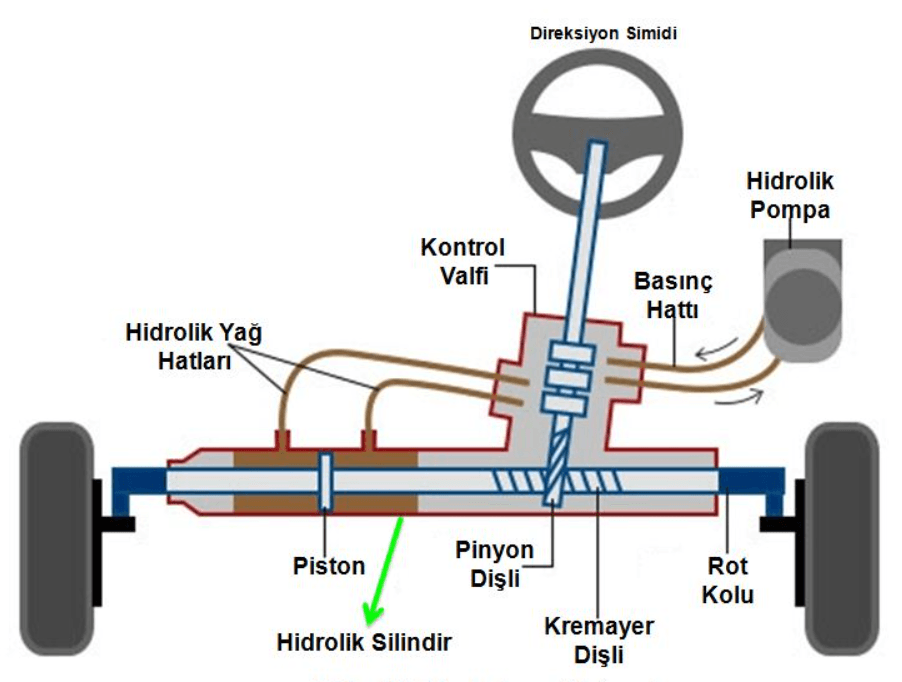
- Hydraulic Steering: In steering systems, hydraulic pumps assist drivers in turning the steering wheel. This system is widely used in heavy and commercial vehicles.
- Production Lines: In automotive factories, hydraulic presses and assembly machines shape and join vehicle bodies. For example, a car door panel is formed using hydraulic presses. In the automotive industry, hydraulic systems enhance safety and comfort while supporting production efficiency.
3. Aviation and Aerospace Industry
The aviation sector is an area where hydraulic systems are used in applications requiring high precision and reliability.
- Landing Gear: Aircraft landing gear is extended and retracted by hydraulic cylinders. This system must be strong enough to support the aircraft’s weight and respond rapidly.
- Wing Control Systems: Flaps and slats on aircraft wings move via hydraulic actuators, providing aerodynamic control during takeoff and landing.
- Simulators: Flight simulators used in pilot training replicate realistic movements through hydraulic systems. These systems must be precise enough to mirror actual flight conditions. The advantage of hydraulic systems in aviation lies in their compact design, ability to generate large forces, and capacity to operate under extreme conditions (high altitude, low temperature).
4. Manufacturing and Production Industry
In manufacturing, hydraulic systems are used in shaping and assembly operations requiring high force.
- Hydraulic Press Machines: Hydraulic presses are used to cut, bend, and shape metal sheets. For example, a steel sheet can be formed into the desired shape in seconds by a hydraulic press.
- Injection Molding: Machines used in plastic part production use hydraulic systems to clamp molds and inject molten plastic. This enables mass production across industries from automotive to electronics.
- CNC Machines: In some CNC machines, hydraulic systems are used to secure workpieces or move cutting tools. In manufacturing, hydraulic systems offer advantages in both speed and power, ensuring consistency in mass production.
Agricultural machinery benefits from the power and flexibility of hydraulic systems.
- Tractors: In tractors, hydraulic systems are used to raise and lower plows, trailers, and other equipment. For example, a plow is lowered into or raised from the soil using hydraulic cylinders.
- Combine Harvesters: In harvesting machines, the movement of cutting blades and collection mechanisms is controlled by hydraulic systems.
- Irrigation Systems: Some modern irrigation equipment uses hydraulic motors to drive water pumps and move irrigation arms. In agriculture, hydraulic systems stand out for their ability to operate under harsh terrain conditions and their operator-friendly control options.
6. Mining and Energy Industry
Mining is an area where the durability and high power capacity of hydraulic systems are critical.
- Drilling Machines: Rock drilling and tunneling machines operate using hydraulic systems. These machines derive the necessary force to break hard surfaces from hydraulic cylinders.
- Loading Equipment: In mines, hydraulic technology underpins the suspension and damping systems of trucks that transport tons of ore.
- Hydraulic Turbines: In energy production, hydraulic turbines in dams convert water pressure into mechanical energy. This is a different application of hydraulic principles. In mining, hydraulic systems provide a reliable solution under heavy loads and continuous operating conditions.
7. Maritime and Shipbuilding Industry
In the maritime sector, hydraulic systems support the complex mechanisms of ships.
- Rudder Systems: The rudders of large ships are controlled by hydraulic motors and cylinders, enabling fast and safe directional changes.
- Cranes and Loading Equipment: Hydraulic cranes used in ports handle the loading and unloading of containers.
- Fishing Equipment: Hydraulic systems are used on fishing vessels to haul and store nets. The advantage of hydraulic systems in maritime applications is their resistance to harsh conditions such as saltwater and humidity.
Hydraulic systems also find use in less commonly known but innovative applications.
- Prosthetics: Some advanced hydraulic prosthetics use hydraulic actuators to mimic human movement, enabling amputees to move more naturally.
- Robotics Systems: In industrial robots, hydraulic systems are used for tasks requiring precise and powerful motion.