


This article was automatically translated from the original Turkish version.
+2 More
Subject(s) | Nahıl Övme | ||||||||
|---|---|---|---|---|---|---|---|---|---|
Region(s) | Nevşehir – Ürgüp and surrounding villages | ||||||||
Type(s) | Wedding traditions / Folk culture | ||||||||
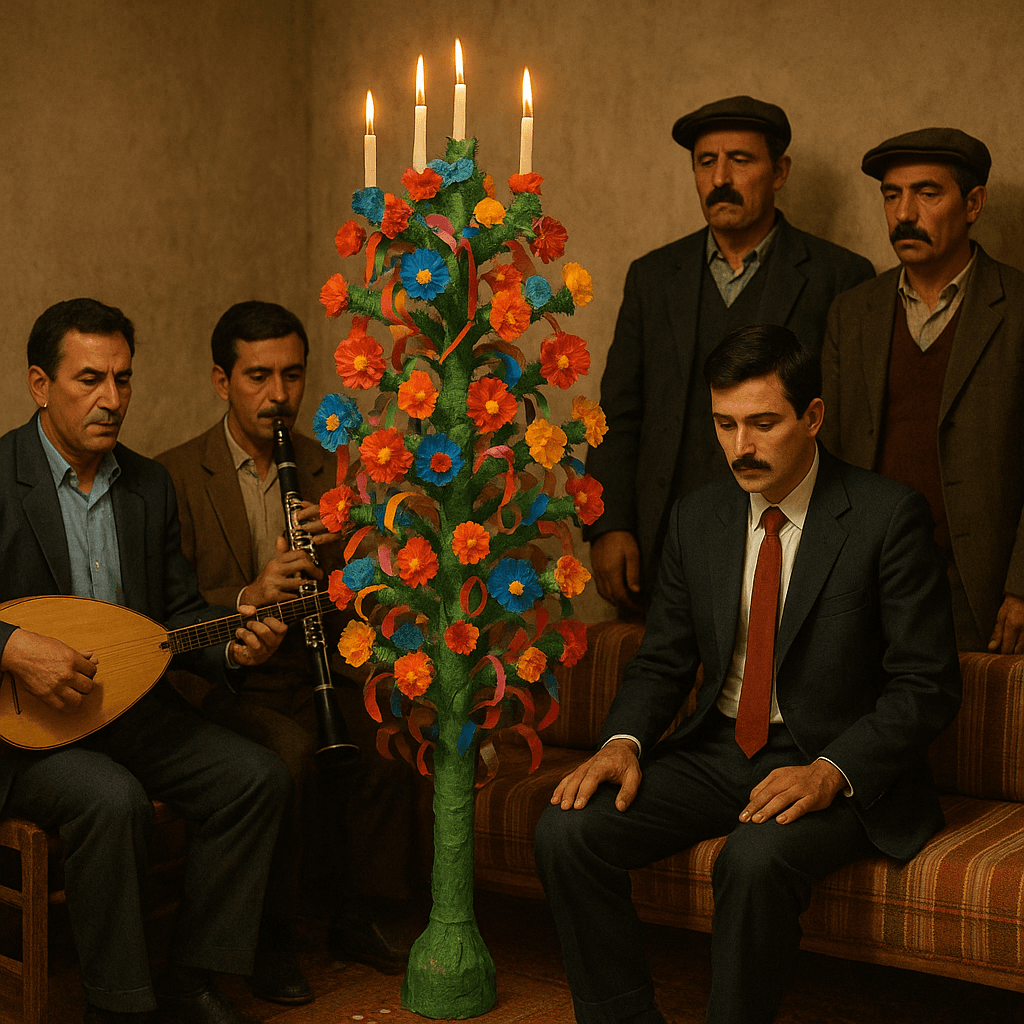
Nahıl övme is a traditional wedding ritual practiced especially in Ürgüp and surrounding villages of Nevşehir. This custom is performed to invoke good fortune for the groom, enhance his social standing, and ensure a blessed beginning to his new life. It is typically carried out on the night connecting Wednesday to Thursday, as part of the “güvey donatma” ceremony.
Nahıl consists of a wooden framework approximately 1.5 to 2 meters in height. The framework is decorated with graph paper, adorned with flat, curved, and floral motifs to create a visually rich appearance. Four candles are placed atop the nahıl, symbolizing the belief in the groom’s bright future. Historically, additional decorations included beeswax, real birds, and fruits.
The nahıl is prepared during the day and brought to the groom’s (güvey’s) side at night. The candles are lit, followed by a ceremonial recitation known as “övme.” During this segment, a special melody attributed to Mahfi Baba is sung, accompanied by bağlama, clarinet, and violin. The lyrics emphasize the beauty of the nahıl, its symbolic meanings, and its connection to the groom’s future. Upon completion of the melody, the groom throws money at the base of the nahıl. His friends then also throw money in an effort to “rescue” him from this act; the collected money is given to the person who constructed the nahıl. The nahıl is subsequently placed in the gerdek room, where it remains throughout the wedding.
The word “nahıl” derives from the Arabic root “nahl,” meaning “date palm tree.” This tree has historically been regarded as a symbol of fertility, abundance, and sexuality. Similar symbols are known to have been carried in religious ceremonies during specific periods of the year in the Phrygian and Hittite eras. In this tradition, the nahıl represents the groom’s masculinity, while the fruit figures on it symbolize the bride’s fertility. According to historian Hammer, Ottoman-era nahıllar can be understood as a local adaptation of ancient Greek and Roman wedding rituals (phallaphoros, flammeum, Fescennia melodies).
The nahıl tradition was not limited to folk weddings but also appeared as a grand feature in Ottoman palace weddings. Evliya Çelebi, in the 17th century, provided a detailed description of the nahilci craftsmen of Istanbul, noting that this guild of five artisans operated shops in various parts of the city and recognized Meyser-i Ezherî as their patron.
Nahıllar used in palace weddings were far more magnificent. These structures, reaching heights of 9 to 25 meters, were decorated with precious stones, silver, and gold plating. Built in the shape of the Süleymaniye minaret, they required hundreds of people to carry them. At times, they were so large that they could not fit through the streets, forcing the eaves or balconies of houses to be demolished. Decorations included phoenix birds, beeswax balls, pearl strings, and turquoise stones. The material value of these grand palace nahıllar sometimes reached tens of thousands of gold coins.
The body of nahıllar is typically constructed from poplar or iron frameworks. Each tier of these layered structures is adorned with ornaments polished with gold or silver leaf. To enable transportation, large nahıllar are fitted with base supports and carrying poles. Ropes are used during transport to prevent them from toppling.
Nahıl Övme Geleneği (TRT Avaz)
The nahıl övme tradition is still actively practiced in some villages of Nevşehir today. However, its influence has significantly diminished in urban centers and modern weddings. The custom of commissioning a nahıl belongs to the bride’s family in marriage ceremonies and to the family of the circumcised boy in circumcision weddings. The nahıl is placed in front of the house and transported in a ceremony known as “mum alması.”
Feniks Dergi. "Kaybolan Geleneklerimizden Nahıl Ağacı Süsleme ve Övme." Feniks Dergi, 2019. Accessed May 10, 2025. https://www.feniksdergi.org/kaybolan-geleneklerimizden-nahil-agaci-susleme-ve-ovme/.
Osman Güldemir and Nermin Işık, *Nevşehir Mutfak Kültürü ve Yemekleri* (Uludağ Üniversitesi & Selçuk Üniversitesi yayını). Accessed May 10, 2025. https://www.academia.edu/download/24154162/Tam_Metin_Nevsehir_Mutfak_Kulturu_ve_Yemekleri_Osman_Guldemir_Nermin_Isik.pdf
Parvana Bayram, "Nevşehir’in Avanos İlçesi, Uçhisar ve Göreme Beldelerinde Evlilik Merasimleri," Nevşehir Üniversitesi Sosyal Bilimler Enstitüsü Dergisi 2 (2013): 17–37. Accessed May 10, 2025.
TRT Avaz. “Nevşehir'de Kına Gecesi ve Nahıl Övme Geleneği.” YouTube video, November 30, 2020. Accessed May 10, 2025. https://www.youtube.com/watch?v=UU8O1T3zmlA.
Özdemir Nutku, “Nahil,” *Türkiye Diyanet Vakfı İslâm Ansiklopedisi*, 2006. Accessed May 10, 2025. https://islamansiklopedisi.org.tr/nahil.

Subject(s) | Nahıl Övme | ||||||||
|---|---|---|---|---|---|---|---|---|---|
Region(s) | Nevşehir – Ürgüp and surrounding villages | ||||||||
Type(s) | Wedding traditions / Folk culture | ||||||||
Ritual Process
Etymology and Symbolic Meaning
Historical Background and Role in Palace Weddings
Structural Features
Current Status