


This article was automatically translated from the original Turkish version.
Helicopter parenting; is a concept describing a parenting style characterized by excessive focus on children’s lives, constant planning on their behalf, immediate intervention in every problem, and denial of autonomy for children to act independently. The term was first used in 1969 by psychotherapist Haim Ginott, after a teenager compared his mother to a helicopter constantly circling above him. 【1】Today, this concept is also referred to by different names depending on the intensity and nature of the overprotective behavior, such as overparenting, lawn mower parenting, tiger parenting or bulldozer parenting.

Temsili Helikopter Ebeveynlik Görseli (Yapay Zeka ile Oluşturulmuştur)
The most prominent feature of individuals with this attitude is their unrestricted and constant interference in their children’s academic, social and emotional lives. They resolve difficulties themselves without giving children the opportunity to overcome challenges independently, and they take away all responsibilities that children should assume on their own. In communication, they tend to integrate themselves into their children’s experiences, using plural subjects. When describing a child’s academic achievement or a simple daily activity, they include themselves in the process to construct a shared narrative.
These parents, who prioritize academic success above all else, maintain continuous relationships of complaint, guidance or surveillance with teachers and school administrations throughout the entire educational journey from preschool to university. In all these control processes, the child’s own desires, expectations or personal preferences are typically ignored.
The adoption of this overly protective and intrusive parenting style by mothers and fathers stems from multiple personal and societal factors:
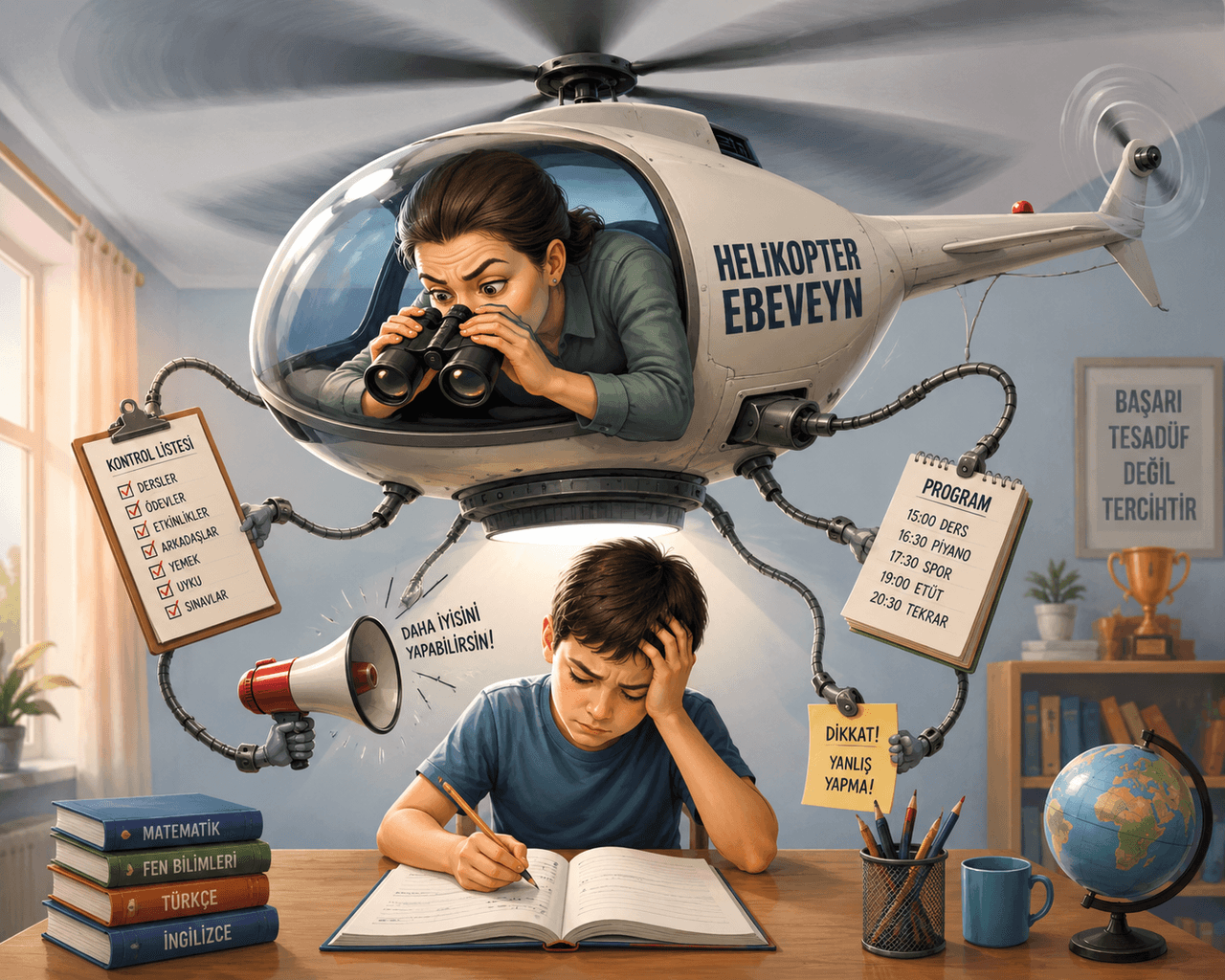
Helikopter Ebeveynlik başlığını temsil eden görsel (Yapay zeka ile oluşturulmuştur)
Tendencies toward helicopter parenting show distinct variations across different demographic characteristics:
Gender and Family Structure: Scientific studies conducted across Türkiye have found that approximately one third of mothers and one seventh of fathers exhibit helicopter parenting behaviors, with mothers demonstrating significantly higher levels of protective behavior than fathers. This parenting style is much more prevalent in families with only one child.【3】
Geographic Location: The place of residence also influences parenting attitudes, with helicopter parenting levels being significantly higher among parents of children growing up in large cities compared to those in rural areas and smaller districts.【4】
Socioeconomic Status: When evaluated socioeconomically, this parenting style is found to be more common among families with middle socioeconomic status.【5】
Educational Stages and Examination Processes: There is a significant increase in helicopter parenting behaviors during middle school, when children face major transitions such as high school entrance and experience high levels of exam-related anxiety. Additionally, mothers who are university graduates show higher helicopter tendencies compared to mothers with other educational levels, while fathers’ levels of helicopter parenting are not significantly influenced by their own educational background.【6】
The effects of helicopter parenting on children can lead to a wide range of problems in terms of psychological well-being and personality development. Individuals constantly under control and deprived of the freedom to make their own decisions show significantly lower levels of psychological well-being and overall life satisfaction.
Within the framework of self-determination theory, healthy psychological development requires the fulfillment of fundamental psychological needs such as autonomy, competence and relatedness. Helicopter parents undermine children’s sense of autonomy and competence by making decisions on their behalf during critical developmental stages, thereby violating these essential needs. Children who are not allowed to practice coping with challenges lose their sense of self-efficacy in adulthood and lose motivation to persevere in the face of life’s difficulties. This situation fosters dependent personality structures, severe difficulties in making independent decisions, and in some developmental cases, narcissistic tendencies.
Systematic reviews and clinical studies in the literature have demonstrated that individuals raised under helicopter parenting exhibit significantly higher rates of anxiety, social phobia, obsession and panic disorder compared to other individuals.【7】
Avcı, Seda Çetin, and Duygu Güleç Şatır. "Yeni Bir Kavram: Helikopter Ebeveynlik." *Ordu Üniversitesi Hemşirelik Çalışmaları Dergisi* 3, no. 2 (2020): 163–168. Accessed July 8, 2026.https://dergipark.org.tr/tr/download/article-file/1108258
Gençdoğan, Başaran, and Arzu Gülbahçe. "Psikolojik İyi Oluş ve Yaşam Doyumunun Bir Yordayıcısı Olarak Algılanan Helikopter Ebeveyn Tutumu." *Millî Eğitim Özel Eğitim ve Rehberlik Dergisi* 1, no. 1 (2021): 66–88. Accessed July 8, 2026.https://orgm.meb.gov.tr/ozelegitimverehberlikdergisi/tr/pub/dosyalar/03basarangencdogan.pdf
Vigdal, Julia Schønning and Kolbjørn Kallesten Brønnick. "A Systematic Review of 'Helicopter Parenting' and Its Relationship With Anxiety and Depression." *Frontiers in Psychology* 13 (2022): article no. 872981. Accessed July 8, 2026.https://doi.org/10.3389/fpsyg.2022.872981
Yılmaz, Hasan. "Türkiye'de Helikopter Ebeveynlik Eğilimi ve Helikopter Ebeveynlerin Demografik Özellikleri." *Sosyal Politika Çalışmaları Dergisi* 20, no. 46 (2020): 133–155. Accessed July 8, 2026.https://dergipark.org.tr/tr/download/article-file/1120167
[1]
Seda Çetin Avcı ve Duygu Güleç Şatır, "Yeni Bir Kavram: Helikopter Ebeveynlik," Ordu Üniversitesi Hemşirelik Çalışmaları Dergisi 3, no. 2 (2020): 164. https://dergipark.org.tr/tr/download/article-file/1108258
[2]
Hasan Yılmaz, "Türkiye'de Helikopter Ebeveynlik Eğilimi ve Helikopter Ebeveynlerin Demografik Özellikleri," *Sosyal Politika Çalışmaları Dergisi* 20, no. 46 (2020): 135–136.
[3]
Yılmaz, "Helicopter Parenting Trend in Turkey," 133.
[4]
Yılmaz, "Helicopter Parenting Trend in Türkiye," 141.
[5]
Yılmaz, "Helicopter Parenting Trend in Turkey," 154.
[6]
Yılmaz, "Helicopter Parenting Trend in Turkey," 148–149.
[7]
Yılmaz, "Türkiye'de Helikopter Ebeveynlik Eğilimi," 136.

No Discussion Added Yet
Start discussion for "Helicopter Parenting" article
Typical Characteristics and Behavioral Patterns of Helicopter Parents
Key Factors Contributing to the Development of Helicopter Parenting
Demographic Characteristics and Social Prevalence
Effects on Children’s Psychological and Social Development