


This article was automatically translated from the original Turkish version.
+1 More
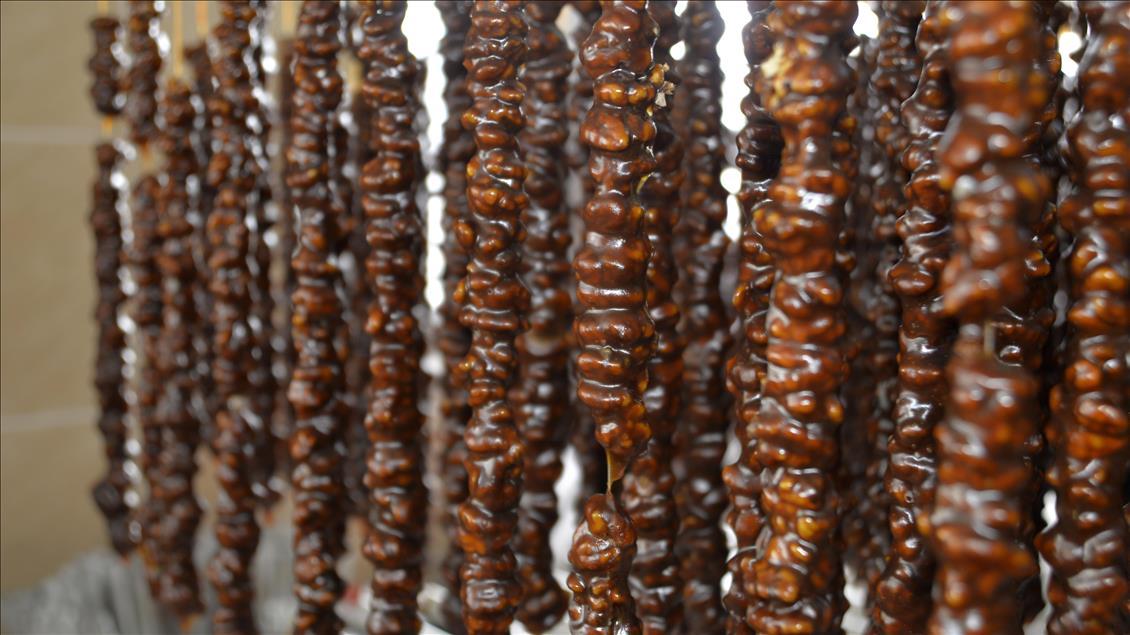
Gümüşhane mine
Production Site | Gümüşhane / Türkiye | ||||||||
|---|---|---|---|---|---|---|---|---|---|
Registration Authority | Turkish Patent and Trademark Office | ||||||||
Geographical Indication | Trademark (Registration No: 62, 2004) | ||||||||
Durability | Can be stored for months at room conditions due to low humidity and low water activity | ||||||||
Export Target | Qatar Saudi Arabia, etc. Greece Moldova USA | ||||||||
Raw Material | Sugar Walnut Mulberry syrup Milk Honey Flour | ||||||||
Gümüşhane Kömesi; walnuts dipped in a special mixture of mulberry juice, milk, honey, flour, and sugar, then threaded onto strings and dried, is a sweet and energy-rich traditional product. Although its appearance resembles walnut sucuk, it differs in composition and production process. Köme, shaped by the unique climate, vegetation, and production traditions of the Gümüşhane region, is both a nutritious and culturally significant product.
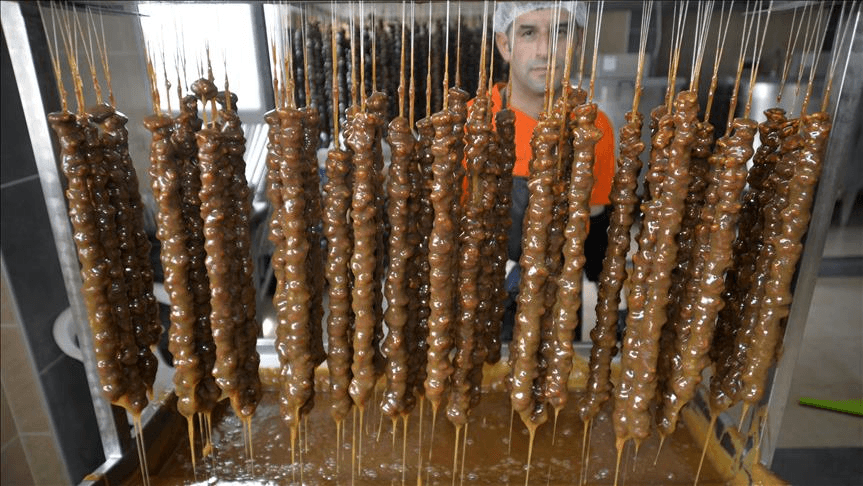
Gümüşhane Kömesi (AA)
The history of Gümüşhane Köme dates back to the Ottoman period. Archival records indicate that pestil and köme produced in Gümüşhane were sent as tributes to the imperial court. Originally made in households as snacks, these products gradually acquired commercial value and became an important economic activity in the region.
The production of köme involves walnuts, honey, milk, sugar, flour, and dried mulberries. The walnuts threaded onto strings are first boiled and then dipped into a mixture prepared from mulberry juice. Honey, milk, and flour are added to this mixture to achieve a specific consistency. The walnuts are dipped into this mixture at least three times, with each dip followed by drying, creating a layered structure. Gümüşhane Köme stands out as an energy source due to its nutritional values: 15 percent moisture, at least 5.5 percent protein, and 38 percent total sugar content.
Gümüşhane Köme was registered as a "geographical indication" by the Turkish Patent and Trademark Office on 11 April 2004. This product, registered under No. 62, is produced within the geographical boundaries covering the provincial center of Gümüşhane and the districts of Kelkit, Köse, Şiran, Torul, and Kürtün. The registration aims to preserve the product’s local characteristics and support its promotion.
Today, approximately 30 businesses in Gümüşhane produce 5,000 tons of pestil and köme annually. Ninety percent of Turkey’s pestil and köme market is supplied by this region. The product provides seasonal employment to 250 to 300 people. Thanks to mulberry trees grown at high altitudes under high-quality sunlight, the flavor and shelf life of köme are enhanced. Additionally, through the project titled "Gümüşhane Pestili ile Dünyaya Açılıyor," exports are targeted to countries such as the United States, Qatar, and Moldova.
Anadolu Ajansı. "Türkiye'nin pestil ve kömesi Gümüşhane'den." Accessed May 1, 2025.https://www.aa.com.tr/tr/pg/foto-galeri/turkiyenin-pestil-ve-komesi-gumushaneden-
Anadolu Ajansı. "Türkiye’nin Pestil ve Kömesi Gümüşhane’den." Accessed May 1, 2025.https://www.aa.com.tr/tr/ekonomi/turkiyenin-pestil-ve-komesi-gumushaneden/891710
Ministry of Culture and Tourism of the Republic of Turkey. "GÜMÜŞHANE KÖMESİ." Türkiye Kültür Portalı. Accessed May 1, 2025.https://www.kulturportali.gov.tr/portal/gumushane-komesi
Turk Patent and Trademark Office. "Gümüşhane Kömesi." Coğrafi İşaretler Portalı. Accessed May 1, 2025.https://ci.turkpatent.gov.tr/cografi-isaretler/detay/37938

Gümüşhane mine
Production Site | Gümüşhane / Türkiye | ||||||||
|---|---|---|---|---|---|---|---|---|---|
Registration Authority | Turkish Patent and Trademark Office | ||||||||
Geographical Indication | Trademark (Registration No: 62, 2004) | ||||||||
Durability | Can be stored for months at room conditions due to low humidity and low water activity | ||||||||
Export Target | Qatar Saudi Arabia, etc. Greece Moldova USA | ||||||||
Raw Material | Sugar Walnut Mulberry syrup Milk Honey Flour | ||||||||
Origin
Production Process and Characteristics
Geographical Indication
Economic and Cultural Significance