


This article was automatically translated from the original Turkish version.
Greenfield investment refers to a situation in which an investor creates a new business from scratch by establishing a new facility or operation without relying on existing infrastructure. Such investments are commonly chosen under the category of foreign direct investment (FDI) when a company seeks to enter a new market or expand capacity within an existing market. Greenfield investments require high initial costs and long-term commitments because they involve building an entirely new structure from the ground up without utilizing any existing business model or infrastructure.
Greenfield investments are a type of investment that requires comprehensive research into the region where the business will operate and careful consideration of local economic conditions. The advantages of such investments include granting the investor full control, enabling the development of strategies tailored to the local market, and allowing operations in less competitive environments. However, risks such as local regulations, labor costs, and infrastructure challenges also exist.
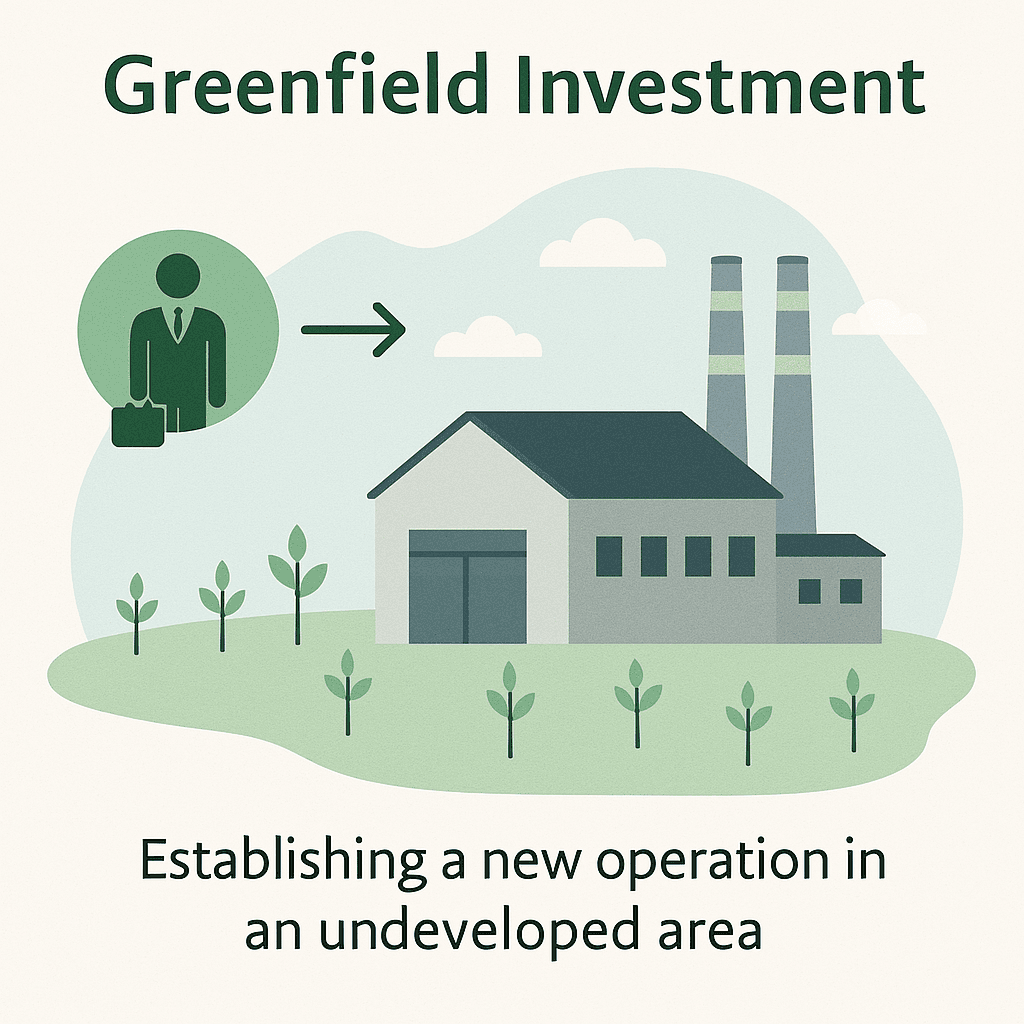
Designed with the aid of artificial intelligence.
One of the key characteristics of Greenfield investments is the construction of an entirely new facility by the investor. This facility may encompass various functions such as production processes, offices, logistics centers, or distribution networks. The investor may receive infrastructure support through agreements with local governments and can generate new employment opportunities. The main advantages of Greenfield investments are as follows:
1. Full Control: The investor maintains complete control over the structure and operations of the new facility. This is a significant advantage, particularly in terms of strategic decision-making.
2. High Investment Potential: Greenfield investments typically create long-term growth opportunities. Investors can optimize their investments according to market size and economic conditions.
3. Contribution to the Local Economy: New enterprises contribute to the local economy by creating jobs and offering skill development opportunities for the local workforce.
The main challenges associated with Greenfield investments are high initial costs and lengthy payback periods. These investments often require substantial capital and carry financial risks for investors. Additionally, complying with local legal regulations, integrating into the local market, and addressing managerial issues arising from cultural differences can present significant obstacles.
Greenfield investments serve as a key driver of global economic integration and the development of local economies. Such investments, particularly in developing countries, offer strategic benefits including attracting foreign capital, employing local labor, and promoting technological advancement. However, the success of Greenfield investments is not limited to capital investment alone; investors must carefully analyze local economic conditions, cultural differences, legal frameworks, and market dynamics.
One of the most important advantages of Greenfield investments is the full control they provide to investors. This situation enables investors to retain decision-making authority throughout every stage, from the design of the new facility to the formulation of business strategies. As a result, companies can optimize their operational processes and production methods to suit the local market and develop innovative solutions that meet local demands. Moreover, investments made on greenfield sites allow companies to construct high-quality facilities and implement environmentally sustainable operations.
However, Greenfield investments also carry various challenges and risks. High initial costs, long-term investment commitments, and the time required for investors to adapt to local market conditions are key factors affecting the success of such investments. In particular, infrastructure deficiencies, bureaucratic barriers, and political uncertainty in developing countries can further complicate Greenfield investments. Moreover, because these investments require long-term capital commitment, they demand patience from investors and strategic flexibility in the event of extended payback periods.
Nevertheless, a successful Greenfield investment can generate wide-ranging positive impacts on the local economy. The establishment of new facilities not only creates employment but also strengthens local supply chains and accelerates technology transfer. This, in turn, enhances the skill levels of the local workforce, improves the competitiveness of businesses, and accelerates regional development. In addition, the proliferation of Greenfield investments can increase foreign trade volumes and contribute to the globalization of local markets.
Adminacade. (January 15, 2024). *Greenfield investment: Greenfield investment meaning & example*.https://academyes.com/greenfield-investment/
Agarwal, Saurabh, and V. Ramaswami. "Choice of Foreign Market Entry Modes: Impact of Ownership, Location and Internalization Factors." Journal of International Business Studies 23, no. 1 (1992): 1-24.
Narula, Rajneesh, and Brian Portelli. “Foreign Direct Investment and Economic Development: Opportunities and Limitations from a Developing Country Perspective.” In *Do Multinationals Feed Local Development and Growth?*, edited by Grazia Ietto-Gillies, 11–33. Oxford: Elsevier, 2007.https://www.researchgate.net/publication/288482428
UNCTAD. World Investment Report 2003: FDI Policies for Development. United Nations Conference on Trade and Development, 2003.

No Discussion Added Yet
Start discussion for "Greenfield Investment" article
Characteristics of Greenfield Investment
Risks and Challenges
Greenfield Investments Today