


This article was automatically translated from the original Turkish version.
In plants, grafting is an asexual (vegetative) propagation method that involves joining living tissues of two genetically similar or conspecific plants so that they develop as a single organism. In grafting, the lower part of the plant that forms the root and stem system is called the “rootstock,” while the upper part containing buds is referred to as the “scion” or “bud eye.”
Grafting is applied for numerous agricultural purposes, including fruit and vegetable production, plant breeding, enhancing disease resistance, and physiological rejuvenation.
The history of plant grafting dates back thousands of years. Chinese manuscripts contain records of grafting being performed on fruit trees as early as 1000 BCE. Ancient Greek thinkers such as Aristotle (384–322 BCE) and his student Theophrastus (371–287 BCE) were among the first scientists to recommend grafting to preserve desirable plant traits.
The first commercial applications of vegetable grafting began in Japan and Korea in the early 20th century. The practice initially involved grafting watermelon onto bottle gourd (Lagenaria siceraria) to confer resistance to Fusarium wilt, and soon expanded to include cucumber, tomato, and eggplant.
By the 1990s, the proportion of grafted vegetables in total production reached 59% in Japan and 81% in Korea.
Grafting is used for the following purposes:
Additionally, grafting saves time in breeding programs. For example, in species that take many years to bear fruit, grafting enables earlier harvests.
Grafting methods are broadly classified into two categories:
One modern technique is in-vitro grafting, which is performed under controlled laboratory conditions using shoot apical meristems typically 0.1 mm to 2 cm in length. This technique is successfully applied in woody plantsprimarily for virus elimination, rejuvenation, and preservation of genetic purity.
During grafting, the critical factor is the precise alignment of the cambium layers between the rootstock and scion. A callus tissue forms at this junction, enabling the development of new xylem (water-conducting vessels) and phloem (nutrient-conducting vessels). This biological bridge is essential for the transport of water, minerals, and organic compounds. In incompatible combinations, this process fails and the graft does not survive.
The role of the cambium is not merely structural union; it also involves regeneration and healing. Connections are established through cell divisions in the pith, cortex, and cortical tissues.
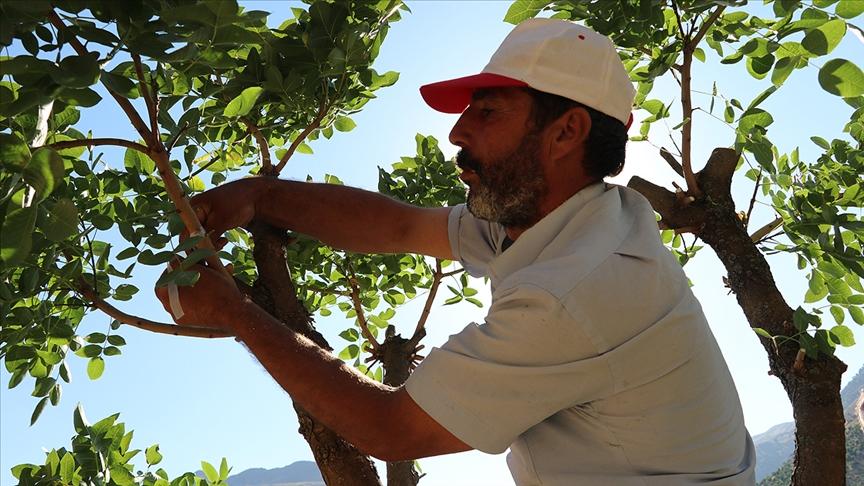
Aşılama İşlemi Yapan Çiftçi (AA)
Success in grafting is directly related to genetic proximity between the rootstock and scion. Plants of the same species or genus are generally compatible and graft successfully. Success rates decline between different genera, and grafting between plants from different families is usually unsuccessful. Physiological condition, plant age, environmental factors, and appropriate technique selection also significantly influence grafting success.
Grafting is a well-established agricultural technique that holds a vital place in both traditional and modern farming practices. With a history spanning thousands of years, this method continues to evolve, being applied today in advanced forms to increase productivity and develop disease-resistant varieties. Alongside traditional methods, in-vitro grafting techniques performed under laboratory conditions enable high success rates, particularly in woody plants, while preserving genetic purity.
Grafting offers multifaceted benefits in terms of plant physiology, genetics, and resistance to environmental stresses. However, its success depends on numerous variables, including the genetic compatibility of the materials used, their physiological state, environmental conditions, and the grafting technique applied. As it has been in the past, grafting remains a critical method for ensuring agricultural sustainability, controlling plant diseases, and enhancing economic production, both today and in the future.
Ertok, Rana, and Hüseyin Padem. "Sebzelerde AşılamaFizyolojisi". Derim 24, sy. 2 (June 2007): 20-26.
Yeşil Türkiye. "Ağaçlarda Aşılama." Accessed [Date].https://yesilturkiye.org/agaclarda-asilama%EF%BF%BC
Yıldırım, Hakan, Nazan Çalar, Ahmet Onay, Hüseyin Karlıdağ, and Tuncay Kan. "Odunsu Bitki Türlerinde İn-vitro Aşılama-I (Anaç, Kalem, Aşı Tekniği)." Iğdır Üniversitesi Fen Bilimleri Enstitüsü Dergisi 7, no. 3 (2017): 31–37.
Çelik, İlay. "Aşı Zamanı." Bilim ve Teknik. (April 2010): 70-73.

History and Development
Objectives and Benefits
Grafting Methods
Physiological Basis and Compatibility
Plant Applications
Limitations and Compatibility Requirements