

+2 More

Füruğ Ferruhzad. (Generated with artificial intelligence.)
Spouse | Perviz Şapur Ibrahim Gülistan (Marriages are not official) | ||||||||
|---|---|---|---|---|---|---|---|---|---|
Date of birth | 1935-01-05 | ||||||||
Mother | Turan Veziri-Taber | ||||||||
Father | Colonel Muhammad Ferruhzad | ||||||||
Child | Kamyar Şapur Hüseyin Mansur | ||||||||
Occupation | Translator Poet Writer Director Painter | ||||||||
Date of death | 1967-02-13 | ||||||||
Forough Farrokhzad (Persian: فروغ فرخزاد, Forough Farrokhzad) was born on 5 January, 1935, in the capital of Iran, Tehran. As a poet, filmmaker, and translator, Farrokhzad produced work throughout the 1950s and 1960s and became one of the most frequently referenced figures in modern Iranian literature and intellectual life. Through her literary and artistic endeavors, Farrokhzad produced diverse works in poetry, documentary cinema, and literary translation during her brief life.
Farrokhzad was born on 5 January 1935 in Tehran. Some sources list her date of birth as 29 December, 1934. Her father, Mohammad Farrokhzad, was an officer in the Iranian military. Her mother was Turan Veziri-Tabar. She was the third of seven siblings.
After completing primary school in Tehran, Farrokhzad attended a girls’ art school, where she received training in painting, handicrafts, and applied arts, and began writing poetry.
At the age of 16 (in 1951), Forough Farrokhzad married her cousin, the cartoonist and satirical writer Perviz Shapur. Shapur was known in the literary circles of the time as an intellectual figure.
Their union produced a son, Kamyar, in 1952. However, the couple’s relationship could not be sustained due to both an age difference and personality conflicts, and they divorced in 1954. According to Iran’s Civil Code at the time, custody of the child was granted to the father, forcing Farrokhzad to separate from her son.
For Farrokhzad, this period was not only a personal breaking point but also a defining beginning to her literary career. During her marriage, her observations intensified regarding the confinement of women within domestic roles and the limitations imposed by motherhood; this condition directly shaped the thematic structure of her early poetry. After the divorce, facing material and social pressures, Farrokhzad began to assert her struggle for independent living while simultaneously making her literary production more visible.
Her first poetry collection, Esir (The Captive), published in 1952, is a product of this period and explores themes such as the woman’s search for individual existence, her entrapment within marriage, and her conflict with societal moral judgments. These texts, which for the first time spoke directly through a female subject in opposition to the dominant classical and formal male-dominated poetic language of the era, made Farrokhzad a controversial yet compelling figure in literary circles.
The relationship Farrokhzad was unable to establish with her son became a persistent thread influencing both her private life and poetic expression for years.
In her poem “Tutsak”, she wrote: “I want you and I know / I will never hold you in my arms” (تو را میخواهم و میدانم که هرگز به دامانم نمیگیری تو را), one of many examples reflecting her inner conflict between motherhood and personal freedom.
Moreover, during this period, Farrokhzad encountered the difficulties of being visible as a woman in Iran’s literary circles. Her open treatment of themes such as love, sexuality, desire, and motherhood in her poetry led conservative circles to label her as “deviant.” While some literary journals avoided publishing her poems on moral grounds, other literary figures accused her of “lumpen sensibility.” Nevertheless, her poetry gained attention particularly among young women and modern urban readers.
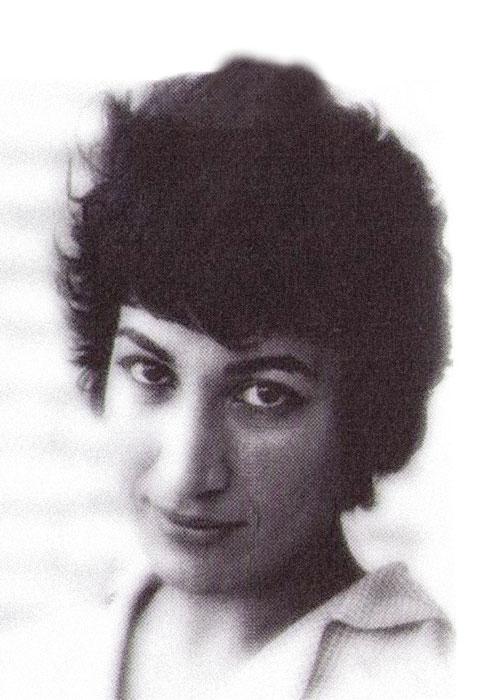
Forough Farrokhzad. (Yapı Kredi Yayınları)
Her first poetry collection, Esir (The Captive), was published in 1952. It was followed by “Duvar” (The Wall, 1956) and “İsyan” (Revolt, 1958). Both books, shaped by her personal experiences and the constraints of being a woman, attracted attention for their implicit or explicit criticism of conservative Iranian society of the time. Farrokhzad translated her observations on social gender roles, marriage, motherhood, and moral norms into poetic language, thereby constructing a poetic space where the personal became political.
In terms of formal structure, Farrokhzad’s early poems often employed the classical Persian poetic form of the chaharpare (quatrain). Nevertheless, while she occasionally used traditional aruz meters, a distinct organic harmony between poetic rhythm and content becomes evident. Although these texts, which predate the “New Poetry” (She'r-e Now) movement, do not represent a complete formal break, it is clear that in content they move beyond the conventions of traditional poetic expression.
Her 1958 trip to Europe marked a significant turning point in Farrokhzad’s intellectual development. During her stay in Italy, she learned Italian and gained direct exposure to classical and modern Western art. This period allowed her to engage with Italian literature and cinema and to undertake translation work. Her brief time in Europe was not merely a linguistic acquisition but also a decisive moment of intellectual expansion and deepening of her aesthetic perspective.
Shortly after returning to Iran, she met in the same year the writer, translator, and director Ibrahim Golestani. This encounter created an influential sphere of interaction that shaped her subsequent poetic and cinematic production. Golestani’s intellectual depth and strong connections within the artistic circles of the time enabled Farrokhzad to develop a more productive and independent artistic practice. Their relationship was both personal and characterized by aesthetic and intellectual collaboration.
During this period, Farrokhzad turned not only to poetry but also to cinema and literary translation. She began working at Golestani Film Studio, writing short texts, producing screenplay drafts, and undertaking translations. She also deepened her practice of literary translation through works translated from English and French. These translation efforts contributed to her poetic language and strengthened her engagement with world literature.
In 1962, Forough Farrokhzad directed a short documentary film titled Ev Karadır (The House Is Black, Khane Siah Ast), focusing on a leprosy colony near the town of Bābak in northwestern Iran. The film was produced with the support of Golestani Film Studio, with Farrokhzad herself writing the screenplay and directing. The documentary does not merely depict the physical symptoms of the disease but also focuses on the daily lives, religious rituals, children’s education, and struggles for survival of the people living there.
Unlike conventional documentary narration, the film adopts a poetic structure, incorporating verses read in Farrokhzad’s own voice and internal monologues. This production, where visual imagery intertwines with lyrical language, is regarded as an aesthetically original example in Iranian documentary cinema. Ev Karadır functions not only as a documentary but also as a cultural intervention that draws attention to a reality ignored by the political and social climate of the time.
The film was screened in 1963 at the International Short Film Festival in Oberhausen, Germany, where it received the International Film Critics Prize (FIPRESCI).
During the filming of the documentary, Farrokhzad met a boy named Hossein Mansur who lived in the colony and formed a special bond with him. After completing the film, she adopted him and cared for him until the end of her life. This event is a significant example demonstrating that Farrokhzad’s social sensitivity extended beyond art into direct personal action.
Ev Karadır is regarded as one of the pioneers of intellectual documentary storytelling in Iranian cinema, due to its thematic depth, formal originality, and social sensitivity. The film is also one of the rare examples in which Farrokhzad successfully translated her poetic vision into cinematic language.
A clear transformation became evident in Farrokhzad’s poetic vision after 1960. Her 1964 collection, Tavalod-e Digar (A New Birth), contains works reflecting her new poetic sensibility. During this period, she moved away from traditional forms and embraced the She'r-e Now (New Poetry) movement pioneered by Nima Yushij. Her use of free verse and abstract expression of personal experience intensified during this time.
One of the poems she wrote shortly before her death, and which also gave its name to her fourth and final poetry collection of 1964, “A New Birth” (Tavalod-e Digar), encapsulates her intellectual and poetic evolution. In this poem, Farrokhzad transforms personal solitude into a form of inner rebirth, presenting the self’s passage from darkness to light as a poetic purification. The following lines from the poem stand out as expressions of this transformation and hope:
All my being became a prayer
before a window in the dark
a window
whose hands reached toward truth
a window
through which the sun’s heart rose
and there the sky was not blue
and there the earth was full of love.
(Original Persian text:)
تمام هستی من
یک دعا بود
در سایهای از پنجرهای تاریک
پنجرهای
که انزوای دستانم را
به حقیقت پیوند میزد
پنجرهای
که از طلوع قلب خورشید
عبور میکرد
و آنجا آسمان آبی نبود
و آنجا زمین پر از عشق بود.
(Forough Farrokhzad, A New Birth)【1】
Forough Farrokhzad died on 13 February 1967 following a car accident in Tehran. It is reported that she was alone at the time of her death and that the accident occurred when the car she was driving swerved to avoid hitting another vehicle and collided with a wall.
Farrokhzad was only 32 years old when she died. She was buried in Tehran’s Zahir-od-Dowleh Cemetery.
Official sources state that the accident was the result of a tragic driving error. However, over time, particularly in literary and press circles, questions arose as to whether her death was truly an ordinary accident. Some testimonies and claims suggest that on the day of the accident, Farrokhzad was psychologically distressed and had not fastened her seatbelt. Some have speculated that her emotional turmoil may have led to what could be interpreted as a form of “passive self-annihilation.” However, neither her family nor her close circle has confirmed these claims; thus, such interpretations remain purely speculative.
After her death, in 1973, a collection of her previously unpublished poems titled “Let Us Believe in the Beginning of the Cold Season” (Bāvar Konim Be Āghāz-e Fasl-e Sard) was published. This volume contains poems from her mature period and continues the formal and thematic transformation begun in A New Birth. In her late poems, themes such as death, emptiness, faith, time, and existence come to the fore, and her poetic language adopts a simpler yet profoundly layered expression.
Today, Forough Farrokhzad is a widely recognized poet in academic studies on Iranian literature and modern world poetry.
Forough Farrokhzad. (Image generated by artificial intelligence.)
Ferruhzad, Füruğ. Bir Başka Doğuş. Trans. Haşim Hüsrevşahi. Istanbul: Totem Yayınları, 2015.
Ferruhzad, Füruğ. Yaralarım Aşktandır. Trans. Haşim Hüsrevşahi. Istanbul: Totem Yayınları, 2015.
Ferruhzad, Füruğ. Yeryüzü Ayetleri. Trans. Onat Kutlar and Celal Hosrovşahi. Istanbul: Can Yayınları, 2008.
Rūzbih, Muḥammed Riẓā. Edebiyât-i Muʿâṣır-i Îrân (Şiʿr). Tehran: Neşr-i Rûzgâr, 2007.
Yapı Kredi Yayınları. "Furuğ Ferruhzad." Accessed April 1, 2025.https://www.yapikrediyayinlari.com.tr/yazarlar/furug-ferruhzad
Yürük, Neslihan. “İran’da Furuğ Ferruhzad Örneğinde Sanat ve Siyaset.” Master's thesis, İstanbul Üniversitesi Sosyal Bilimler Enstitüsü, 2019. Accessed April 1, 2025.
[1]
1: (Alıntı: Füruğ Ferruhzad, Bir Başka Doğuş, çev. Haşim Hüsrevşahi, İstanbul: Totem Yayınları, 2015, s. 87.)

Füruğ Ferruhzad. (Generated with artificial intelligence.)
Spouse | Perviz Şapur Ibrahim Gülistan (Marriages are not official) | ||||||||
|---|---|---|---|---|---|---|---|---|---|
Date of birth | 1935-01-05 | ||||||||
Mother | Turan Veziri-Taber | ||||||||
Father | Colonel Muhammad Ferruhzad | ||||||||
Child | Kamyar Şapur Hüseyin Mansur | ||||||||
Occupation | Translator Poet Writer Director Painter | ||||||||
Date of death | 1967-02-13 | ||||||||
Childhood and Education
Marriage, Motherhood, and Divorce
Impact of Her Personal Life on Her Narrative
Literary Works
Formal Characteristics of Her Literary Works
Artistic Environment and European Travel
Cinematic Activities
Late Poetry and Formal Transformation
Death, Legacy, and Place in Literature