


This article was automatically translated from the original Turkish version.

FOMO (Fear of Missing Out)
Developer(s) | Dan Herman | ||||||||
|---|---|---|---|---|---|---|---|---|---|
Related Field(s) | Psychology Sociology Social Media Media Studies Public Relations Marketing | ||||||||
Basic Assumption | FOMO (Fear of Missing Out) refers to a person's fear of missing out on social, entertaining, rewarding, or important experiences around them. | ||||||||
FOMO (Fear of Missing Out) refers to the fear that one is missing out on social, entertaining, rewarding, or important experiences occurring around them. With the widespread adoption of Social media and digital communication tools, the term FOMO has become even more prevalent today, and its visibility has increased due to the constantly updating and rapidly spreading nature of content on social media. This emotion often leads individuals to observe their online friends’ social activities and posts, generating a sense that they have missed something important in their own lives. This feeling of loss commonly opens the door to emotions such as loneliness, inadequacy, or exclusion.
FOMO does not only affect social media usage but can also have significant impacts on a person’s overall psychological state and social relationships. Individuals may experience anxiety and dissatisfaction due to not participating in the enjoyable activities of those around them.
The concept of FOMO was first articulated in the early 2000s as a reference to opportunities or developments and entered academic literature through marketing expert Herman (2000).
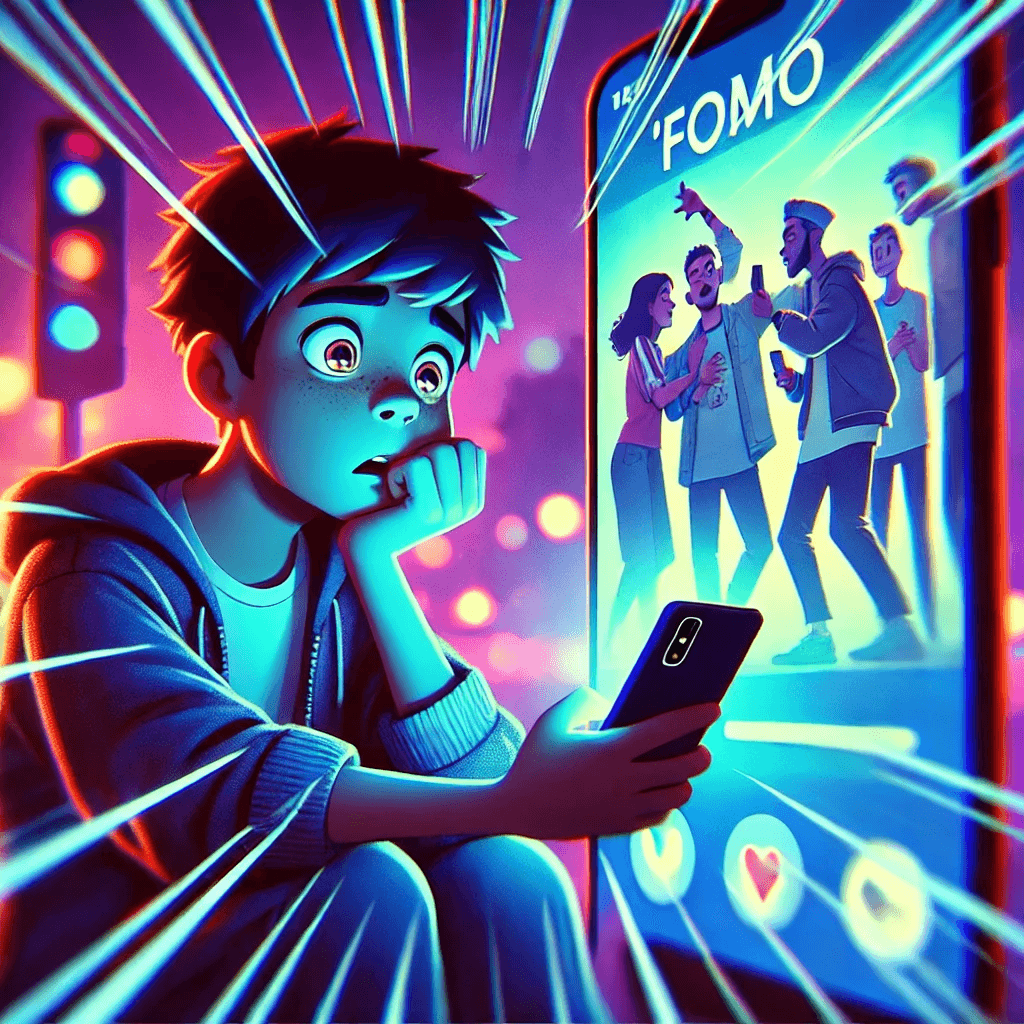
An AI-generated image depicting FOMO.
The foundation of FOMO lies in the societal perception of “success” displayed in social relationships and culture. This phenomenon causes individuals to feel deprived of such success by continuously observing others in their environment and following their social media posts. The main causes of FOMO are as follows:
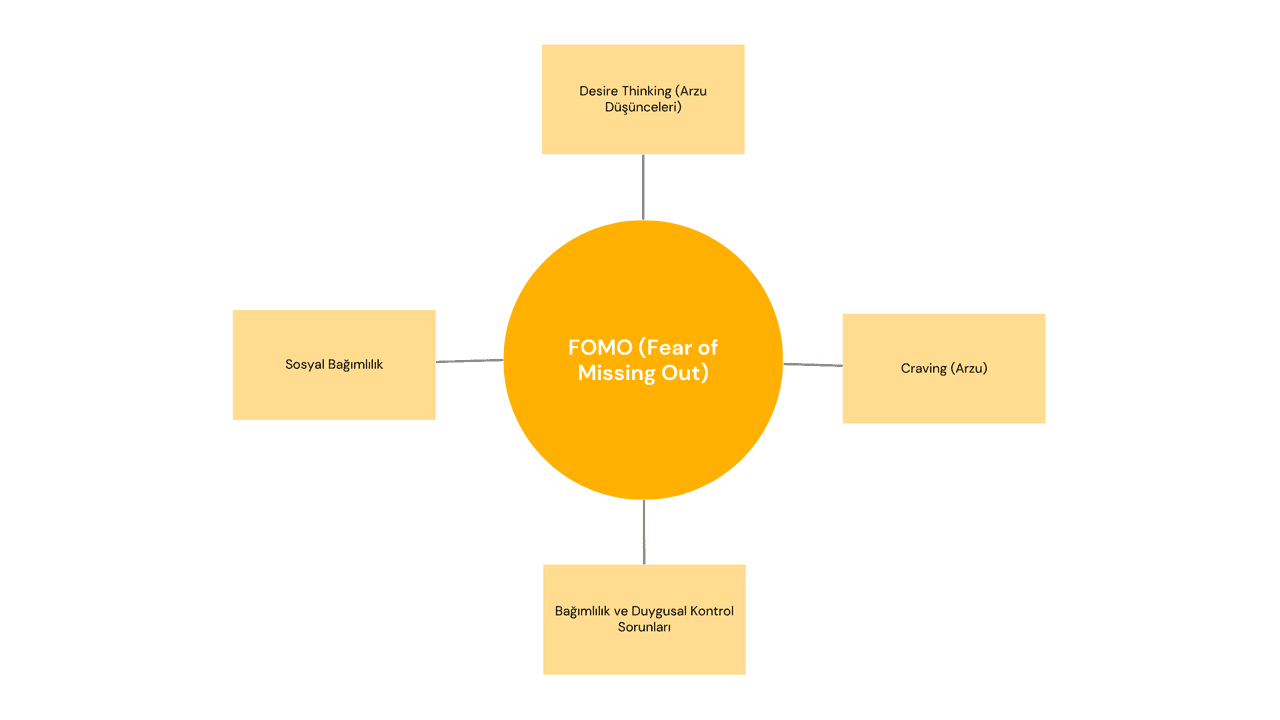
Prepared by the author using Canva.
Different types of FOMO can vary depending on individuals’ experiences and patterns of social media use. These include:
Generated by AI.
FOMO is a pervasive emotional state encountered by individuals in the digital age. Social media use has made this feeling more frequent and intense. When individuals see the “perfect moments” in others’ lives, they may perceive deficiencies in their own. However, FOMO is not merely a reaction to social media and external events; it is underpinned by complex psychological mechanisms. Linked to desire thinking, craving, social media addiction, and other cognitive processes, the sustained effects of FOMO can impact individuals’ emotional and social well-being. Therefore, it is essential to develop strategies to manage the effects of FOMO, particularly through psychotherapeutic interventions and by fostering healthier social media habits.
Arshad, M. I., et al. "The Influence of Work-Life Balance on Employee Well-Being." Springer Journal of Behavioral Sciences 8, no. 2 (2023): 45-56. https://link.springer.com/article/10.1186/s40359-023-01216-0.
Bekman, Müge. "FOMO'nun Halkla İlişkilerdeki Yeri ve Etkileri: Trendyol Örneği." *Selçuk İletişim Dergisi* 15, no. 2 (2022): 528-557. https://dergipark.org.tr/en/download/article-file/2428336.
Rath, S., et al. "Exploring the Influence of Organizational Culture on the Work-Life Balance of Employees." Journal of Business and Economic Research 19, no. 2 (2021): 123-137. https://journals.klalliance.org/index.php/JBER/article/view/192/187.
Rath, S., et al. "Impact of Work-Life Balance on Employee Engagement and Retention." Journal of Business Research 95 (2016): 23-29. https://www.sciencedirect.com/science/article/abs/pii/S0747563216304198.
Rath, S., et al. "Impact of Work-Life Balance on Organizational Commitment." Journal of Business Research 84 (2017): 1-7. https://www.sciencedirect.com/science/article/abs/pii/S0747563213000800.

FOMO (Fear of Missing Out)
Developer(s) | Dan Herman | ||||||||
|---|---|---|---|---|---|---|---|---|---|
Related Field(s) | Psychology Sociology Social Media Media Studies Public Relations Marketing | ||||||||
Basic Assumption | FOMO (Fear of Missing Out) refers to a person's fear of missing out on social, entertaining, rewarding, or important experiences around them. | ||||||||
No Discussion Added Yet
Start discussion for "FOMO (Fear of Missing Out)" article
Factors Contributing to FOMO
Concepts Associated with FOMO
Types of FOMO