This article was automatically translated from the original Turkish version.
+2 More
Official Name | Federal Republic of Nigeria | ||||||||
|---|---|---|---|---|---|---|---|---|---|
Capital | Abuja | ||||||||
Form of Government | Federal Republic | ||||||||
Date of Independence | 1 Ekim 1960 (İngiltere'den) | ||||||||
National Day | 1 October | ||||||||
President | Bola Ahmed Tinubu | ||||||||
Area | 923,768 km² | ||||||||
GDP | 285.003 billion dollars | ||||||||
GDP per Capita | 1,200 USD | ||||||||
Climate | Southern coasts equatorial; central regions tropical; northern regions semi-arid | ||||||||
Total Population | 242,431,841 (2026 estimate) | ||||||||
Religious Composition | Muslim (56.1%); Christian (43.4%); other religions (0.60%) | ||||||||
Ethnic Groups | Hausa-Fulani; Yoruba; Igbo | ||||||||
Official Languages | English | ||||||||
Common Languages | Hausa; Yoruba; Igbo | ||||||||
Telephone Code | +234 | ||||||||
Internet Domain Code | .ng | ||||||||
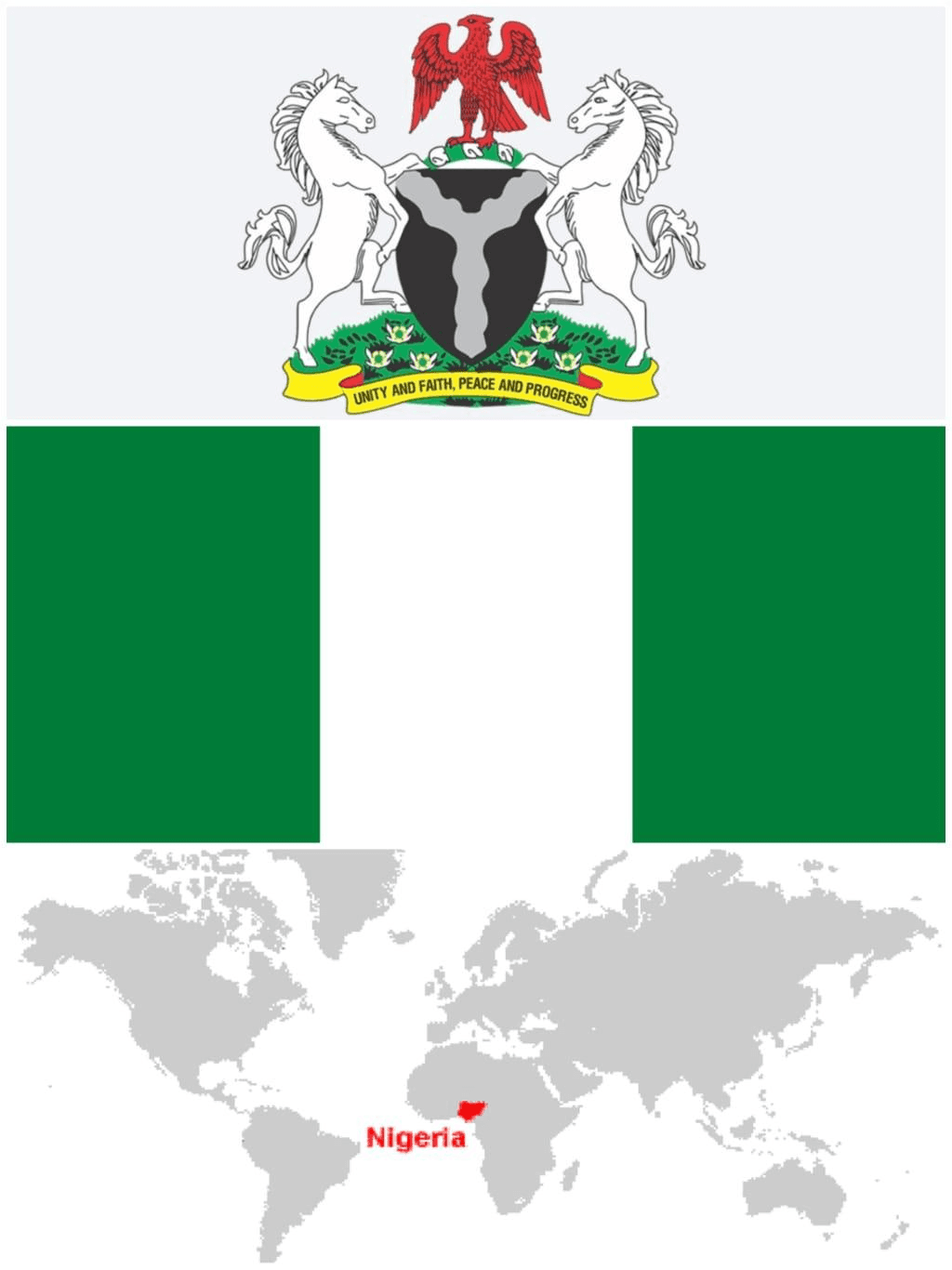
Federal Republic of Nigeria, is a state located in West Africa with a population of approximately 230 million, making it the most populous country on the continent and, based on nominal GDP figures, an economy of about $477 billion, positioning it as Africa’s largest economy.【1】 The country is situated along the Gulf of Guinea and shares borders with Niger to the north, Cameroon and Chad to the east, and Benin to the west. The foundations of modern Nigeria were laid during the British colonial period through independence movements that followed the ancient kingdoms and city-states of the region, and the country achieved full independence on 1 October 1960.【2】
The country hosts more than 250 ethnic groups and a wide range of cultural diversity, and due to its large population, natural resources, and influence in continental politics, it is referred to as the "Giant of Africa."【3】 Governed by a federal republican structure, Nigeria consists of 36 states and the Federal Capital Territory of Abuja. Its economy is largely based on oil and natural gas exports, but agriculture and the technology sector also hold significant importance.
The national symbols of the Federal Republic of Nigeria reflect the country’s unity, natural wealth, and struggle for independence.
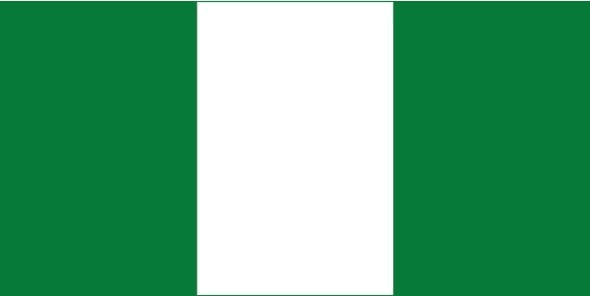
Nigeria Flag (Store Norske Leksikon)
Nigeria’s national flag was designed by Taiwo Akinkunmi during the country’s independence process and was first hoisted on 1 October 1960. The flag consists of three equal vertical stripes: the two outer stripes are green and the central stripe is white. With its simple design, the flag symbolically represents Nigeria’s natural wealth and national ideals.
The green color on the flag represents Nigeria’s fertile lands, agricultural potential, and rich vegetation. The central white stripe symbolizes peace, unity, and national integrity. In this way, the Nigerian flag refers both to the country’s natural resources and to the ideal of social unity and stability to be built after independence.【4】
Nigeria’s current national anthem is titled "Arise, O Compatriots." Adopted in 1978, the lyrics of this anthem are designed as a call to citizens to serve their country, uphold justice, and live in unity.【5】 The anthem honors Nigeria’s past struggles while aiming to guide future generations. The Turkish translation of Nigeria’s national anthem is as follows;
Nigeria National Anthem (National Anthems Channel)
We salute you, Nigeria!
Our beloved land,
Though tribes and languages differ,
We stand united in brotherhood;
We are all Nigerians,
We take pride in serving our sovereign homeland.
Our flag shall be a symbol;
Of truth and justice prevailing,
Of our honor in peace and in war.
And we count this as a triumph;
To pass on to our children,
A flag without stain.
O God of all creation,
Accept this our only prayer;
Help us build our nation,
As a land where no one suffers injustice.
Thus in peace and plenty,
May Nigeria be blessed.
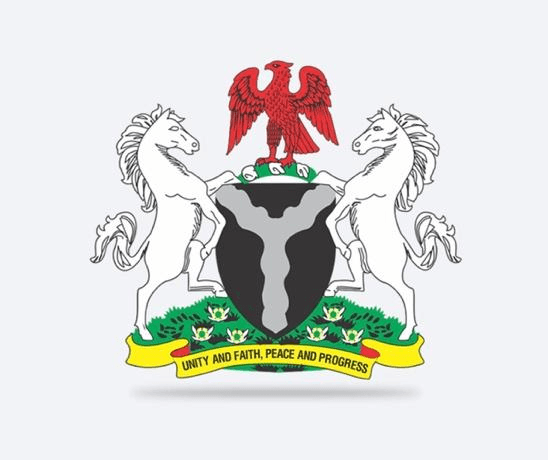
Nigeria Coat of Arms (NTDA Medya Portalı)
Nigeria’s official state coat of arms consists of symbolic elements reflecting the country’s geography, natural wealth, and core values. At its center, the black shield represents Nigeria’s fertile lands, while the silver "Y" shape on the shield symbolizes the confluence of the two main rivers, the Niger and the Benue. The two white horses on either side of the shield represent dignity and strength; the red eagle at the top of the coat of arms stands as a symbol of the state’s power and authority.
The base and yellow flowers at the bottom of the coat of arms symbolize Nigeria’s natural beauty. These flowers are commonly associated with wildflowers native to the country and refer to its natural diversity. At the bottom of the coat of arms, on a ribbon, is Nigeria’s official motto: "Unity and Faith, Peace and Progress." This motto, translatable into Turkish as "Birlik ve İnanç, Barış ve İlerleme," emphasizes Nigeria’s ideals of national unity, social harmony, and progress.
The Nok Culture, the earliest and most advanced settled civilization on Nigerian territory, emerged around 1500 BCE on the Jos Plateau and its surroundings and persisted until approximately 200 CE.
Nok was not a single ethnic group or tribe but a shared cultural pool formed by diverse communities across a wide geographic area who shared similar artistic styles and technological skills. The key elements uniting these communities were their distinctive terracotta sculpture art and advanced iron-smelting technology, the earliest known in Sub-Saharan Africa. In this structure, with a clear social hierarchy, artisans and farmers formed a complex network of cooperation.
Around 500 BCE, this cultural pool transitioned from stone tools to iron tools, increasing agricultural productivity and enabling population concentration. This was the first major technological breakthrough forming the economic foundation for subsequent kingdoms in the region.【6】
This civilization lasted for approximately 1700 years and disappeared from the historical record around 200 CE. Although there is no definitive evidence for its decline, historians emphasize three primary causes:
Although the Nok culture physically ended around 200 CE, its aesthetic and technical legacy did not vanish entirely. The stylistic elements and metalworking techniques of Nok art directly influenced the craft traditions of the Ife and Benin civilizations, which emerged centuries later in the same region.
Nigeria’s medieval history developed through the parallel rise of trade-oriented empires in the north and centralized forest kingdoms in the south, linked indirectly through trade routes.
The Kanem-Bornu Empire (9th century – 1893), established around Lake Chad in the 9th century, grew wealthy by controlling Trans-Saharan trade routes. In the 11th century, with the adoption of Islam, it became the region’s largest political, military, and religious authority. It established military dominance over the Hausa city-states to its west, using them as a "security buffer." Rather than engaging in direct warfare with southern kingdoms such as Ife and Benin, it served as the northern terminus of a vast trade network, exchanging luxury goods from the north (salt, horses, cloth) for raw materials from the south (ivory, metals). It weakened in the 19th century with the spread of the Sokoto Caliphate and was ultimately dismantled in 1893 by Rabih az-Zubayr, who exploited the pre-colonial chaos to end its political existence.【7】
The Ife Kingdom (11th century – 15th century) emerged in the 11th century in southwestern Nigeria as the spiritual and cultural center of the Yoruba people. It became one of the recognized civilizations of West Africa due to its advanced metal casting art (famous Ife bronzes) and urban planning. It is regarded as the "spiritual ancestor" of the Benin Empire; indeed, the Benin dynasty traces its origins to Ife. Its relationship with northern states was purely commercial, and it sought to preserve its traditional beliefs and artistic traditions against the Islamic structure of the north. From the 15th century onward, it lost its political power to the rapidly strengthening and more aggressive Benin Empire, eventually transforming from a political power into a symbolic religious center.
The Benin Empire (13th century – 1897) was founded in the 13th century by a branch of the royal lineage from Ife and became a military superpower in Africa during the reign of Oba (ruler) Ewuare in the 15th century. The walled city of Benin developed the most centralized administrative system in the region. While preserving its spiritual roots in Ife, the empire remained economically dependent on northern trade routes. However, by the end of the 15th century, its maritime trade with the Portuguese enabled it to become independent from the north and, through access to firearms, establish absolute dominance over the south. In 1897, it was invaded by the United Kingdom in the "Benin Expedition" (Punitive Expedition), its capital was looted, and its independence was terminated.
The early modern period encompasses a 300-year process during which Nigerian territory opened to the outside world (the Atlantic), empires rose and fell in the interior, and the modern religious map was drawn.
From the early 16th century, the arrival of Portuguese, Dutch, and English traders along the coast integrated the region into the Atlantic trade network. During this period, the Benin Empire reached its peak in military and economic power through direct trade with Europeans (ivory, palm oil, and slaves). In the north, Kanem-Bornu strengthened its dominance in Saharan trade by integrating firearms into its army.
In the 18th century, the Oyo Empire in southwestern Nigeria became the dominant political power in the region with its powerful cavalry. Oyo subjugated neighboring kingdoms such as Dahomey and established economic hegemony by organizing the Atlantic slave trade through coastal ports (especially Badagry and Lagos). This century also marked the peak of inter-tribal warfare and population displacements in the region.【8】
In 1804, the Fulani Jihad, led by Usman dan Fodio (Osman b. Fûdî), became one of the largest political movements in Nigerian history.【9】 This movement destroyed the Hausa city-states, which it deemed corrupt, and established the centralized Sokoto Caliphate in the north. This event enabled the deep penetration of Islam into Nigeria’s interior and transformed the "North-South" cultural divide into a political identity.
The collapse of the Oyo Empire in the 1830s due to internal turmoil and pressure from Sokoto triggered a prolonged civil war period among the Yoruba (Kiriji Wars). Simultaneously, Britain’s abolition of the slave trade led to an economic shift toward "legitimate trade," primarily palm oil. This commercial transformation enabled European penetration into the interior and paved the way for the occupation of Lagos in 1861.
Britain’s complete domination over Nigeria was not the result of a sudden invasion but a 100-year process that began with commercial interests and gradually evolved into full political control. In the mid-19th century, Britain’s interest in the region rested on three main pillars:
Britain’s first concrete political intervention began in 1851 when it deposed the Lagos king who supported the slave trade and replaced him with a ruler it backed. In 1861, Lagos was formally declared a British colony. This marked the first official step in Nigeria’s colonization and provided Britain with a strategic port for penetrating the interior.
To expand its influence without using state funds, Britain granted extensive powers to the Royal Niger Company, founded by George Goldie. This company signed "protection agreements" with local tribes, gaining control over inland trade routes through force or diplomacy. At the 1885 Berlin Conference, Britain presented these agreements as proof to secure international recognition of its claims in the region.
In 1900, the British government took over administration from the company and established the Protectorates of Southern and Northern Nigeria. The military defeat of the Sokoto Caliphate in 1903 broke resistance. In 1914, Lord Lugard merged the two distinct structures into a single entity under the name "Nigeria" (Amalgamation) for economic efficiency. Lugard institutionalized the "Indirect Rule" system, using local leaders (emirs and chiefs) as intermediaries to govern vast territories with minimal personnel.
Although colonial administration built basic modern infrastructure such as railways and schools, this system deepened ethnic divisions. In response to rising nationalist movements and increasing demands for independence after World War II, Britain began transferring powers through constitutional reforms in the 1950s. The process culminated on 1 October 1960, when Nigeria emerged on the world stage as an independent federation.【10】
The World War II period witnessed a partial weakening of British power over its colonies and a growing unwillingness among colonial populations to send their citizens to fight in wars they had no stake in, leading to significant independence movements. In Nigeria, the independence movement began as a consolidation of the local population’s economic and political demands against colonial rule into a mass movement.
The first systematic step toward independence was taken in 1944 with the founding of the NCNC (National Council of Nigeria and the Cameroons) by Herbert Macaulay and Nnamdi Azikiwe. This movement aimed to unite all ethnic groups under a common "Nigerian" identity in opposition to Britain’s "divide and rule" policy.
The return of Nigerian soldiers who had fought on the Allied side during the war helped popularize the question: "If we are fighting for democracy abroad, why are we under colonial rule at home?" This transformed nationalism into a popular movement.
In response to rising nationalist demands and political pressure, Britain sought to maintain control over the process through gradual constitutional reforms rather than abandoning colonial rule entirely. Under this framework, the 1946 Richards Constitution structured the country around three regional assemblies—North, East, and West—laying the first institutional foundations of federalism. However, this arrangement was deemed inadequate by Nigerian nationalists for limiting public participation in governance and preserving the colonial administration’s decisive role.
The 1951 Macpherson Constitution initiated a new era in which Nigerians gained more visible representation in central governance and election processes became more prominent. The 1954 Lyttelton Constitution, which followed, further transformed Nigeria into a federal structure, granting regions greater autonomy in their internal affairs. Thus, Britain’s attempt to maintain control through constitutional reforms gradually evolved into a process that prepared Nigeria’s legal and administrative infrastructure for independence.
By the end of the 1950s, the focus of political struggle in Nigeria shifted from whether independence would occur to how the independent Nigeria would be administratively and politically structured. Regional demands for autonomy gained strength; in 1957, the Western and Eastern regions gained self-rule, and in 1959, the Northern region joined the process. Thus, Nigeria’s federal structure became visibly more pronounced before independence.
During this period, Sir Abubakar Tafawa Balewa emerged as one of the leading political figures in Nigeria’s transition to independence. As the first Prime Minister of the federal government formed in 1957, Balewa played a decisive role in peaceful negotiations with British authorities. Thus, Nigeria prepared for independence not through a sudden rupture but through a transition process that expanded regional autonomy and gradually strengthened federal governance.
On 1 October 1960, Nigeria gained sovereign state status by separating from British rule during an independence ceremony held in Lagos. The lowering of the British flag and the hoisting of Nigeria’s green-white-green flag during the ceremony became one of the main symbols of the country’s transition from colonial rule to independent governance.
The independence process was not merely an administrative change but the beginning of a new political order that brought together diverse ethnic, linguistic, and regional communities under a single state. With the adoption of a republican status in 1963, Nigeria’s head of state was separated from the British monarch, and the country’s constitutional structure was reorganized according to an independent and republican model.
Nigeria’s contemporary political structure rises atop a fragile cycle of alternating civilian governments (Republics) and military interventions, each time resetting the constitutional order. The country’s first civilian government, the First Republic (1960–1966), ended with a military coup in 1966 and the subsequent outbreak of the Biafra Civil War. The 13-year First Military Era (1966–1979), overshadowed by this war, was an authoritarian period during which the country’s territorial integrity was preserved through military discipline and oil revenues were centralized under state control.
The Second Republic (1979–1983), initiated by General Obasanjo’s handover to civilian rule, was interrupted by a coup led by General Muhammadu Buhari, who cited economic crisis and corruption allegations. The Second Military Era (1983–1993) under Buhari and later Babangida became a phase of suspended democracy and suppressed civil movements. The 1993 Third Republic experiment ended when the military regime annulled the June 12 elections won by M.K.O. Abiola, triggering nationwide chaos and paving the way for the era of General Sani Abacha.
The Fourth Republic (1999–Present), which forms the foundation of contemporary Nigeria, began in 1999 under the 1999 Constitution following Abacha’s death in 1998. Despite political crises and the legacy of military tutelage, this period has continued uninterrupted to the present day, making it Nigeria’s longest continuous civilian administration in history.
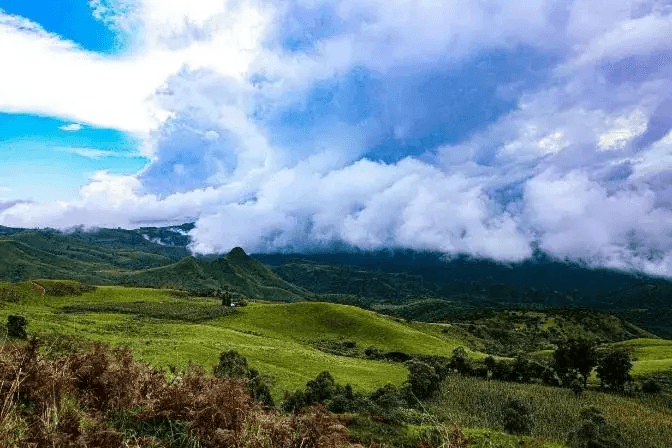
Mambilla Plateau (Pexels)
Nigeria is located in the center of West Africa and is one of the countries with the most diverse physical geography on the continent.【11】 With an area of approximately 923,768 square kilometers, the country presents a broad natural spectrum, encompassing both equatorial rainforest belts and semi-arid desert conditions within the same borders.
Nigeria is situated roughly between 4° and 14° North latitudes and 3° and 15° East longitudes.【12】 The country has a coastline of approximately 853 kilometers along the Gulf of Guinea (Atlantic Ocean). It shares borders with Benin to the west, Niger to the north, Chad and Cameroon to the northeast and east, respectively.
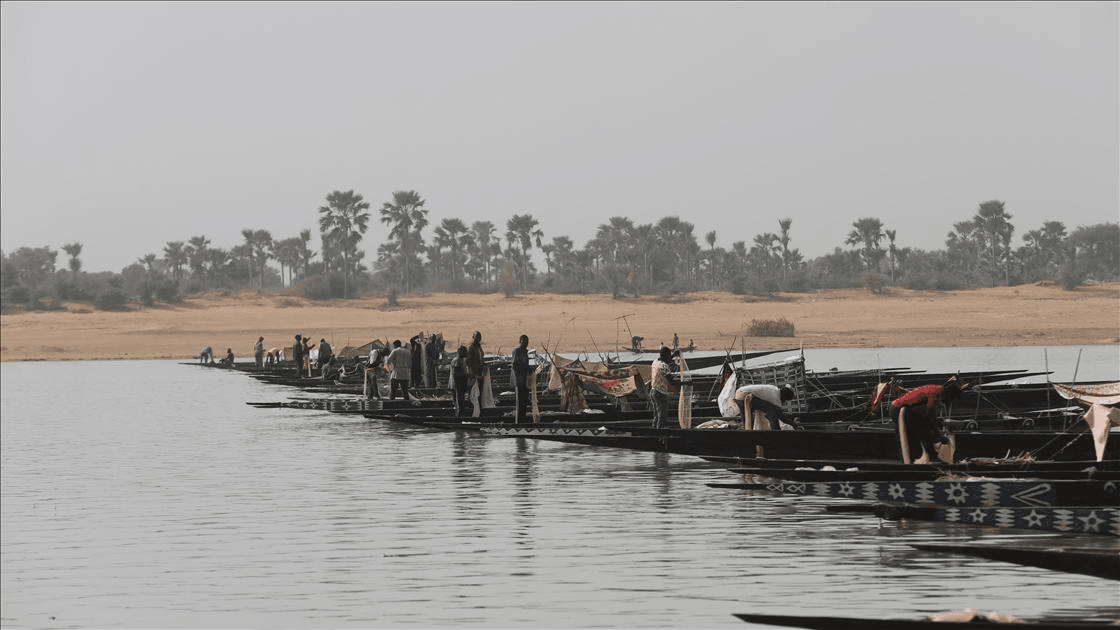
Niger River (Anadolu Ajansı)
The country’s topography features a gently undulating plateau that rises gradually from low coastal plains in the south to broad plateaus in the north. With an average elevation of about 380 meters above sea level, its underlying geological structure consists of ancient massifs rising in steps from the coastal zone.
The country’s highest elevations lie along the western extension of the Cameroon Mountains on the eastern border. The highest peak is Chappal Waddi, located in the Adamawa Highlands near the Cameroon border, reaching approximately 2,419 meters. In the country’s center lies the Jos Plateau, with an average elevation of 1,200–1,300 meters, featuring extinct volcanic cones, deep valleys, and granite outcrops.
In the south, a broad coastal plain extends inland for about 100 kilometers. This region contains the Niger Delta, one of the world’s largest river deltas, with hundreds of distributaries. Moving northward, vast savanna plains, alluvial lowlands, and high plateaus, covering approximately 730,000 square kilometers, dominate the landscape.
The Niger River, Africa’s third-largest river, and its largest tributary, the Benue River, form Nigeria’s main water arteries. These two rivers converge in the interior in a "Y" shape, dividing the country into three major geographic regions before flowing southward and emptying into the ocean via the Delta. In the northeast, part of Lake Chad, a closed basin, lies within Nigerian and Nigerien borders; however, the surrounding lands are highly saline and unsuitable for agriculture.
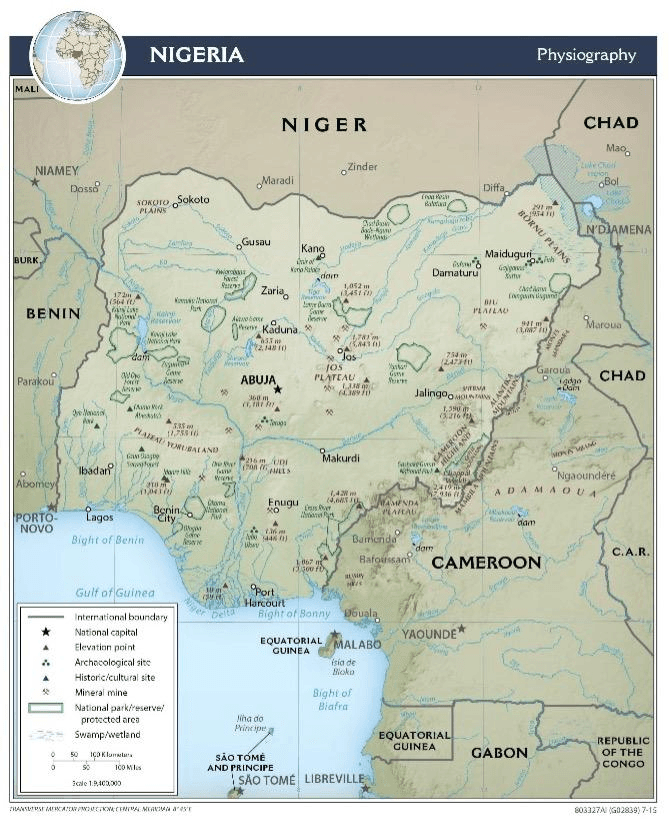
Nigeria Physiography (The World Factbook)
Nigeria’s climate changes distinctly from south to north. Southern regions exhibit tropical characteristics with high humidity year-round and annual rainfall exceeding 2,000 mm, while rainfall decreases and temperature variations become more pronounced as one moves northward.
In northern regions, annual rainfall drops to as low as 500 mm in places, creating semi-arid climatic conditions. The Harmattan winds, active between December and February, are dry, dusty desert winds blowing from the north and are felt across much of the country.
Vegetation also changes from south to north according to climatic zones. Mangrove swamps and dense rainforests dominate the southern coast, while inland areas transition into wooded savannas.
Further north, decreasing rainfall leads to the dominance of Sahelian savanna and steppe-type vegetation. This diversity demonstrates Nigeria’s possession of a broad natural structure encompassing equatorial, tropical, and semi-arid environmental conditions within the same geography.【13】
Nigeria is among the countries in Africa with the largest proven natural resource reserves. With approximately 37 billion barrels of crude oil and 206 trillion cubic feet (tcf) of natural gas reserves, the country holds a strategic position as a global energy supplier. In addition to energy resources, its geological structure allows for commercial exploitation of coal, tin, iron ore, limestone, gold, and lead deposits.
Agricultural lands, covering approximately 78% of the country’s total area (about 708,000 km²), and water resources provided by the Niger-Benue river system form the fundamental components of the nation’s natural capital.【14】
Nigeria’s energy sector relies heavily on hydroelectric and thermal power plants. However, despite its abundant natural resource potential, the country faces various challenges regarding continuity and adequacy in energy supply. Inadequacies in electricity generation and distribution infrastructure cause disruptions in many areas, from industrial production to daily life, making this one of the main obstacles to economic development.
Transportation infrastructure is one of the areas under development. While road networks are Nigeria’s most common mode of transport, they suffer from maintenance, security, and capacity issues. Modernization efforts have led to the construction or renovation of rail lines such as Lagos-Ibadan and Abuja-Kaduna. In air transport, Murtala Muhammed International Airport in Lagos and Nnamdi Azikiwe International Airport in Abuja serve as the country’s primary international transport hubs.
In the southern region, the Niger Delta has experienced high levels of pollution in water sources and agricultural soils due to long-standing crude oil exploration and extraction activities, pipeline leaks, and illegal crude oil processing facilities. This has damaged the delta’s mangrove swamps and biodiversity.
Conversely, in the northern states, climatic drought trends in the Sahel zone, combined with overgrazing and deforestation for firewood, have led to severe desertification and the southward advance of the Sahara Desert.
Due to physical geography and seasonal wind systems, particularly during the rainy season when tropical monsoon rains intensify, river channels often exceed their capacity, resulting in large-scale flooding due to inadequate infrastructure. These flood disasters are reported as the most frequent and socio-economically damaging natural hazard in Nigeria.
The Nigerian economy is one of the three largest in Sub-Saharan Africa by both purchasing power parity and nominal GDP. Traditionally based on agriculture, the economy underwent a fundamental transformation following the oil discoveries of the 1970s, evolving into a "petroleum-dependent" growth model. Today, the government is focused on strengthening non-oil sectors to protect the economy from fluctuations in global oil prices.
The Nigerian economy holds a decisive position on the continent in terms of nominal Gross Domestic Product (GDP) and is managed under a Mixed Economy Model based on public-private cooperation. In this structure, strategic sectors such as energy remain under state control, while sectors such as telecommunications, finance, and entertainment grow through private enterprise dynamism. The country’s greatest demographic advantage is that over 60% of its population is under 25 years of age; this positions Nigeria as a vast domestic market and potential labor force center. However, this potential is under pressure from macroeconomic challenges such as high inflation and foreign exchange instability.
The energy and mining sector, the country’s economic locomotive, has positioned Nigeria as Africa’s largest crude oil producer and one of the world’s most significant natural gas reserve holders. Nigeria, a critical supplier in global markets with high-quality crude oil such as "Bonny Light," derives approximately 60% of its government revenues and over 90% of its export earnings from this source.【15】 However, despite its oil wealth, the country’s insufficient refining capacity forces it to import refined petroleum products, creating one of the most striking structural paradoxes in its trade balance.
The traditional production area of agriculture and livestock continues to serve as the backbone of social functioning by employing approximately 35–40% of the country’s labor force. Crops such as cocoa, sesame, groundnuts, and rubber play a significant role in exports, and Nigeria ranks among the top global cocoa producers. The government encourages local production of staple foods such as rice and wheat through programs like "Green Alternative" to ensure food security and reduce external dependency.
In recent years, the services and technology sector has begun playing a leading role in reducing the economy’s dependence on oil. Lagos has become a "Fintech capital," producing "Unicorn" startups worth billions of dollars in digital payment systems and banking technologies. Parallel to this, Nollywood (Nigerian cinema), with production volumes rivaling Hollywood and Bollywood, contributes more than 2% to GDP and creates a vast employment base.
On the foreign trade front, partnerships with major economies such as India, Spain, France, and China strengthen the economy’s global integration. The government has established Special Economic Zones (SEZs) around Lagos and Abuja to attract foreign investment by offering favorable conditions in production and renewable energy sectors. These strategic zones are part of a vision to balance the country’s wide import list—from machinery to electronics—with local production.
Data in the table is based on the latest consolidated official reports from the World Bank, IMF, OEC, and the National Bureau of Statistics of Nigeria.
The Nigerian economy rises on three main pillars: agriculture, industry, and services. Traditional production centered in agriculture and livestock, enabled by approximately 33% of the country’s land being arable, contributes 20–25% to GDP and employs the largest share of the labor force.【16】 In this sector, strategic export crops such as cocoa, cotton, palm oil, groundnuts, and rubber are cultivated alongside staple foods such as yams, cassava, and maize that meet the population’s basic food needs. Agriculture is not merely an economic activity but also Nigeria’s most critical guarantee of food security.
The industrial component of the economy accounts for approximately 20% of GDP, with oil and natural gas production serving as its flagship. According to 2024 data, Nigeria produces an average of 1.57 million barrels of crude oil per day, maintaining its weight in the global energy market.【17】 The most critical recent development in the sector is the Dangote Refinery’s transition to full capacity, aiming to reduce the country’s dependence on imported refined products. Besides oil, cement, textiles, and food processing industries are rapidly growing sectors contributing to industrial diversity.
Today, Nigeria’s largest and fastest-growing economic engine is the services and finance sector, accounting for 58.76% of GDP.【18】 With one of Africa’s most advanced financial technology (Fintech) markets, telecommunications and banking services have expanded significantly due to digitalization. This sectoral dynamism is supported by Nollywood, which has become a cultural export brand, and rapidly growing digital services.
Nigeria’s foreign trade balance is based on a cycle of raw material exports and finished product imports. Over 90% of export earnings are derived from mineral fuels (oil and gas), with cocoa, fertilizers, and metal ores completing the list.【19】 Conversely, imports are dominated by high-value-added products such as machinery, motor vehicles, and electronic devices, as well as staple grains such as wheat and rice.
Nigeria is one of the most attractive destinations for foreign investors due to its vast market potential. The government aims to improve the investment climate in 2024–2025 through foreign exchange reforms and tax system simplifications. However, infrastructure deficiencies, foreign exchange restrictions, and security concerns remain the primary obstacles to doing business.
Nigeria is a federal presidential republic established under the 1999 Constitution. The country’s political structure is based on the principle of separation of powers and follows an American-style system.
Nigeria’s legal system is pluralistic, incorporating English common law, customary law, and Islamic law (Sharia), which is applied in the northern states. The current Constitution, enacted in 1999, is the country’s fundamental legal document and guarantees the basic rights of all citizens.
Nigeria is a federal republic composed of 36 states and the Federal Capital Territory of Abuja, designed to unify regional diversity under a central authority. At the center of this system, the President holds extensive powers as both the head of state and the chief of the executive branch, and also serves as Commander-in-Chief of the Armed Forces, the highest authority for national security.
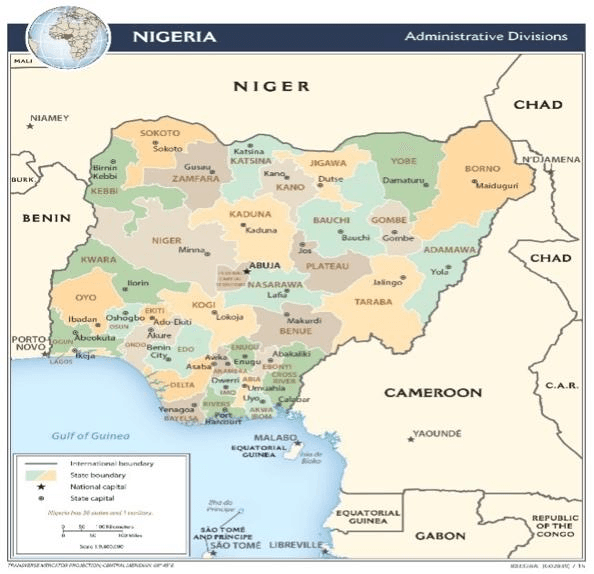
Nigeria Administrative Map (The World Factbook)
The electoral process, the foundation of democratic legitimacy, is shaped by direct public participation. The President and state governors are elected by universal suffrage for citizens aged 18 and above, serving four-year terms. To preserve political stability and prevent personalization of power, the Constitution limits any candidate to a maximum of two terms (eight years total).
The country’s administrative structure is built on a three-tier hierarchical system designed to deliver services down to the local level. At the top is the Federal Government, responsible for all strategic areas affecting the entire country, such as national defense, foreign policy, and macroeconomics.
The middle tier consists of the 36 State Governments, which operate autonomously within the federal framework; each state has its own governor and legislative assembly that determine local development priorities.
The most grassroots and vital arteries of the system are the 774 Local Government Areas (LGAs) spread across the country. These local units, focused directly on citizens’ daily needs, serve as the most fundamental administrative level of the federal structure.
In Nigeria, state authority is divided among three independent branches—legislative, executive, and judicial—to operate democratic checks and balances. At the federal level, legislative power is exercised by the bicameral National Assembly. This parliamentary structure consists of the 109-seat Senate, where each state has equal representation, and the 360-seat House of Representatives, where seats are allocated by population, aiming to safeguard both state rights and direct public representation.
Executive power is exercised under the leadership of the President, elected by the people. The President exercises this authority through the Federal Executive Council (Cabinet), where strategic decisions are made and policies implemented. At the apex of the independent judiciary is the Supreme Court of Nigeria, responsible for upholding the rule of law. Its judges are appointed by the President and must receive formal approval from the Senate before assuming office, completing the democratic accountability mechanism.
Nigeria has a multi-party democratic system. Political parties must be organized at the national level, and establishing parties based on ethnic or religious grounds is constitutionally prohibited. In current political life, the "All Progressives Congress" (APC) and the "Peoples Democratic Party" (PDP) are the two dominant mainstream parties. Nigerian politics is characterized by an informal "zoning" system that seeks regional balance and rotates power between the north and the south.
Nigeria is one of the most critical forces shaping the human geography of West Africa. Its population size, youthful age structure, and ethnic diversity make it a demographic focal point not only on the continent but globally.
Receiving much of its "Giant of Africa" title from its massive population, Nigeria possesses one of the world’s fastest-growing demographic structures. In the midst of its demographic transition, over 60% of the population is under 25, positioning the country as both a large domestic market and a potential future labor force center.【20】
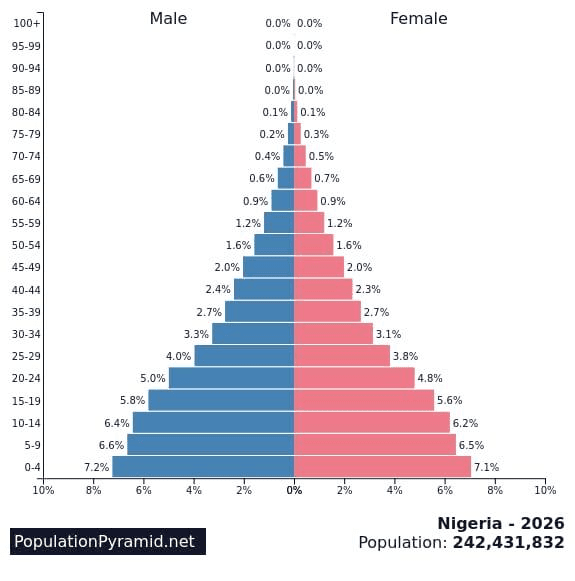
Population Pyramid (Nigeria 2026 Population Data)
Population distribution across the country exhibits a heterogeneous structure influenced by geographic and economic conditions. The most densely populated areas cluster around the commercial hub of Lagos in the southwest, the industrial zones of the southeast, and the commercial center of Kano in the north. Rapid urbanization, particularly in cities like Lagos and the capital Abuja, continues at a pace that strains infrastructure capacity, making modern urban planning one of the country’s top priorities.
Nigeria hosts more than 250 ethnic groups. This diversity, which forms the foundation of the country’s federal political balance, is primarily composed of three dominant groups: the Hausa-Fulani, who hold political and traditional weight in the north; the Yoruba, prominent in the southwest for their commercial and cultural structure; and the Igbo, known for their entrepreneurial character in the southeast. Alongside these major groups, numerous other ethnic communities such as the Ijaw, Kanuri, and Tiv form the fundamental pillars of Nigeria’s principle of "unity in diversity."
The social fabric is broadly shaped along two main religious axes. Muslims, constituting 48% of the population, are predominantly followers of the Maliki school of Islam and are concentrated in northern states and inland areas, where Islam holds significant influence in traditional and legal life. In contrast, Christians (mainly Protestants and Catholics), who make up 34% of the population, are the dominant faith in southern regions. Alongside these two major religions, approximately 18% of the population adheres to animist and indigenous traditional beliefs, which continue to persist in social rituals and cultural practices, especially in rural areas.
Nigeria does not face a population decline due to high birth rates but rather a population growth rate that requires management. However, the country is seriously confronting the phenomenon of "brain drain," particularly among educated youth migrating to Western countries. This outward migration, driven by economic aspirations and security concerns, alongside internal migration from rural areas to major cities, continues to create housing and employment pressures in urban centers.
In Nigeria, education is recognized as the most important instrument for national development and economic diversification. However, rapid population growth continuously increases demand on the education infrastructure.
Nigeria’s overall literacy rate has increased in recent decades and currently stands at 51.1% among adults. The expansion of educational institutions, urbanization, and government-supported education policies have been the main drivers of this increase. However, literacy levels are unevenly distributed across the country. Male literacy stands at 62.3%, significantly higher than the female rate of 40.2%. Consequently, the government and international organizations are implementing programs to increase girls’ access to education.
Regional disparities in literacy are also pronounced. Access to education and literacy levels in southern states are more advanced than in rural northern regions. Poverty, rural settlement patterns, security issues, and social factors limiting girls’ educational participation in the north deepen educational inequalities. Therefore, Nigeria’s literacy issue is not merely a matter of education policy but must be addressed alongside regional development, gender equality, and social support mechanisms.
Nigeria’s formal education system consists of four main stages, from basic to higher education. Primary education lasts six years and is considered free and compulsory under the Universal Basic Education system, aiming to equip children with fundamental literacy, numeracy, and general knowledge skills. The Junior Secondary stage, which follows, lasts three years and constitutes the first level of secondary education, serving as the final stage of basic education.
After Junior Secondary, students proceed to a three-year Senior Secondary education. This level, equivalent to high school, aims to prepare students for both higher education and vocational training. Higher education, which follows, typically consists of at least a four-year undergraduate program. Thus, Nigeria’s education system presents a progressive structure that prepares students academically, vocationally, and socially from basic education onward.
Nigeria is among the countries in Africa with the most extensive higher education network. The country features a diverse institutional structure comprising federal universities, state universities, and private universities, whose numbers have rapidly increased in recent years. This diversity contributes to the widespread availability of higher education across different regions and offers students various educational opportunities through public or private institutions.
Within Nigeria’s higher education tradition, the University of Ibadan, established in 1948, holds a special place and is regarded as one of the country’s most important intellectual centers. Nigerian universities, particularly in fields such as medicine, engineering, and law, have produced graduates recognized not only nationally but across the African continent. However, brain drain, budgetary constraints, infrastructure deficits, and poor working conditions for academic staff remain among the main challenges facing the higher education system.
Nigeria, with more than 250 ethnic groups and over 500 indigenous languages, is one of the countries in Africa with the highest ethnic and linguistic diversity. The Hausa-Fulani, Yoruba, and Igbo peoples, who together constitute approximately 70% of the population, are the primary groups shaping the country’s social structure and cultural identity.【21】
Nigerian literature is known globally through both indigenous oral traditions and modern works written in English. The country has produced internationally renowned authors such as Wole Soyinka, the first African to win the Nobel Prize in Literature in 1986, as well as Chinua Achebe, Ben Okri, and Chimamanda Ngozi Adichie. Common themes in their works include post-colonial identity, the conflict between tradition and modernity, and social justice.
Traditional masked dances and oral storytelling form the foundation of modern Nigerian theater. Wole Soyinka’s plays integrate these traditional elements with Western dramatic forms.
Nigeria is home to Nollywood, one of the world’s largest film industries by production volume, rivaling India’s Bollywood and the United States’ Hollywood. With approximately 2,500 films produced annually, Nollywood makes a critical contribution to the national economy and cultural outreach.
Nigeria has held a position as Africa’s aesthetic memory in plastic arts since ancient times. Its traditional art heritage begins with the Nok Culture’s terracotta sculptures, dating back to 1500 BCE and known for their distinctive facial features. This deep-rooted tradition reached its peak during the medieval period with the naturalistic bronze busts of the Ife Kingdom and the Benin Bronzes. These works are not merely aesthetic objects but historical documents that convey the political power and religious beliefs of Nigeria’s ancient kingdoms to the present day.
In the modern era, this heritage was reinterpreted by the "Zaria Rebels," an artist group emerging in the late 1950s. Led by pioneers such as Bruce Onobrakpeya, this movement blended Western painting techniques introduced during the colonial period with traditional African motifs, creating a unique Nigerian school of art. This artistic approach enabled the representation of local identity within global modernism.
Nigeria’s architectural landscape has developed in diverse styles shaped by regional beliefs and cultural diversity, historical periods, and socio-cultural relationships with external communities. The country’s architectural heritage is generally examined under two main traditions: traditional Islamic and Hausa-Fulani architecture in the north and colonial and Afro-Brazilian architectural styles along the southern coast. In northern regions, traditional earthen and clay structures were built under the influence of Hausa and Fulani culture. The Sultan’s Palace in Sokoto and its surroundings, constructed before 1820, is among the region’s most important civil architectural examples.
In religious architecture, the mosques and tomb complex of Usman dan Fodio, rebuilt in the 1960s in their original form, are recorded as the most important monumental and religious architectural works in the north. From the late 19th century, an architectural style known as Afro-Brazilian became widespread in coastal cities of the south, particularly in the former capital Lagos, influenced by communities returning from the transatlantic slave trade. One of the most unique and officially recognized examples of this style in Nigeria is the Shitta Bey Mosque, built in Lagos in 1894 by architect Joao Baptist Da Costa. Known locally as the "Turkish Mosque" and designated a national monument in 2013, this structure is one of the most concrete representations of Baroque-influenced Afro-Brazilian stonework and façade decoration along the West African coast.
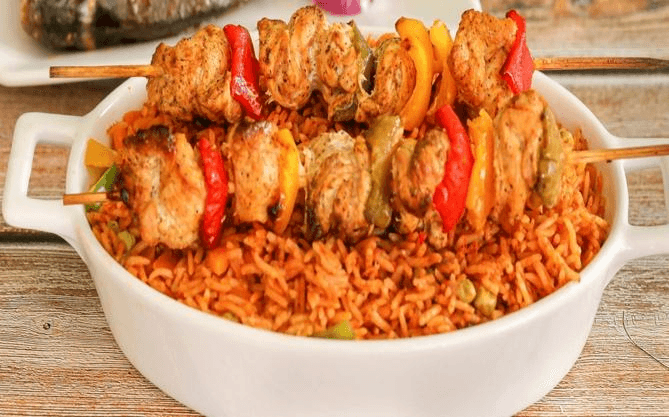
Jollof Rice (Pexels)
Nigerian cuisine features a food culture reflecting the country’s ethnic and regional diversity. Staple foods include Jollof Rice prepared with tomatoes, peppers, and spices, Pounded Yam made from mashed yams, and Garri derived from cassava. These dishes are widely consumed in daily meals and communal gatherings, forming the core elements of Nigerian cuisine through regional variations in cooking methods.
Soups and sauces also hold an important place in Nigerian food culture. Egusi soup, made from melon seeds, and Okra soup, made from okra, are typically prepared with meat, fish, or seafood and served alongside complementary foods such as yam, fufu, or garri. Among street foods, Suya stands out as a spicy grilled skewered meat, consumed as a traditional snack across nearly every region of the country.
Nigerian social life is shaped by extended family ties, local traditions, and shared celebration practices. In addition to religious holidays such as Ramadan, Eid al-Adha, and Christmas, numerous festivals reflecting different ethnic and regional cultures are held throughout the country. The Durbar Festival in northern regions is notable for its horse parades and traditional attire, while events such as the Argungu Fishing Festival and the Eyo Festival hold significant cultural importance in southern and western regions.
Music, entertainment, and cinema are also defining elements of Nigeria’s social and cultural life. Fela Kuti played a pivotal role in the development of Afrobeat, while contemporary Nigerian artists, known globally as Afrobeats, have made the country’s music industry one of Africa’s leading centers. Meanwhile, Nollywood, Nigeria’s film industry, is recognized as one of the world’s largest film sectors by production volume and plays a key role in projecting the country’s cultural influence internationally.【22】
Football is not only Nigeria’s most popular sport but also a unifying social force in the construction of national identity. The men’s national football team, nicknamed the "Super Eagles," has won the Africa Cup of Nations (AFCON) three times (1980, 1994, 2013) and became the first African country to win the gold medal at the 1996 Atlanta Olympics. Besides football, basketball (D’Tigers) and boxing also have large followings in the country; in particular, the Nigerian national basketball team consistently qualifies for global tournaments and ranks among the top teams in Africa according to FIBA rankings.【23】
The country’s tourism sector is built on a wide range of historical sites, UNESCO-recognized cultural landscapes, and national parks preserving biological diversity.
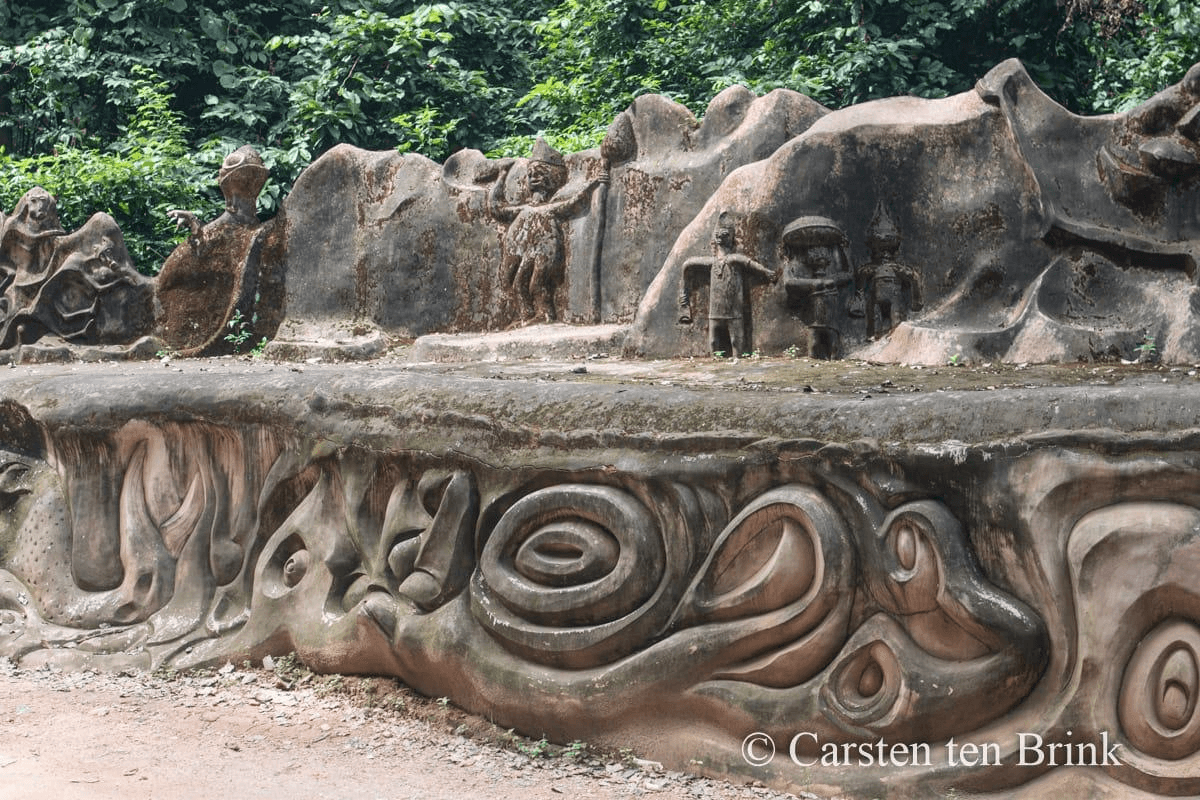
Osun-Osogbo Sacred Grove (Flickr)
Nigeria’s tourist attractions and recreational areas are shaped by the country’s physical geography, natural conservation areas, ethnographic heritage, and cultural heritage sites. Within this context, the Osun-Osogbo Sacred Grove in Osun State, which preserves traditional Yoruba religious beliefs, and the Sukur Cultural Landscape are internationally recognized and studied as primary cultural attractions on the UNESCO World Heritage List.【24】
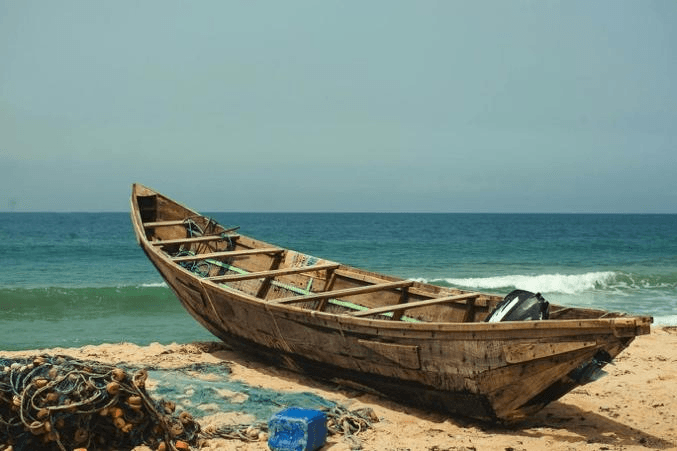
Lekki Beach (Pexels)
National parks established to preserve Nigeria’s biodiversity and wildlife form the foundation of ecotourism activities. Yankari National Park in Bauchi State is known for its savanna ecosystem wildlife and natural hot springs, while Cross River National Park, important for agricultural diversity and river transport, is visited for scientific and tourism purposes due to its tropical rainforest flora and fauna.
The coastal strip along the Atlantic Ocean in the south is used for marine tourism and recreational activities. Beaches such as Bar Beach and the Lekki Peninsula serve as important coastal recreation areas for the urban population of Lagos and surrounding areas, as well as foreign visitors.
In addition, the country’s ethnic and religious diversity provides the basis for large-scale events held periodically that serve as tourist attractions. The Argungu Fishing Festival in Kebbi State and the Durbar Festivals, featuring horse parades and part of northern Islamic culture during religious holidays, are reported as significant components of Nigeria’s intangible cultural heritage and seasonal tourism activity.
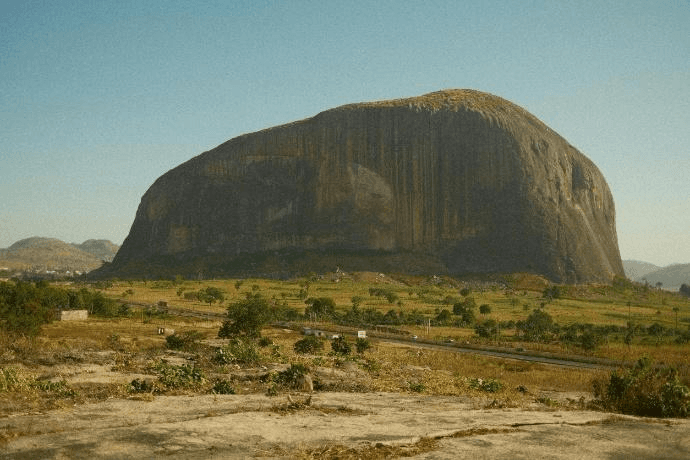
Zuma Rock (Pexels)
The Nigerian government positions tourism as a strategic sector to reduce dependence on oil as part of its economic diversification strategy. Policies pursued in this direction focus on modernizing transportation networks, incentivizing investment in the accommodation sector, and enhancing security in tourist areas. Tourism, as part of the services sector, is increasingly contributing to GDP and holds significant potential for job creation.
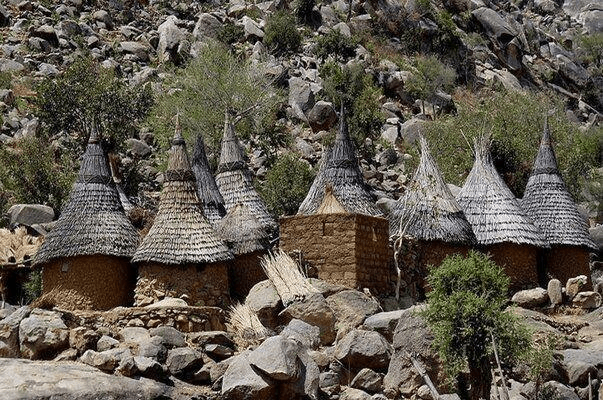
Sukur Cultural Landscape (ResearchGate)
The country’s visitor profile is largely composed of the Nigerian diaspora, business representatives, and African cultural researchers. The international promotion of tourism is supported by established festivals. The Argungu Fishing Festival, the Durbar Festival with its horse parades, and the Calabar Carnival, dubbed "Africa’s biggest street party," are recognized as the most powerful tools of Nigeria’s cultural diplomacy and tourism marketing.
Nigeria’s foreign policy has developed since its 1960 independence along an "Afrocentric" axis. Its traditional orientation is based on strengthening post-colonial solidarity within the continent, preserving regional peace, and maintaining a balanced stance in inter-bloc competition.
Nigeria follows a strategy of strategic diversity in its relations with global powers:
The primary focus of Nigeria-U.S. relations is military-technical cooperation and counter-terrorism operations. Particularly in combating armed groups such as Boko Haram and the Islamic State West Africa Province (ISWAP), which destabilize northern and northeastern Nigeria, the U.S. provides Nigeria’s armed forces with tactical intelligence, logistical support, and military training programs. The most concrete and critical step in this operational partnership was the acquisition of 12 A-29 Super Tucano light attack aircraft from the U.S., delivered in 2021 after a long procurement process, to enhance the Nigerian Air Force’s strike power and air defense capabilities.
Bilateral relations with the People’s Republic of China are driven entirely by macroeconomic investments, large-scale infrastructure projects, and financial credit partnerships. Nigeria engages in intensive cooperation with Chinese state-owned enterprises and banks to modernize its national transportation network and energy infrastructure. In this context, the financing and construction of the massive Lagos-Kano railway line, connecting Nigeria’s economic capital with the strategic northern trade hub of Kano, and deep-sea port projects aimed at strengthening maritime trade are largely supported by Chinese capital and engineering expertise.
Relations with the Russian Federation focus on defense industry cooperation, technical personnel training, and military ammunition supply as alternatives to Western actors. Nigeria has signed comprehensive military-technical cooperation agreements with Russia to diversify its arms inventory against internal security threats. As a result of this military partnership, Russian-made high-capacity Mi-35 attack helicopters have been integrated into Nigeria’s inventory to enhance close air support and reconnaissance capabilities. Additionally, Nigerian officers and military technical personnel receive professional tactical and operational training at Russian military academies.
Relations with the Republic of Turkey have gained multidimensional momentum in recent years through strategic steps in defense industry cooperation, operational experience sharing in counter-terrorism, and mutual high-level diplomatic visits. Within the developing military-economic partnership, Nigeria has procured high-tech Bayraktar TB2 unmanned aerial vehicles (UAVs) and T129 ATAK attack helicopters from Turkey to meet its asymmetric warfare and counter-terrorism needs. Additionally, regular technical cooperation processes are conducted between the defense ministries and general staff headquarters of both countries to establish mechanisms for border security, military logistics coordination, and combating terrorist financing.
Nigeria is a member of the following organizations to play an active role in regional and global governance:
The Nigerian Armed Forces (NAF), with a long institutional history in Sub-Saharan Africa, rank among the most influential military forces in the West African subregion, playing a vital role in the regional security architecture and the preservation of geopolitical balances. Nigeria’s military capacity is continuously modernized to address both internal security threats and regional peacekeeping missions.
Nigeria has a manpower base of approximately 160,000 active and 32,000 reserve personnel.【25】 The military system is based on voluntary enlistment. This employment structure is supported by the country’s demographic strength and institutional selection mechanisms. With no conscription, military recruitment is conducted entirely through professional cadres and voluntary applicants. The limited employment opportunities for the youth population elevate military careers as a socio-economic guarantee, while institutional loyalty among the population increases application numbers.
The continuous expansion of the applicant pool allows the defense administration to set higher standards through military academies and selection commissions, thereby ensuring the selection of personnel with high operational and technical capabilities for deployment on modern platforms.
Nigeria has one of the highest defense budgets in Africa. For the 2024–2025 period, the budget covers approximately 1–1.5% of GDP, primarily due to counter-terrorism operations in the north and inventory modernization.【26】 The budget’s primary allocations are for funding ongoing counter-terrorism operations in northern states, enhancing border security, and modernizing operational platforms in the inventory.
The country’s domestic production base is the Defence Industries Corporation of Nigeria (DICON). Centered in Kaduna, this institution is taking steps toward localization in infantry small arms, tactical munitions, and military vehicle production. The "Ezugwu," a mine-resistant and ambush-protected (MRAP) armored personnel carrier designed and produced indigenously by DICON, is among the most concrete military outputs of Nigeria’s domestic industrial capacity and is integrated into the inventory.
The Nigerian military is divided into three main components, combining asymmetric and conventional warfare capabilities:
The Nigerian Army is the largest component of the military and bears the bulk of operational responsibilities. The conventional inventory of the ground forces is primarily composed of T-72 and Vickers Mk 3 main battle tanks (MBTs) and armored reconnaissance vehicles. Special emphasis is placed on equipping units with highly mobile, mine-resistant (MRAP) armored vehicles to enhance tactical mobility against asymmetric terrorist threats in northern regions.
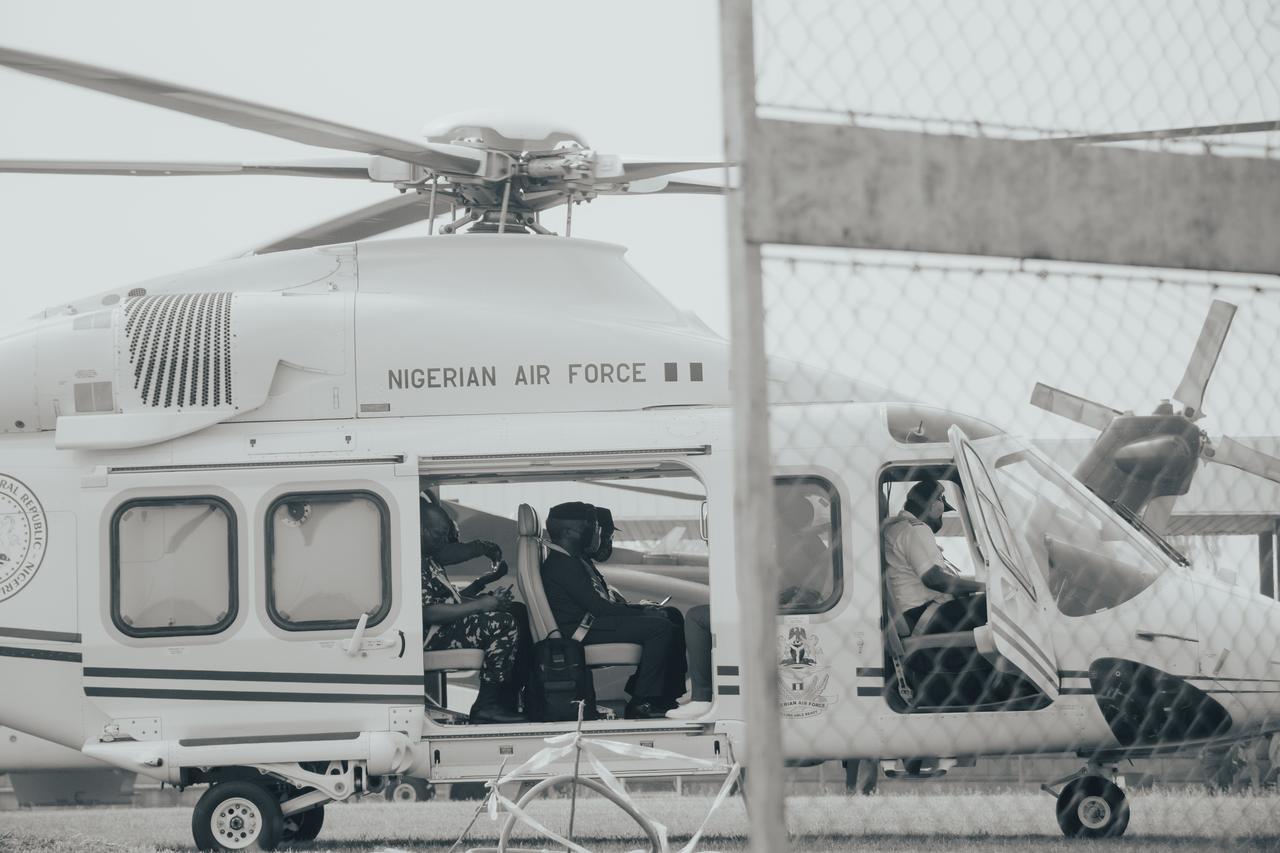
Nigerian Air Force Helicopter (Pexels)
The Nigerian Air Force possesses the most technologically and operationally advanced air fleet in West Africa. Its strike, close air support, and aerial reconnaissance capabilities are provided by multinational procurement programs. The inventory includes JF-17 Thunder fighter jets co-produced by Pakistan and China, A-29 Super Tucano light attack aircraft supplied by the U.S., and Turkish-made Bayraktar TB2 armed unmanned aerial vehicles (UAVs) and T129 ATAK attack helicopters, forming the backbone of air operations.
The Nigerian Navy is structured to protect the country’s strategic energy infrastructure in the Gulf of Guinea, offshore oil platforms, and combat piracy. The naval inventory includes modern frigates, offshore patrol vessels (OPVs), and fast boats with rapid response capabilities in shallow waters. Vessels such as "NNS Thunder" and "NNS Unity" are among the largest naval platforms in the region.
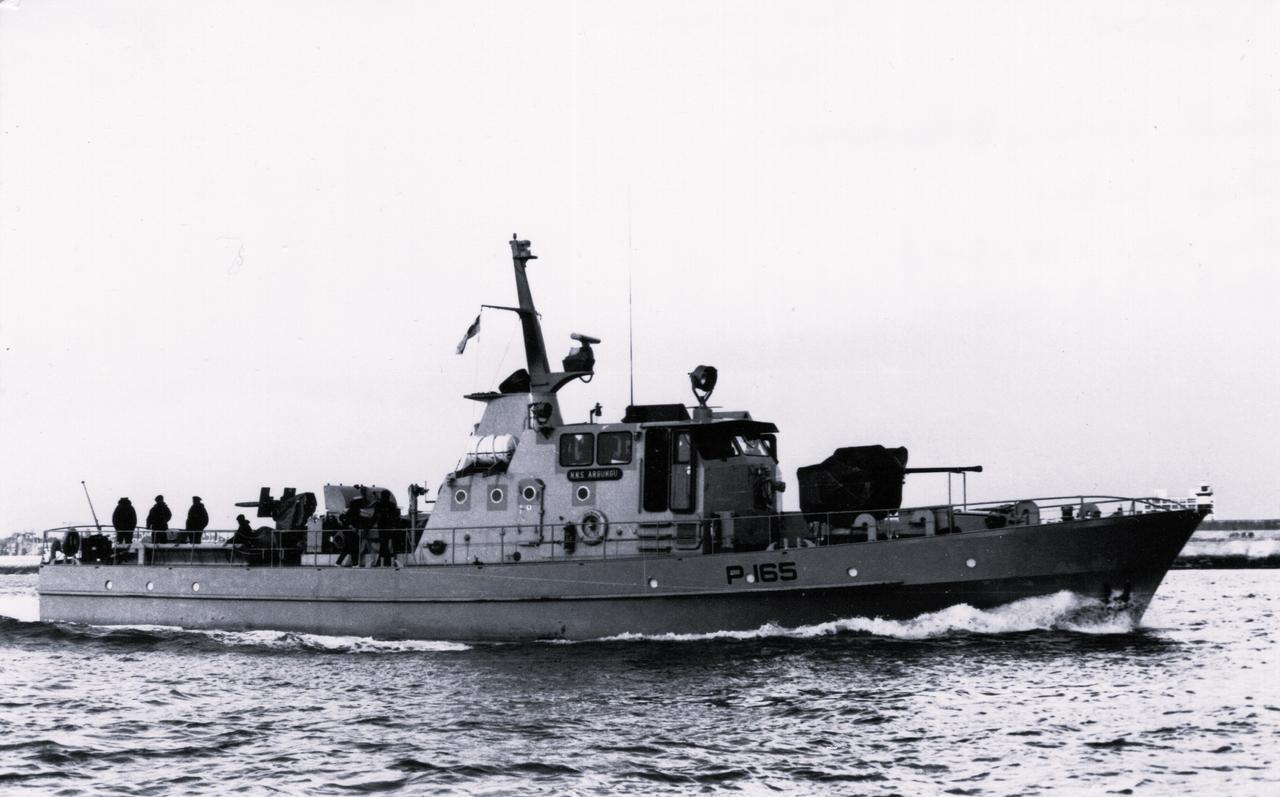
Nigerian Navy (Flickr)
Nigeria is among the few African countries with active space capabilities and satellite infrastructure. Managed by the National Space Research and Development Agency (NASRDA) for both military and civilian purposes, satellites such as NigeriaSat-2 and the remote-sensing NigComSat-1R provide the military with strategic geospatial data and intelligence flows for intelligence gathering, border security, and tracking armed groups in operational zones.
The Nigerian military possesses extensive operational experience due to both internal security challenges and regional crises in West Africa. Since 2009, operations against groups such as Boko Haram and later ISWAP have significantly influenced the military’s operational approach. This process has enabled the Nigerian Armed Forces to gain experience in asymmetric warfare, counter-terrorism, border security, and securing civilian settlements.
Nigeria has also been a major component of the ECOMOG force under the Economic Community of West African States (ECOWAS). During the 1990s civil wars in Liberia and Sierra Leone, the Nigerian military played a significant role in interventions aimed at restoring peace and stability. These missions established Nigeria as a military and diplomatic actor with considerable weight not only within its own borders but across West Africa.
Nigeria is developing strategic partnerships with various countries to enhance its defense capacity and more effectively combat security threats. In this context, Turkey has become one of Nigeria’s most notable defense partners in recent years. UAV and UCAV systems, military training activities, and joint production projects are among the main areas of defense cooperation between the two countries.
Nigeria’s defense relations are not limited to Turkey. The United States provides counter-terrorism training and aircraft supplies, while China supplies armored vehicles and various missile systems. Additionally, Nigeria conducts joint military operations with neighboring countries such as Chad, Niger, and Cameroon under the Multinational Joint Task Force to combat armed groups operating in the Lake Chad Basin. These collaborations are viewed as part of Nigeria’s strategy to strengthen national security and contribute to regional stability.
Abiodun, Adedire. "People Sitting on a Helicopter." Photograph. Pexels. Accessed June 20, 2026. https://www.pexels.com/photo/people-sitting-on-a-helicopter-10604061/
Accessed November 26, 2025. https://www.aa.com.tr/tr/kultur/ahlatta-acilan-kurslarla-geleneksel-tas-isciligi-yasatiliyor/3116279.
Akujieze, Christopher N., and Imoukhuede Idehai. "World map showing Nigeria." *Standardization of the Electricity and Economic Potentials of Landfill gas (LFG) in Lagos, Nigeria*. ResearchGate, 2015. Accessed April 23, 2026. https://www.researchgate.net/figure/World-map-showing-Nigeria_fig1_280937846
Amusan, Olalekan. “Aerial View of Obalende, Lagos.” Photograph. Pexels. 2024. Accessed May 1, 2026. https://www.pexels.com/photo/aerial-view-of-obalende-lagos-27741697/
Anadolu Ajansı. "Afrika'nın Kalbi: Nijerya." Accessed April 19, 2026. https://www.aa.com.tr/tr/dunya/afrikanin-kalbi-nijerya/834644
Anadolu Ajansı. "Mali halkı Nijer Nehri'nde balıkçılık yaparak geçimini sağlıyor." Foto Galeri. Accessed May 3, 2026. https://www.aa.com.tr/tr/pg/foto-galeri/mali-halki-nijer-nehrinde-balikcilik-yaparak-gecimini-sagliyor/147464
BTI Project. "Nigeria Country Report 2024." Accessed April 19, 2026. https://bti-project.org/en/reports/country-report/NGA
Business Insider Africa. "Top 10 African countries with the strongest navy." Accessed April 19, 2026. https://africa.businessinsider.com/local/lifestyle/top-10-african-countries-with-the-strongest-navy/01hyl4k
CRW Flags. "Nigeria." Accessed April 19, 2026. https://www.crwflags.com/fotw/flags/ng.html
CRW Flags. "Nigeria." Accessed April 19, 2026. https://www.crwflags.com/fotw/flags/ng.html
Central Intelligence Agency. "Nigeria [Map]." *The World Factbook*. Langley, VA: Central Intelligence Agency, 2024. Accessed April 20, 2026. https://www.cia.gov/resources/map/nigeria/
Chatham House. "Democracy in Nigeria." Accessed April 19, 2026.
Chatham House. "How Nigeria flipped the script on Trump." Accessed April 19, 2026. https://www.chathamhouse.org/2026/01/how-nigeria-flipped-script-trump
Chatham House. "Nigeria." Accessed April 19, 2026. https://www.chathamhouse.org/regions/africa/nigeria
CountryReports. "Nigeria." Accessed April 19, 2026. https://www.countryreports.org/country/Nigeria.htm
Embassy of Nigeria Madrid. "Nigerian National Anthem." Accessed May 10, 2024. https://www.nigeriaembassymadrid.org/nigerian-national-anthem/
Embassy of the Federal Republic of Nigeria, Germany. "About Nigeria." Accessed April 19, 2026.
Embassy of the Federal Republic of Nigeria, Germany. "Business Climate." Accessed April 19, 2026. https://nigeriaembassygermany.org/Business-Climate.htm
Embassy of the Federal Republic of Nigeria, Germany. "Culture & Tourism." Accessed April 19, 2026. https://nigeriaembassygermany.org/Culture---Tourism.htm
Embassy of the Federal Republic of Nigeria, Germany. "Government." Accessed April 19, 2026. https://nigeriaembassygermany.org/Government.htm
Embassy of the Federal Republic of Nigeria, Germany. "History and People." Accessed April 19, 2026. https://nigeriaembassygermany.org/history-and-people.htm
History World (Archive). "History of Nigeria." Accessed April 19, 2026.
Logbaby (Archive). "Nigerian Army." Accessed April 19, 2026. https://web.archive.org/web/20200612195806/https://logbaby.com/directory/nigerian-army_6193.html
Ministry of Foreign Affairs of the Republic of Türkiye. "Nigeria Profile." Accessed April 19, 2026. https://www.mfa.gov.tr/nijerya-kunyesi.tr.mfa
Ministry of Trade of the Republic of Türkiye. "Nigeria General Information." Accessed April 19, 2026. https://ticaret.gov.tr/yurtdisi-teskilati/afrika/nijerya/genel-bilgiler
Mivanyi, Yuwanna Jenny. "Nijerya." *Kültürler Arası Aileler*, 419-426. August 2006. ResearchGate. Accessed April 19, 2026. https://www.researchgate.net/publication/292361739_Nigeria
National Anthems Channel. “Nigeria National Anthem (Instrumental).” YouTube. Accessed May 2, 2026. https://www.youtube.com/watch?v=xtoxuvHf9m0
National Technology Development Agency (NTDA). “NTDA Media Assets.” Accessed May 1, 2026. https://ntda.gov.ng/media.assets.php
Nigeria Federal Government Official Website. "About Nigeria." Accessed April 19, 2026. https://nigeria.gov.ng/about-nigeria/
Nigeria Federal Government Official Website. "Economy." Accessed April 19, 2026. https://nigeria.gov.ng/about-nigeria/economy/
Nigeria Federal Government Official Website. "Festivals." Accessed April 19, 2026. https://nigeria.gov.ng/about-nigeria/festivals/ https://nigeria.gov.ng/about-nigeria/festivals/
Nigeria Federal Government Official Website. "Foreign Relations." Accessed April 19, 2026. https://nigeria.gov.ng/about-nigeria/foreign-relations/
Nigeria Federal Government Official Website. "History of Nigeria." Accessed April 19, 2026. https://nigeria.gov.ng/about-nigeria/history-of-nigeria/
Nigeria Federal Government Official Website. "Natural Resources." Accessed April 19, 2026. https://nigeria.gov.ng/about-nigeria/nigeria-natural-resources/
Nigeria Federal Government Official Website. "Nigerian Culture." Accessed April 19, 2026. https://nigeria.gov.ng/about-nigeria/nigerian-culture/
Nigeria Federal Government Official Website. "People of Nigeria." Accessed April 19, 2026. https://nigeria.gov.ng/about-nigeria/people-of-nigeria/
Nigeria Federal Government Official Website. "Political Parties." Accessed April 19, 2026. https://nigeria.gov.ng/about-nigeria/political-parties/
Nigeria Federal Government Official Website. "Sports and Recreation." Accessed April 19, 2026. https://nigeria.gov.ng/about-nigeria/sports-and-recreation/
Nigeria Federal Government Official Website. "Tourism." Accessed April 19, 2026. https://nigeria.gov.ng/about-nigeria/tourism/
Nigerian Army (Archive). "History of the Nigerian Army." Accessed April 19, 2026. https://web.archive.org/web/20210602212304/https://army.mil.ng/history-of-the-nigerian-army/
Nigerian Community in Turkey. "Nijerya Hakkında." Accessed April 19, 2026. https://nigeriancommunity.org.tr/tr/hakkimizda/nijerya-hakk-nda
Pexels. "Aerial View of Scenic Nigerian Waterfalls." Photographed by Mujahid Tyabo Abdullahi. Accessed May 2, 2026. https://www.pexels.com/photo/aerial-view-of-scenic-nigerian-waterfalls-32707664/
Pexels. "Traditional Fishing Boat on Lekki Beach, Nigeria." Photograph by Boye Sanda. Accessed May 2, 2026. https://www.pexels.com/photo/traditional-fishing-boat-on-lekki-beach-nigeria-37153736/
PopulationPyramid.net. "Population Pyramid: Nigeria 2026." Accessed May 1, 2026. https://www.populationpyramid.net/nigeria/2026/
ResearchGate. "Sukur Cultural Landscape: A UNESCO World Heritage Site." Figure 1. June 2024. Accessed May 2, 2026. https://www.researchgate.net/figure/Sukur-Cultural-Landscape-A-UNESCO-World-Heritage-Site_fig1_381188080
Store Norske Leksikon. "Klima i Nigeria." Accessed April 19, 2026. https://snl.no/Klima_i_Nigeria
Store Norske Leksikon. "Kunst i Nigeria." Accessed April 19, 2026. https://snl.no/Kunst_i_Nigeria
Store Norske Leksikon. "Medier i Nigeria." Accessed April 19, 2026. https://snl.no/Medier_i_Nigeria
Store Norske Leksikon. "Planteliv i Nigeria." Accessed April 19, 2026. https://snl.no/Planteliv_i_Nigeria
Store Norske Leksikon. "Skole og utdanning i Nigeria." Accessed April 19, 2026. https://snl.no/Skole_og_utdanning_i_Nigeria
Store Norske Leksikon. "Økonomi og næringsliv i Nigeria." Accessed April 19, 2026. https://snl.no/%C3%98konomi_og_n%C3%A6ringsliv_i_Nigeria
T.C. Ministry of Health Travel Health. "Nigeria." Accessed April 19, 2026. https://www.seyahatsagligi.gov.tr/site/SaglikBilgisi/WAN
TB, Carsten. "View from Zuma Rock." Flickr. Photograph. September 21, 2019. https://www.flickr.com/photos/carsten_tb/48864140598/in/photostream/
TDV İslâm Ansiklopedisi. "Nijerya." Accessed April 19, 2026. https://islamansiklopedisi.org.tr/nijerya
Tankilevitch, Polina. "Vegetables on a Plate." Pexels. September 14, 2022. Accessed April 21, 2026. https://www.pexels.com/es-es/foto/vegetales-verduras-cena-comida-13915043/
The Thinker. "A Scenic View of the Mambilla Plateau." Pexels. Accessed April 23, 2026. https://www.pexels.com/photo/a-scenic-view-of-the-mambilla-plateau-13564694/
The Thinker. "Colorful Traditional Architecture in Nigeria." Pexels. Accessed April 23, 2026. https://www.pexels.com/photo/colorful-traditional-architecture-in-nigeria-30253011/
The Thinker. "Zuma Rock in Abuja, Nigeria: Majestic Landmark." Pexels. Accessed April 23, 2026. https://www.pexels.com/photo/zuma-rock-in-abuja-nigeria-majestic-landmark-31800347/
Think Africa (Archive). "Nri Nigeria." Accessed April 19, 2026. https://web.archive.org/web/20190930155136/https://thinkafrica.net/nri-nigeria/
U.S. Department of State. "2025 Investment Climate Statements: Nigeria." Accessed April 19, 2026. https://www.state.gov/reports/2025-investment-climate-statements/nigeria/
U.S. Department of State. "Deputy Secretary Landau’s Meeting with Nigerian Foreign Minister Tuggar." Accessed April 19, 2026. https://www.state.gov/releases/office-of-the-spokesperson/2025/09/deputy-secretary-landaus-meeting-with-nigerian-foreign-minister-tuggar/
UNESCO World Heritage Centre. "Nigeria." Accessed April 19, 2026. https://whc.unesco.org/en/list/?search=Nigeria&components=1&order=country
Webb, Tim. CH-47F Chinook. Photograph. Flickr, August 8, 2022. Accessed June 20, 2026. https://www.flickr.com/photos/42117802@N06/52270190542
https://nigeriaembassygermany.org/about-nigeria.htm
https://web.archive.org/web/20211003223531/http://historyworld.net/wrldhis/PlainTextHistoriesResponsive.asp?historyid=ad41
[1]
T.C. Ticaret Bakanlığı, "Nijerya Genel Bilgiler." Erişim tarihi: 19 Nisan 2026. https://ticaret.gov.tr/yurtdisi-teskilati/afrika/nijerya/genel-bilgiler
[2]
BBC News. "Nigeria Profile - Timeline." Erişim tarihi: 30 Nisan 2026. https://www.bbc.com/news/world-africa-13951696
[3]
CIA World Factbook. "Nigeria: People and Society." Erişim tarihi: 30 Nisan 2026. https://www.cia.gov/the-world-factbook/countries/nigeria/
[4]
Store Norske Leksikon. "Nigeria." Erişim tarihi: 19 Nisan 2026. https://snl.no/Nigeria
[5]
Nijerya Federal Hükümeti Resmi Arşivi. "National Anthem and Prayer." Erişim tarihi: 19 Nisan 2026. https://www.nigeria.gov.ng/about-nigeria/national-symbols/
[6]
UNESCO World Heritage Centre. "Sukur Cultural Landscape - Iron Technology and Development in West Africa." Erişim tarihi: 19 Nisan 2026. https://whc.unesco.org/en/list/938/
[7]
Kavas, A. (2007). "Nijerya". TDV İslâm Ansiklopedisi. Cilt 33, s. 109-112. Erişim tarihi: 7 Mayıs 2026. https://cdn2.islamansiklopedisi.org.tr/dosya/33/C33024084.pdf
[8]
Cartwright, M. (2019). "Oyo Empire". World History Encyclopedia. Erişim tarihi: 07 Mayıs 2026. https://www.worldhistory.org/Oyo_Empire/
[9]
Kavas, A. (2007). "Nijerya". TDV İslâm Ansiklopedisi. Cilt 33, s. 109-112. Erişim tarihi: 7 Mayıs 2026. https://cdn2.islamansiklopedisi.org.tr/dosya/33/C33024084.pdf
[10]
Kavas, A. (2007). "Nijerya". TDV İslâm Ansiklopedisi. Cilt 33, s. 109-112. Erişim tarihi: 7 Mayıs 2026. https://cdn2.islamansiklopedisi.org.tr/dosya/33/C33024084.pdf
[11]
Nations Online Project. "Geography of Nigeria: Regions and Landscapes." Erişim tarihi: 30 Nisan 2026. https://www.nationsonline.org/oneworld/nigeria.htm#Geography
[12]
Nations Online Project. "Map of Nigeria - Geographic Coordinates." Erişim tarihi: 1 Mayıs 2026. https://www.nationsonline.org/oneworld/nigeria.htm
[13]
World Meteorological Organization (WMO). "World Weather Information Service: Nigeria." Erişim tarihi: 3 Mayıs 2026. https://worldweather.wmo.int/en/country.html?countryCode=NGA
[14]
CIA World Factbook. "Nigeria: Economy (Natural Resources, Land Use)." Erişim tarihi: 1 Mayıs 2026. https://www.cia.gov/the-world-factbook/countries/nigeria/#economy
[15]
U.S. Department of State. "2025 Investment Climate Statements: Nigeria." Erişim tarihi: 19 Nisan 2026. https://www.state.gov/reports/2025-investment-climate-statements/nigeria/
[16]
World Bank. "Nijerya: Tarımsal Arazi ve GSYİH Katkısı." Erişim tarihi: 1 Mayıs 2026. https://data.worldbank.org/indicator/AG.LND.ARBL.ZS?locations=NG
[17]
Trading Economics. "Nigeria Crude Oil Production: 2024 Data." Erişim tarihi: 1 Mayıs 2026. https://tradingeconomics.com/nigeria/crude-oil-production
[18]
National Bureau of Statistics (NBS). "Nijerya GSYİH Sektörel Analiz Raporu." Erişim tarihi: 1 Mayıs 2026. https://nigerianstat.gov.ng/
[19]
T.C. Ticaret Bakanlığı, Nijerya Ülke Profili, (Ankara: Uluslararası Anlaşmalar ve Avrupa Birliği Genel Müdürlüğü, 2025), s. 7-11.Erişim tarihi: 7 Mayıs 2026. https://ticaret.gov.tr/yurtdisi-teskilati/afrika/nijerya/ulke-profili
[20]
World Bank. "Nigeria: Population, age dependency ratio, young." World Bank Open Data. Erişim tarihi: 3 Mayıs 2026. https://data.worldbank.org/indicator/SP.POP.DPND.YG?locations=NG
[21]
World Bank. "Nigeria - People and Society: Ethnic and Linguistic Composition." Erişim tarihi: 1 Mayıs 2026. https://data.worldbank.org/country/nigeria
[22]
UNESCO. "The Film Industry in Africa: Trends, Challenges and Opportunities for Growth." Erişim tarihi: 1 Mayıs 2026. https://en.unesco.org/creativity/publications/film-industry-africa-trends-challenges
[23]
CAF Online. "Member Association: Nigeria Football Federation - Honors." Erişim tarihi: 1 Mayıs 2026. https://www.cafonline.com/member-associations/nga/
[24]
UNESCO World Heritage Centre. "Nigeria - Properties inscribed on the World Heritage List." Erişim tarihi: 1 Mayıs 2026. https://whc.unesco.org/en/statesparties/ng
[25]
International Institute for Strategic Studies (IISS). The Military Balance 2024. London: Routledge, 2024. Erişim tarihi: 3 Mayıs 2026. https://www.iiss.org/publications/the-military-balance/
[26]
The World Bank. "Military expenditure (% of GDP) - Nigeria." Erişim tarihi: 3 Mayıs 2026. https://data.worldbank.org/indicator/MS.MIL.XPND.GD.ZS?locations=NG


Official Name | Federal Republic of Nigeria | ||||||||
|---|---|---|---|---|---|---|---|---|---|
Capital | Abuja | ||||||||
Form of Government | Federal Republic | ||||||||
Date of Independence | 1 Ekim 1960 (İngiltere'den) | ||||||||
National Day | 1 October | ||||||||
President | Bola Ahmed Tinubu | ||||||||
Area | 923,768 km² | ||||||||
GDP | 285.003 billion dollars | ||||||||
GDP per Capita | 1,200 USD | ||||||||
Climate | Southern coasts equatorial; central regions tropical; northern regions semi-arid | ||||||||
Total Population | 242,431,841 (2026 estimate) | ||||||||
Religious Composition | Muslim (56.1%); Christian (43.4%); other religions (0.60%) | ||||||||
Ethnic Groups | Hausa-Fulani; Yoruba; Igbo | ||||||||
Official Languages | English | ||||||||
Common Languages | Hausa; Yoruba; Igbo | ||||||||
Telephone Code | +234 | ||||||||
Internet Domain Code | .ng | ||||||||
No Discussion Added Yet
Start discussion for "Federal Republic of Nigeria" article
National Symbols
Flag
National Anthem
National Coat of Arms
History
Ancient Period
Medieval Period
Early Modern Period
Modern Period
World War II and After
Contemporary Era
Geography
Location
Landforms
Mountains
Plains and Valleys
Rivers and Lakes
Climate and Vegetation
Natural Resources
Energy and Transportation Infrastructure
Environmental Issues and Natural Disasters
Economy
Key Economic Indicators
Sectoral Distribution
Foreign Trade
Foreign Investment and Business Environment
Political and Administrative Structure
Legal and Constitutional System
Governance System
Legislative, Executive, and Judicial Powers
Political Parties and Current Political Structure
Demography, Society, and Education
Key Demographic Indicators
Population Distribution and Urbanization
Ethnic Structure
Religious Distribution
Migration and Population Decline
Education
Literacy Rate
Educational Institutions
Higher Education Structure
Culture
Literature
Performing Arts
Visual Arts
Architecture
Culinary Culture
Traditions and Social Life
Sports Culture
Tourism
Tourist Regions and Attractions
Tourism Policy
Foreign Policy and Security
Current Foreign Policy and Bilateral Relations
United States
China
Russia
European States
Turkey
Membership in International Organizations
Military and Defense Capacity
General Structure
Personnel Status
Defense Budget
Defense Industry
Armed Forces
Ground Forces
Air Forces
Naval Forces
Space Assets
Operational History
International Military Cooperation