


This article was automatically translated from the original Turkish version.
+2 More
Desert Farming: The Future of Global Agriculture
Total Agricultural Area | 12,000 hectares | ||||||||
|---|---|---|---|---|---|---|---|---|---|
Cultivated Products | Wheat, maize, legumes, vegetables | ||||||||
Number of People Employed | 2,500 people | ||||||||
Irrigation Systems | Installation of 15,000 meters of drip irrigation line | ||||||||
Production Targets | 5,000 tons of wheat, 4,000 tons of maize, 2,000 tons of legumes | ||||||||
Increase in Water Use Efficiency | 40 percent less water consumption | ||||||||
Across World, climate change and population increase are making it necessary to seek new solutions for sustainable agricultural production. The decline of Water resources and the degradation of arable land are increasing the need for alternative production models, particularly in dry regions. In this context, agricultural projects initiated by Turkish entrepreneurs in the Desert Desert are emerging as pioneering important efforts to test whether farming is feasible in arid lands.
Land previously considered unsuitable for agriculture is now being brought into production through advanced technology and modern farming practices. Projects carried out in Algeria and its surrounding areas are among the most significant examples demonstrating that large-scale agricultural activities can be made sustainable in desert environments.
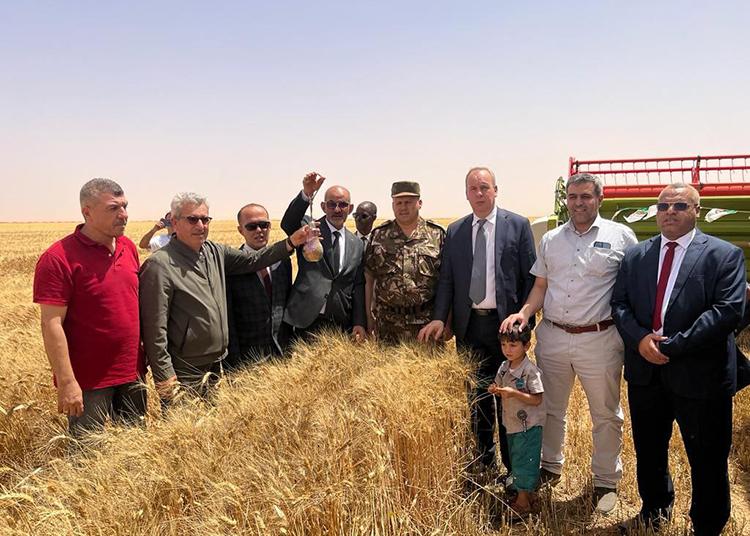
The Turkish company Dekinsan Group has launched large-scale agricultural production in the Adrar region of southern Algeria under a agreement agreement with the Algerian government. The company, known as Sarl Dunaysır, employs advanced irrigation systems and specialized farming techniques to make agricultural production possible despite the harsh conditions of the Sahara Desert.
As part of the project, the region’s suitability for agriculture was first assessed and studies were conducted to ensure efficient use of water resources. Given the critical importance of preventing water waste in desert environments, irrigation systems were optimized using drip irrigation and center pivot system like methods. These technologies aim to achieve maximum efficiency with minimal water usage.
As a result of the company’s efforts, wheat, maize and various legumes have been successfully cultivated in desert conditions. Initial harvests in recent years have shown yields per hectare exceeding expectations. This situation demonstrates that the project is not merely a promising agricultural venture but also has the potential to contribute to making the region long suitable for agriculture in the long term.
In addition, agricultural activities have not been limited to production alone; they have also contributed to the local region economy by increasing employment. If desert agriculture becomes widespread, it is anticipated that Algeria’s dependence on agricultural imports could decrease and regional food supply could be strengthened.
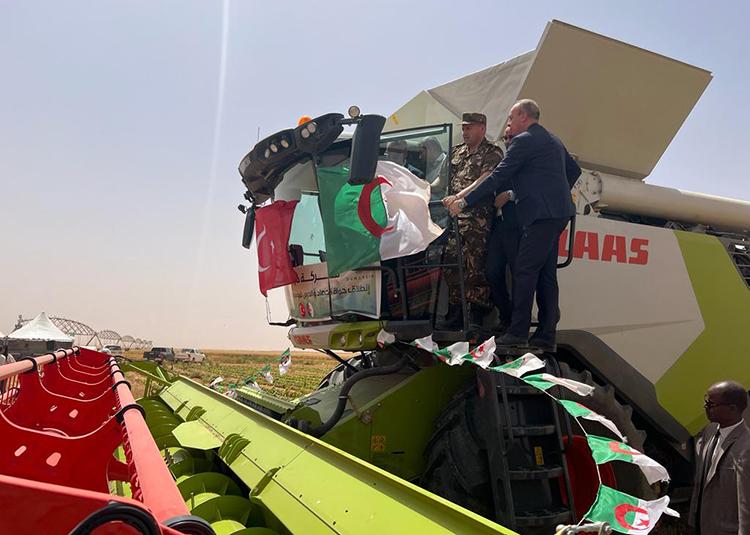
First wheat harvest
【1】
In addition to Dekinsan Group’s large-scale agricultural production, Tabit Smart Agricultural Technologies is pursuing a different strategy to enhance productivity in desert environments. The company’s work focuses particularly on soil improvement and nutrient management on.
One of the major factors hindering plant growth in the Sahara Desert is the deficiency of organic substance in the soil. To address this, the Tabit team is conducting research to enrich the soil using organic compounds derived from microalgae and sea seaweed. Increasing the organic matter content helps retain water in the soil for longer periods, enabling plants to become more resilient to arid conditions.
Specialized solutions are also being developed to tackle water scarcity, one of the greatest challenges in the desert. Through precise sensors and smart irrigation systems, the exact water requirements of crops are determined in real time, preventing waste. These methods offer a significant model not only for desert environments but also for other regions facing water shortages, enabling sustainable agricultural production.
The projects implemented in the Sahara Desert provide critical data on the feasibility of agriculture in arid regions. These initiatives, which employ advanced technology and sustainable source management instead of traditional farming methods, demonstrate that desert farming could become more common in the future.
Such projects do more than increase agricultural output; they also make important contributions in the following areas:
• Food Security: Farming in deserts can create new production areas in a world where arable land is shrinking, thereby supporting food supply.
• Economic Development: Desert agriculture can boost local employment and open opportunities for agricultural exports.
• Water Management: Smart irrigation systems can enable more efficient use of water resources.
• Environmental Impact: These initiatives may offer a new perspective for understanding how agricultural production can contribute to combating desertification.
In this context, the projects undertaken by Turkish entrepreneurs in the Sahara Desert are regarded as pioneering models that could be replicated in other geographic regions. The success of these desert-based initiatives has the potential to reshape the global agricultural sector and provide crucial insights into the future of food production.
Anadolu Ajansı. Cezayir Çölü’nde Tarım Yapan Türk Şirketi İlk Hasadına Başladı. April 30, 2023. https://www.aa.com.tr/tr/dunya/cezayir-colunde-tarim-yapan-turk-sirketi-ilk-hasadina-basladi/2887320 Accessed March 27, 2025.
İhlas Haber Ajansı. Türk Girişimcilerden Sahra Çölü’nde Tarım Projesi. March 26, 2025. https://www.iha.com.tr/izmir-haberleri/turk-girisimcilerden-sahra-colunde-tarim-projesi-212805026 Accessed March 27, 2025.
[1]
First Wheat Harvest

Desert Farming: The Future of Global Agriculture
Total Agricultural Area | 12,000 hectares | ||||||||
|---|---|---|---|---|---|---|---|---|---|
Cultivated Products | Wheat, maize, legumes, vegetables | ||||||||
Number of People Employed | 2,500 people | ||||||||
Irrigation Systems | Installation of 15,000 meters of drip irrigation line | ||||||||
Production Targets | 5,000 tons of wheat, 4,000 tons of maize, 2,000 tons of legumes | ||||||||
Increase in Water Use Efficiency | 40 percent less water consumption | ||||||||
No Discussion Added Yet
Start discussion for "Farming Initiative in the Desert by Turkish Entrepreneurs" article
Agricultural Transformation in the Sahara Desert
Agricultural Production in Algeria: The Dekinsan Group’s Desert Project
Alternative Farming Methods: Tabit Smart Agricultural Technologies’ Desert Strategy
Desert Farming: Could It Be the Future of Global Agriculture?