This article was automatically translated from the original Turkish version.
Radius | Approximately 0.4 light-years | ||||||||
|---|---|---|---|---|---|---|---|---|---|
Distance(s) | ~6 000 parsecs) 500 light-years (2 | ||||||||
Temperature of the Central Star | Approximately 140,000 K | ||||||||
Expansion Rate | Approximately 40 km/s | ||||||||
Apparent Brightness (V Band) | Approximately +11.9 magnitude | ||||||||
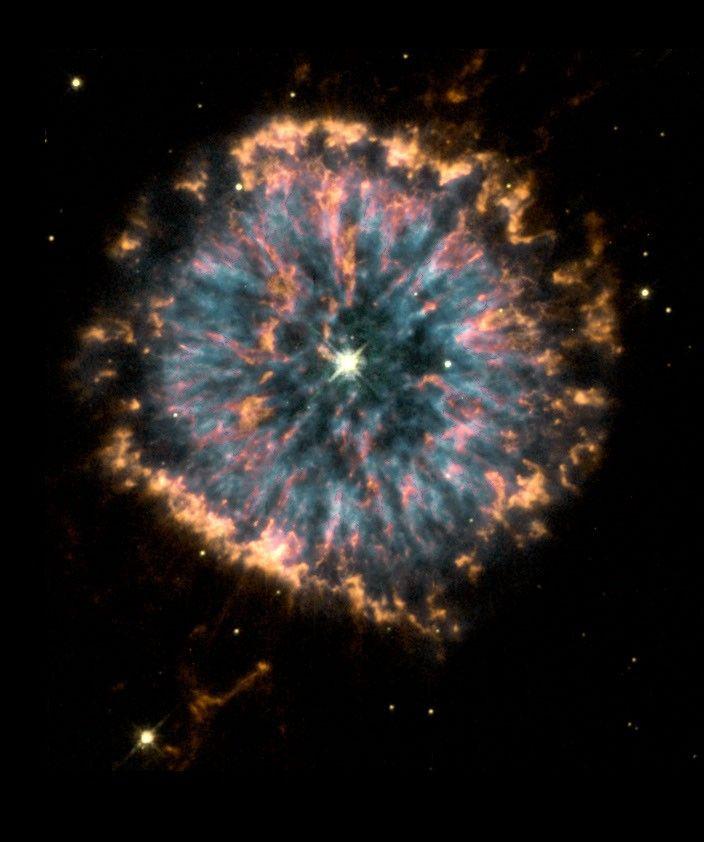
NGC 6751 is a compact planetary nebula located in the direction of the Aquila constellation. This object, sometimes referred to in popular sources as the Eye of Heaven, lies approximately 6,500 light years from Earth. The nebula formed when the outer layers of a central white dwarf star were ejected into space during the final stages of its life.
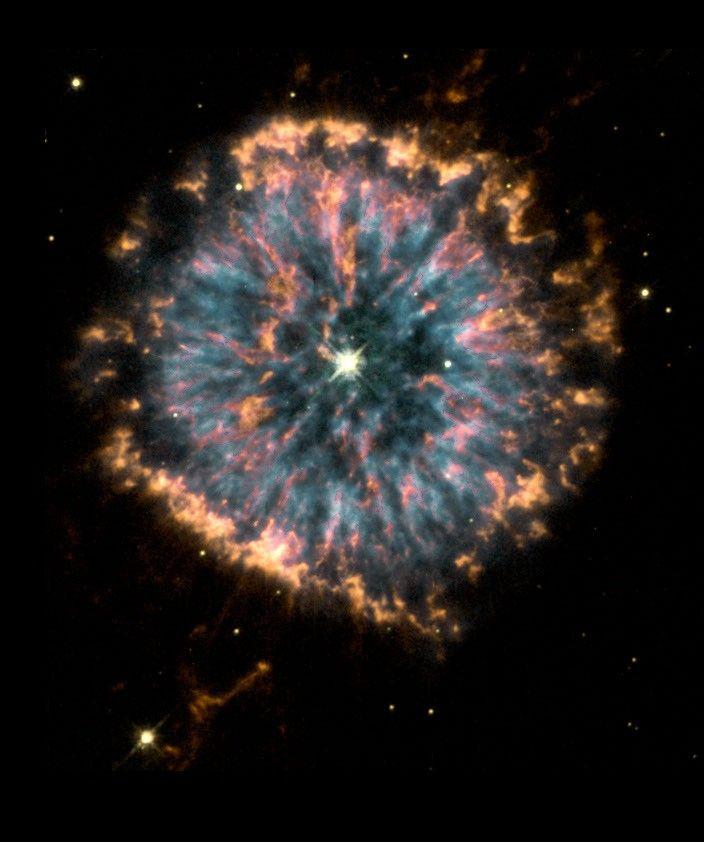
The Eye of Heaven Nebula. (NASA)
NGC 6751 is a classic example of a planetary nebula with a bipolar morphology. Examination of its overall structure reveals lower density outer shells surrounding a spherical central region, marked by filamentary features. Images obtained by the Hubble Space Telescope reveal that the nebula possesses a highly symmetric structure.
Technical Parameters
These technical parameters indicate that the nebula is in an advanced evolutionary stage and exhibits a bright structure composed of ionized gas due to the high temperature of its central star.
Spectroscopic studies have revealed that NGC 6751 contains prominent emission lines from oxygen (O III), helium (He II), nitrogen (N II), and hydrogen (Hα). These lines indicate that the surrounding gas is ionized by ultraviolet radiation emitted from the central star.
The elemental abundances in the nebula provide clues about galactic chemical evolution and demonstrate enrichment through nuclear reactions occurring in the late stages of stellar evolution.
The star at the center of NGC 6751 is a hot, carbon-rich Wolf-Rayet type white dwarf ([WC4]). Such stars are characterized by high mass-loss rates and powerful stellar winds. Its spectrum shows strong carbon (C IV) and helium lines, suggesting that fusion products from the star’s core have been transported to its outer layers.
The central star is predicted to have completed its Asymptotic Giant Branch (AGB) phase and will soon transition fully into a white dwarf state.
Hubble Space Telescope observations reveal structures within the inner shells that indicate bipolar symmetry. In contrast, the outer layers exhibit a lower density and more diffuse structure. Expansion velocity measurements suggest that the outer layers are gradually diluting and mixing with the galactic medium.
It is believed that the central star’s winds play a crucial role in shaping the ejected gas. The filamentary structures observed in Hubble images are thought to result from these stellar winds.
With an apparent magnitude of approximately +11.9, NGC 6751 can only be detected using medium or large telescopes under dark sky conditions. Observing its internal structural details requires high-resolution telescope systems.
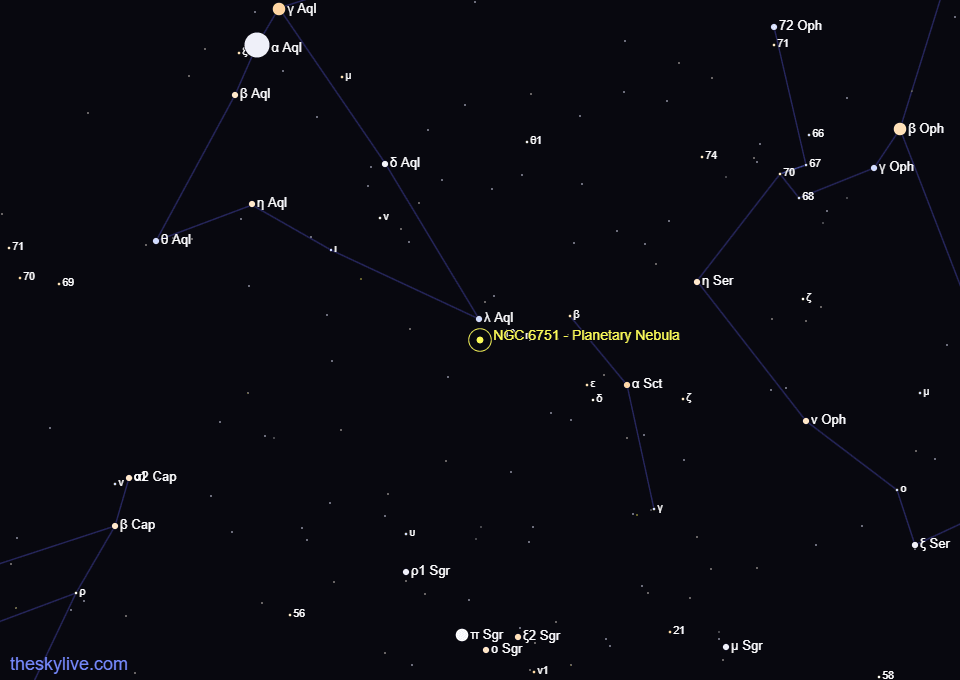
Position of NGC 6751. (theskylive.com)
NGC 6751 is one of the objects studied to understand the structure, chemical composition, and central star evolution of planetary nebulae. With its high-temperature central star, ionized gas structure, double-shell morphology, and rich spectroscopic features, it is a key target for both theoretical and observational astrophysical research. This nebula provides valuable insights into the transformations stars undergo during the final stages of their lives.
ESA/Hubble. “NGC 6751 – James Long.” ESA/Hubble FITS Liberator. Accessed July 17, 2025. https://esahubble.org/projects/fits_liberator/fitsimages/james_long_6/.
Ivester, Roger. “September 2022 Observer’s Challenge: NGC 6751.” Roger Ivester Observing Blog. Accessed July 17, 2025. https://rogerivester.com/wp-content/uploads/2022/09/september-2022-observers-challenge-_ngc-6751b.pdf.
NASA. “The Glowing Eye of Planetary Nebula NGC 6751.” *NASA Science, Hubble Mission*. Accessed July 17, 2025. https://science.nasa.gov/asset/hubble/the-glowing-eye-of-planetary-nebula-ngc-6751/.
“Glowing Eye Nebula (NGC 6751).” *Constellation Guide*. Accessed July 17, 2025. https://www.constellation-guide.com/glowing-eye-nebula-ngc-6751/.
“NGC 6751 – Planetary Nebula in Aquila.” *The Sky Live*. Accessed July 17, 2025. https://theskylive.com/sky/deepsky/ngc6751-object.
“NGC 6751.” *Deep Sky Corner*. Accessed July 17, 2025. https://www.deepskycorner.ch/obj/ngc6751.en.php.
“NGC 6751.” *Observing at Skyhound*. Accessed July 17, 2025. https://www.observing.skyhound.com/archives/aug1/NGC_6751.html.
“NGC 6751: An Overlooked Planetary Nebula in Aquila.” *British Astronomical Association*. Accessed July 17, 2025. https://britastro.org/journal_contents_ite/ngc-6751-an-overlooked-planetary-nebula-in-aquila.
“Summer Constellation Spotlight: Aquila.” Celestron. Accessed July 17, 2025. https://www.celestron.com/blogs/knowledgebase/summer-constellation-spotlight-aquila.

Radius | Approximately 0.4 light-years | ||||||||
|---|---|---|---|---|---|---|---|---|---|
Distance(s) | ~6 000 parsecs) 500 light-years (2 | ||||||||
Temperature of the Central Star | Approximately 140,000 K | ||||||||
Expansion Rate | Approximately 40 km/s | ||||||||
Apparent Brightness (V Band) | Approximately +11.9 magnitude | ||||||||
No Discussion Added Yet
Start discussion for "Eye of Heaven Nebula (NGC 6751)" article
Physical and Structural Properties
Spectroscopic Analysis and Chemical Composition
Central Star and Its Evolution
Morphology and Dynamic Structure
Observability