This article was automatically translated from the original Turkish version.
+1 More
Region | Erzurum and its surroundings | ||||||||
|---|---|---|---|---|---|---|---|---|---|
Historical Background | Preserved through oral and practical cultural transmission | ||||||||
Musical Accompaniment | Davul and zurna | ||||||||
Main Games | Dadaş Barı, Aşırma Barı, Hançer Barı, Nare Barı, Tamzara | ||||||||
Costume | Traditional Regional Bar Costumes | ||||||||
Type | Traditional Folk Dance | ||||||||
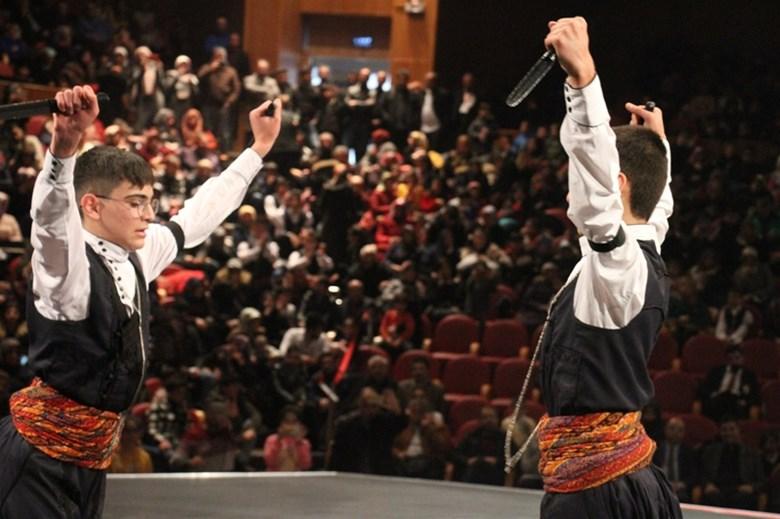
Erzurum bar game refers to the collective body of traditional folk dances characterized by region-specific movement patterns, musical understanding, and performance rules. These dances developed on a shared cultural foundation in Erzurum and its surrounding districts, exhibiting local variations over time while preserving their fundamental structural features. Physically, bar games are defined as dances in which participants line up side by side, holding shoulders or arms, and collectively perform specific figures.
The scope of bar games extends beyond mere dance figures. This tradition encompasses multiple layered elements including music, rhythm, costume, dance organization, leadership systems, and social functions. Thus, Erzurum bars are not merely an aesthetic sequence of movements but a holistic cultural structure reflecting social relationships and values. The order observed during performance, the harmony among participants, and adherence to specific rules form the foundation of the bar concept.
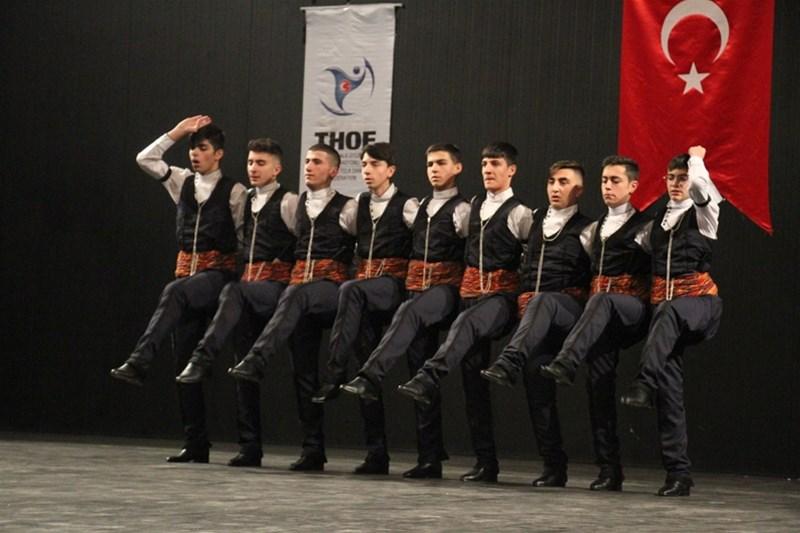
Performing the Erzurum Bar Game (Erzurum Directorate of Youth and Sports)
In terms of scope, Erzurum bar games are examined under different groups, primarily male bars and female bars. Male bars are distinguished by more vigorous, dynamic, and militarily suggestive figures, while female bars feature softer transitions and different rhythmic structures. Nevertheless, the common element in both groups is the collective movement concept and adherence to rhythm. Some bar games have, over time, adopted mixed performance formats within staged arrangements and cultural events.
The scope of Erzurum bars has also expanded through the social contexts in which they are performed. Traditionally performed in communal settings such as village halls, weddings, holidays, and military send-offs, bars are now also presented in different contexts through cultural festivals, official ceremonies, and folk dance competitions. This demonstrates that the functional domain of bar games has broadened over time and acquired new layers of meaning.
The historical background of Erzurum bar games is closely linked to the region’s socio-cultural structure, geographical position, and the political and social transformations it has undergone throughout history. Erzurum has been influenced by various civilizations throughout history, a factor that decisively shaped its regional culture. Bar games emerged during this long historical process and gradually developed into a distinct traditional form.
Although the exact historical origins of bar games cannot be definitively established through written documents, oral cultural transmission and folklore research indicate that these dances possess an ancient heritage. The collective movement concept, disciplined formations, leadership systems, and rhythmic structures reveal that bars served not only as entertainment but also as functional mechanisms reinforcing social order and solidarity. These characteristics suggest that bar games were historically connected to military traditions, ceremonial practices, and communal rituals.
During the Ottoman period, Erzurum’s status as a frontier city was a significant factor influencing the character of bar games. The emphasis on discipline, synchronized movement, and hierarchical order in regional social life was reflected in the figures and performance style of the dances. During this era, bar games were performed in village halls, military send-offs, weddings, and various social gatherings, becoming a symbol of social cohesion. These dances were sustained through oral and practical transmission from master to apprentice, rather than through written rules.
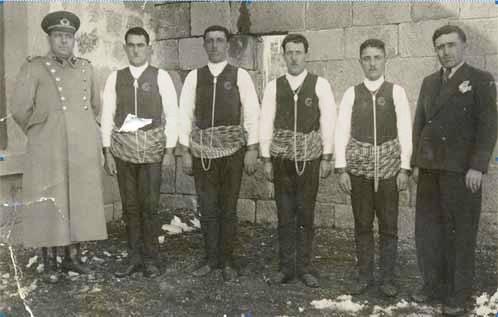
1934 – Erzurum Gücü Sports Club Bar Team with Colonel İhsan Yavuzer (Ministry of Culture and Tourism of the Republic of Türkiye)
During the Republican era, Erzurum bar games began to be systematically collected and documented alongside growing interest in folk culture. Research conducted by the Ministry of Culture and Tourism and universities contributed to identifying the figures, music, and performance characteristics of bar games. During this period, bars reached broader audiences not only within local communities but also through staged performances, folk dance ensembles, and cultural events.
Over time, changes have occurred in the performance contexts of bar games. Traditionally, bar games performed in natural settings with limited improvisation and strict adherence to rules have been adapted through specific modifications for stage presentations. Nevertheless, the fundamental figure structure, rhythmic organization, and discipline have been largely preserved. This demonstrates that Erzurum bar games have maintained historical continuity into the present day.
Erzurum bar games have been directly shaped by the natural conditions of the region where they emerged and developed. Erzurum’s harsh continental climate, with long and cold winters, led to the concentration of social life indoors, creating favorable conditions for the proliferation of bar games—collective dances that reinforce a sense of solidarity. Village halls, spacious interiors of homes, and communal gathering spaces became the primary venues for bar performances.
The geographical context also played a decisive role in shaping the movement structure of bar games. The sharp, angular, and ground-anchored figures seen in Erzurum bars are associated with the region’s challenging living conditions. Participants’ firm stances, sudden stops and rises, and powerful steps highlight both physical endurance and collective movement awareness. These features reflect not only the aesthetic structure of bar games but also the daily life practices of the region’s people.
Culturally, Erzurum bar games developed in close association with the “dadaşlık” ethos. Dadaşlık is an identity marker in the region defined by values such as courage, honesty, solidarity, and social responsibility. Bar games serve as a non-verbal expression of these values, materialized through the disciplined postures and synchronized movements exhibited by performers during the dance. In this sense, bars are not merely physical activities but also spaces where cultural identity is expressed.
The cultural context of Erzurum bars is also linked to gender roles. Traditionally, male and female bars were performed separately, with each group reflecting the social norms and aesthetic sensibilities of their time. In male bars, strength and discipline were emphasized, while female bars featured softer transitions and distinct rhythmic patterns. This distinction reveals that bar games are connected to the broader social structure of the community.
The geographical and cultural context of bar games did not remain confined to Erzurum; over time, they developed through interaction with neighboring regions. However, Erzurum bars have largely preserved their unique characteristics in terms of figure structure, musical understanding, and performance discipline. This demonstrates that while bar games maintain their regional identity, they also exhibit openness to cultural exchange.
Erzurum bar games attract attention through their disciplined, collective movement structure performed within specific rules. The most distinctive feature of these games is the emphasis on group harmony rather than individual expression. Participants move in unison, adhering to the same rhythm; figures are executed in a predetermined sequence without disrupting the overall formation. This distinguishes bar games from other folk dances that rely on improvisation.
Formation is of great importance in bar games. Participants typically line up side by side, holding shoulders or arms, to perform the dance. The person at the front of the line, known as the bar head, directs the performance and determines transitions between figures. The bar head’s commands are often conveyed through body movements rather than verbal instructions. This leadership system ensures the maintenance of order and rhythmic unity during the dance.
Rhythmic structure holds a central position among the general characteristics of Erzurum bar games. The dances usually begin with a slow tempo and gradually accelerate into a more dynamic form. This tempo shift enhances the dramatic effect of the performance while testing the physical endurance of the participants. Sudden stops, forceful foot stomps, and pronounced body movements are characteristic features of Erzurum bars.
Another important feature of bar games is the discipline and seriousness displayed during performance. Participants’ facial expressions, postures, and movements adhere to a strict measure; excessive facial expressions and individual displays are avoided. This seriousness indicates that bar games are perceived not merely as entertainment but as a form of representation and expression. Mistakes made during performance, which disrupt group cohesion, are not tolerated and are corrected by the bar head within the traditional context.
In terms of figure structure, Erzurum bar games consist of simple yet emphatic movements. Movements are predominantly lower-body focused and emphasize firm grounding. Jumping and leaping movements are limited; strong steps and synchronized turns dominate. This characteristic defines the aesthetic approach of bar games and ensures their compatibility with the performance spaces. The general features of Erzurum bar games are shaped around collective movement, rhythmic unity, leadership systems, and discipline. These features have transformed bar games into a unique folk dance tradition reflecting the cultural identity of the Erzurum region.
In Erzurum bar games, music is one of the fundamental determining elements and is directly linked to movement. The figure structure, tempo changes, and transitions of the dances are shaped according to the rhythmic patterns of the melodies used. Therefore, music in bar games is not merely an accompaniment but a primary component that guides the flow and shapes the performance. The most commonly used instruments in bar game performances are the davul and zurna.
The davul establishes the rhythmic foundation, while the zurna defines the melodic structure. The deep, powerful beats of the davul guide the participants’ steps and ground accents. The zurna’s repertoire, ranging from long, drone-like melodies to lively tunes, supports the emotional and dynamic character of the dance. This instrument pair provides a suitable sonic structure for both open-air and indoor bar performances.
Meter and tempo play a crucial role in Erzurum bar music. The dances typically begin with a slow, heavy introduction and gradually accelerate through subsequent sections. This tempo shift strengthens the dramatic structure of the performance and necessitates coordination among participants. Since any disruption in the rhythmic structure directly affects the integrity of the dance, a strong synchronization between musicians and dancers is essential.
Erzurum - Bar Game (TRT Avaz)
In terms of melodic structure, Erzurum bar music is based on the repetition of short motifs. These repetitions facilitate the learning of figures and synchronized movement among participants. Simultaneously, sudden pauses and accents in the melodies highlight transitions between figures. This makes musical structure an important element enhancing the visual impact of bar games.
Musical elements may vary according to the type of bar game. Some bar games favor sharp, fast melodies, while others emphasize slow, measured tunes. This variation directly affects the character and performance style of the dance. However, the common fundamental feature in all bar games is the central role of music in guiding the performance. Ultimately, the musical elements of Erzurum bar games—rhythm, tempo, and melodic structure—are inseparable components of the dance. Accompanied by davul and zurna, this music completes both the aesthetic and functional structure of bar games, ensuring the continuity of the traditional performance.
Erzurum bar games are classified into different types based on the composition of the performing groups, the nature of the figures, and the social contexts in which they are performed. This classification reveals the diversity of the bar tradition and makes clearer the functions and cultural meanings of the dances within society. Generally, Erzurum bars are categorized as male bars, female bars, and mixed performance forms that emerged over time.
Male bars constitute the most common and prominent type within the Erzurum bar tradition. The figures in these bars exhibit a strong, dynamic, and disciplined structure. Participants’ firm stances, powerful steps, and synchronized movements are emphasized. The collective movement concept is highly pronounced in male bars, with limited room for individual deviations. The guiding role of the bar head is clearly felt throughout the performance, reinforcing the hierarchical order and discipline within the dance. Traditionally, male bars were performed in social settings characterized by strong communal solidarity, such as weddings, military send-offs, and collective gatherings.
Female bars differ from male bars in terms of figure structure and performance style. Movements in female bars are relatively softer, with smoother transitions. While the rhythmic structure is preserved, sharp ground accents and sudden stops are more restrained. Aesthetic concerns, harmony, and rhythmic adherence take precedence in female bars. Within the traditional social structure, female bars were typically performed in female-only settings and served as one of the social interaction spaces for women in the region. This reflects the relationship between the bar tradition and gender roles in society.
The mixed bar performances that emerged over time are evaluated primarily within the context of staging and representation rather than traditional practice. These performances have become widespread through cultural events, festivals, and folk dance ensemble shows. In mixed performances, traditional figures are preserved, but stage arrangement, aesthetic unity, and visual impact are prioritized. In this context, mixed bars are regarded as one of the contemporary forms of bar representation. This distinction among bar game types does not represent rigid, fixed categories but rather a classification shaped by performance context and social conditions.
Erzurum bar games share common regional features but consist of various dances, each distinguished by its unique figure structure, rhythmic organization, and performance style. These dances hold an important place in local memory and documentation efforts as concrete examples of the bar tradition. The major Erzurum bar games reflect the core characteristics of bar culture through the intensity of their figures, tempo changes, and collective movement patterns.
Dadaş Bar holds a symbolic position among Erzurum bar games. Its name is directly linked to the region-specific “dadaş” identity. In Dadaş Bar, disciplined formations, powerful steps, and pronounced ground accents are emphasized. The dance typically begins with a slow tempo and accelerates in later sections. The synchronized and harmonized execution of figures forms the core character of the dance. Dadaş Bar is regarded as one of the representative examples of the general structure of Erzurum bars.
Aşırma Bar exhibits a lively and dynamic figure structure. Although jumping and lifting movements are limited, increased step speed and sudden directional changes are notable. Aşırma Bar features a distinct rhythmic structure, and the dancers’ synchronization with the music directly affects the fluidity of the performance. This dance is typically performed in the middle or faster sections of the bar sequence.
Hançer Bar is one of the bar games distinguished by its dramatic structure and symbolic figures. The movements used in the dance consist of controlled, measured actions, with sudden stops and emphatic steps playing a prominent role. As its name suggests, Hançer Bar carries historical and symbolic significance. In this sense, the dance is not merely a physical performance but also regarded as a representational form of expression.
Nare Bar is one of the bar games notable for its rhythmic structure and figure transitions. Throughout the dance, tempo changes proceed in a controlled manner, with harmony among participants taking precedence. The figures in Nare Bar are simple, yet rhythmic repetitions ensure the integrity of the performance. This feature facilitates learning and intergenerational transmission of the dance.
Tamzara (Erzurum variant) is a dance known in various regions, but its form performed in Erzurum is considered part of the local bar tradition. The Erzurum variant of Tamzara exhibits regional characteristics in its figure structure and tempo interpretation, while preserving the bar formation and discipline concept. This demonstrates that the Erzurum bar tradition has evolved through interaction with neighboring regions while maintaining its distinctive identity.
The costumes and clothing used in Erzurum bar games serve not only to complete the aesthetic appearance of the dance but also as indicators of regional identity and cultural continuity. Bar attire has been shaped according to Erzurum’s climatic conditions, historical lifestyle, and social values, gradually acquiring a distinct traditional form. These garments serve the dual function of supporting movement during performance and ensuring visual unity.
Traditional clothing for male bar games typically consists of dark, natural colors. Key components include şalvar (baggy trousers), cepken (vest), kuşak (belt), and çizme or yemeni (boots). The loose fit of şalvar allows for comfortable movement during the dance, while the cepken and kuşak accentuate body posture and enhance the clarity of figures. The manner of tying the belt and the accessories used reflect regional variations.
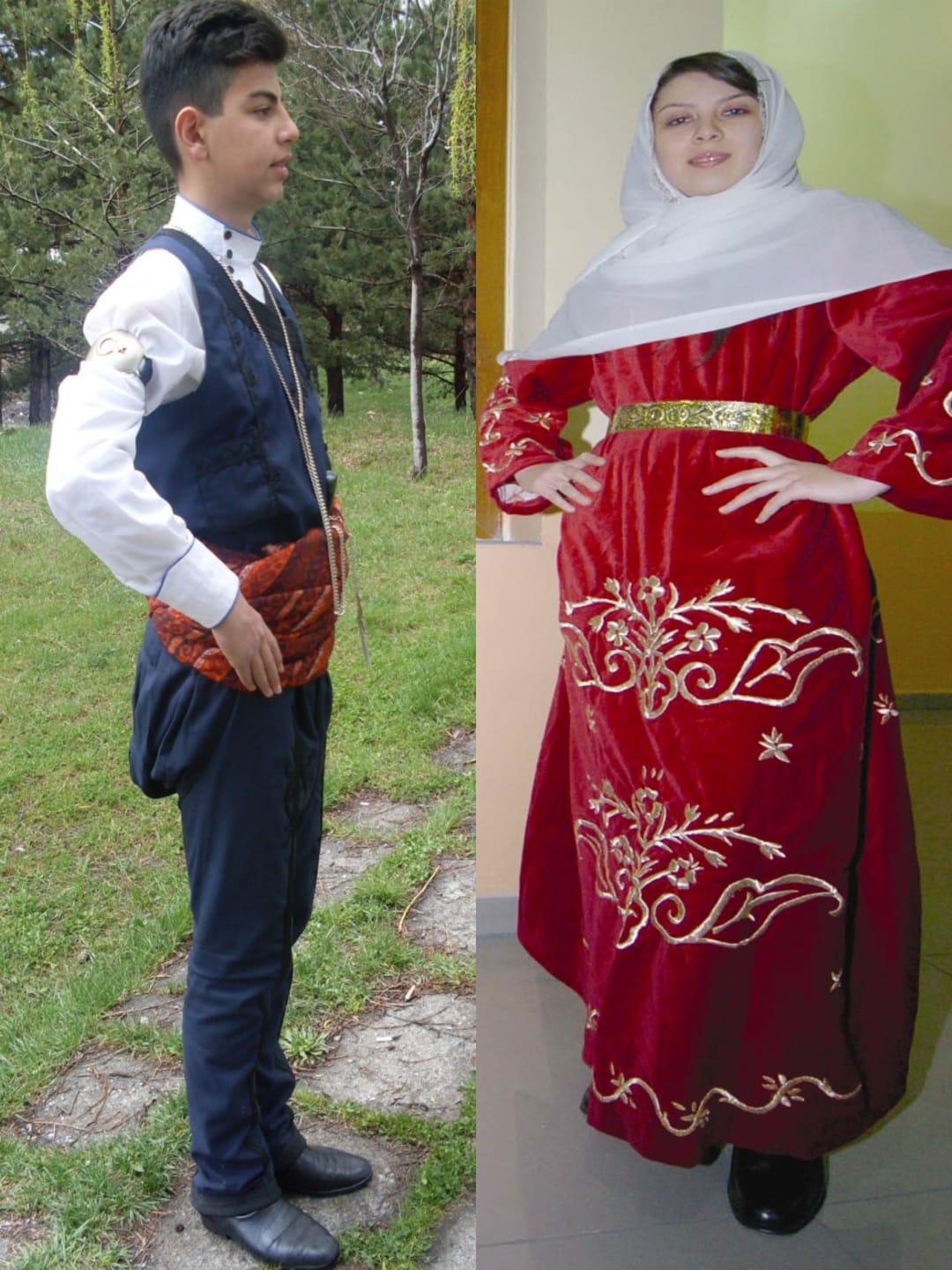
Erzurum Bar Costumes (Ministry of Culture and Tourism of the Republic of Türkiye)
The clothing worn in female bar games exhibits a richer decorative style. Long entari (dresses), embroidered vests, head coverings, and jewelry are the main elements of female bar attire. Color usage in these garments is more varied compared to male costumes. Nevertheless, despite the richness of decoration and color, the garments are designed to not restrict movement during performance. This reflects the balance between aesthetic concerns and functionality.
Bar costumes have been viewed not merely as garments worn during performance but also as reflections of social status and traditional values. In the past, the quality of fabric, density of embroidery, and nature of accessories could provide clues about an individual’s social position. In this sense, bar costumes function as a non-verbal cultural narrative.
Today, Erzurum bar costumes have become the subject of various initiatives aimed at preserving cultural heritage. Efforts to register traditional bar garments demonstrate that they are regarded not merely as folkloric elements but as vital components of tangible cultural heritage. These garments, used by folk dance ensembles and cultural events, are reproduced while remaining faithful to their traditional forms.
Today, Erzurum bar games continue to exist not only within their traditional context but also within cultural representation and staging processes. Although performed in more limited settings compared to the past, bar games are recognized as an essential element of cultural identity and are actively sustained through various institutions. This reflects an effort by the bar tradition to adapt to changing social conditions.
In Erzurum today, bar games are primarily performed through folk dance ensembles, cultural associations, and official events. Local festivals, national holiday celebrations, and cultural promotion activities are the main platforms where bar games gain visibility. In these events, the dances are presented with their traditional figure structures adapted to stage arrangements.
Efforts by the Ministry of Culture and Tourism and local administrations play a critical role in documenting and promoting Erzurum bar games. Collection, archiving, and publication activities related to bar games contribute significantly to their formal recognition. Additionally, academic research conducted within universities enables the scientific examination of the historical, structural, and cultural dimensions of bar games.
One of the most significant challenges in transmitting bar games today is the gradual decline of traditional performance settings. As village halls and daily communal gatherings are replaced by staged and performance-oriented presentations, the natural transmission process of the bar tradition is restricted. Nevertheless, folk dance courses and cultural projects targeting youth play a vital role in ensuring the continuity of this tradition.
Media and digital platforms are also among the factors increasing the visibility of Erzurum bar games today. Visual recordings, documentaries, and online sharing enable bar games to reach wider audiences, offering new opportunities for both promotion and education. However, such transmissions also carry the risk of detaching the tradition from its original context.
In conclusion, contemporary Erzurum bar games are seeking a balance between traditional and modern performance forms. As long as their preservation is supported by accurate transmission and conscious representation approaches, it is considered possible for bar games to be passed on to future generations.
Erzurum bar games are considered within the framework of intangible cultural heritage due to their historical structure, social function, and traditional transmission across generations. Intangible cultural heritage refers to the totality of practices, narratives, knowledge, and skills recognized by communities, groups, and individuals as part of their cultural identity. Erzurum bar games, as a living and transmitted cultural practice, fit this definition.
In Türkiye, bar games are categorized under the folk dance tradition by the Ministry of Culture and Tourism and are recognized as cultural values requiring protection. Erzurum bars have been included in national inventory and archiving initiatives and have been represented in activities aimed at raising awareness of intangible cultural heritage. Publications and digital resources developed by the Ministry play a critical role in promoting and documenting bar games.
The principle of safeguarding through transmission, a cornerstone of the UNESCO Convention for the Safeguarding of the Intangible Cultural Heritage, is also a defining approach for Erzurum bar games. It is essential for the survival of this heritage not only to archive the dances but also to perform them within their natural context and sustain their social functions. Accordingly, bar games are being sustained by maintaining a balance between traditional performance settings and staged representations.
Another important aspect of Erzurum bar games within the intangible cultural heritage framework is their community-based transmission process. The bar tradition relies on collective memory rather than individual creation, aligning with UNESCO’s understanding of cultural heritage. The active participation of local communities in learning, practicing, and transmitting the dances strengthens the cultural continuity of bar games.
Moreover, the traditional clothing, music, and performance rules associated with Erzurum bar games are considered complementary elements of intangible cultural heritage. Efforts to preserve and register bar costumes reflect this holistic understanding of heritage. This approach reveals that bar games are not merely a collection of figures but a multi-layered cultural structure.
In conclusion, Erzurum bar games are recognized as a cultural value requiring protection and sustenance, aided by their alignment with UNESCO’s concept of intangible cultural heritage. The ongoing process, supported by national institutions, academic research, and local community efforts, aims to strengthen the place of Erzurum bar games within cultural identity and ensure their transmission to future generations.
Doğan, Ahmet Selim. "Erzurum’da Oyun Folkloru." Atatürk Üniversitesi Güzel Sanatlar Fakültesi Dergisi. Accessed January 16, 2026.https://dergipark.org.tr/tr/download/article-file/29029.
Erzurum Gençlik ve Spor İl Müdürlüğü. "Halk Oyunları Rüzgarı." Accessed January 16, 2026.https://erzurum.gsb.gov.tr/HaberDetaylari/1/34/183580/halk-oyunlari-ruzgari.
Ministry of Culture and Tourism. "Bar." E-Kitap. Accessed January 16, 2026.https://ekitap.ktb.gov.tr/TR-78927/bar.html.
Sağlam, Selami. "Erzurum'un Nesilden Nesle Aktarılan 'Bar Kıyafeti' Tescil Yolunda." Anadolu Ajansı, May 4, 2024. Accessed January 16, 2026.https://www.aa.com.tr/tr/ekonomi/erzurumun-nesilden-nesle-aktarilan-bar-kiyafeti-tescil-yolunda/3514112
T.C. Ministry of Culture and Tourism. "Erzurum Barları." Erzurum İl Kültür veTurizm Müdürlüğü. Accessed January 16, 2026.https://erzurum.ktb.gov.tr/TR-273905/erzurum-barlari.html.
TRT Avaz. “Erzurum - Bar Oyunu - Kültürden Medeniyete.” YouTube. Accessed January 16, 2026.https://www.youtube.com/watch?v=krSA_9VyE4U.
Şen, Yavuz, and Mahmut Kıvanç. "Erzurum Yöresine Ait Oyun Havalarının Türler ve Sınıflandırma Yönünden Tespiti." Atatürk Üniversitesi Güzel Sanatlar Enstitüsü Dergisi. Accessed January 16, 2026.https://dergipark.org.tr/tr/download/article-file/477223.
Region | Erzurum and its surroundings | ||||||||
|---|---|---|---|---|---|---|---|---|---|
Historical Background | Preserved through oral and practical cultural transmission | ||||||||
Musical Accompaniment | Davul and zurna | ||||||||
Main Games | Dadaş Barı, Aşırma Barı, Hançer Barı, Nare Barı, Tamzara | ||||||||
Costume | Traditional Regional Bar Costumes | ||||||||
Type | Traditional Folk Dance | ||||||||
Historical Background
Geographical and Cultural Context
General Characteristics of Bar Games
Musical Elements
Types of Bar Games
Major Erzurum Bar Games
Costume and Clothing Elements
Erzurum Bar Games Today
UNESCO and the Context of Intangible Cultural Heritage