This article was automatically translated from the original Turkish version.
Parent Planet | Saturn | ||||||||
|---|---|---|---|---|---|---|---|---|---|
Class | Small, irregular natural satellite | ||||||||
Discovery Year(s) | 1966 | ||||||||
Discoverer | Richard L. Walker | ||||||||
Shape | It is not spherical and has an irregular shape. | ||||||||
Orbital Dance | Because their masses are very close, they exchange orbital positions with each other every four years with Janus. | ||||||||
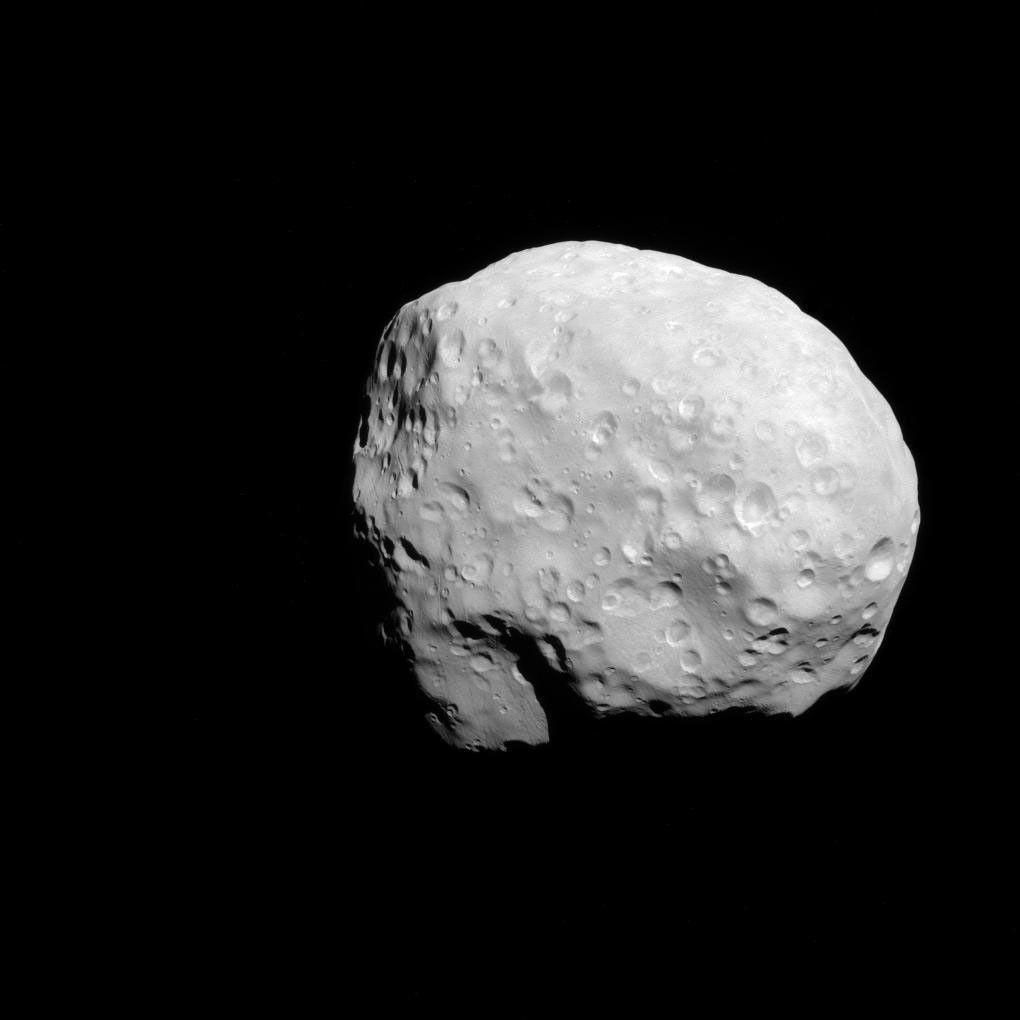
Epimetheus, Satürn’ün doğal uydularından biridir ve Satürn’ün halka sistemiyle yakın ilişkisi bulunan küçük, düzensiz uydular arasında yer alır. Epimetheus, yörüngesel özellikleri bakımından Satürn sisteminde özgün bir yörünge düzenine sahip olup, Janus uydusuyla kurduğu karşılıklı yörünge etkileşimiyle tanımlanır.
Epimetheus was first observed in 1966 by Richard L. Walker; however, this observation was long confused with that of Janus. The definitive identification of Epimetheus as an independent celestial body became possible only through subsequent orbital analyses. This situation is directly related to the unusual nature of Epimetheus’s orbital characteristics.
The moon Epimetheus derives its name from Epimetheus, brother of Prometheus in Greek mythology. This naming follows the established tradition of using mythological figures for Satürn’s moons.
Epimetheus has average dimensions of approximately 84 by 65 by 65 miles (135 by 108 by 105 km), reflecting its irregular, potato-like shape. Its surface bears numerous impact craters, including several larger than 30 km in diameter. Epimetheus is believed to have a low density, consistent with a composition rich in water ice, suggesting a structure resembling a “rubble pile” formed from aggregated fragments of ice and rock.
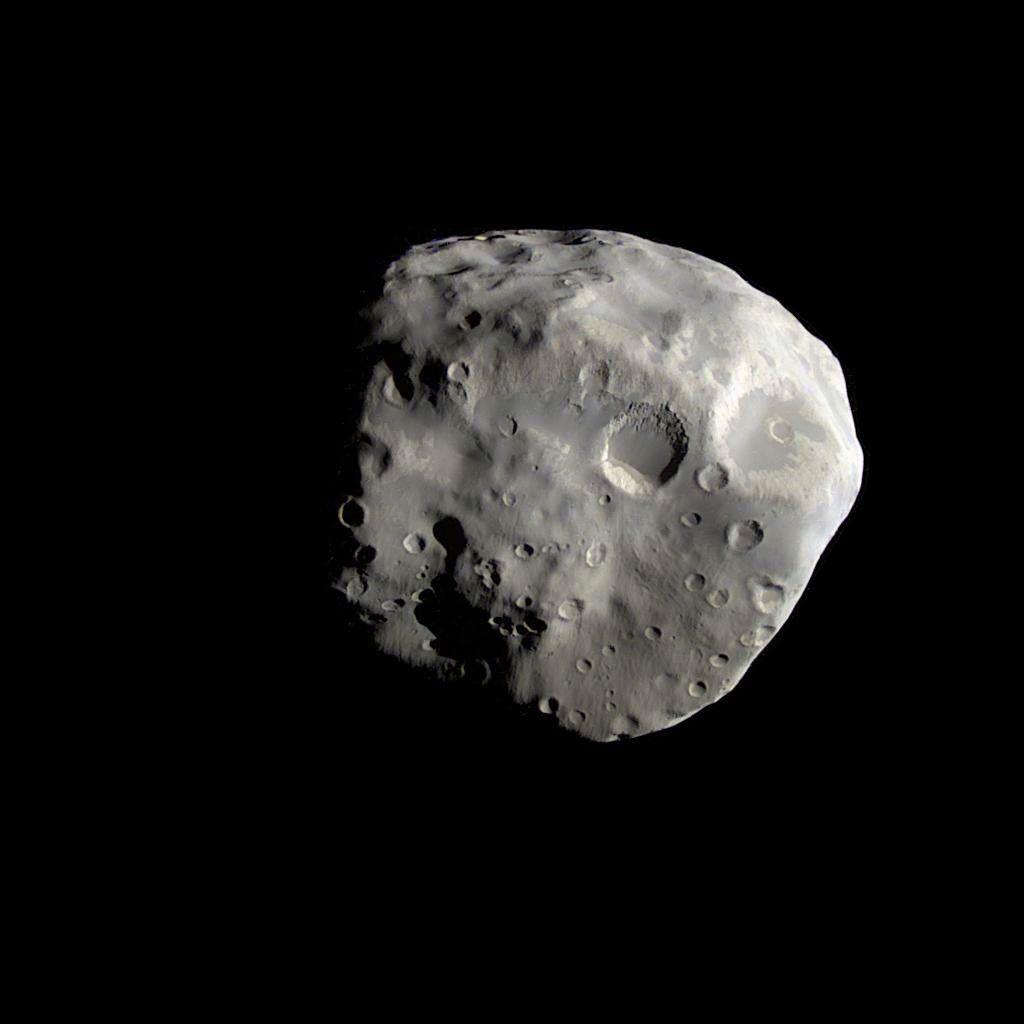
Epimetheus (NASA)
Epimetheus possesses one of the most remarkable orbital features in the Satürn system. Sharing nearly the same orbit as Janus, Epimetheus exhibits a co-orbital motion. The average distance between the two moons is only about 50 kilometers. Every four years, the inner moon, which moves faster, approaches the outer moon. During this close encounter, mutual gravitational interactions occur, causing the moons to exchange orbits. As a result, the trailing moon accelerates and moves into a higher orbit, while the leading moon slows down and drops into a lower orbit. Despite periodically switching orbits, the two moons never make physical contact and continue their motion without collision.
Epimetheus orbits close to Satürn’s ring system. This proximity results in indirect interactions with the ring dynamics. The combined gravitational influence of Epimetheus and Janus plays a role in maintaining the structure of the outer edge of Satürn’s A ring.
Epimetheus is an important observational target for understanding the complex orbital dynamics of the Satürn system. Its orbital exchange with Janus is regarded as a striking example in celestial mechanics. This phenomenon enables scientists to study gravitational interactions within multi-moon systems.
Scientific observations have shown that small moons such as Pan, Daphnis, Atlas, Pandora, and Epimetheus interact with Satürn’s rings. According to these observations, Epimetheus appears bluer than other small moons when it is farther from the planet, likely due to the deposition of water ice particles from Satürn’s E ring.
Modern observations and missions to the Satürn system have enabled more detailed investigation of the relationship between small moons like Epimetheus and the planet’s rings. Such studies are providing new insights into the origin and evolution of Satürn’s moons.
Anadolu Ajansı. “Bilim İnsanlarından Satürn’de Yeni Keşif.” Accessed January 15, 2026.https://www.aa.com.tr/tr/bilim-teknoloji/bilim-insanlarindan-saturnde-yeni-kesif/1433620
NASA. “Epimetheus Revealed.” NASA Science. Accessed January 15, 2026.https://science.nasa.gov/photojournal/epimetheus-revealed/
NASA. “Epimetheus.” NASA Science. Accessed January 15, 2026.https://science.nasa.gov/saturn/moons/epimetheus/

Parent Planet | Saturn | ||||||||
|---|---|---|---|---|---|---|---|---|---|
Class | Small, irregular natural satellite | ||||||||
Discovery Year(s) | 1966 | ||||||||
Discoverer | Richard L. Walker | ||||||||
Shape | It is not spherical and has an irregular shape. | ||||||||
Orbital Dance | Because their masses are very close, they exchange orbital positions with each other every four years with Janus. | ||||||||
Discovery Process
Naming
Physical Characteristics
Orbital Dynamics and Relationship with Janus
Relationship with Satürn’s Ring System
Observational and Scientific Significance
Ring Interactions and Color Properties
Current Research and Discovery Context