This article was automatically translated from the original Turkish version.
Think of those famous phrases ingrained in our minds for years by popular culture, songs, and romantic comedies: “I cannot live without you,” “Love me more than anyone else,” “I’m trapped in your absence,” “You are the center of my life…” But what if these desires were fulfilled literally, word for word—and the person before you erased their entire identity, morality, friendships, even their instinct for survival, all for you? What then?
One of the most effective tricks in horror cinema is not taking something from you; it is irrevocably corrupting something you love, trust, or consider innocent.
After Smile, even a genuine smile can unsettle people. Squid Game transformed the games that once symbolized the most innocent moments of our childhood into arenas of death. Now, hopscotch is no longer just a child’s game; our memories carry it with an entirely new meaning.
In my view, Obsession does exactly the same thing, but from a far more “romantic comedy” perspective. Because this film corrupts the phrase “I love you.” As the story progresses, this phrase ceases to be a declaration of love and begins to sound like a threat. Every time Nikki says “I love you,” it becomes evidence of her losing a little more of her own will. Those two words, normally comforting, now instill fear by the film’s end.
Obsession opens with a clichéd romantic setup that we all know too well. Bear is hopelessly in love with Nikki, who has been a constant presence in his life. There is a familiarity between them, something outsiders might say, “There’s something between them.” Bear seeks romantic potential in this closeness and wants to believe it exists. But the problem is that instead of taking the risk of confronting her directly and risking rejection, he chooses the easy path: he turns to a supernatural power to guarantee Nikki’s love for him!
Warning: Contains spoilers.
Bear’s move is more than just the desperate cry of someone trapped in platonic love. There is a “wish twig” called Willow involved. And this wish reveals just how one-sided and selfish Bear’s interpretation of their relationship has always been. Bear is afraid to know what Nikki truly feels; instead, he decides for himself what she ought to feel.
That is why dismissing Obsession as just another “be careful what you wish for” horror film would be a great injustice. The film’s true subject is the blurry boundary between love and the desire to possess.
If love is based on free choice, then it is love. The moment you guarantee someone’s love for you, what remains is no longer love.
If a person does not love you by their own choice, can it still be called love?
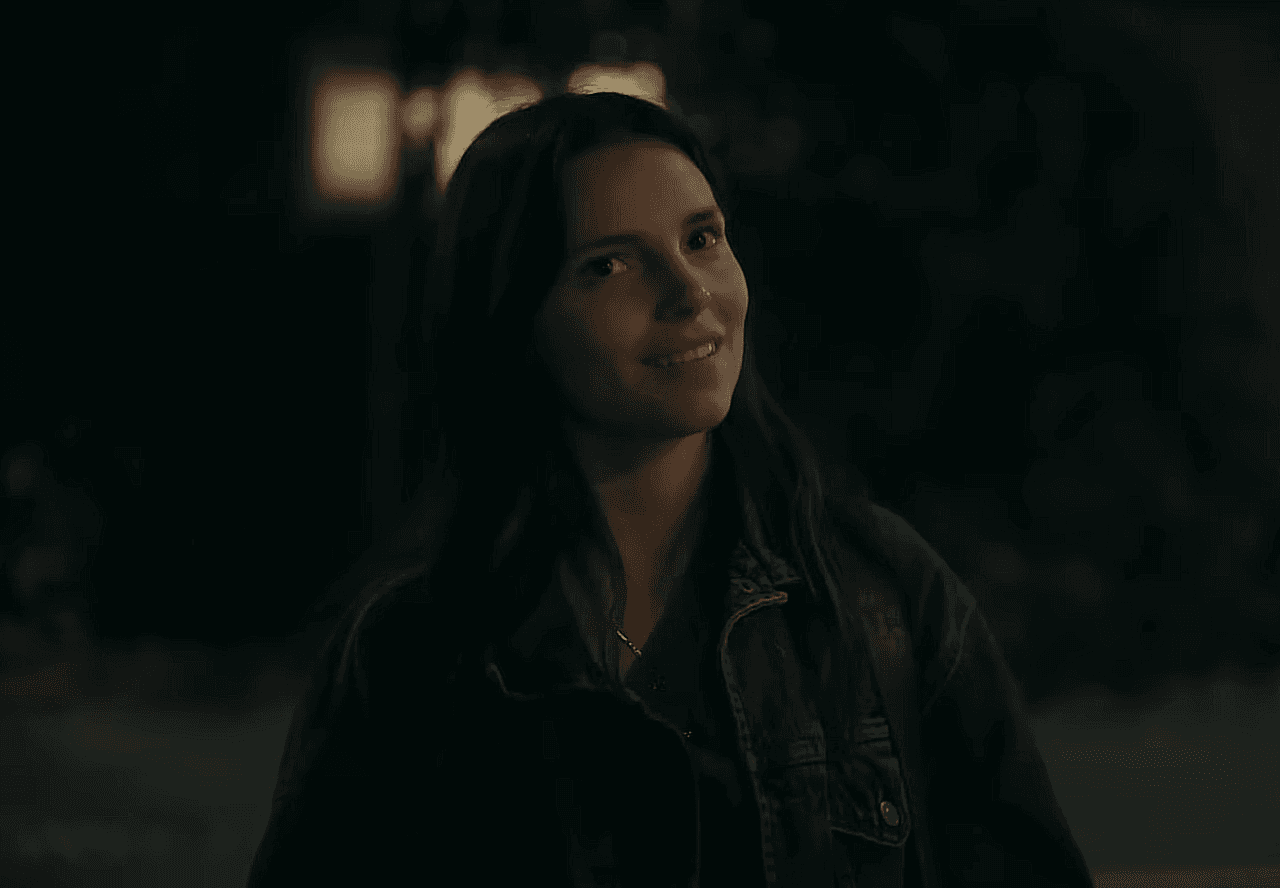
Obsession (Saplantı) filminden Nikki Freeman. (Inde Navarrette) (Box Office Türkiye)
Bear does not see himself as bad, manipulative, or dangerous. And indeed, he is not—at least not in intent. His goal is certainly not to harm Nikki, frighten her, or turn her life into a prison. In his own small world, he is simply a shy, emotionally unfulfilled, somewhat unlucky man. Naturally, his wish does not feel like an act of violence to him; he sees it as a desperate attempt to seize the small chance in life that has always slipped through his fingers. Bear’s greatest mistake is failing to truly observe Nikki. He constantly interprets her through his own lens. He makes no effort to understand what is really happening between them; he reads every step she takes and every joke she makes as support for his romantic script.
But the truth is very different. Nikki sees him almost like a little brother.
Her comfort and lack of self-consciousness around Bear stem entirely from this safe closeness.
That is precisely why I believe one of the film’s most important scenes is the one most viewers overlook on first viewing: the Hansel and Gretel poem. At first glance, this scene appears merely as an unsettling gothic performance. But it carries a deeper meaning. In Nikki’s poem, Hansel and Gretel are no longer the siblings of the fairy tale.
The poem’s most critical line is this: “A love only the branch of a willow could conjure.” That is, “Such a love could only be summoned by the willow’s branch.”
When considered alongside the rest of the film, this line reveals that Nikki’s feelings for Bear are not romantic; they are more like friendship, safety, and familial closeness.
When a person is forced into a romantic relationship with someone they have always placed in a completely different mental category, the experience feels profoundly alien, disturbing, and identity-shattering. The Hansel and Gretel example is one of the harshest ways to convey this sense of alienation.
In other words, Nikki is saying: “I would never have loved you this way under normal circumstances.” Therefore, Nikki’s “supernatural event” is not falling into unrequited love; it is the forced reconstruction of her own self.
The thing I most want to emphasize about Obsession is the common assumption: “Bear’s wish went wrong.”
Many people interpret the film as a classic Monkey’s Paw story: a character makes a wish, the wish is granted, but the universe punishes them through a cruel wordplay.
I disagree. Because if you watch the film carefully, you realize that the wish twig, Willow, does not misunderstand Bear’s wish. On the contrary, perhaps the only flawless element in the film is Willow itself.
What does Bear wish for?
“Nikki loves me more than anyone else in the world.”
Now let’s examine Nikki’s transformation.
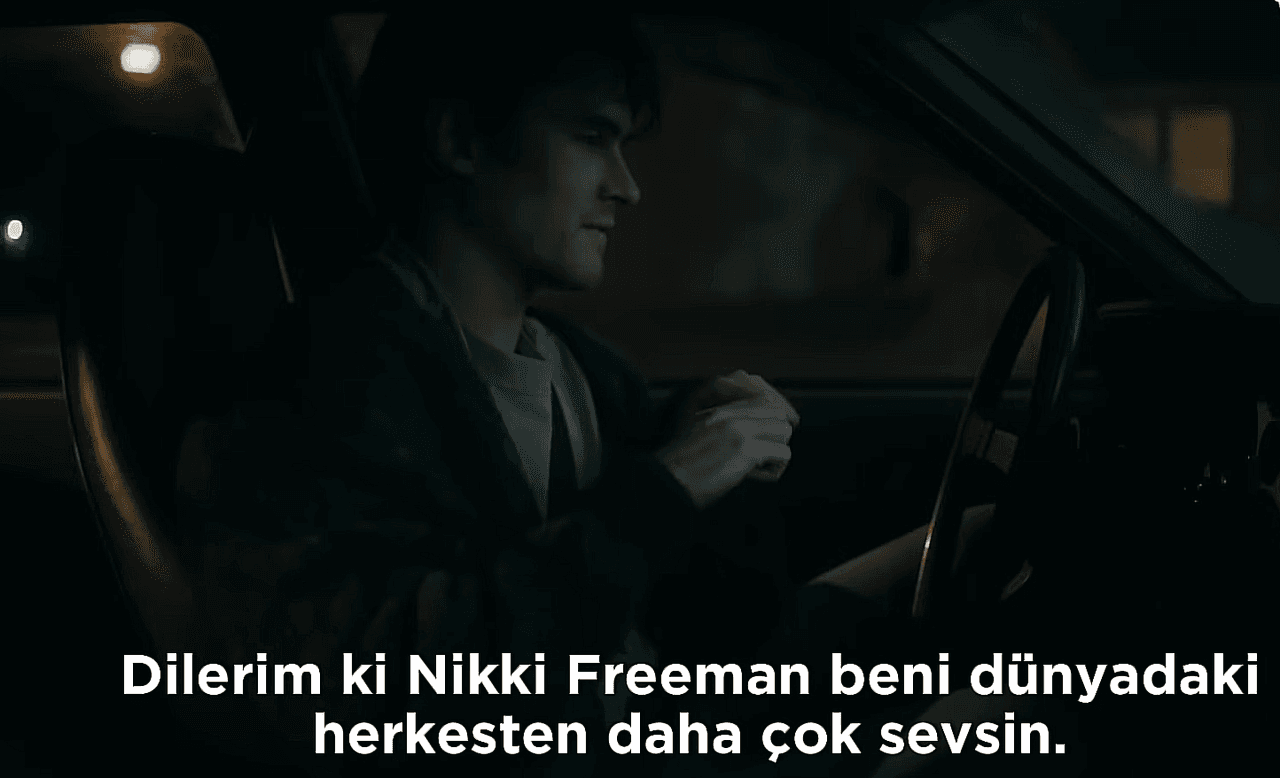
Obsession (Saplantı) filminden Bear, dileği dilerken. (Michael Johnston.) (Box Office Türkiye)
She begins to care about nothing except Bear. She ignores her friends. She quits her job. She abandons her own life. Even her own body becomes secondary. She endures pain, death, and even commits murder just to be with Bear. Isn’t this exactly what Bear wanted? Bear never said, “Let Nikki fall in love with me.” He never said, “Let Nikki make me happy.” He never said, “Let us have a balanced relationship.” Bear’s wish is absolute: “Let her love me more than anyone else.”
What does it mean for someone to truly love you more than anyone else in the world?
Because most of us have thought about this through romantic comedies, the answer seems innocent: “Make me your priority.” “Choose me.” “Value me.”
But Willow does not work with romantic clichés. Willow works with words. Like Nikki, like all writers… it takes words to their absolute limit.
If someone truly loves you more than anyone else in the world, then everyone else in the world automatically falls to second place. Their family. Their friends. Their job. Their dreams. Their moral boundaries. Their own body. Their own life. Even themselves.
This is exactly what happens to Nikki. That is why I could never interpret the film as a story of a wish gone wrong. I believe nothing went wrong. The problem lies in Bear’s wish itself.
Bear’s discomfort is deeply ironic. Because although Wish Nikki is the direct product of his wish, Bear soon begins trying to escape this relationship.
I believe what Bear truly wants is not boundless love, but love he can control.
Bear wants Nikki to constantly think of him, but he never considers that this will change her entire life. He wants Nikki to build her entire existence around him, yet he does not want his own life to revolve around her. In short, Bear does not imagine an equal relationship; he imagines one with himself at the center. Wish Nikki completely eliminates this balance.
Now, in the relationship, it is no longer only Bear’s needs that matter. Nikki has needs too—and all of them are tied to Bear. She constantly craves attention. She constantly craves contact. She constantly wants to be by his side. For the first time, Bear experiences the burden of being on the other side of his romantic fantasy. That is, Bear wants Nikki to love him, but he does not want to bear the responsibility of her love.
How much does this resemble modern relationships?
From another perspective, Wish Nikki also shatters everyone’s definition of the “ideal partner.” In popular culture, the ideal lover is often romanticized as someone attainable, jealous, devoted, loving you more than anyone else, constantly attentive, and never giving up.
But would you really want to live with someone like that?
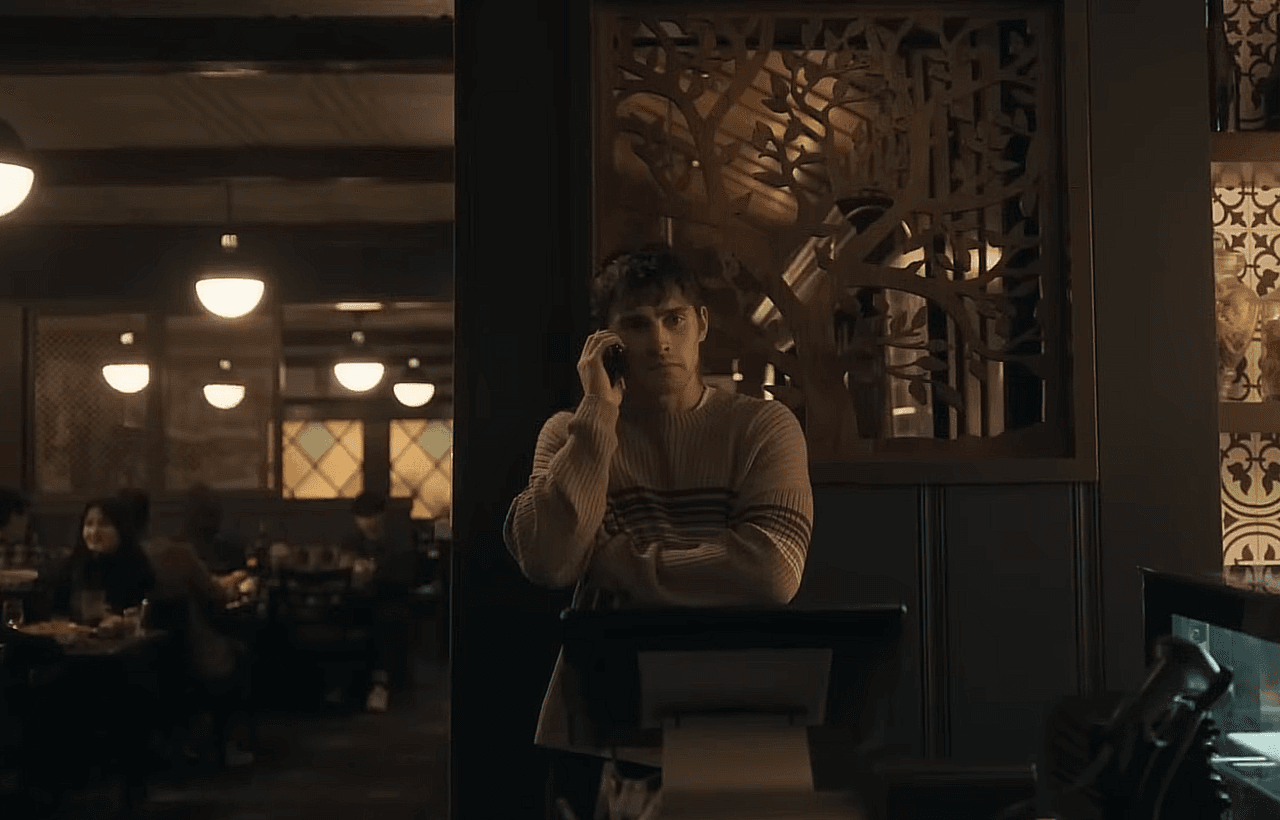
Obsession (Saplantı) filminden Bear. (Michael Johnston.) (Box Office Türkiye)
Bear has spent his life dreaming of a woman who loves him more than anyone else. But when he finally meets such a woman, he begins searching for ways to escape her. If Wish Nikki represents the relationship Bear dreamed of, then where is the real Nikki?
On one side is the personality created by Bear’s wish. On the other is the real Nikki, forced to live through all of it. One of the most important scenes supporting this is again the scene where the Hansel and Gretel poem is read. Wish Nikki suddenly reverts to normal Nikki, begins attacking herself, and screams repeatedly: “This is not me.”
In later parts of the film, we see similar small fractures. Wish Nikki’s behavior occasionally stutters. Certain glances, hesitations, facial expressions… they constantly suggest that another consciousness is still fighting within her.
This uncertainty makes the film’s horror far stronger. Because if the real Nikki is still inside, she may be witnessing everything.
Just thinking about this is terrifying. Imagine you cannot control your own body. You are speaking, but you are not the one speaking. You are touching people, but you do not want to touch them. You are hurting others, but you cannot stop yourself. Your body moves, while you are merely an observer from within.
Obsession does not say, as classic possession films do, that a demon has entered her. It proposes a far more disturbing possibility: Perhaps the real Nikki is fully aware of everything but powerless to do anything.
Bear endures an unwanted relationship for a few days. The real Nikki may be forced to watch her own life unfold from inside her body, unable to stop it.
Before you think of Nikki, the film wants you to like Bear. Or rather, it does not want you to start by hating him. Because Bear is not, at first glance, the classic cinematic “dangerous man.” He is not obsessively stalklike like Joe Goldberg. He is not a charismatic psychopath like Patrick Bateman. He is not constantly manipulative or hateful toward women. He is quiet, introverted, slightly socially awkward, and kind to his friends. He owns a cat. He jokes. He listens to people. For the first half hour, it is entirely normal to think, “This boy’s only crime is loving too much.”
I believe one of Curry Barker’s smartest choices was precisely this. Because if Bear had been repellent from the start, the film would have been far easier to read. The audience would have labeled him a “bad man” within minutes and severed all emotional connection the moment he made his wish. But Obsession does the opposite. It deliberately makes Bear appear good. Thus, in the film’s later moments, the audience is left face-to-face with a far more disturbing question.
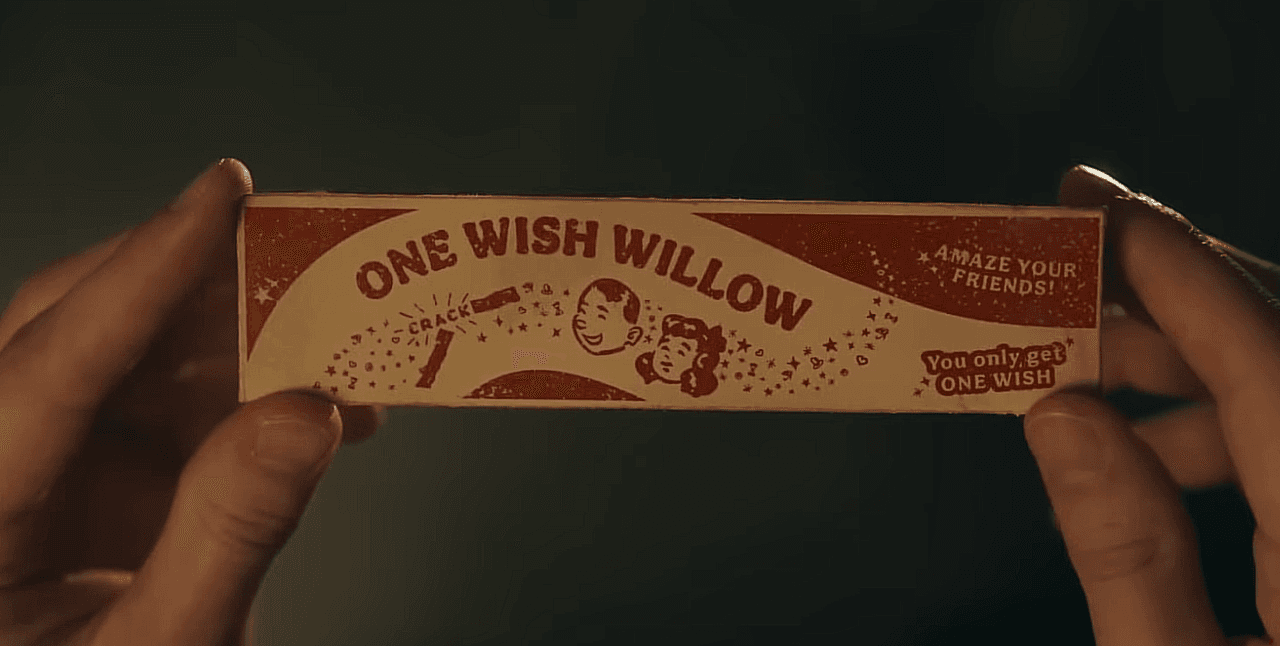
Obsession (Saplantı) filminden "Willow" - Dilek Dalı Ürünü. (Box Office Türkiye)
By the way, while mentioning Barker, I must make a parenthesis: Obsession’s story is not limited to what we see on screen. Behind this film is Curry Barker, a 26-year-old director who gained attention on YouTube.【1】 He shot the film for approximately $750,000—less than many commercial ads cost…【2】
When it entered theaters, it opened with a $17 million weekend, then continued breaking its own records over the next four weeks, ultimately earning nearly 500 times its budget. Obsession, at an unexpected moment, took the title of the highest-grossing original live-action English-language film of the 2020s from Sinners.【3】
Marketing also became part of the game. Focus Features brought the film’s cursed object into real life, selling replicas of the “One Wish Willow” in specialty stores, themed vending machines, and online. The product sold out within hours, and in some places, it was resold at ten times its original price. People left theaters still talking, the film went viral on social media, and audiences rewatched it repeatedly. Isn’t it strangely fitting that such a small budget created such a massive reaction—mirroring the film’s own central theme: the power of a wish?
In recent years, a concept frequently used in social psychology and gender studies is the “Nice Guy Syndrome.” Here, the “nice guy” is slightly different from the internet stereotype. It describes a man who defines himself as good and therefore believes he deserves romantic attention.
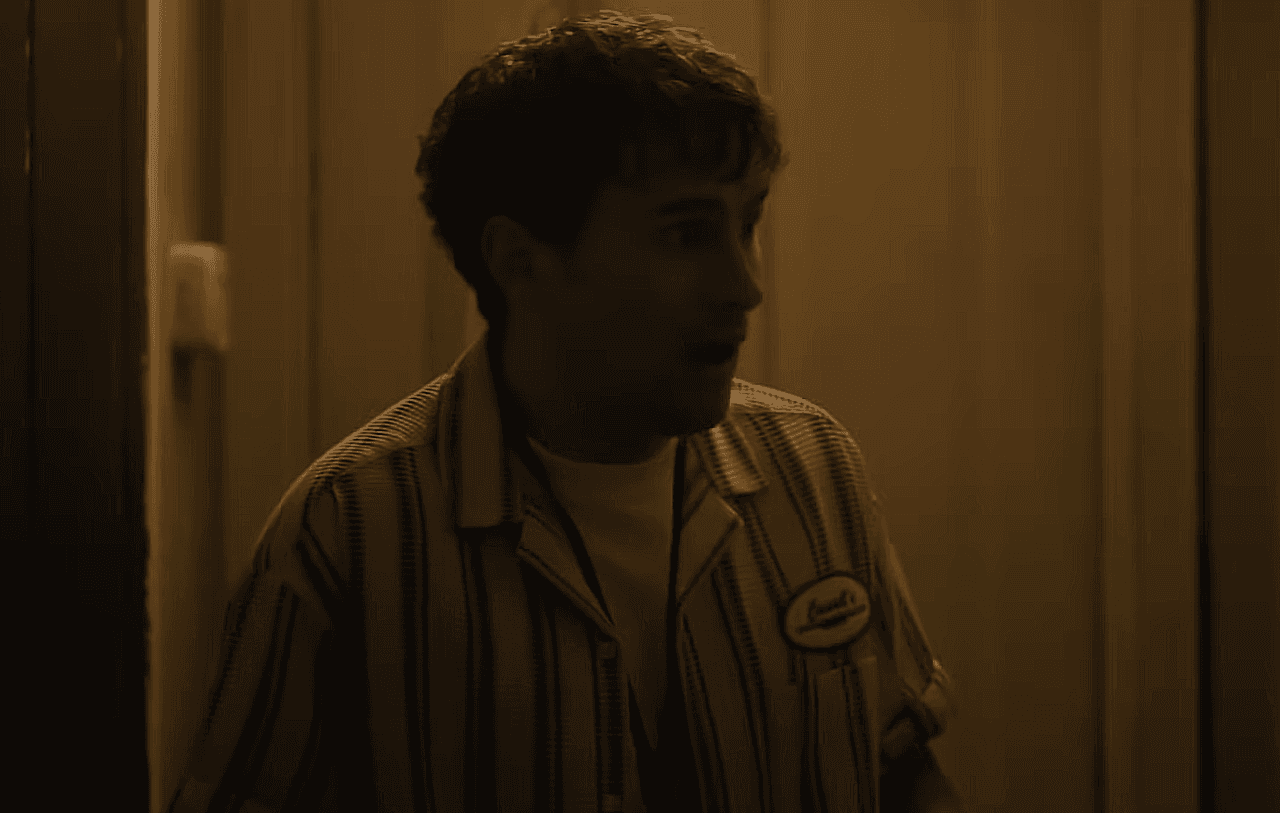
Obsession (Saplantı) filminden Bear. (Michael Johnston.) (Box Office Türkiye)
These individuals rarely scream, threaten, or openly manipulate. The problem is more subtle. They believe that being kind, patient, and enduring their emotions for long periods should eventually be rewarded romantically. Bear’s story may be read from this perspective…
Because he never says, “Nikki must choose me.” But his wish says it for him. The phrase “Nikki loves me more than anyone else in the world” is actually an expression of a deeper desire: “Let the possibility that Nikki won’t choose me disappear.”
Bear sees himself as a good person, just as we see him. When a person does not see themselves as bad, they rarely recognize their own boundary violations as such. Therefore, the film’s greatest turning point is not when the wish is made. I believe the true breaking point is when Bear realizes Nikki is no longer herself, yet continues the relationship anyway.
At that point, he sees clearly that there is no longer any romantic reciprocity. Nikki’s behavior is unnatural. Her love is unhealthy. Her constant need to be with him is not normal. Yet Bear cannot let go. Because for the first time in his life, someone loves him this intensely. Even his cat died from his medication and abandoned him…
He knows it is wrong, but he also does not want to give up this love.
Let’s return to our subject… It is hard not to feel sorry for Bear. He is profoundly lonely. He truly wants to be loved. He truly wants to be happy. But good intentions do not erase ethical violations. Sometimes the greatest mistakes are made not by malice, but by desperation and loneliness combined with good intentions.
Bear is not a stranger to us… isn’t he?
When you watch Obsession, as you are now reading this, you inevitably focus on Bear and Nikki’s relationship. The film wants you to. The camera lingers on them constantly. But after a while, something interesting happens: your eyes begin to drift toward the “side characters.” Because it is Ian who tells us who Bear really is. It is Sarah who notices the change in Nikki. And perhaps even Sandy best represents the film’s moral compass.
It is a brilliant cinematic touch that even the cat carries such symbolic weight in a horror film.
Let’s start with Ian. “Greedy,” “selfish,” “opportunistic”—these labels might come to mind the moment he sees the Willow. But let’s be honest: Ian’s only fault is saying aloud what many people think. If you had a magical wish, would everyone immediately think of their soulmate? I’m not sure. The number of people who check stock charts, ask for lottery numbers, or sigh, “If only I’d bought that land in 2008…” is not small. Ian, at least, is honest.
In the first half of the film, Ian’s greed is unsettling. But when you consider Bear’s wish in the second half, the moral scale shifts entirely. Ian wants money. Bear wants another person’s will.
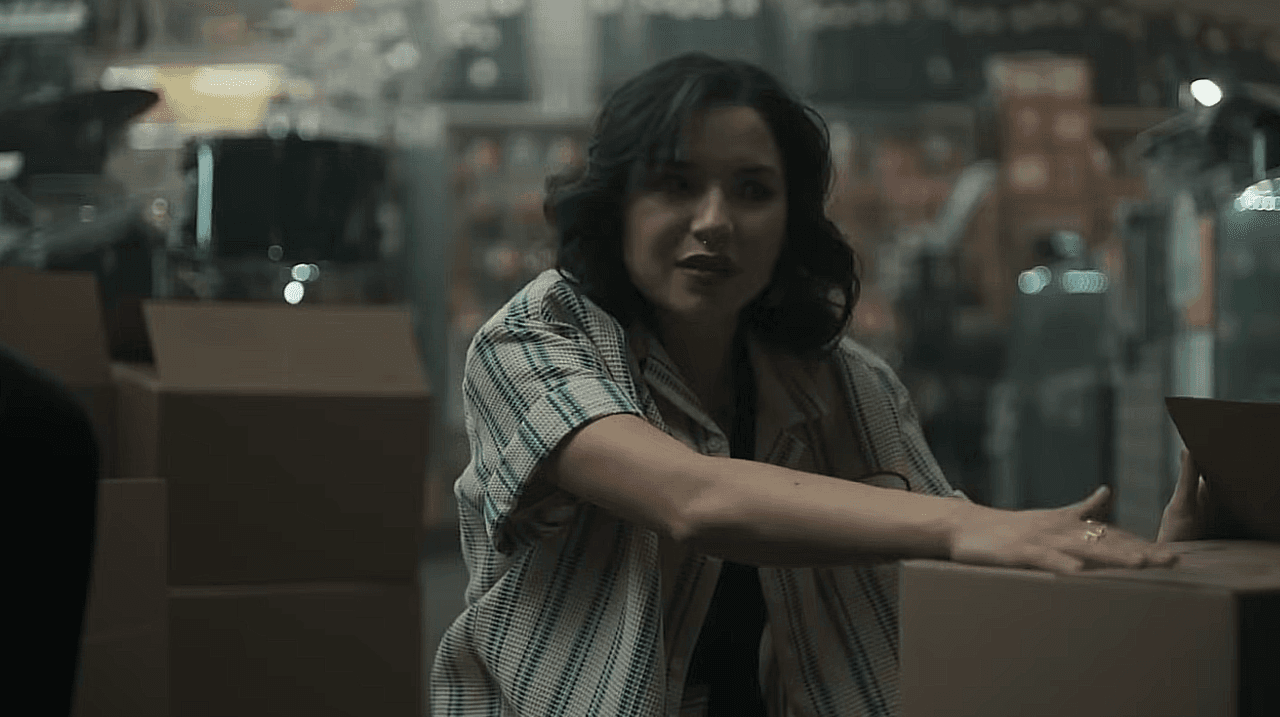
Obsession (Saplantı) filminden Sarah. (Megan Lawless.) (Box Office Türkiye)
Sarah is the film’s silent hero. There is a long-standing cliché in horror cinema: everyone decides to go into the basement, one person says, “I think we shouldn’t,” and naturally, no one listens. Sarah is exactly that person. But what makes her interesting is not that she solves the supernatural mystery early; it is that she can truly see Nikki. Bear is always looking at Nikki, but he is always seeing himself. Sarah, when she looks at Nikki or Bear, sees only Nikki and Bear. The difference is far greater than we realize.
To truly know a person is not to guess how they feel about you. It is to recognize their own life, their own emotions, and their own transformation. Sarah achieves this. Moreover, we see far more clearly than Ian that she has her own dreams, her own life, her own identity. That is why the first person to notice Nikki’s fracture is not Bear or Ian, but Sarah. In my view, Sarah is the healthiest character in the film.
If you have a friend like her, do not lose them. They might annoy you sometimes, but at least they try to keep you away from magical willow branches. If you ignore them, their patience wears thin—until one day, you realize… oh well, never mind.
And Sandy… Let’s be honest; being a pet in horror cinema is bad luck. The moment you list “cat” on your CV, your life expectancy plummets dramatically. Oh, my dears… Sandy cannot escape this tradition. The animal’s entire purpose was probably to bask in sunlight and wait for mealtime. It had no idea about Bear’s romantic crisis or what a Willow was. But one of the first characters to pay the real price is still it. Sandy’s death, in my view, is one of the film’s most important symbols. Because the script gives us a very clear message from the beginning: Bear’s wish will not remain confined between him and Nikki.
The greatest feature of unhealthy desires is that they never stay limited to two people. Friends suffer. Families suffer. Work life suffers. Daily life suffers. Even a cat with no knowledge of anything suffers. What begins as a romantic problem becomes a vortex that swallows everything around it.
In the end, Sandy, unfortunately, becomes the tragic protagonist of a horrific event, tearing up its CV as a minor cat role.
We have spoken a lot about Bear so far. We discussed his wish, his psychology, the “Nice Guy” debate. But a few hours after finishing the film, all these discussions begin to fade. Only one character remains: Nikki.
Throughout the film, everyone talks about Nikki. Bear talks. Sarah talks. Ian talks. The audience talks. But Nikki herself hardly speaks. And when she does, she is not the real Nikki.
Nikki cannot speak directly because even her own voice may no longer belong to her. The only space left to her is writing. That is why it never feels accidental to me that the character is a writer…
That is why the film’s ending affects me more than its bloody scenes. Because Bear dies and his story ends. Our protagonist pays the price, and the curtain closes. For Nikki, however, the curtain opens precisely then.

Obsession (Saplantı) filminden Nikki Freeman. (Inde Navarrette) (Box Office Türkiye)
She is left behind as someone who has murdered her friends, cannot explain what happened to anyone, will likely go to prison, and must live with memories she will never be able to make sense of.
In horror films, we usually feel relief when the “survivor” lives. Obsession flips this expectation entirely.
I believe the real evil is not Willow. Not the bloody scenes. Not the deaths at the end. The real evil is that we will never fully know what happened inside Nikki’s mind.
If she was truly still inside, if she truly witnessed everything, then there is another film—unseen by us—still playing.
In conclusion… Obsession leaves you with a character soaked in blood.
Her name isn't Bear.
Nikki.
Nikki, who makes a wish at the last moment.
Freaky Nikki.
Come to think of it, who was this Freaky Nikki?
Was it the one inside, or the one who came out?
"How Did Obsession Become a Box Office Hit? Budget and Numbers Explained." The Review Geek. Accessed July 12, 2026.https://www.thereviewgeek.com/boxofficeexplained-obsession/
"Nice Guy Syndrome and 5 Important Ways to Break Free From It." PsychUniverse. Accessed July 12, 2026.https://psychuniverse.com/nice-guy-syndrome/
"Obsession (2025) - Box Office and Financial Information." The Numbers. Accessed July 12, 2026.https://www.the-numbers.com/movie/Obsession-(2026)
"Obsession (2026) Budget: $750K Production Cost." Saturation.io. Accessed July 12, 2026.
"Takıntı (Obsession) | Altyazılı Fragman - 15 Mayıs'ta Sinemalarda." YouTube video, March 14, 2026. Accessed July 12, 2026.https://www.youtube.com/watch?v=wa9sQappK2w
Director: Curry Barker. Los Angeles: Focus Features, 2026.
Hookstead, David. "How 'Obsession' Went from a Sub-$1M Horror Film to a $371.2M Box Office Phenomenon That Dethroned 'Sinners.'" OutKick (via Fox News), June 2026. Accessed July 12, 2026.
Lammers, Tim. "'Obsession' Arrives on Streaming as Film Tops $370 Million at Box Office." Forbes, June 30, 2026. Accessed July 12, 2026.https://www.forbes.com/sites/timlammers/2026/06/30/obsession-arrives-on-streaming-this-week-as-film-tops-370-million-at-box-office/
Lammers, Tim. "'Obsession,' Made for $750,000, Crosses $400 Million at Box Office." Forbes, July 5, 2026. Accessed July 12, 2026.https://www.forbes.com/sites/timlammers/2026/07/05/obsession-made-for-750000-crosses-400-million-at-box-office/
Roeloffs, Mary. "'Obsession' Becomes This Summer's Breakout Box Office Hit." Forbes, May 25, 2026. Accessed July 12, 2026.https://www.forbes.com/sites/maryroeloffs/2026/05/25/obsession-becomes-this-summers-breakout-box-office-hit/
[1]
Mary Roeloffs, "'Obsession' Becomes This Summer's Breakout Box Office Hit," Forbes, May 25, 2026, Accessed July 12, 2026,https://www.forbes.com/sites/maryroeloffs/2026/05/25/obsession-becomes-this-summers-breakout-box-office-hit/.
[2]
Obsession (2026) Budget: $750K Production Cost," Saturation.io, erişim tarihi 12 Temmuz 2026, https://saturation.io/budgets/obsession-2026.
[3]
Tim Lammers, "'Obsession,' Made for $750,000, Crosses $400 Million at Box Office," Forbes, July 5, 2026, Accessed July 12, 2026,https://www.forbes.com/sites/timlammers/2026/07/05/obsession-made-for-750000-crosses-400-million-at-box-office/
“I never actually existed with you, Bear.”
“I wish Nikki Freeman loved me more than anyone else in the world.”
“You are not my wife, Gretel!”
“Be very careful what you wish for!”
“Why can’t you love me?!”
“Whatever you want me to be, I will be.”
“What was I searching for… Do you cancel wishes?”
“Bear, I love you so, so, so very much.”
“It’s a bit strange that you suddenly started leaving.”
“What’s so bad about being with me, Nikki?”