At KÜRE Encyclopedia, we use cookies to provide you with the most efficient and enjoyable experience possible.
With your consent, we may personalize our content and services based on your browsing history and preferences. If you choose to allow only essential cookies, some features may operate with limited functionality.

This article was automatically translated from the original Turkish version.
Parasite, directed by South Korean filmmaker Bong Joon-ho and released in 2019, has emerged as one of the most significant films in contemporary cinema in its exploration of class relations. The film won the Palme d’Or at the 2019 Cannes Film Festival and, at the 2020 Academy Awards, became the first non-English language film to win the award for Best Picture.【1】Blending black comedy, thriller, and drama, the film critically examines class inequality in modern capitalist society through the lens of everyday practices.
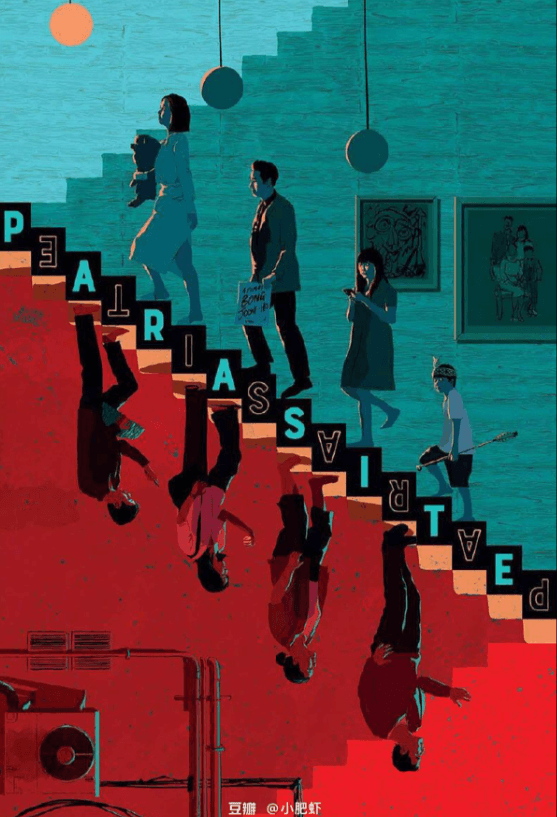
Parasite (2019) (IMDb)
The film centers on the relationship between the economically disadvantaged Kim family and the affluent Park family. What begins as a mutually beneficial professional arrangement gradually transforms into a deepening dynamic of domination and tension. In this context, the film offers a compelling example that can be read through James C. Scott’s concepts of the “public transcript” and the “hidden transcript.”
According to Scott, in relations of domination, subordinate groups strategically perform compliance and obedience in the presence of the dominant class. This is not a reflection of genuine consent but rather a role imposed by power imbalances.
The behavior of the Kim family toward the Park family in the film can be interpreted within this framework of the public transcript. Ki-woo’s infiltration of the household under a false identity as a tutor, followed by the other family members assuming various roles within the home, creates an outward impression of harmony and professionalism. Yet this is a strategic performance aimed at securing a foothold within the system.
In this context, the film’s line “Rich people are not good people; they are good because they are rich. If I were rich, I would be good too”【2】, clearly reveals that moral qualities are not independent of class conditions. Here, goodness is represented not as an individual virtue but as a privilege granted by material means. This underscores an ideological process that enables the dominant class to appear “natural” and “legitimate” in the public sphere.
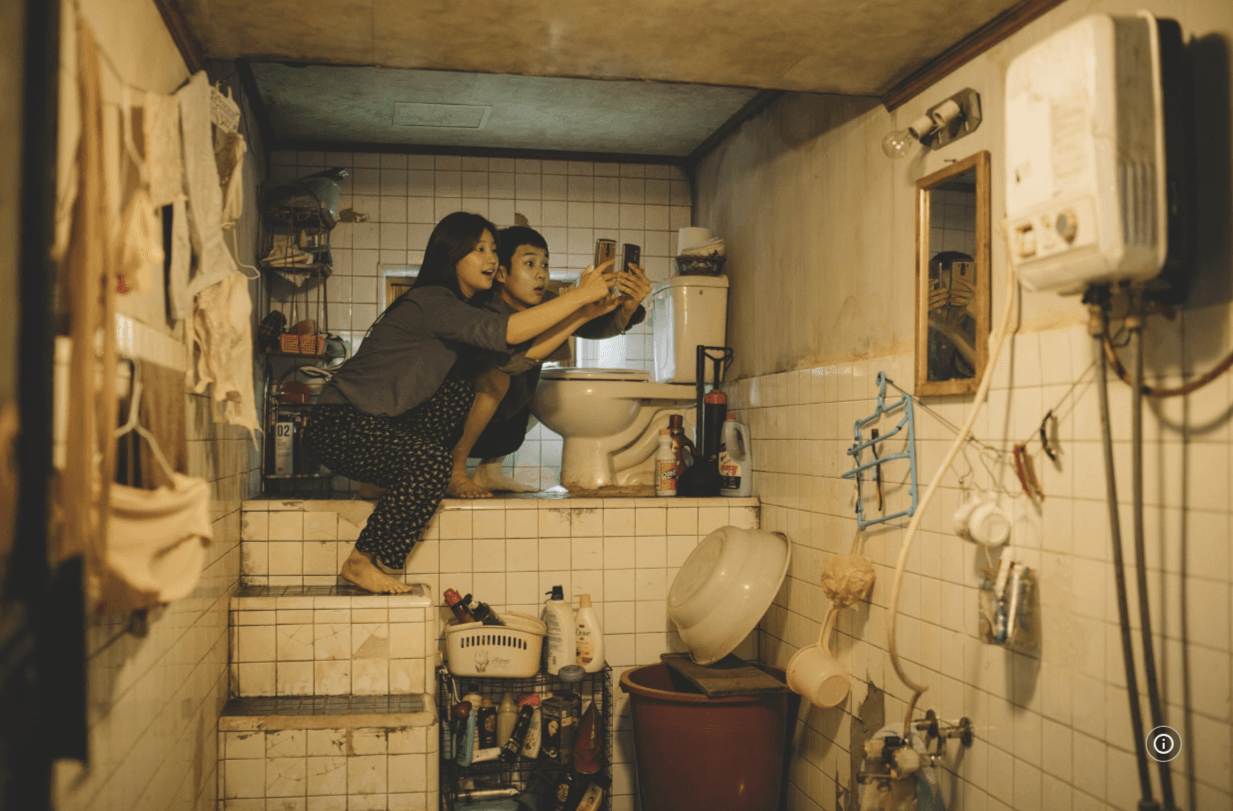
Parasite (2019) (IMDb)
Scott’s concept of the “hidden transcript” refers to the space where the subordinate class expresses its true feelings and thoughts in the absence of the dominant class. In the film, when the Park family is away, the Kim family takes over the house and behaves with ease—an example of this phenomenon. This scene represents a moment in which suppressed desires and class boundaries are temporarily lifted.
Yet this sense of freedom is fleeting. With the sudden return of the Park family, the Kim family is forced back into the public transcript. This illustrates the persistence of domination and the limited scope of agency available to the subordinate class.
The film’s spatial construction further supports this distinction. The stark contrast between the spacious, sunlit home of the Park family and the half-basement apartment of the Kim family is a physical manifestation of class disparity. In this context, the man hidden in the basement represents the invisible class existing at the lowest stratum of the system. His use of Morse code to thank his employer, yet the message going entirely unnoticed, exposes the internalized and invisible dimensions of domination. This illustrates a form of silent acceptance and invisibility that replaces overt resistance.

Parasite (2019) (IMDb)
The birthday party scene in the film marks a critical turning point where the hidden transcript erupts into the public sphere. Ki-taek’s murder of the Park family’s patriarch can be understood as the sudden release of repressed rage. This corresponds to what Scott describes as rare “explosion moments” in relations of domination.
This act of violence is not merely an individual reaction but the culmination of prolonged class degradation. Particularly, the Park family’s derogatory remarks about “smell” as a marker of the lower class serve as a crucial trigger for this outburst. In this context, resistance emerges not as an organized, sustained movement but as an abrupt expression of accumulated tension.
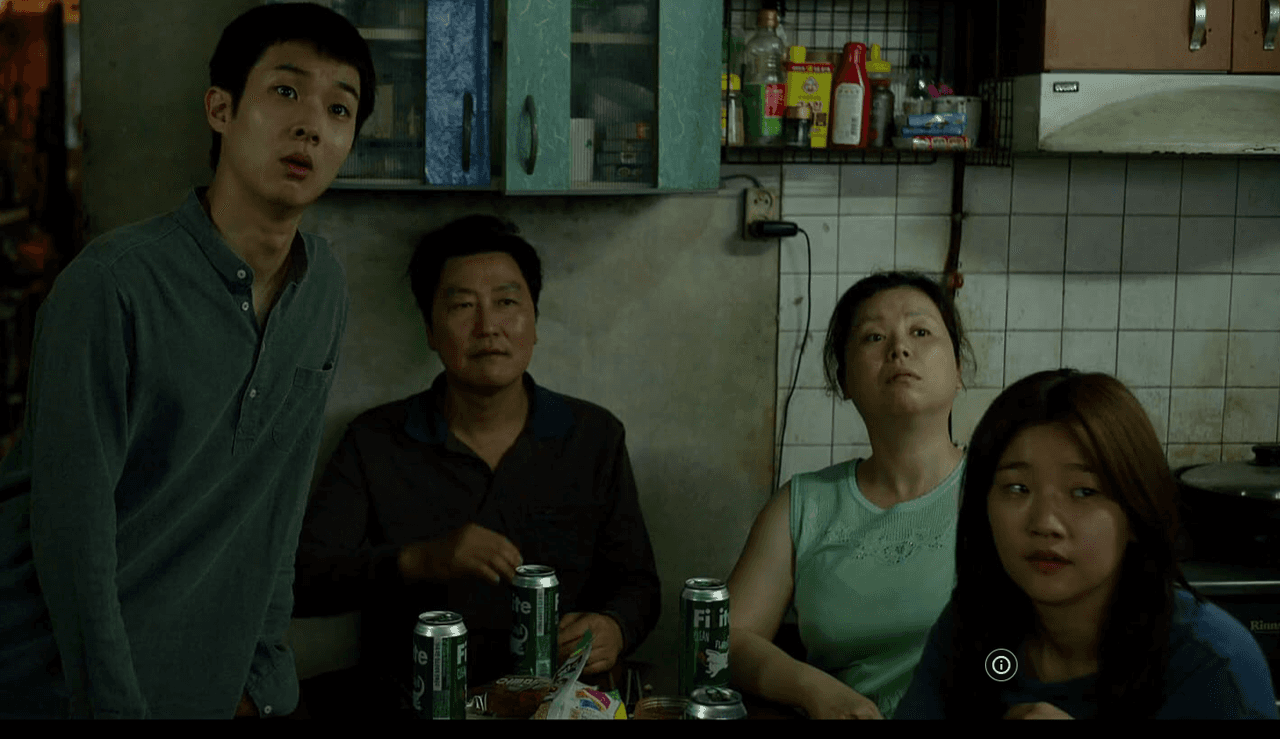
Parasite (2019) (IMDb)
Ki-taek’s statement in the film, “If you make a plan, life ruins it; if you don’t make a plan, you won’t be disappointed,”【3】summarizes the structural entrapment of the subordinate class. This approach implies a deliberate abandonment of future expectations and the adoption of a survival-oriented strategy.
This stance can be linked to Scott’s concept of “subpolitics.” Subordinate classes often develop survival strategies without directly confronting the system. Here, unplanning is not passivity but a form of adaptation to the insecurity created by the system.
Parasite offers a multilayered narrative that addresses class relations not merely as an issue of economic inequality but also through everyday practices, spatial divisions, and symbolic interactions. The film reveals that the subordinate class is not entirely passive; rather, its resistance is often invisible, fragmented, and temporary.
It also demonstrates how resistance sometimes manifests as internalized acceptance and at other times as sudden, destructive outbursts. In this regard, the film provides a powerful sociological example for understanding relations of domination and resistance, concretizing Scott’s theoretical framework through cinematic storytelling.
IMDb. "Parasite Awards." Accessed April 3, 2026. https://www.imdb.com/title/tt6751668/awards/
IMDb. "Parasite." IMDb. Accessed April 3, 2026. https://www.imdb.com/title/tt6751668/
Joon-ho, Bong, dir. Parasite. South Korea: Barunson E&A, 2019.
Scott, James C. Tahakküm ve Direniş Sanatları: Gizli Senaryolar. Trans. Şenol Bezci. Istanbul: Ayrıntı Yayınları, 2013.
[1]
IMDb, “Parasite Awards,” IMDb, last accessed: 3 April 2026, https://www.imdb.com/title/tt6751668/awards/
[2]
Parasite, directed by Bong Joon-ho (South Korea: Barunson E&A, 2019).
[3]
Parasite, directed by Bong Joon-ho (South Korea: Barunson E&A, 2019).
The Public Transcript: Conformity, Role, and Appearances
The Hidden Transcript: Behind the Scenes and the Reality of Class
The Moment of Outburst: The Publicization of the Hidden Transcript
Helplessness and Subpolitics: The Strategy of Unplanning
Evaluation