


This article was automatically translated from the original Turkish version.
+1 More
Dömeke Square Battle
History | 17 May 1897 | ||||||||
|---|---|---|---|---|---|---|---|---|---|
Region(s) | Dömeke | ||||||||
Result(s) | Ottoman Victory | ||||||||
Parties | Kingdom of Greece Ottoman State | ||||||||
Powers | 000 Greece: 20 000 Ottoman: 40 | ||||||||
The Battle of Domokos on 17 May 1897 was the most decisive phase of the Greco-Turkish War. It erupted as a result of unrest on the island of Crete and Greece’s expansionist policies aligned with the Megali Idea against the Ottoman State. Although the Ottoman army achieved a military victory in this battle, it lost its diplomatic advantage following the peace negotiations that concluded the war.
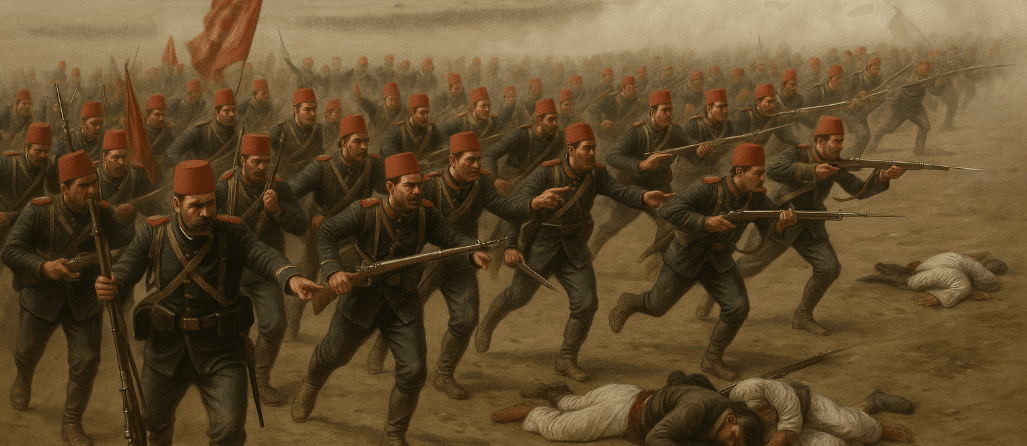
Attack of the Ottoman Army (Generated by Artificial Intelligence.)
By the late 19th century the Ottoman State had suffered significant territorial losses due to internal rebellions and foreign interventions. Greece which had gained its independence in 1830 exploited this weakness and intensified its claims over Ottoman territories. The fundamental driver behind these claims was the Megali Idea an ideological vision shaped by a historical perception linking ancient Greece to Byzantium and then to modern Greece. The uprisings and armed activities by Greeks on Crete must be understood within this context. The general peace maintained by the Ottomans on the island began to be systematically disrupted from 1866 onward.
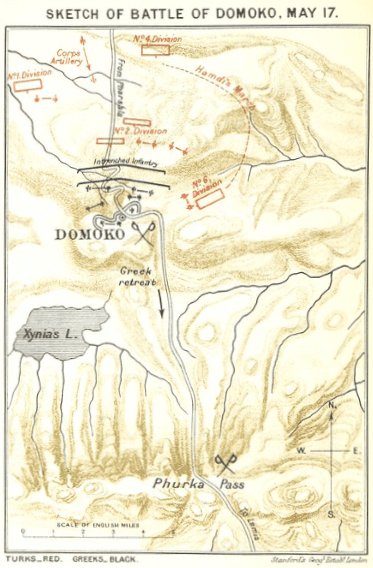
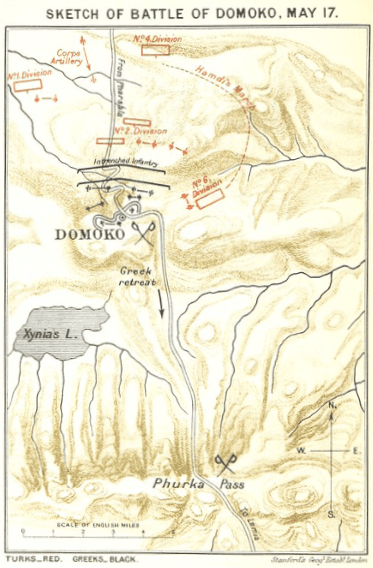
Plan of the Battle of Domokos 1 (Flicker: British Library)
During the war the Ottoman forces outnumbered the Greek forces approximately 40 000 Ottomans against around 20 000 Greeks. However Greece held a strategically advantageous position in terms of defensive lines and terrain. When the war began on 16 May 1897 the Ottoman army quickly gained superiority on the Thessalian Front. Under the command of Mushir Ethem the Ottoman forces crossed the Milan Pass and captured the key locations of Valestin Çatalca Tirhala and Galos. On the morning of 17 May the Ottoman army advanced in multiple columns while Hayri Pasha’s wing moved toward the village of Tsioba and Neşet Pasha’s force advanced along the road toward Domokos. In the center Hamdi Pasha was positioned while the left wing was arranged to target the Greek right flank.
Haydar Pasha commanded the reserve forces following Hamdi Pasha. In the early morning Hayri Pasha’s troops encountered a Greek infantry unit at Tsioba. Overestimating the size of the Greek force Hayri Pasha opted for a cautious attack and the position was only captured after an hour of fighting. Hayri Pasha’s slow advance forced Neşet Pasha to halt as well. During the same hours Hamdi Pasha’s troops engaged the Greek 4th Division under Colonel Mastrapas and made progress with artillery support. Memduh Pasha’s forces came into contact with Greek units.
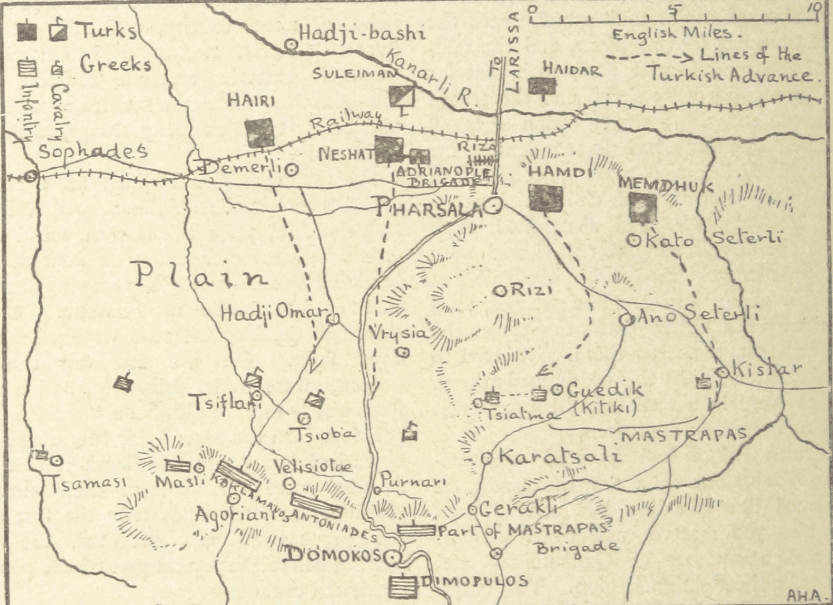
Plan of the Battle of Domokos 2 (Flicker: British Library)
By midday Ottoman units approached the Greek defensive lines on the plain before Domokos. While Neşet Pasha’s artillery bombarded Greek positions infantry advanced up to 400–600 yards. However by evening artillery fire diminished and the Greek lines largely held their ground. At 23.00 during the night Edhem Pasha was informed by a report from Hamdi Pasha. According to the report Hamdi and Memduh Pashas’ forces had approached the Greek right flank and reached a position from which they could target the Greek right or rear. Edhem Pasha ordered Hamdi Pasha to attack and break through the Greek right flank the next morning and Memduh Pasha to cut off the Greek army’s line of retreat via the Furka Pass.
Facing the Ottoman offensive the Greek army could not hold and began to retreat in disarray. As a result the Ottoman army defeated the numerically inferior Greek forces in the Battle of Domokos between 17 and 20 May 1897 capturing Domokos Ermiye and the Furka Pass. With this victory the Greek army was largely dispersed and the road to Athens lay virtually open to the Ottomans.
Despite its military success the Ottoman State suffered a diplomatic defeat. Intervention by the Great Powers led to a ceasefire on 19 May 1897 followed by the signing of the Treaty of Constantinople on 4 December 1897. Thessaly was returned to Greece and the Ottoman State received four million Ottoman liras in compensation. Most of the territories captured by the Ottoman State during the war were returned; this demonstrated that the war had ended on the negotiating table to the detriment of the Ottomans.
Barbara Jelavich. Balkan Tarihi 1. Çev. Ferda Aras. İstanbul: Küre Yayınları, 2021.
Esra Özsüer (Ed.). Türk-Yunan İlişkileri 1821–2021. İstanbul: Boyut Yayıncılık, 2022.
Karl Julius W. Viktor. Modern Warfare: As Illustrated by the Greco-Turkish War. London: S. Sonninschein and Company, 1900, pp. 186–203.
Sannav, Sabri Can, and Cem Turan. “Askerî Zaferden Diplomatik Yenilgiye Bir Örnek: 1897 Dömeke Meydan Muharebesi ve Sonrasında Meydana Gelen Gelişmeler.” *Turkish Studies - Historical Analysis*, Volume 14, no. 4, 2019, pp. 989-1000. doi:10.29228/TurkishStudies.39340.
“Image: Battle Scene from the Greco-Turkish War.” British Library on Flickr. Accessed April 16, 2025. https://www.flickr.com/photos/britishlibrary/11250159573/in/photostream/
“Image: Greek and Turkish Soldiers, 1897.” British Library on Flickr. Accessed April 16, 2025. https://www.flickr.com/photos/britishlibrary/11241942076/in/photostream/

Dömeke Square Battle
History | 17 May 1897 | ||||||||
|---|---|---|---|---|---|---|---|---|---|
Region(s) | Dömeke | ||||||||
Result(s) | Ottoman Victory | ||||||||
Parties | Kingdom of Greece Ottoman State | ||||||||
Powers | 000 Greece: 20 000 Ottoman: 40 | ||||||||
No Discussion Added Yet
Start discussion for "Dömeke Square Battle" article
Causes and Course of the Battle
Diplomatic Developments and the Treaty