


This article was automatically translated from the original Turkish version.
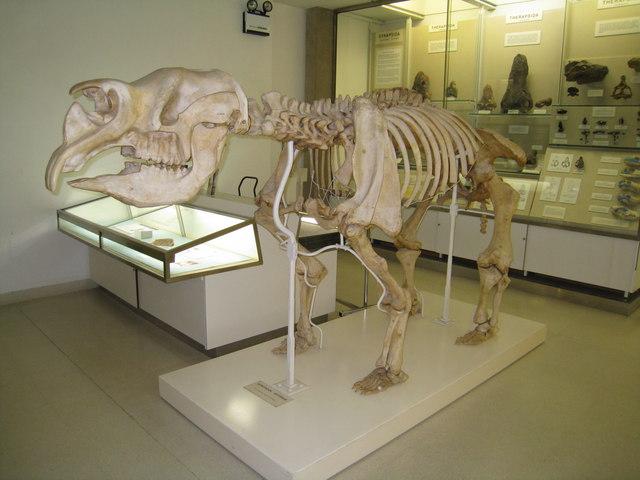
Diprotodon
Scientific Name(s) | Diprotodon optatum | ||||||||
|---|---|---|---|---|---|---|---|---|---|
Kingdom(s) | Animalia | ||||||||
Phylum | Chordata | ||||||||
Class | Mammalia | ||||||||
Order | Diprotodontia | ||||||||
Family | Diprotodontidae | ||||||||
Subfamily | Diprotodontinae | ||||||||
Genus | Diprotodon | ||||||||
Specie(s) | D. optatum | ||||||||
Dimension(s) | Length: ~4 m Height: ~1.8 m Weight: 2 000 kg 500–3 | ||||||||
Habitat | Throughout Australia (particularly southeastern eastern and interior regions) | ||||||||
Ecological Role | Herbivorous megaherbivore (generalist browser) | ||||||||
Distinguishing Feature | Enormous size, sexual dimorphism, pneumatised skull structure, large sinuses | ||||||||
Important Fossil Sites | Darling Downs, Lake Callabonna, Bacchus Marsh, Myall Creek, Nelson Bay | ||||||||
Diprotodon is recognized as the largest marsupial to have ever lived on the Australia continent and one of the most striking members of the Pleistocene megafauna. This massive animal, reaching lengths of approximately three metres and shoulder heights of 1.8 metres, was distinctly larger than most contemporary mammals, with a mass exceeding 2500 kilograms. Ecologically, Diprotodon fulfilled the role of Australia’s dominant herbivorous “big av animal,” occupying the megaherbivore niche represented in Eurasia by mammoths and in the Americas by mastodons. Like many other large land mammals, Diprotodon became extinct during the Late Pleistocene.
Taxonomically, Diprotodon has occupied a contentious position regarding species diversity throughout its history. Some of the species described in the 19th century were based solely on isolated and singular fossil specimens. This situation, combined with the presence of individuals of varying sizes, led to disagreements over the number of valid species. However, an assessment based on Gilbert J. Price’s comprehensive morphometric study revealed no significant morphological differences among these taxa. Consequently, it has been concluded that Diprotodon is a monophyletic genus containing only one valid species: Diprotodon optatum. The two distinct size classes observed in the fossil record are explained by sexual dimorphism, with larger individuals assumed to be male and smaller ones female.
Fossil remains of Diprotodon have been found across a wide variety of geographic regions in Australia. This broad distribution indicates that it was a generalist species capable of thriving in diverse ecosystems.
A large number of anatomical elements, including teeth, jaw fragments, and skull specimens, have been recovered. Teeth, particularly the P3 premolar and M1–M4 molar series, are of considerable importance for species identification and analysis of individual variation. Dental-based body mass estimates have revealed that size differences among individuals exhibit a sharp, non-continuous distribution. This supports the interpretation that these differences reflect sex-based variation rather than ontogenetic stages. Another fossil assemblage from the Nelson Bay Formation, composed of relatively small individuals, initially suggested the possible existence of a separate species. However, morphological and morphometric comparisons have demonstrated that these individuals also belong to D. optatum. This finding suggests that within the evolutionary lineage of Diprotodon, body size increased over time and that these individuals may represent transitional forms. The evolutionary origin of Diprotodon is traced back to the smaller Euryzygoma dunense, known from the Pliocene. The observed increase in body size along this lineage is likely an adaptation to environmental and biotic conditions.
The skull structure of Diprotodon exhibits notable features when compared to other mammals of similar size. The skull bones are extremely thin and extensively pneumatized with air spaces—that is, sinuses. Three-dimensional biomechanical modeling has shown that this structure served both to lighten the skull and to distribute the forces generated by the chewing muscles. Particularly large sinuses in the regions where the temporalis muscle attaches allow for efficient transmission of biting forces without compromising bone integrity, thereby enhancing the mechanical efficiency of the skull. Such an adaptation enabled Diprotodon, despite its massive body size, to maintain a relatively small brain volume while achieving a balanced architectural design in its head structure.
The paleoecological characteristics of Diprotodon have been illuminated to a significant extent through geological and taphonomic analyses of the sedimentary layers in which its fossils are found. This species had an extensive geographic range and is represented in Late Pleistocene deposits across nearly all regions of Australia, particularly in the southeast, east and interior areas. Fossils recovered from sites such as Darling Downs (Queensland), Lake Callabonna (South Australia), Bacchus Marsh (Victoria), Myall Creek, and Reddestone Creek (New South Wales) indicate assemblages comprising individuals of both sexes and various ages. This distribution suggests that Diprotodon was not restricted to specific habitats but was ecologically generalist. Indeed, it is proposed that it inhabited both open grasslands and more closed, wooded environments. Dietary analysis indicates that it was an herbivore, primarily feeding on grasses, herbs, and small shrubs.
Although direct observational evidence of Diprotodon’s social structure is lacking, the pronounced sexual dimorphism suggests a social organization similar to that of other megaherbivores. It is believed that large male individuals dominated females and that the species followed a polygynous reproductive strategy. Furthermore, it has been proposed that they formed sex-segregated herds, with males and females living in separate groups at different times. The presence of fossil assemblages containing only small-form individuals or only large-form individuals is interpreted as taphonomic evidence supporting this view. For example, fossils from Bacchus Marsh consist exclusively of small-form individuals and point to a mass mortality event. This scenario suggests that a female–juvenile herd may have perished en masse due to an abrupt environmental event.
The skull and jaw structure of Diprotodon carry not only anatomical but also behavioral and ecological significance. The skull, characterized by thin bone tissue and a widespread sinus system, presents a structurally lightweight yet robust form. Finite element analyses have demonstrated that this structure effectively disperses mechanical loads generated during chewing over a broad area. On the other hand, the expanded sinuses increased the surface area available for attachment of the temporalis muscle, potentially enabling a powerful bite. The lightening of the skull in this manner also provided advantages in terms of head support and balance. Despite having a relatively
Price, Gilbert J. *Taxonomy and Palaeobiology of the Largest-Ever Marsupial, Diprotodon Owen, 1838 (Diprotodontidae, Marsupialia)*. Zoological Journal of the Linnean Society 153, no. 2 (2008): 389–417. https://doi.org/10.1111/j.1096-3642.2008.00374.x.
Price, Gilbert J., and Katarzyna J. Piper. "Gigantism of the Australian Diprotodon Owen 1838 (Marsupialia, Diprotodontoidea) through the Pleistocene." *Journal of Quaternary Science* 24, no. 8 (2009): 1029–1038. https://doi.org/10.1002/jqs.1285.
Sharp, Alana C., and Thomas H. Rich. "Cranial Biomechanics, Bite Force and Function of the Endocranial Sinuses in Diprotodon optatum, the Largest Known Marsupial." *Journal of Anatomy* 228, no. 6 (2016): 984–995. https://doi.org/10.1111/joa.12456.

Diprotodon
Scientific Name(s) | Diprotodon optatum | ||||||||
|---|---|---|---|---|---|---|---|---|---|
Kingdom(s) | Animalia | ||||||||
Phylum | Chordata | ||||||||
Class | Mammalia | ||||||||
Order | Diprotodontia | ||||||||
Family | Diprotodontidae | ||||||||
Subfamily | Diprotodontinae | ||||||||
Genus | Diprotodon | ||||||||
Specie(s) | D. optatum | ||||||||
Dimension(s) | Length: ~4 m Height: ~1.8 m Weight: 2 000 kg 500–3 | ||||||||
Habitat | Throughout Australia (particularly southeastern eastern and interior regions) | ||||||||
Ecological Role | Herbivorous megaherbivore (generalist browser) | ||||||||
Distinguishing Feature | Enormous size, sexual dimorphism, pneumatised skull structure, large sinuses | ||||||||
Important Fossil Sites | Darling Downs, Lake Callabonna, Bacchus Marsh, Myall Creek, Nelson Bay | ||||||||
Taxonomy and Sexual Dimorphism
Fossil Distribution and Geographic Range
Morphology and Functional Anatomy
Biomechanical Features and Skull Function
Paleoecology and Behavioral Interpretations