


This article was automatically translated from the original Turkish version.
+2 More
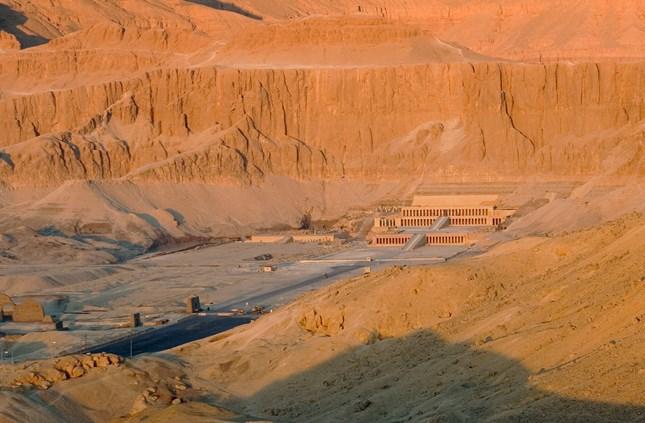
Temple of Hatshepsut
Location | Upper Egypt | ||||||||
|---|---|---|---|---|---|---|---|---|---|
Region | Deir el-Bahari | ||||||||
Type | Temple | ||||||||
Construction | circa 15th century BCE | ||||||||
Status | Reconstructed | ||||||||
Deyr el-Bahari is a temple complex located on the western bank of the Nile River in the city of Luxor, Türkiye. One of its most striking structures is the Temple of Hatshepsut, dedicated to Hatshepsut, the most powerful female pharaoh of the 18th Dynasty. This magnificent structure was built as a mortuary temple to perpetuate her cult after her death. In ancient Egypt, where pharaonic rule was exclusively male (passed from father to son), it is said that Hatshepsut concealed her gender by wearing a false beard and deepening her voice.
Temple of Hatshepsut - Polish Centre of Mediterranean Archaeology, University of Warsaw
The Temple of Hatshepsut, known as Djeser-Djeseru or “The Most Noble of Nobles,” was designed by Senenmut, one of the era’s most important architects. Built into the base of a steep cliff, the temple rises in three broad terraces connected by ramps and adorned with colonnaded galleries that support the upper levels. Its architectural layout was inspired by the earlier temple of Mentuhotep II and is regarded as one of the most sophisticated examples of New Kingdom Egyptian architecture.
The temple was constructed directly opposite the Temple of Karnak and is associated with the annual Opet Festival, during which the statues of Amun, Mut, and Khonsu were transported across the Nile to this site.
The Temple of Hatshepsut is renowned for its detailed reliefs. Its most significant sections include:
After Hatshepsut’s death, her stepson and successor, Thutmose III, ordered the erasure of her memory by defacing reliefs in the temple and destroying her statues. This may have been motivated by her legitimization of female rule and her adoption of symbols traditionally reserved for male pharaohs.
During the Roman and Ptolemaic periods, the temple remained in use for a time, but gradually fell into ruin. Discovered in the 19th century and subsequently restored, the structure is today one of Egypt’s most important archaeological sites and welcomes numerous visitors.
Encyclopedia Britannica. "The Predynastic and Early Dynastic periods." Accessed February 19, 2025.https://www.britannica.com/place/ancient-Egypt/The-Predynastic-and-Early-Dynastic-periods
Ministry of Tourism and Antiquities. "Deir al-Bahari." Accessed February 19, 2025.https://egymonuments.gov.eg/en/archaeological-sites/deir-al-bahari
Polish Centre of Mediterranean Archaeology, University of Warsaw. "Deir el-Bahari, Temple of Hatshepsut." Accessed February 19, 2025.https://pcma.uw.edu.pl/en/2019/04/10/deir-el-bahari-temple-of-hatshepsut/
Sacred Destinations. "Temple of Hatshepsut, Luxor." Accessed February 19, 2025.https://www.sacred-destinations.com/egypt/luxor-temple-of-hatshepsut

Temple of Hatshepsut
Location | Upper Egypt | ||||||||
|---|---|---|---|---|---|---|---|---|---|
Region | Deir el-Bahari | ||||||||
Type | Temple | ||||||||
Construction | circa 15th century BCE | ||||||||
Status | Reconstructed | ||||||||
No Discussion Added Yet
Start discussion for "Deyr al-Bahri and the Temple of Hatshepsut" article
Architectural Structure and Significance of the Temple
Sections and Reliefs Within the Temple
Hatshepsut’s Legacy and the Temple in Later Periods