


This article was automatically translated from the original Turkish version.
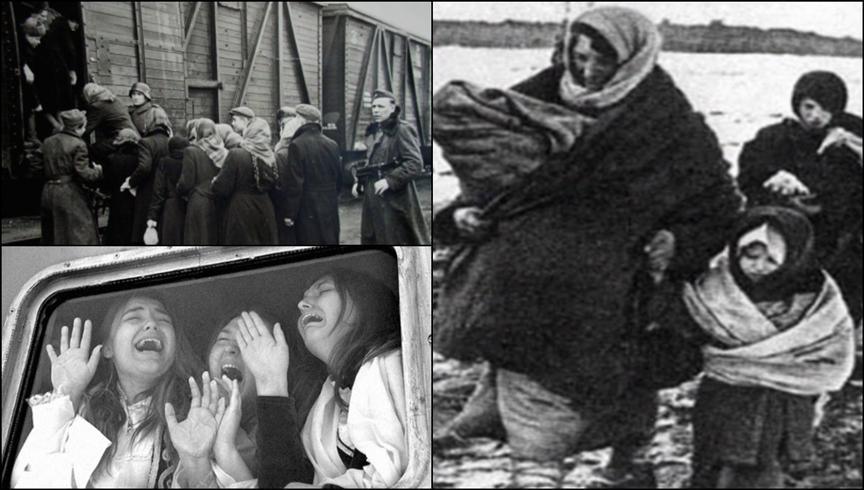
Deportation of the Crimean Tatars in 1944
History | 18 May 1944 – 20 May 1944 | ||||||||
|---|---|---|---|---|---|---|---|---|---|
Location of the Event | Crimean Peninsula → Uzbekistan, Kazakhstan, Siberia, Ural Region | ||||||||
Deported Population | Approximately 191,044 people | ||||||||
Estimated Loss | More than 44,000 deaths (especially children and the elderly); 20 percent loss within the first year | ||||||||
Mode of Transportation | Unventilated train cars with nailed shut doors, unsuitable even for transporting animals | ||||||||
The 1944 Crimean Tatar Deportation is the forced and sudden expulsion of the Crimean Tatar Turks from their homeland Crimea by the Soviet Union on 18 May 1944, due to their ethnic identity. They were deported en masse to various regions of Central Asia, primarily Uzbekistan.
This deportation was carried out within the framework of the Soviet regime’s forced relocation policies targeting certain ethnic groups. It resulted in the deaths of tens of thousands, the severing of the Crimean Tatars from their homeland, and severe damage to their linguistic and cultural structure. This event is regarded as a major social and humanitarian crisis in the recent history of the Turkish world.
Documentary on the Crimean Tatar Deportation (TRT Avaz)
The Crimean Peninsula, located north of the Black Sea and bordered by the Sea of Azov to the east and the Black Sea to the south and west, has been a strategic region attracting the attention of numerous nations throughout history. It drew interest not only due to its geographical position but also because of its natural resources and favorable climate for agriculture. Crimea served as both a military base and a gateway for states seeking dominance over the Black Sea and Eurasian geography.
Since ancient times, this land was inhabited by various peoples such as the Scythians, Sarmatians, and Alans. From the 7th century onward, it became a settlement area for Turkic tribes. In the 13th century, Crimea came under the rule of the Golden Horde and later emerged as an independent khanate in 1441 under the leadership of Hacı Giray, a descendant of Genghis Khan. In 1475, following Ottoman intervention in the region, the Crimean Khanate came under the protection of the Ottoman Empire, a status that lasted for approximately three centuries.
Documentary on the Crimean Tatar Deportation (TRT Arşiv)
The Crimean Tatars are a community shaped as the people of the Golden Horde and the Crimean Khanate, continuing the Kipchak steppe culture and possessing a Muslim Turkic identity. Formed from a mixture of Kuman, Pecheneg, Khazar, Oghuz, and various Mongol Turkic elements, the Crimean Tatars became the indigenous population of the region from the 15th century onward, defined by their language, religion, and cultural values.
Through intellectuals such as İsmail Gaspıralı, the Crimean Tatars experienced an intellectual awakening in the 19th century through the Ceditçilik movement, which promoted unity in language, thought, and work. They became one of the symbols of cultural revival both in Crimea and across the Turkish world.
During World War II, the Soviet Union targeted many peoples on the grounds of collaboration with Nazi Germany, beginning systematic deportations from 1943 onward. However, a significant portion of the Crimean Tatars fought in the ranks of the Red Army. It is recorded that 56.9 percent of the Crimean Tatar population participated in the Red Army and partisan movements, and it is documented that thousands of them lost their lives in the war.
Despite all this, on 11 May 1944, under Stalin’s order via Decree No. 5859, the Crimean Tatars were accused of “collective treason,” and an ethnic cleansing operation was launched. This decision aimed to completely remove the native Muslim Turkic population from strategic regions such as Crimea and to Slavicize the area.
The operation, which began at 03:00 on 18 May 1944, was carried out by NKVD units. Within three days, 180,014 Crimean Tatars were loaded onto train wagons unsuitable for transporting goods or livestock and sent to the Ural Mountains, Kazakhstan, and Siberia, primarily to Uzbekistan. On the same date, 11,000 men were conscripted as forced laborers to the rear fronts. In total, 191,044 people were removed from Crimea.
Thousands perished during the journey due to inadequate food, water, and hygiene. According to official Soviet data, approximately 20 percent of the deportees (about 44,000 people) died within the first year. The actual figures are believed to be higher. During the deportation, children and the elderly suffered disproportionately high mortality rates.
During the deportation, Soviet authorities forgot about the Arabat village, a Crimean Turk settlement located between the Sea of Azov and Sivash. The villagers, who lived by fishing and salt production, were not evacuated. Upon learning that the village had not been emptied, NKVD official Kobulov issued the order: “There will not be a single Crimean Turk left there within two hours.” However, the deportation trains had already departed and could not be reached. As a result, all Crimean Tatars in Arabat were loaded onto a large, old ship and locked in its hold. The ship was taken to the deepest part of the sea and sunk. Everyone on board drowned. Thus, not a single person survived from the village of Arabat. After this event, Kobulov was able to send his report to Moscow stating: “Crimea has been completely cleansed of Turks.”【1】
The deported Crimean Tatars were primarily resettled in cities such as Samarkand, Tashkent, Fergana, Namangan, and Andijan in Uzbekistan, where they were forced to live under a “special settlement regime.” Their freedom of movement was restricted, and basic needs such as healthcare, education, and housing were neglected.
During this period, the Crimean Tatars lived integrated within Uzbek society, leading to linguistic and cultural intermixing. Uzbek culinary terms (mantı, samsa, lagman), household items (dastarhan, çapan), and agricultural terminology entered Crimean Tatar Turkish. Even names on identity documents were written according to Uzbek orthography. As a result, deep linguistic and cultural interaction emerged within Crimean Tatar Turkish.
Although the Crimean Tatars were released from the camp regime in 1956, they were denied the right to return to Crimea. In the 1970s, the Soviet authorities offered them autonomy within Uzbekistan, but this proposal was rejected by the people. Finally, gradual returns began from 1989 onward. According to the 2001 census, Crimean Tatars constituted only 12 percent of Crimea’s population.
After the deportation, Russian, Ukrainian, and Armenian settlers were brought into the abandoned villages, completely altering the region’s demographic structure.
The 1944 deportation affected not only the Crimean Tatar people but the entire Turkish world. The deep-rooted Turkish presence in Crimea, one of the most significant cultural legacies of the Turkish world along the Black Sea, was nearly eradicated. Mosques were destroyed, cemeteries desecrated, place names were Russified, and efforts were made to erase the collective memory of the people.
This deportation is one of the most concrete examples of the Soviet Union’s systematic repression and assimilation policies toward Turkic peoples. The Crimean Tatar Deportation remains in collective memory not only as a historical trauma but also as a symbolic event that sustains the spirit of solidarity, cultural resistance, and the struggle for rights among the Turkish nation.
Folk Song on the Crimean Tatar Deportation (TRT Avaz)
Abdullayev, N. A. "Milliyetçilik Kuramı Çerçevesinde Kırım Tatar Türkleri’nin Değerlendirilmesi." Uluslararası İlişkiler ve Politika Dergisi 3, no. 2 (2023): 103–120.https://dergipark.org.tr/tr/pub/ulipod/issue/77931/1241926
Ayhün, Erşahin Ahmet. “Anılarla 18 Mayıs 1944 Sürgünü.” Eskişehir Osmangazi Üniversitesi İlahiyat Fakültesi Dergisi II (2015): 91–112.https://dergipark.org.tr/tr/pub/esoguifd/issue/29554/317135
Görgen, İsmail. “Kırım’ın Jeopolitik Önemi ve Kırım Türkleri.” ODÜ Sosyal Bilimler Araştırmaları Dergisi (ODÜSOBİAD) 12, no. 1 (2022): 283–300.https://dergipark.org.tr/tr/pub/odusobiad/issue/69019/1073217
Kurtbilal, Niyar. "1944 Sürgünü Sonrası Özbek Türkçesinden Kırım Tatar Türkçesine Geçen Kelimeler Üzerine Bir İnceleme." Türk Dünyası, no. 47 (2019): 195–228.
Morkva, Valeriy. “Rusya’nın 2014 İlhakı Sonrası Kırım’da Kırım Tatar Halkının Durumu.” Türk Dünyası İncelemeleri Dergisi 21, no. 2 (2021): 375–397.https://dergipark.org.tr/tr/pub/egetdid/issue/66570/984393
Pohl, J. Otto. "The Deportation of the Crimean Tatars in the Context of Settler Colonialism." International Crimes and History 16 (2015): 45–50.
TRT Arşiv. "Kırım Tatar Sürgünü -1 | TRT Arşiv." TRT Arşiv Youtube Kanalı. Accessed May 17, 2025.
TRT Avaz. "Biz Kırım'dan Çıkanda - Kırım - Türküğ Müzik Topluluğu - TRT Avaz." TRT Avaz Youtube Kanalı.
TRT Avaz. "Kırım Tatar Sürgünü - Belgesel - TRT Avaz." TRT Avaz outube Kanalı. Accessed May 17, 2025.
Tantan, Hatice Gonca Türkay, and Ferdi Güçyetmez. "Milliyetçilik Kuramı Çerçevesinde Kırım Tatar Türkleri’nin Değerlendirilmesi." Uluslararası İlişkiler ve Politika Dergisi 3, no. 2 (2023): 103–120.
Yıldız, Turhan. “Kırım Türklerinin 1944 Sürgününün 70. Yılında Kültür ve Sanattaki İz Düşümleri Üzerine Düşünceler.” Atatürk Üniversitesi Türkiyat Araştırmaları Enstitüsü Dergisi 51 (2014): 357–378.https://dergipark.org.tr/tr/pub/ataunitaed/issue/2890/40101
Özcan, Kemal. Kırım Türklerinin Sürgünü ve Vatana Dönüş Mücadelesi (1944–1990). Necmettin Erbakan Üniversitesi, Sosyal ve Beşeri Bilimler Fakültesi, Genel Türk Tarihi Bölümü.https://dergipark.org.tr/tr/download/article-file/3174188
Özkan, Nevzat. “Kırım Tatar Türkçesinin Yayılma Alanları.” Turkish Studies 3, no. 7 (2008): 523–530.https://turkishstudies.net/turkishstudies?mod=makale_tr_ozet&makale_id=13777
[1]
Kemal Özcan, *Kırım Türklerinin Sürgünü ve Vatana Dönüş Mücadelesi (1944–1990)*, Necmettin Erbakan Üniversitesi, Sosyal ve Beşeri Bilimler Fakültesi, Genel Türk Tarihi Bölümü, Düşünce Dünyasında Türkiz, pp. 56–57.

Deportation of the Crimean Tatars in 1944
History | 18 May 1944 – 20 May 1944 | ||||||||
|---|---|---|---|---|---|---|---|---|---|
Location of the Event | Crimean Peninsula → Uzbekistan, Kazakhstan, Siberia, Ural Region | ||||||||
Deported Population | Approximately 191,044 people | ||||||||
Estimated Loss | More than 44,000 deaths (especially children and the elderly); 20 percent loss within the first year | ||||||||
Mode of Transportation | Unventilated train cars with nailed shut doors, unsuitable even for transporting animals | ||||||||
No Discussion Added Yet
Start discussion for "Deportation of the Crimean Tatars in 1944" article
Geopolitical and Historical Crimea
Crimean Tatars
The Path to Deportation
The Deportation Process
The Arabat Tragedy: The Mass Execution of a Village
Life After Deportation: Forced Assimilation and Cultural Interaction
The Struggle for Return and Demographic Consequences
Consequences from the Perspective of the Turkish World