


This article was automatically translated from the original Turkish version.
+1 More
Curve fitting is a numerical analysis method that enables a dataset to be represented by a specific mathematical model. It is commonly applied to establish a relationship between discrete data points obtained through measurement or experimentation. This relationship is expressed through a functional structure, and the resulting model is expected to produce values as close as possible to the observed data.
The curve fitting process involves a series of data pairs
A lightly curved, simple model. It generally fits the data but may fail to accurately represent certain points.
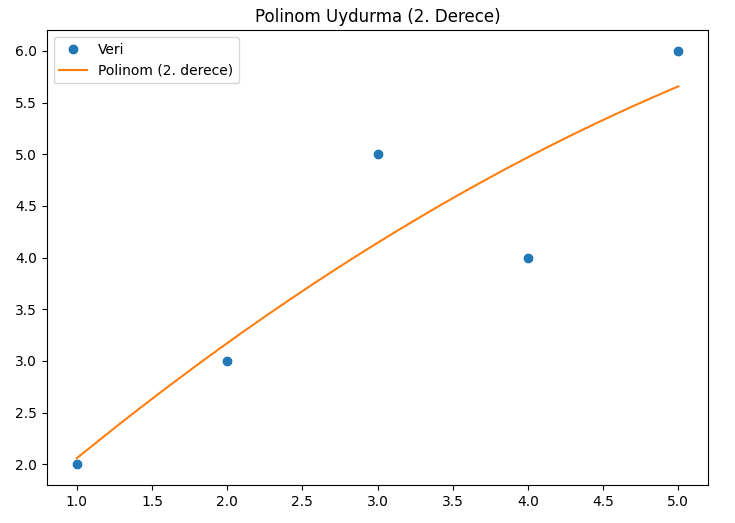
Author's own work.
Higher-degree polynomials are more flexible. Although they may appear to fit the data better, they can cause excessive oscillations (carrying a risk of overfitting).
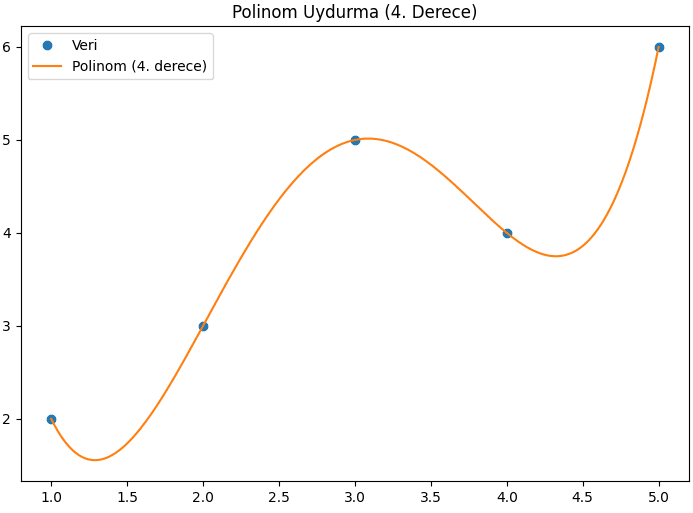
Author's own work.
Linear model (least squares): Assumes a constant trend throughout the entire dataset.
Exponential model: More suitable when growth or decline is accelerating. In this example, it shows excessive growth and is therefore not appropriate for the data.
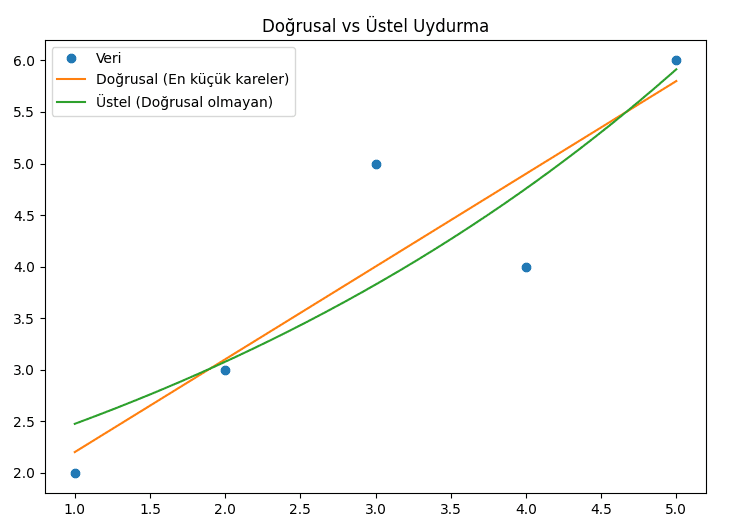
Author's own work.
Performed using piecewise cubic polynomials. It ensures a smooth and continuous transition between data points, providing a flexible and precise fit to the data.
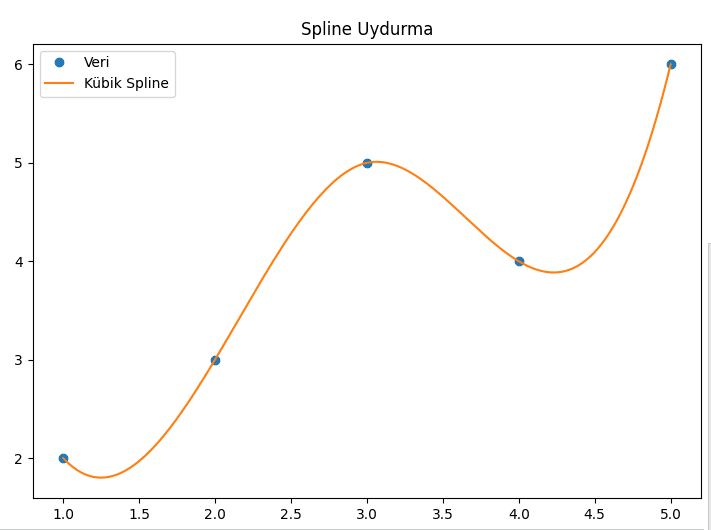
Author's own work.
The suitability of a model is assessed using various statistical indicators. The most common is the coefficient of determination
Here, represents the mean of the observed values. A value of approaching 1 indicates a high degree of fit between the model and the data.
Curve fitting is applied across diverse fields such as engineering, physics, biology, economics, and data science. It is used for modeling experimental results, constructing prediction systems, and determining system parameters.
As model complexity increases, the risk of overfitting also rises. This results in a model that fits the existing data well but performs poorly on new data. Therefore, when selecting a model, its generalization capacity must also be considered.
Tektaş, Mehmet. "MATLAB Eğri Uydurma (Curve Fitting)." tektasi.net. Accessed May 2025. Accessed Adresi.
Yükselen, M.A. "Eğri Uydurma ve İnterpolasyon." HM504 Uygulamalı Sayısal Yöntemler Ders Notları. İstanbul Teknik Üniversitesi. Accessed May 2025. Accessed Adresi.

Methods
Polynomial Approximations
Least Squares Method
Nonlinear Fitting
Spline Fitting
Example Scenario
Polynomial Fitting (Second Degree)
Polynomial Fitting (Fourth Degree)
Linear and Exponential Models
Cubic Spline Fitting
Evaluation Criteria
Applications
Warnings and Limitations