


This article was automatically translated from the original Turkish version.
Art has been a powerful tool for human self-expression from the past to the present. For children, however, art is less an aesthetic activity and more an activity that develops their imagination and allows them to express their emotions freely. The importance of children’s art lies not only in its ability to reveal their creative potential but also in its contribution to their cognitive, emotional and social development.
Children’s art consists of original activities. It is typically a process through which children naturally reflect their creativity and imagination without adult intervention or direction. The most distinctive feature of children’s art is that children do not share the aesthetic concerns of adults and instead employ a free form of expression.
Art is not merely an entertaining activity for children; it is also a process that enables them to express themselves. While drawing or coloring, children attempt to make sense of their environment and the world around them. This process also expresses their emotional states and social relationships.
Children’s art is also significant in terms of cognitive development. Colors and shapes contribute to the development of children’s hand-eye coordination and creativity. Therefore, it is important to understand and support this stage to ensure healthy child development.
Children’s artistic development occurs in distinct stages, each providing opportunities to enhance their motor skills. The purpose of their drawings is usually not aesthetic but rather the act and experience of movement itself.
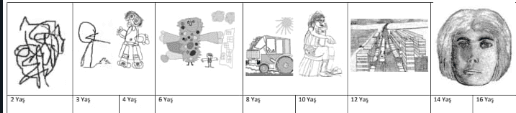
class=\
This stage marks the beginning of children’s artistic development. Children use their motor skills to produce chaotic and uncontrolled drawings. Although these scribbles may appear random, they provide children with opportunities to explore their surroundings and their own movements. The purpose of these drawings is not aesthetic but rather the act and experience of movement itself.
During this stage, children begin to use symbols to represent objects in their environment. They draw people and objects in simple but consistent forms. For example, a human figure is typically represented by a head, a torso and stick-like limbs. Children create a mental order by transforming what they see into basic shapes.
The transitional stage is characterized by children incorporating more detail and realistic elements into their drawings. Children strive to develop an awareness of concepts such as perspective, but these skills are still not fully developed. They express a desire to represent their surroundings in a more realistic manner.
During this stage, children strive to include greater detail and realistic proportions in their drawings. They begin to focus on elements such as perspective, proportion and symmetry. Children’s artistic output may be influenced by their social environment and their process of self-evaluation. The opinions of others play an important role in shaping children’s motivation for art.
In this stage, the individual consciously chooses forms of artistic expression. The process of viewing art as a means of communication or expressing oneself in alternative ways develops. While some individuals become more interested in artistic pursuits during this stage, others may distance themselves from art.
Children’s artistic productions reflect their natural creativity, rich imagination and original perspectives, free from aesthetic concerns. This situation has attracted the attention of many adult artists and served as a source of inspiration.
Children are free to understand and represent the world as they wish. This freedom is also evident in the works of many adult artists. For example, Pablo Picasso emphasized the uniqueness of children’s art, stating, “Every child is an artist. The difficult part is remaining an artist when we grow up.”
The aesthetic-free, simple and natural mode of expression in children’s art has also inspired many artists. For instance, artists such as Henri Matisse and Joan Miró drew inspiration from children’s simple and original drawing techniques. Children’s disproportionate depictions of objects and their creatively imaginative works have led to the emergence of new forms of expression in art.
In conclusion, the unique and natural modes of expression found in children’s art have served as a source of inspiration for adults in creating original works.
Kırışoğlu, O. T. Çocukluktan Gençliğe Sanatsal Gelişme. Ankara: Pegem Yayınları, 2002.
Lowenfeld, Viktor, and W. Lambert Brittain. Creative and Mental Growth. New York: Macmillan, 1987.
Malchiodi, Cathy A. The Art Therapy Sourcebook. New York: McGraw-Hill, 1998.
Milli Eğitim Dergisi. "Çocukların Sanatsal Gelişimi Üzerine Bir İnceleme." Milli Eğitim Dergisi, no. 195 (2017). Accessed February 9, 2025.https://dergipark.org.tr/tr/pub/milliegitim/issue/36937/422285.
Picasso, Pablo. "Çocuk Sanatı ve Modern Sanat İlişkisi Üzerine Yorumları." Yayım tarihi belirtilmemiş.

Children’s Art
Stages of Children’s Artistic Development
Scribbling Stage (Ages 2–4)
Schematic Stage (Ages 4–7)
Transitional Stage (Ages 7–9)
Realism Stage (Ages 9–12)
Decision-Making Stage (Age 12 and Above)
The Influence of Children’s Art on Adult Art