


This article was automatically translated from the original Turkish version.
+2 More
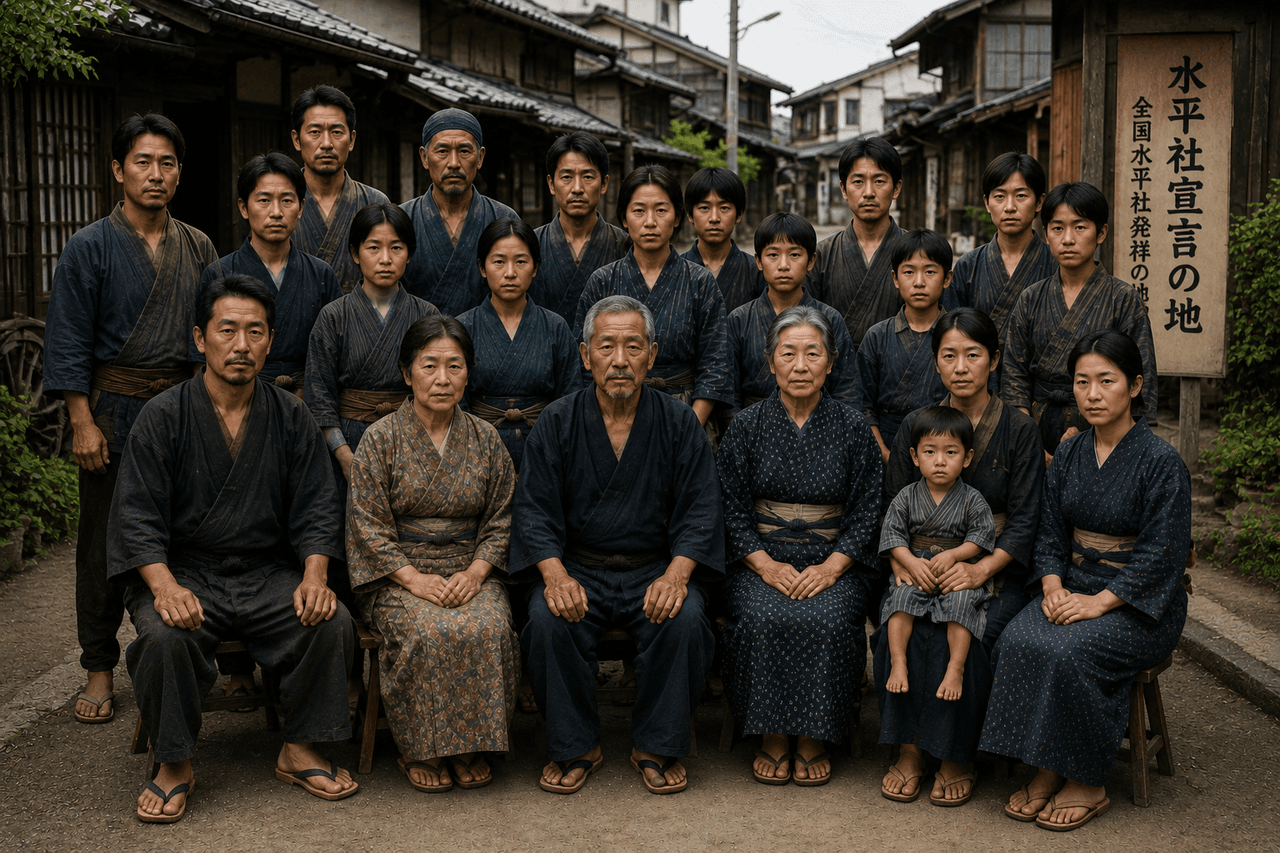
Burakumin (Generated with Artificial Intelligence.)
Ethnic Origin | Native Japanese population | ||||||||
|---|---|---|---|---|---|---|---|---|---|
Estimated Population | Between 1 million (official data, 1993) and 3 million (BLL estimate) | ||||||||
Historical Origin | 8th century (Taika Restoration / Ryōmin-Senmin distinction) | ||||||||
Legal Status Change | 1871 (Kaihō-rei / Emancipation Edict) | ||||||||
Rights Advocacy Organization | Buraku Liberation League | ||||||||
Historical Professions | Butchery Pottery Executioner Funeral services | ||||||||
Burakumin (literally meaning "village people" or "hamlet people") is an indigenous Japanese group historically marginalized and subjected to social isolation due to roots extending back to Japan's feudal era and traditional caste system, which has led to their classification as a minority.【1】 This community cannot be distinguished biologically or racially from the rest of the Japanese population; social differentiation has been entirely shaped by historical residential patterns and family registry records (koseki).
The origins of the Burakumin community lie in the social stratification that emerged in 8th century Japan, grounded in Confucian hierarchical order and religious belief systems. Initially, following the Taika Reform of 701, the population was legally divided into two main classes: "Ryomin" (good people) and "Senmin" (low or second-class people), and marriage between these castes was strictly prohibited by law.【2】
This structural division evolved over subsequent centuries into a mechanism of exclusion through its fusion with Shinto and Buddhist beliefs regarding "impurity," "unsanctity," and contact with death. Activities such as slaughtering animals, bloodletting, or handling human corpses were considered spiritually polluting, leading to the groups performing these tasks being pushed to the margins of society.
By the Tokugawa period (1603–1867), this social isolation had become fully institutionalized, with the population legally fixed into two distinct castes: "Eta" (abundance of filth) and "Hinin" (non-human). The Eta class, engaged in physically demanding trades such as butchery, execution, tanning, shoemaking, animal trapping, cleaning, and garbage collection, and the Hinin class, involved in itinerant entertainment, begging, and prostitution, were placed at the lowest rung of the feudal hierarchy and spatially segregated.【3】 These individuals lived in communities entirely separate from ordinary villages, subject to restrictions in clothing, freedom of movement, and other aspects of daily life, and were legally valued at only one-seventh the worth of a common person. Their descendants, over centuries of systemic degradation, formed the historical foundation of today's modern "Burakumin" (hamlet people) identity.
With the Meiji Restoration and Japan's modernization process, the feudal structure was formally dismantled by the Kaihō-rei (Emancipation Edict), also known as the Senshō-haish-rei (Abolition of Status Designations), issued in 1871. This edict legally abolished the rigid caste system and discontinued the official use of status labels such as Eta and Hinin. However, this measure failed to eliminate social prejudice; legal equality did not translate into social acceptance.
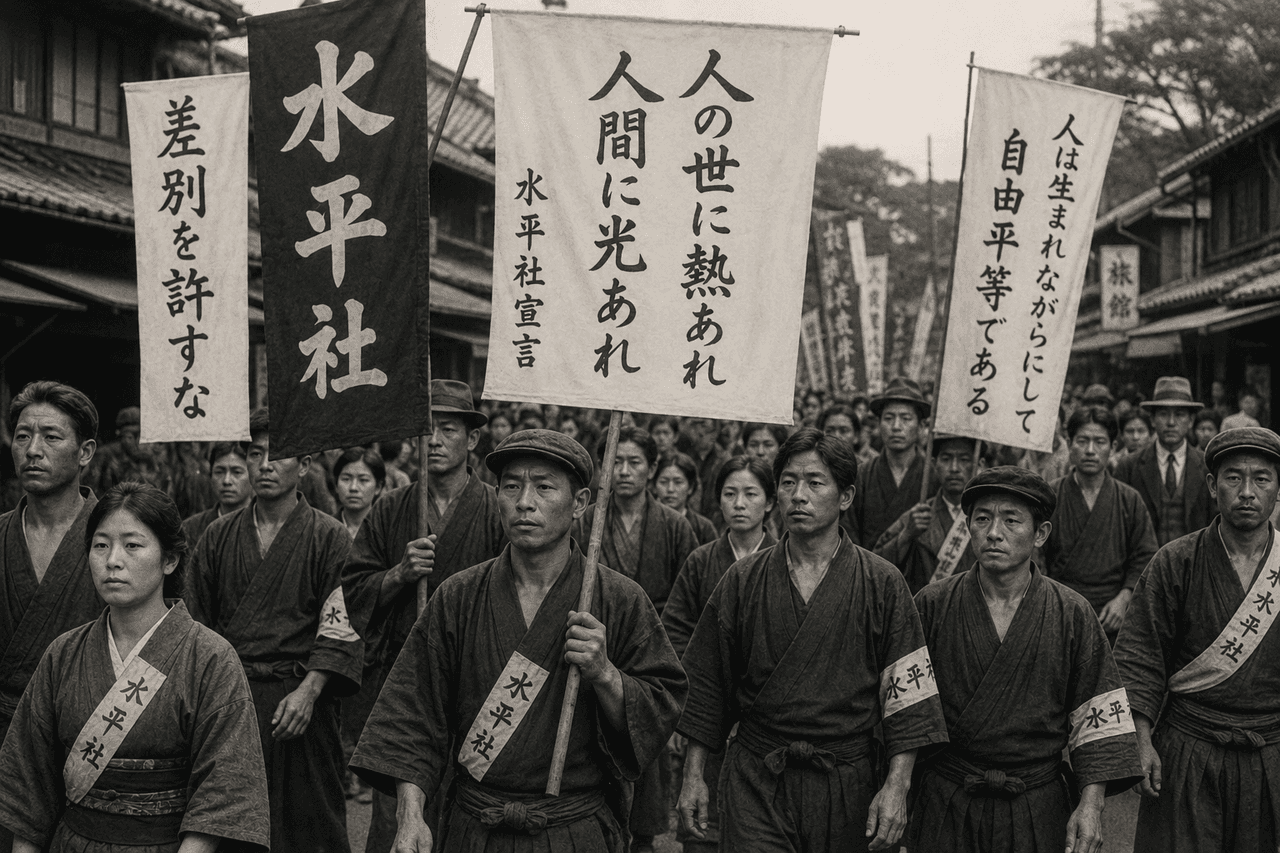
Burakumin Topluluğu ve Yasal Hareketler (Yapay Zeka ile Oluşturulmuştur.)
Burakumin individuals continued to be registered in official records using covert labeling such as "former Eta" or the exclusionary term Shin-heimin (new commoners). Moreover, this legal transformation stripped Burakumin of historical monopolies over certain trades such as leatherworking and revoked tax exemptions, leaving them economically vulnerable.
Mainstream societal groups perceived this formal equality as a threat to their social position, resulting in widespread protests, violent incidents, and clashes across the country. During this period, many Burakumin villages were burned and the community became the target of physical attacks.【4】 The failure of legal reforms prompted Burakumin communities to adopt organized strategies from the early 20th century onward to defend their rights.
In 1918, the growing "Rice Riots" (Kome Sōdō), driven by economic injustice, marked a turning point when Burakumin joined mass street demonstrations and developed political consciousness. As a result of this social mobilization, the Suiheisha (Association for the Emancipation) was founded in Kyoto on March 3, 1922.【5】 Suiheisha launched a human rights struggle based on human dignity and implemented an active "accountability and denunciation" (kyōdan) strategy against anyone using discriminatory language or exhibiting exclusionary attitudes.
After World War II, renewed social activism led to the establishment of the Buraku Liberation Committee in 1946, which by 1955 had transformed into a civil society organization known today as the Buraku Liberation League (BLL). The BLL exerted public pressure on the Japanese state through political lobbying, mass protests, and taking discrimination cases to court.【6】
As a result of this struggle and the denunciation campaigns, the Japanese government was forced to retreat. In 1969, the Special Measures Law for Dowa (Assimilation) Communities was enacted, aiming to equalize infrastructure, housing quality, education levels, and economic standards in urban and rural areas with high concentrations of Burakumin populations to those of mainstream Japanese society.【7】 These rehabilitation and integration programs, funded with billions of yen, narrowed the gap between regions and continued until 2002 through successive legislative extensions.【8】
Burakumin Topluluğu (Yapay Zeka ile Oluşturulmuştur.)
The demographic size of the Burakumin community within Japanese society remains contested due to differences in data collection methods and definitions used by official institutions and civil society organizations. According to the last official survey conducted by the Japanese government in 1993, approximately one million citizens of Burakumin origin resided in over 4,000 officially recognized "Dowa" (assimilation) areas nationwide.【9】 In contrast, the Buraku Liberation League (BLL), as a human rights advocacy group, argues that these official figures fail to account for excluded regions.【10】
Based on its own field studies, the BLL estimates that the number of settlements with historical ties to marginalized communities approaches 6,000, with a total population of nearly three million tracing such origins.【11】 Although the Japanese constitution and current legislation prohibit all forms of discrimination, Burakumin-origin individuals continue to face institutionalized and implicit social exclusion in daily life, particularly in employment and marriage decisions.【12】
One concrete example of this exclusion came to light in the 1970s, when a 330-page handwritten document known as the "Buraku Lists" (Buraku Chimei Sōkan) was secretly compiled, containing maps of Burakumin neighborhoods, common family surnames, occupations, and specific community characteristics.【13】 These illegal intelligence lists were secretly sold to numerous companies, including major Japanese conglomerates, whose human resources departments used them to systematically screen job applicants and exclude those of Burakumin origin.【14】
Burakumin Topluluğunun Üyelerini, Geleneksel Bir Japon Yerleşiminde Birlikte Gösteren Bir Görsel (Yapay Zeka ile Oluşturulmuştur.)
This spatial profiling in social memory has generated new controversies in the digital age; in 2009, Google Earth's integration of feudal-era maps of cities such as Tokyo and Kyoto made the precise modern locations of former Burakumin villages publicly visible, intensifying debates about the resurgence of historical prejudice through digital profiling.【15】
The centuries-long cycle of social and economic marginalization has generated psychological and sociological problems among younger generations of the community. Some Burakumin youth, facing prejudice in education and employment, have been drawn into the ranks of the Japanese organized crime syndicate, the Yakuza, seeking social belonging and economic power.【16】 Due to this phenomenon, it is estimated that a portion of today's Yakuza members have Burakumin ancestry.【17】
On the other hand, the stigma created by historical prejudice is not limited to bloodline alone. Today, workers engaged in historically deemed "impure" or "unclean" occupations—such as slaughterhouses, meat processing, butchery, or industrial waste cleanup—are socially excluded by their communities and targeted with hate mail, messages, and graffiti, even if they are not genetically descended from Burakumin.【18】
Nevertheless, despite these structural problems, public awareness campaigns led by civil society organizations, the inclusion of human rights topics in educational curricula, and recent court rulings in Japan awarding compensation in cases of hate speech and discrimination represent measures implemented in the fight against discrimination.
BBC. "Japan's hidden caste of untouchables." Accessed July 18, 2026.https://www.bbc.com/news/world-asia-34615972
Laidlaw, Ian R. "The Origins and Future of the Burakumin". University of Otago, pp. 3–192. Accessed July 18, 2026.
Werly, Richard. "The Burakumin, Japan's invisible outcasts." UNESCO 54, no. 9 (2001): 1-52. Accessed July 18, 2026.https://unesdoc.unesco.org/ark:/48223/pf0000123476
Yıldız, Kemal, and Bilal Coşan. “Kötü İşler Ile Dışlanmış Sınıfların Eşlenikliği: Burakumin Örneği”. *Ekonomi İşletme Ve Maliye Araştırmaları Dergisi* 6, no. 1 (2024): 64–78. Accessed July 18, 2026.https://doi.org/10.38009/ekimad.1447901
[1]
Kemal Yıldız ve Bilal Coşan, “Kötü İşler Ile Dışlanmış Sınıfların Eşlenikliği: Burakumin Örneği”. Ekonomi İşletme Ve Maliye Araştırmaları Dergisi 6 (1): 72-73, https://doi.org/10.38009/ekimad.1447901
[2]
Yıldız ve Coşan, “Kötü İşler Ile Dışlanmış Sınıfların Eşlenikliği: Burakumin Örneği, ”71-72.
[3]
Yıldız ve Coşan, “Kötü İşler Ile Dışlanmış Sınıfların Eşlenikliği: Burakumin Örneği, ” 72.
[4]
Richard Werly, "The Burakumin, Japan's invisible outcasts." UNESCO, Volume 54, no. 9, p. 30, Accessed July 18, 2026.
[5]
Yıldız ve Coşan, “Kötü İşler Ile Dışlanmış Sınıfların Eşlenikliği: Burakumin Örneği, ” 74.
[6]
Yıldız ve Coşan, “Kötü İşler Ile Dışlanmış Sınıfların Eşlenikliği: Burakumin Örneği, ” 74.
[7]
Yıldız ve Coşan, “Kötü İşler Ile Dışlanmış Sınıfların Eşlenikliği: Burakumin Örneği, ” 74.
[8]
Yıldız ve Coşan, “Kötü İşler Ile Dışlanmış Sınıfların Eşlenikliği: Burakumin Örneği, ” 74.
[9]
Yıldız ve Coşan, “Kötü İşler Ile Dışlanmış Sınıfların Eşlenikliği: Burakumin Örneği, ” 74.
[10]
Yıldız ve Coşan, “Kötü İşler Ile Dışlanmış Sınıfların Eşlenikliği: Burakumin Örneği, ” 74.
[11]
Yıldız ve Coşan, “Kötü İşler Ile Dışlanmış Sınıfların Eşlenikliği: Burakumin Örneği, ” 74.
[12]
Yıldız ve Coşan, “Kötü İşler Ile Dışlanmış Sınıfların Eşlenikliği: Burakumin Örneği, ” 75.
[13]
BBC. "Japan's hidden caste of untouchables." Accessed July 18, 2026.
[14]
BBC. "Japan's hidden caste of untouchables."
[15]
BBC. "Japan's hidden caste of untouchables."
[16]
BBC. "Japan's hidden caste of untouchables."
[17]
BBC. "Japan's hidden caste of untouchables."
[18]
BBC. "Japan's hidden caste of untouchables."

Burakumin (Generated with Artificial Intelligence.)
Ethnic Origin | Native Japanese population | ||||||||
|---|---|---|---|---|---|---|---|---|---|
Estimated Population | Between 1 million (official data, 1993) and 3 million (BLL estimate) | ||||||||
Historical Origin | 8th century (Taika Restoration / Ryōmin-Senmin distinction) | ||||||||
Legal Status Change | 1871 (Kaihō-rei / Emancipation Edict) | ||||||||
Rights Advocacy Organization | Buraku Liberation League | ||||||||
Historical Professions | Butchery Pottery Executioner Funeral services | ||||||||
Origins
Legal Transformation and Liberation Movements
Current Status