This article was automatically translated from the original Turkish version.
+1 More
Location | Çiftlikköy Türkiye Yalova | ||||||||
|---|---|---|---|---|---|---|---|---|---|
Period(s) | Byzantine 6th–9th centuries | ||||||||
Usage | Bath, then church | ||||||||
Plan | Cruciform domed | ||||||||
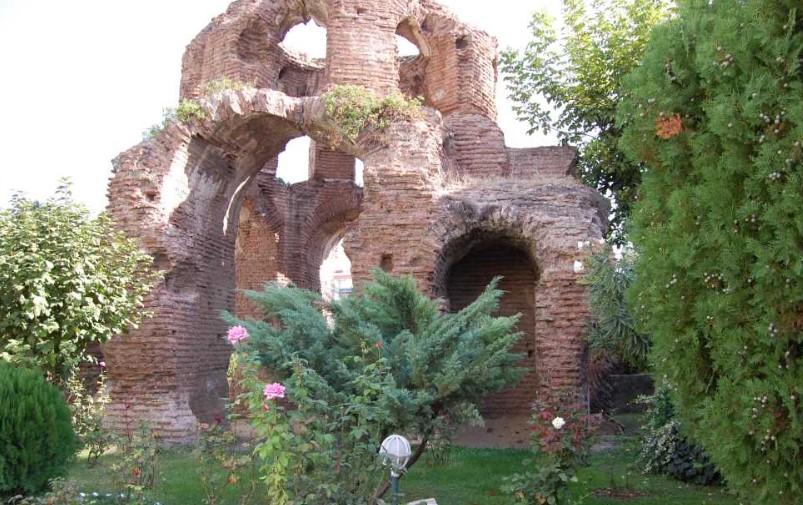
The Kara Kilise, located within the boundaries of Çiftlikköy district in Yalova Province, is a multi-layered structure dating from the early Byzantine period, with architectural features spanning from the late antique to the middle Byzantine era. Originally constructed as a bathhouse, it later functioned as a church; some sources describe it as a Roman-era water structure.
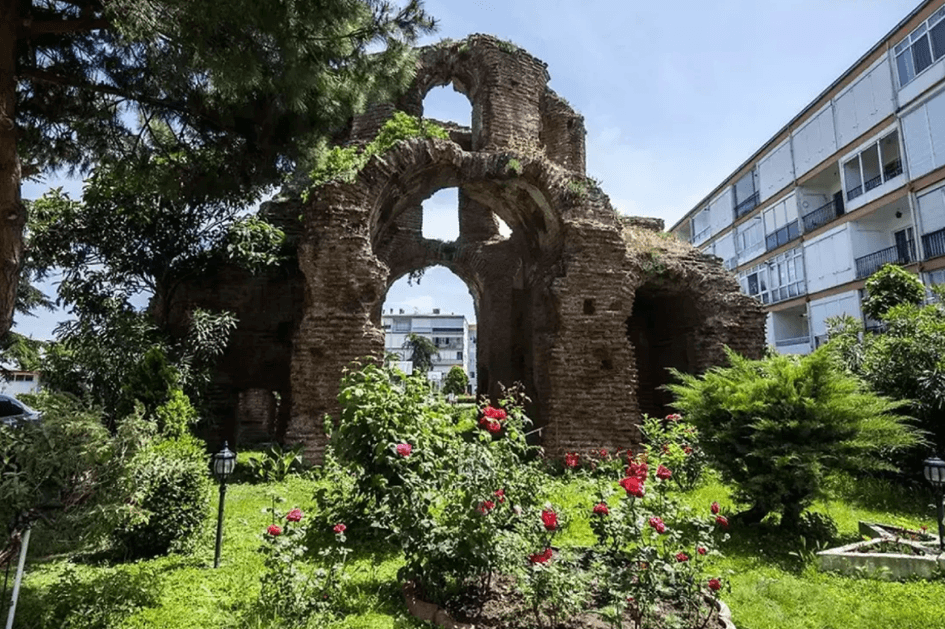
Kara Kilise (Çiftlikköy Municipality)
The area where Kara Kilise stands was known as Pylai during the Byzantine period. The settlement has been documented since the 4th century AD and became a significant center of habitation particularly between the 11th and 12th centuries. Along the coast, summer palaces belonging to prominent figures of the era have been identified. It is generally accepted that Kara Kilise was used as a bathhouse in the 6th century AD and was later converted into a church during the 8th and 9th centuries. Stelae and other archaeological finds excavated around the structure are exhibited at the Istanbul Archaeology Museums.
Kara Kilise is a cruciform structure measuring 13 metres north-south and 10 metres east-west, with a wall thickness of 5.5 metres. The north-south axis of the cross is longer than the east-west axis, giving it a resemblance to a Latin cross. Four enclosed spaces (exedras) are located at the corners of the structure. The eastern corner chamber contains three doorways opening into the eastern arm of the cross the naos and the exterior. The western corner chamber has two doorways. These chambers are believed to have served functions such as preparation for liturgical services and storage of sacred objects.
The ends of the eastern, western and northern arms of the cross are open. Along the northern arm axis there are two lateral exit openings. In the central space, a dome with a diameter of 5.5 metres rests on an octagonal drum with eight windows. The upper part of the dome is entirely open. The arms of the cross are covered with barrel vaults. A double narthex and an apse were added to the structure at a later stage.
Detailed information regarding restoration or conservation works on Kara Kilise is not available in the sources. Today the structure survives primarily through its exterior wall remains and architectural details.
Surrounding Kara Kilise, remains of an ancient harbor, aqueduct fragments and numerous stelae have been discovered. These finds reflect the socio-cultural and religious structure of the period and are exhibited at the Istanbul Archaeology Museums. The area is recognized as an important settlement during the Byzantine period.
T.C. Ministry of Culture and Tourism. "Kara Kilise." *Kültür Portalı*. Accessed August 16, 2025. https://www.kulturportali.gov.tr/turkiye/yalova/kulturenvanteri/kara-kilise
T.C. Çiftlikköy District Governorship. "Kara Kilise." Çiftlikköy District Governorship Official Website. Accessed August 16, 2025. http://www.ciftlikkoy.gov.tr/kara-kilise
Çiftlikköy Municipality. "Kara Kilise." *Çiftlikköy Municipality.* Accessed August 16, 2025. https://www.yalovaciftlikkoy.bel.tr/tarihi-merkez/7

Location | Çiftlikköy Türkiye Yalova | ||||||||
|---|---|---|---|---|---|---|---|---|---|
Period(s) | Byzantine 6th–9th centuries | ||||||||
Usage | Bath, then church | ||||||||
Plan | Cruciform domed | ||||||||
History
Architectural Features
Restoration Efforts
Archaeological Finds and Surroundings