


This article was automatically translated from the original Turkish version.
+2 More
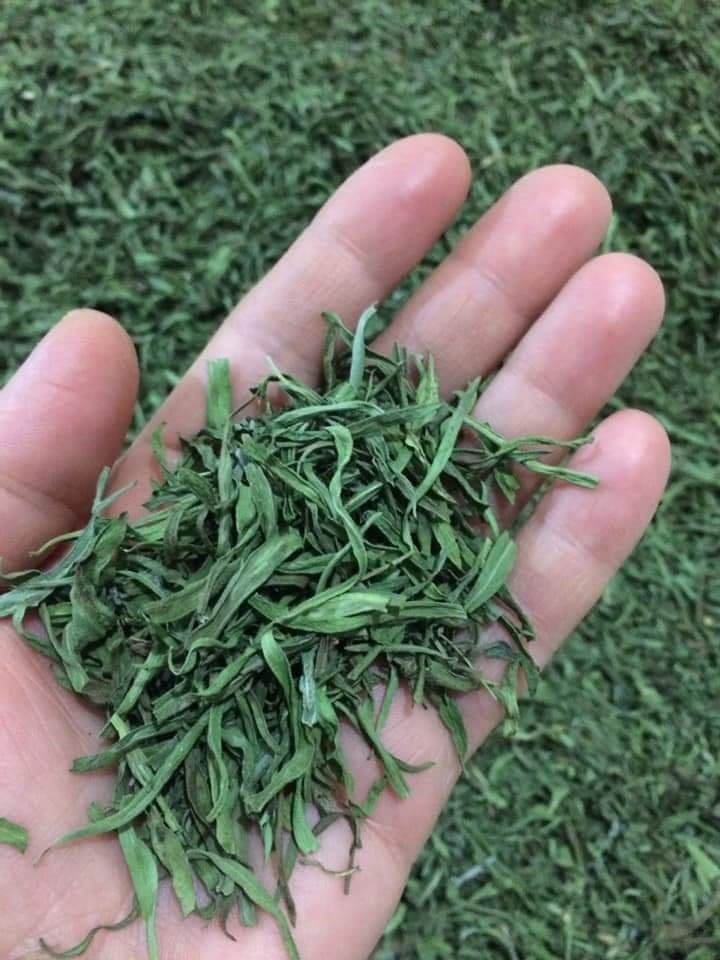
Bayburt Tarhunu
Product / Product Group | spices/flavorings for food sauces and salt | ||||||||
|---|---|---|---|---|---|---|---|---|---|
Applicant / Registrant | Bayburt University | ||||||||
Registration Date | 15.04.2025 | ||||||||
File Number | C2024/000153 | ||||||||
Registration Number | 1722 | ||||||||
Bayburt tarhunu, a perennial herb belonging to the species Artemisia dracunculus L., is cultivated in the province of Bayburt in Türkiye. It was officially registered with the Turkish Patent and Trademark Office on 15 April 2025 under the designation of “Origin Name”.
Bayburt Tarhunu is a perennial shrub-like plant with a taproot and short lateral roots. Its stem is light green in color and circular in cross-section, reaching a height of 30–45 cm. The leaves are pointed, thorn-like, slightly toothed, and vary in color from light green to dark green, with a slightly hairy surface.
The 1550-meter elevation of Bayburt and the microclimate conditions in the valleys around the Çoruh River directly influence the quality and yield of the product. The plant is resistant to temperatures as low as -35°C. The soil in which it grows has a slightly alkaline pH (7.7–7.9), high lime content (17.31%), high potassium levels (43.8 kg/da), and low salinity (0.01%).
Bayburt Tarhunu is distinguished by its high levels of fixed oil (5.39–7.022%), dry matter (34.16–41.62%), and volatile oil content (0.30–1.40%). Forty-two compounds have been identified in its volatile oil, most of which contribute to its aromatic profile. The most prominent components include estragole, camphor, 1,8-cineole, borneol, and linalool.
Bayburt Tarhunu is propagated exclusively by vegetative means (root division). Seedling production begins at the end of April through the division of roots from mother plants. Seedlings are planted with a row spacing of 50–60 cm and a plant spacing of 40–50 cm within rows. The plant forms clumps with a diameter of 25–30 cm within three years. When necessary, it is transplanted to other areas within the same parcel or to new parcels.
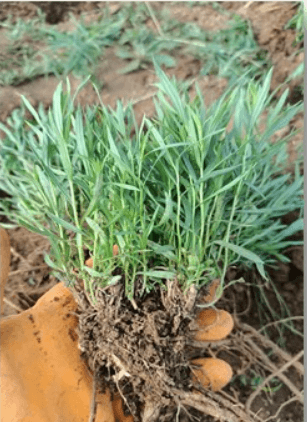
Bayburt Tarhunu Dikim (Bayburt Üniversitesi)
No irrigation is performed until the first harvest. Natural rainfall supports plant development during the year. Weekly irrigation is carried out after each harvest. The plant is weeded three times before the first harvest and once after each subsequent harvest. Weeding is performed to aerate the soil and control weeds.
The soil is prepared before seedling planting with well-rotted farmyard manure. Nitrogen fertilizer at a rate of 15 kg/da is applied in spring. Mechanical methods are preferred over chemical interventions for weed and disease control. Problematic seedlings are removed from the production area if necessary.
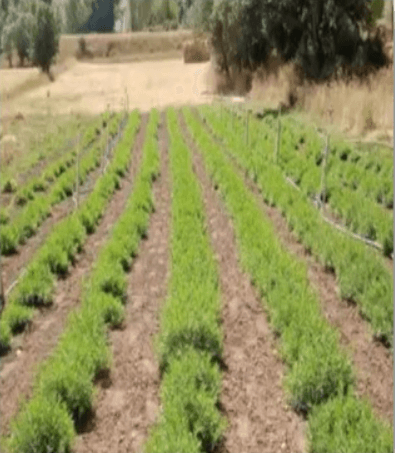
Bayburt Tarhun Bahçesi (Bayburt Üniversitesi)
Bayburt Tarhunu is harvested three times per year: 1–20 June, 1–15 August, and 15–25 September. Harvesting is done with a sickle, cutting at the base of the stem just above ground level. Drying is carried out in well-ventilated areas protected from direct sunlight. After separation from the main stem, the leaves are sorted, cleaned, and packaged according to size. A proper drying method preserves the leaf color.
The product is stored in dry cloth bags or plastic packaging. It is recommended to store it in a cool and dry environment.
Production of the product is restricted exclusively within the boundaries of Bayburt Province. Monitoring is conducted by a commission of at least three members coordinated by Bayburt University, comprising representatives from the university, the Provincial Directorate of Agriculture, the Chamber of Agriculture, and producers. Monitoring is carried out at least once per year and may be increased upon complaint or on a periodic basis as needed.
Bayburt Valiliği. (n.d.). "Vali Cüneyt Epcim: Tarhunu Bayburt’un Markası Haline Getirmek İstiyoruz." Accessed May 27, 2025.http://www.bayburt.gov.tr/vali-cuneyt-epcim-tarhunu-bayburtun-markasi-haline-getirmek-istiyoruz
Bayburt Üniversitesi. (2024). *Bayburt Tarhunu’nun Coğrafi İşaret Tescili*. Accessed May 27, 2025.https://www.bayburt.edu.tr/tr/universitemizden-bolgesel-kalkinmaya-onemli-katki-bayburt-tarhununun-cografi-isaret-tescili-aldik
Bayburt Üniversitesi. (2024). *Şehrimize ve Çiftçilerimize Müjde: Bayburt Tarhunu Resmi Olarak Tescilledik*. Accessed May 27, 2025.https://bayburt.edu.tr/tr/sehrimize-ve-ciftcilerimize-mujde-bayburt-tarhununu-resmi-olarak-tescilledik
Turk Patent and Trademark Office. "Bayburt Tarhunu." Geographical Indication Registration Certificate No: 1722. Accessed June 4, 2025.https://ci.turkpatent.gov.tr/cografi-isaretler/detay/11387

Bayburt Tarhunu
Product / Product Group | spices/flavorings for food sauces and salt | ||||||||
|---|---|---|---|---|---|---|---|---|---|
Applicant / Registrant | Bayburt University | ||||||||
Registration Date | 15.04.2025 | ||||||||
File Number | C2024/000153 | ||||||||
Registration Number | 1722 | ||||||||
Product Description and Distinctive Characteristics
Production Method
Propagation and Planting
Irrigation and Weeding
Fertilization and Pest Control
Harvesting and Drying
Packaging and Storage
Geographical Boundary and Monitoring