


This article was automatically translated from the original Turkish version.
Bauhaus is a design school founded in early 20th century Germany with the aim of integrating art craft and technology through a holistic approach. Its institutional structure and curriculum significantly influenced the development of modern architecture and design adopting an approach that responded to the social cultural and industrial transformations of its time. Its interdisciplinary structure the principle of “form follows function” and the goal of integrating aesthetics with everyday life played a role in shaping the modernist design ethos.
The Bauhaus School was established in 1919 in the German city of Weimar by architect Walter Gropius under the name “Staatliches Bauhaus in Weimar.” The school’s primary objective was to create a new creative educational model that united fine arts and crafts. Gropius articulated this goal with the statement that “there should be no distinction between art and industry.” The founding of Bauhaus can be seen as a response to the social changes and the transition to an industrial society in post-World War I Europe reflected in the fields of architecture and design.
Initially influenced by expressionist tendencies the school shifted from 1923 onward toward a more rational and functional design approach. This shift developed alongside efforts to engage with industry and emphasized the production of simple forms suitable for mass production. In 1925 due to political pressures in Weimar the school relocated to Dessau where it acquired a symbolic status in architectural history with the Bauhaus Building designed by Walter Gropius. During this period under leaders such as Hannes Meyer and Ludwig Mies van der Rohe a more functionalist and socially oriented approach was adopted.
In 1932 following the rise of the Nazis the school moved from Dessau to Berlin and was permanently closed in 1933. The faculty included figures such as Paul Klee Wassily Kandinsky Josef Albers László Moholy-Nagy and Marcel Breuer. Their postwar academic activities in Europe and the United States laid the groundwork for the international dissemination of Bauhaus principles.
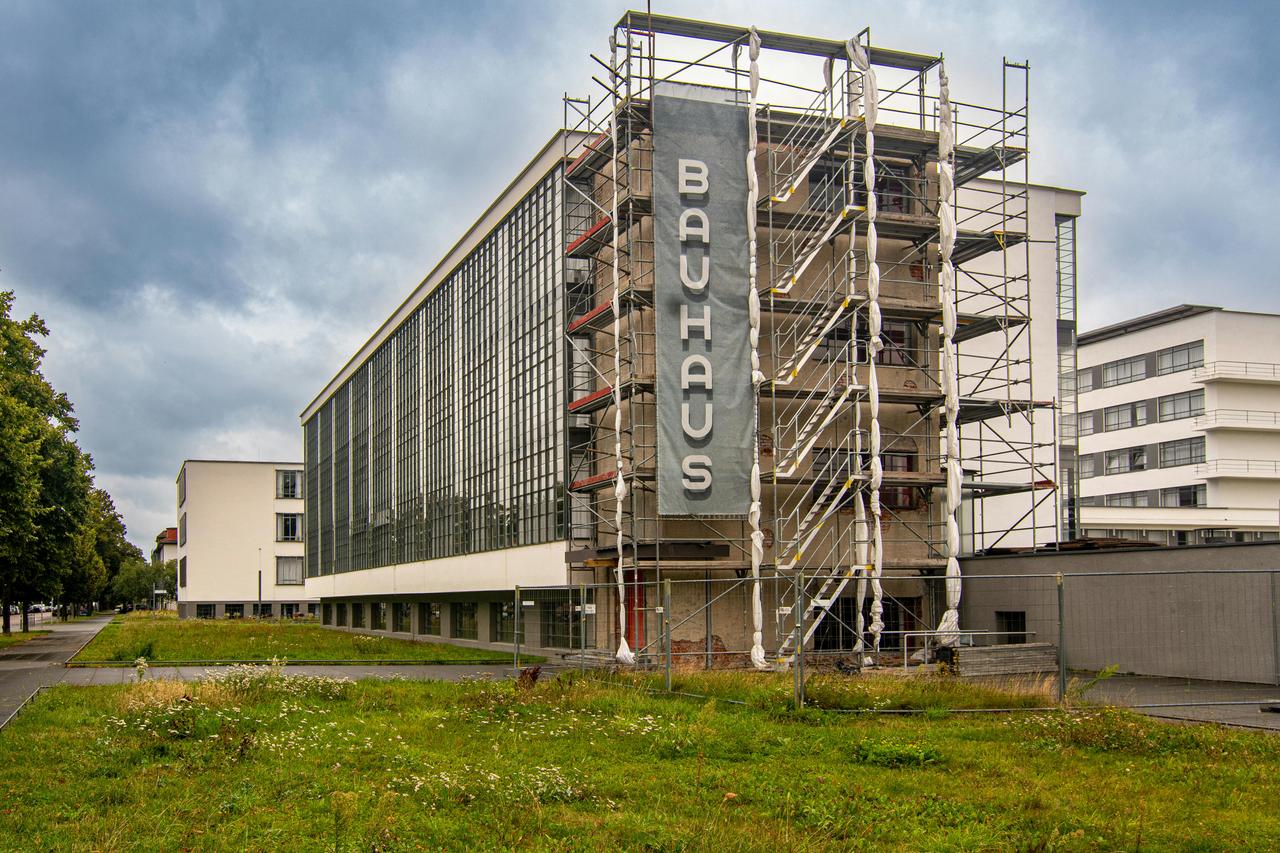
Bauhous Okulu, Dessau-Roßlau, Almanya (Pexels, Siegfried Poepperl)
The Bauhaus educational philosophy was based on a workshop system that integrated theoretical knowledge with practical production. After completing foundational art training students were directed to workshops focused on different materials and production techniques each led by a “master” (meister) and a “craftsman” (handwerker). This structure strengthened the relationship between artistic thinking and technical application.
The system based on Walter Gropius’s concept of “Gesamtkunstwerk” (total work of art) brought together architecture interior architecture industrial design graphic design and stage arts under one umbrella blending individual creativity with social responsibility.
Bauhaus’s contribution to architectural education lay in redefining architecture not merely as an aesthetic endeavor but as a spatial structural and social process. Elements such as material knowledge structural technology ergonomics and user behavior were integrated into the curriculum. By dissolving the boundaries between interior architecture and architecture interior space design was treated as a functional and experiential component.
The international spread of Bauhaus pedagogy was largely achieved through the schools established by its graduates and instructors in the United States. The New Bauhaus founded by László Moholy-Nagy in Chicago and the work of Mies van der Rohe at the Illinois Institute of Technology continued this influence. Today project-based education interdisciplinary collaboration and the workshop model widely practiced in architecture faculties are continuations of this legacy.
After the closure of Bauhaus in 1933 its instructors and graduates migrated to various countries notably the United States of America where Bauhaus principles were reinterpreted in diverse contexts. Institutions such as the New Bauhaus and the School of Design in Chicago continued the Bauhaus pedagogical tradition. Bauhaus’s simple forms open floor plans and use of industrial materials played a significant role in shaping international modernist architecture. Today this legacy extends beyond architecture to disciplines such as graphic design industrial product design fashion and digital design. The integration of digital fabrication techniques parametric design approaches and sustainable material research into educational programs reflects parallels with Bauhaus’s interdisciplinary and innovative approach. Exhibitions publications and academic events held during the centenary of Bauhaus encouraged renewed engagement with this design heritage thereby reinforcing Bauhaus as a framework that connects design not only with form but also with cultural social and technological dimensions.
https://dergipark.org.tr/en/download/article-file/32439
Artun, Ali, and Aliçavuşoğlu, Esra. Bauhaus: Modernleşmenin Tasarımı. "Türkiye’de Mimarlık, Sanat, Tasarım Eğitimi ve Bauhaus" Sempozyumu. Istanbul: İletişim Yayıncılık, 2009. Accessed May 28, 2025.
Baktır, Özlem. Bauhaus Felsefesi ve Endüstriyel Tasarımdaki İşlevsellik Boyutu. Master's thesis,Akdeniz Üniversitesi Institute of Social Sciences, 2006. Accessed May 28, 2025.
Bulat, Serap, Bulat, Mustafa, and Aydın, Barış. "Bauhause Tasarım Okulu."Atatürk Üniversitesi Journal of Social Sciences 18, no. 1 (2014): 105–120. Accessed May 28, 2025.
Konak, Ceyhun. "Bauhaus Okulu ve Eğitim Anlayışı." Kesit Akademi Dergisi 2, no. 3 (March 2016): 154–162. Accessed May 28, 2025.
Serim, Sema, Alemdar Yeşim Ünal, and Açıkgöz Şeyda Güngör. "Mimarlık Eğitimine Başlamak; Bauhaus İçinden Bir Yeniden Konumlandırma Denemesi." Ege Mimarlık, January 2016. Accessed May 28, 2025.
Sezer, Özge. "Bauhaus’un Modern Mimari Kültürünün Yayılmasındaki Rolü." mimar•ist 2019, no. 2. In Bauhaus’un Uzak Yankıları. Accessed May 28, 2025.

Foundation and Historical Development
Educational Model and Interdisciplinary Approach
Impact on Architectural Education
Dissemination and Contemporary Influences