


This article was automatically translated from the original Turkish version.
Area | War Strategy Justice Art Handicrafts Wisdom Intelligence | ||||||||
|---|---|---|---|---|---|---|---|---|---|
Symbols and Objects | Owl, Olive Branch, Helmet, Shield (Aegis), Spear | ||||||||
Belonging Pantheon | Olympian Gods (Ancient Greece) | ||||||||
Father | Zeus | ||||||||
Mother | Metis (swallowed by Zeus before birth) | ||||||||
Birth | Born from Zeus's head fully armed (symbolizing intellect, without a mother) | ||||||||
Titles | Parthenos (Virgin), Pallas Athena, Protector of Athens | ||||||||
City of Patronage | Athens – Won the hearts of its people by offering the olive tree | ||||||||
Mythological Role | In a male-dominated society, the figure of the 'rational and warrior woman', goddess of strategic warfare, distinct from Ares, detached from motherhood and romance, a virgin goddess | ||||||||
Social Gender Interpretations | Considered as an independent and neutral figure shaped by masculine values, outside traditional female roles | ||||||||
Athena, in ancient Greek mythology, is the goddess of wisdom, strategy, intelligence, war, art and craft. She is a figure revered by both gods and humans. In ancient texts, Athena is described as rational, independent and masculine, making her one of the most powerful and original female figures in the Greek pantheon. She is also a notable figure in terms of the representation of women in mythology.
Athena’s birth is one of the most intriguing myths in Greek mythology. The goddess was born from the head of her father Zeus, fully armed and clad in battle gear, after Zeus swallowed her mother Metis. This extraordinary birth symbolizes Athena’s status as a female deity born from a male authority and underscores her motherlessness. This situation also serves as a powerful metaphor for how the patriarchal order was mythologically constructed.
Athena embodies mental power and strategic intelligence. Although she is a goddess of war, her warfare is not based on brute force but on planning, reason and strategy. This distinguishes her from Ares. She is also the protector of cities, especially Athens, which lies under her patronage. The olive tree, spear, helmet and owl are symbols of Athena.
Athena is interpreted in mythology as the embodiment of the “woman who accommodates male dominance.” Defined by masculine traits and a rejection of conventional femininity, she stands outside traditional female archetypes. Particularly through her motherless birth and virginity (Parthenos), she represents a “acceptable” female figure within the patriarchal system. The goddess’s detachment from motherhood signifies a space beyond the roles assigned to women in the patriarchal system, yet this space remains confined within the boundaries of male dominance.
In ancient Greek society, Athena was identified with high morality, justice and rationality. She is especially associated with art and architecture through the Parthenon Temple. As the eponymous patron of the city-state of Athens and the giver of the olive tree to humanity, she emphasizes her role as a founder of wisdom and civilization. She can also be interpreted as the mythological representation of women’s access to knowledge and reason.
Athena holds an exceptional place among female goddesses in mythology. She is neither fertile nor involved in romantic relationships. Therefore, it is difficult to associate her with nature, fertility or emotion. On the contrary, she embodies “masculine” values such as reason, strategy, discipline and order. This allows Athena to carve out a third, more neutral space in contrast to the mythological portrayal of women as either “mothers and fertile beings” or “figures linked to love.” However, this neutrality is only possible through accommodation to a male-centered value system.
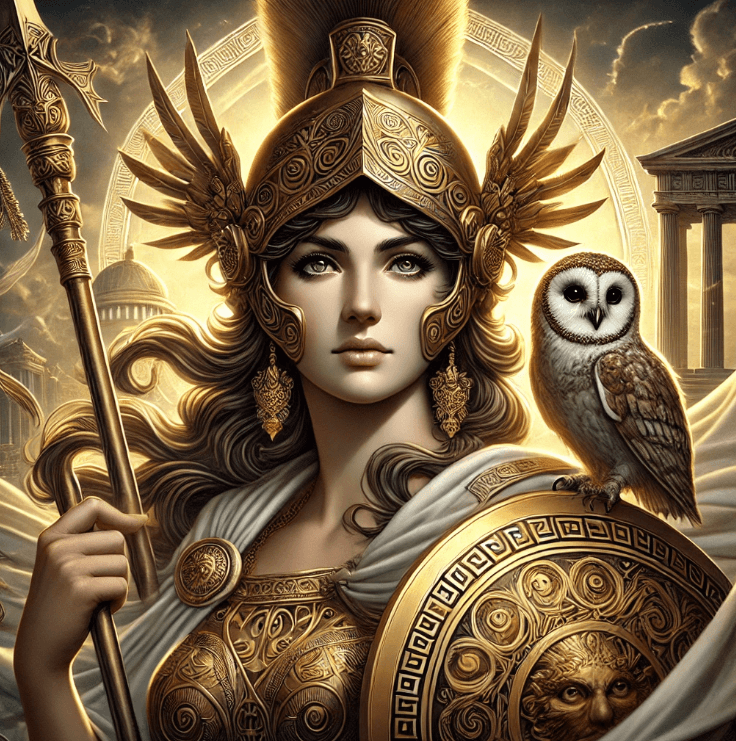
Image generated by artificial intelligence.
Can, Ş. (2020). *Klasik Yunan Mitolojisi*. Ötüken Neşriyat. (https://www.otuken.com.tr/u/otuken/docs/k/l/klasik-yunan-mitolojisi-1606387213.pdf)
Elçi, D. Ö. (2018). *Batı ve Doğu Mitolojilerinde Kadın İmgesi: Tanrıçalar*. Atlas International Refereed Journal on Social Sciences, 4(11), 826–840. (https://atlasjournal.net/index.php/atlas/article/view/113)

Area | War Strategy Justice Art Handicrafts Wisdom Intelligence | ||||||||
|---|---|---|---|---|---|---|---|---|---|
Symbols and Objects | Owl, Olive Branch, Helmet, Shield (Aegis), Spear | ||||||||
Belonging Pantheon | Olympian Gods (Ancient Greece) | ||||||||
Father | Zeus | ||||||||
Mother | Metis (swallowed by Zeus before birth) | ||||||||
Birth | Born from Zeus's head fully armed (symbolizing intellect, without a mother) | ||||||||
Titles | Parthenos (Virgin), Pallas Athena, Protector of Athens | ||||||||
City of Patronage | Athens – Won the hearts of its people by offering the olive tree | ||||||||
Mythological Role | In a male-dominated society, the figure of the 'rational and warrior woman', goddess of strategic warfare, distinct from Ares, detached from motherhood and romance, a virgin goddess | ||||||||
Social Gender Interpretations | Considered as an independent and neutral figure shaped by masculine values, outside traditional female roles | ||||||||
Origin and Birth
Qualities She Represents
Gender and Athena
Cultural Influences
Athena and the Image of Woman