


This article was automatically translated from the original Turkish version.
+2 More
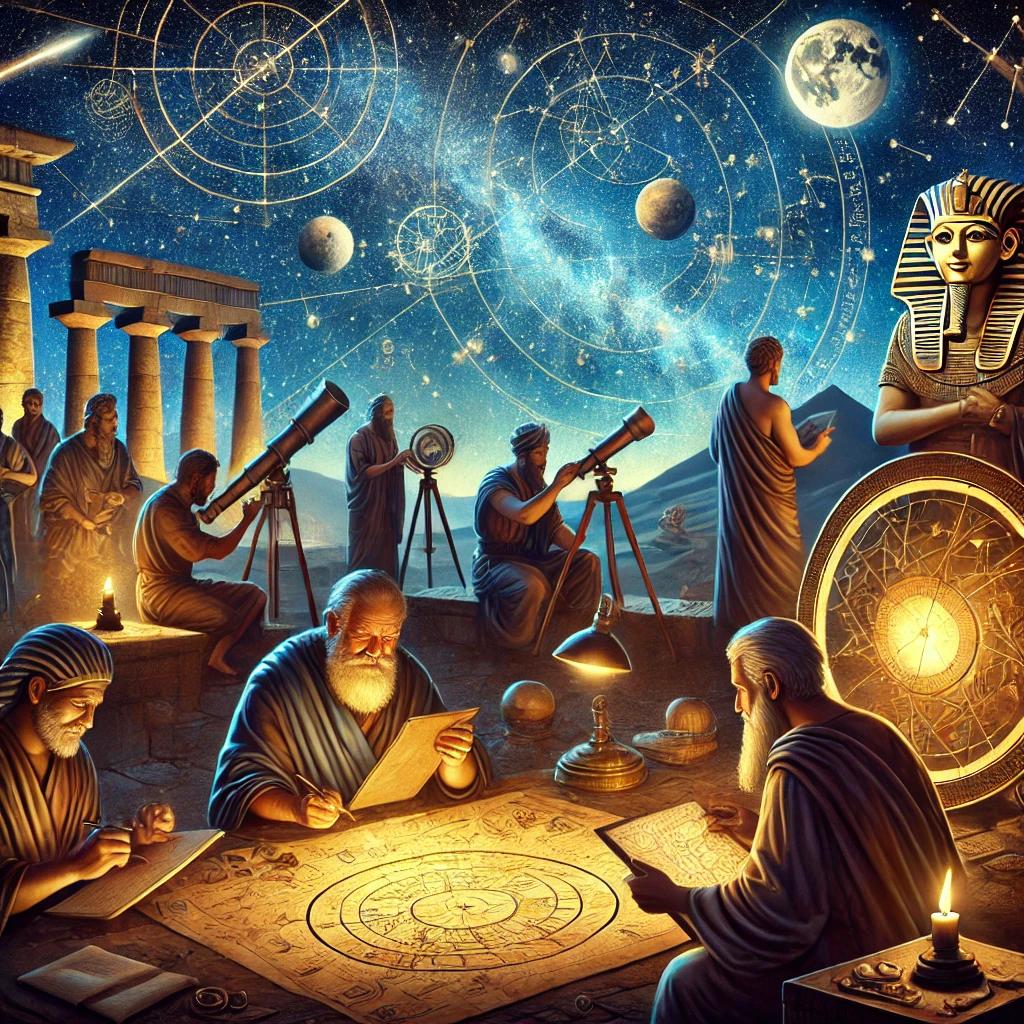
Origins of Astronomy and Astrophysics in Antiquity
Important Scientists | Hipparchus (c. 190–120 BCE): Created star catalogs and studied the motions of the Sun and Moon. Ptolemy (c. 100–170 CE): Developed the geocentric model of the universe through his work Almagest. Thales (c. 624–546 BCE): Recognized as one of the first philosophers to predict solar eclipses. | ||||||||
|---|---|---|---|---|---|---|---|---|---|
Tools Used | Gnomon: A simple sundial that measures time by the length of its shadow. Astrolabe: An instrument used for observing the sky and determining star positions. Water Clock (Clepsydra): Hydraulic clocks used for measuring time. | ||||||||
Discoveries Related to Astronomy | Observation of Planets: Ancient Greeks and Babylonians observed Mercury, Venus, Mars, Jupiter and Saturn. Phases of the Moon: Babylonian and Egyptian civilizations created calendars by tracking the Moon's movements. Mathematical Calculations: Ancient Greek astronomers used trigonometry to explain the motions of planets. | ||||||||
Astronomy is one of humanity’s oldest sciences and has played an important role since ancient times in organizing agricultural practices, calendars and religious rituals. Ancient civilizations carefully observed the sky, recording the movements of stars and planets, and developed this knowledge through mathematical and philosophical approaches.
Mesopotamia was home to some of the earliest applications of astronomy. The Sumerians divided the sky into specific regions to identify constellations and systematically recorded the movements of celestial bodies. The Babylonians laid the foundations of astronomy by noting planetary motions on clay tablets and developed the first calendar systems based on the cycles of the Moon and the Sun.
The ancient Egyptians used astronomy to predict the flooding cycles of the Nile River. Belief systems centered on the sun god Ra played a significant role in advancing astronomical calculations. The alignment of the Giza Pyramids with the Orion Constellation demonstrates the advanced level of Egyptian astronomy.
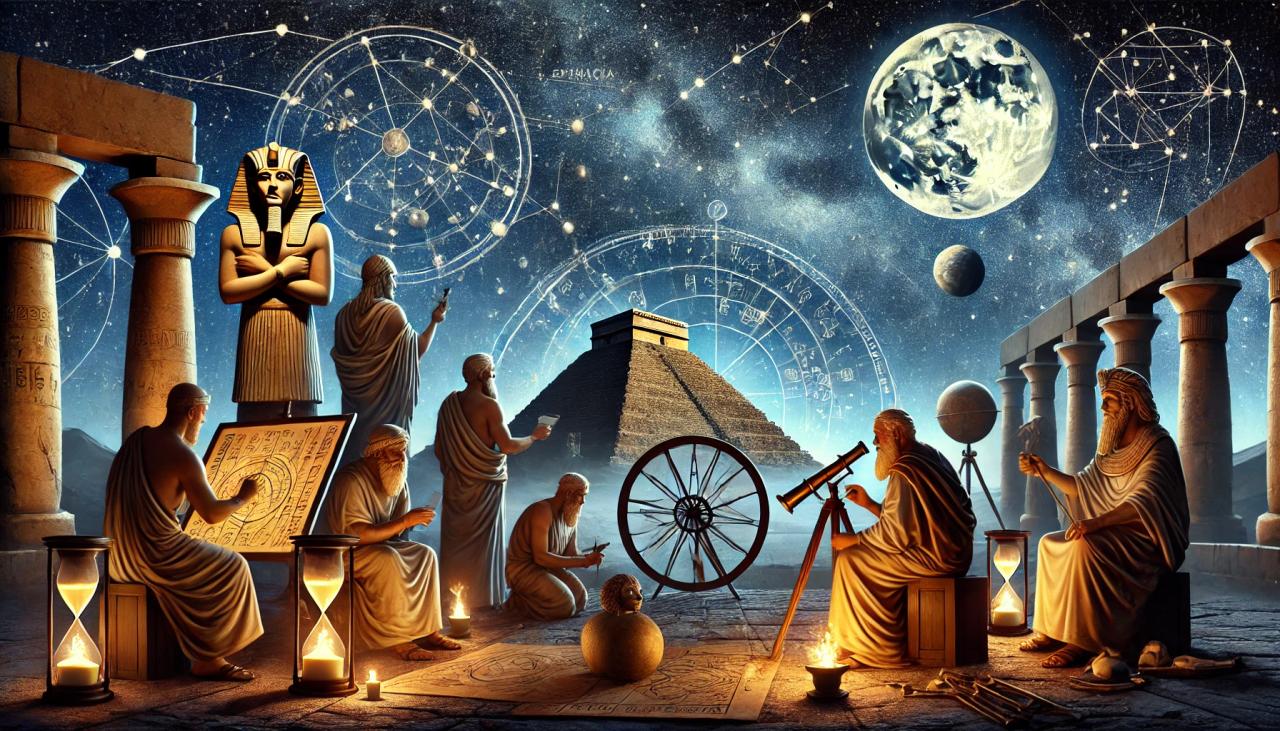
Astronomy and Astrophysics in Antiquity (Image generated by artificial intelligence)
The ancient Greeks transformed astronomy into a theoretical discipline. Aristotle proposed a system with the Earth at the center of the universe, while Hipparchus compiled star catalogs and conducted detailed studies of celestial motions. Ptolemy developed a long-standing astronomical theory in his work the Almagest, presenting the geocentric model.
Indian astronomy recorded planetary movements and celestial events, providing detailed observational data in religious texts. In Chinese astronomy, observatories and detailed star maps held a central place. Chinese astronomers meticulously documented changes in the sky, making some of the earliest recorded observations of supernovae in history.
The Maya civilization developed highly precise calendar systems based on the movements of the Sun. The Maya meticulously tracked planetary motions and recorded celestial events. The Aztecs placed great importance on the planet Venus and structured their religious rituals around this celestial body.
Astrolabe: An important instrument used to measure the altitude of celestial bodies. It was especially used in navigation and astronomical calculations, helping observers determine star positions and perform time calculations.
Sundials and Water Clocks: Important tools used in antiquity to measure time and perform astronomical calculations. Sundials determined time based on the Sun’s movement across the sky, while water clocks measured the volume of water flowing at a constant rate to establish units of time.
Stonehenge and Other Stone Structures: Structures aligned with the movements of the Sun and Moon, used for early astronomical calculations. Structures such as Stonehenge were built to determine seasons and observe astronomical events. Similarly, Egyptian and Maya civilizations constructed temples and stone structures aligned with astronomical principles.
The influence of ancient astronomy on modern science has been profound. The calendar systems used today are inherited from these civilizations and have been further refined. Ancient theories inspired scientists such as Copernicus, Galileo and Kepler, contributing to the foundations of modern astronomy. Traces of these ancient insights can still be seen in space exploration, and constellation systems continue to be used in astronomical calculations.
In antiquity, astronomy emerged as one of the foundational pillars of scientific thought and experienced significant development across various civilizations. This accumulation of knowledge contributed to the formation of modern astronomy and played a vital role in humanity’s process of understanding the universe. The observations of ancient astronomers continue to inspire today’s scientists.
Ankara Üniversitesi. *Astronomi Tarihi II*. Ankara University Open Course, Accessed March 17, 2025.https://acikders.ankara.edu.tr/pluginfile.php/42597/mod_resource/content/0/Ders_7.pdf.
Gürkan Özsoy. "Antik Dönemden Günümüze Astronomi Tarihi Hakkında İlginç Bilgiler." Gürkan Özsoy Kişisel Blogu. Accessed March 17, 2025.https://gurkanozsoy.com/dunya-tarihi/antik-donemden-gunumuze-astronomi-tarihi-hakkinda-ilginc-bilgiler.
Karatay University. "Eski Çağlarda Astronomi ve Gökbilim." *Karatay Üniversitesi Sürekli Eğitim Merkezi*. Accessed March 17, 2025.https://karsem.karatay.edu.tr/eski-caglarda-astronomi-ve-gokbilim.
İstanbul Teknik Üniversitesi. "Astronomi Tarihi II." İTÜ Astronomi ve Uzay Bilimleri Bölümü. Accessed March 17, 2025.https://astronomi.itu.edu.tr/genel/astronomi-tarihi-ii.

Origins of Astronomy and Astrophysics in Antiquity
Important Scientists | Hipparchus (c. 190–120 BCE): Created star catalogs and studied the motions of the Sun and Moon. Ptolemy (c. 100–170 CE): Developed the geocentric model of the universe through his work Almagest. Thales (c. 624–546 BCE): Recognized as one of the first philosophers to predict solar eclipses. | ||||||||
|---|---|---|---|---|---|---|---|---|---|
Tools Used | Gnomon: A simple sundial that measures time by the length of its shadow. Astrolabe: An instrument used for observing the sky and determining star positions. Water Clock (Clepsydra): Hydraulic clocks used for measuring time. | ||||||||
Discoveries Related to Astronomy | Observation of Planets: Ancient Greeks and Babylonians observed Mercury, Venus, Mars, Jupiter and Saturn. Phases of the Moon: Babylonian and Egyptian civilizations created calendars by tracking the Moon's movements. Mathematical Calculations: Ancient Greek astronomers used trigonometry to explain the motions of planets. | ||||||||
No Discussion Added Yet
Start discussion for "Astronomy and Astrophysics in Antiquity" article
Astronomy in Ancient Civilizations
Mesopotamian Astronomy: The First Observers
Ancient Egyptian Astronomy: Calendars and Pyramids
Ancient Greek Astronomy: Foundations of Science
Indian and Chinese Astronomy: Observatories and Star Maps
Mayan and Aztec Astronomy: Sun and Calendar Systems
Instruments and Methods Used in Ancient Astronomy
The Influence of Ancient Astronomy on Modern Science
The Legacy of Astronomy