


This article was automatically translated from the original Turkish version.
The Arts and Crafts movement is a multidisciplinary art, design, and architectural movement that emerged in the second half of the 19th century in England as a response to the mass production ethos introduced by the Industrial Revolution. It championed handcraftsmanship, naturalness, and craftsmanship over industrial standardization. This movement developed not only as an aesthetic orientation but also as an ideological stance, forming a comprehensive reaction against alienation of labor, disconnection from nature, and aesthetic degradation in modern society. Spearheaded by thinkers such as William Morris and John Ruskin, the movement promoted a high-quality, human- and environment-sensitive design philosophy across all fields, from architectural production to everyday object design.
Following the Industrial Revolution, rapid mechanization increased the quantity of production while diminishing its quality; original handcrafted objects were replaced by standardized, soulless goods. In opposition to this trend, John Ruskin elevated the value of craft labor and the collective building traditions of Gothic architecture, while William Morris argued that art must be integrated into daily life. Guided by these ideas, the Arts and Crafts movement asserted that beauty is not confined to art objects alone but can also be found within everyday life and ordinary objects.
Theoretically, the movement was built upon principles such as closeness to nature, use of local materials, simplicity, respect for handcraftsmanship, and the elimination of distinctions between art, design, and craft. These values offered both an ethical approach that encouraged individual production and a practical framework that prioritized the aesthetic dimension of production.
The Arts and Crafts movement generated a comprehensive transformation in architecture, introducing not only formal aesthetic inquiries but also an ethical stance toward the process of construction. Emerging in late 19th-century England, the movement defended handcraftsmanship and local building traditions against the rapid, standardized, and soulless production methods of the Industrial Revolution. In architectural practice, this approach manifested in fundamental principles such as the relationship between a building and its natural surroundings, material selection, and spatial organization.
In the movement’s pioneering structures, harmonious integration between building and landscape was emphasized. The visible and honest use of local materials, the deliberate preservation of craft marks in design, and the integration of ornamentation as an intrinsic part of the structure are characteristic features of Arts and Crafts architecture. In this context, Philip Webb’s 1859 Red House, with its brick facades, wooden beams, and handcrafted details, is regarded as one of the earliest concrete examples of the movement’s realization in architecture.
The influence of the Arts and Crafts movement is particularly evident in rural residential architecture and interior design. Architects such as Charles Voysey, Edwin Lutyens, and Mackay Hugh Baillie Scott were influential in their time through designs featuring harmonious integration with nature, minimalist yet functional spatial layouts, and individualized detailing. In their buildings, a holistic design philosophy was maintained between exterior façades and interior spaces; architectural elements such as furniture, window handles, lamps, and flooring were considered inseparable components of the overall design.
At the core of this approach lies a philosophy that rejects the artificial separation between art and craft, treating both as organic components of architectural production. Organizations such as Morris & Co. were pioneering in translating this philosophy into practice, producing work across architecture, interior design, and textiles, while placing both aesthetic and moral responsibility at the center of the design process. This perspective asserts that a building is not merely a functional shelter but a lived, felt, and meaning-laden space.
From the perspective of interior architecture, the Arts and Crafts movement aimed to create interior spaces that were hand-formed, human-scaled, and aesthetically satisfying. Traces of craftsmanship are evident in areas such as ceiling details, window openings, and furniture elements, with every component of the space customized to establish direct engagement with the user. This approach made a significant contribution to the personalization of interior spaces and the enrichment of spatial experience.
The Arts and Crafts movement’s critique of industrial production created a structural rupture in the architectural discourse of its time. The homogenizing effect of mass production on design and its detachment from aesthetic values became central points of opposition. In this context, a new architectural philosophy emerged that redefined production at a human scale, treated craftsmanship as a social ethic, and insisted that buildings must carry not only physical but also cultural and moral values. This intellectual foundation can also be regarded as a precursor to the ethical underpinnings of modernist architecture.
The Arts and Crafts movement contributed to the development of an approach in which cultural, social, and ethical dimensions were integrated into the design process beyond formal production. Its influence extends beyond its historical context and is now associated with contemporary architectural approaches such as sustainability, local production, and user-centered design.
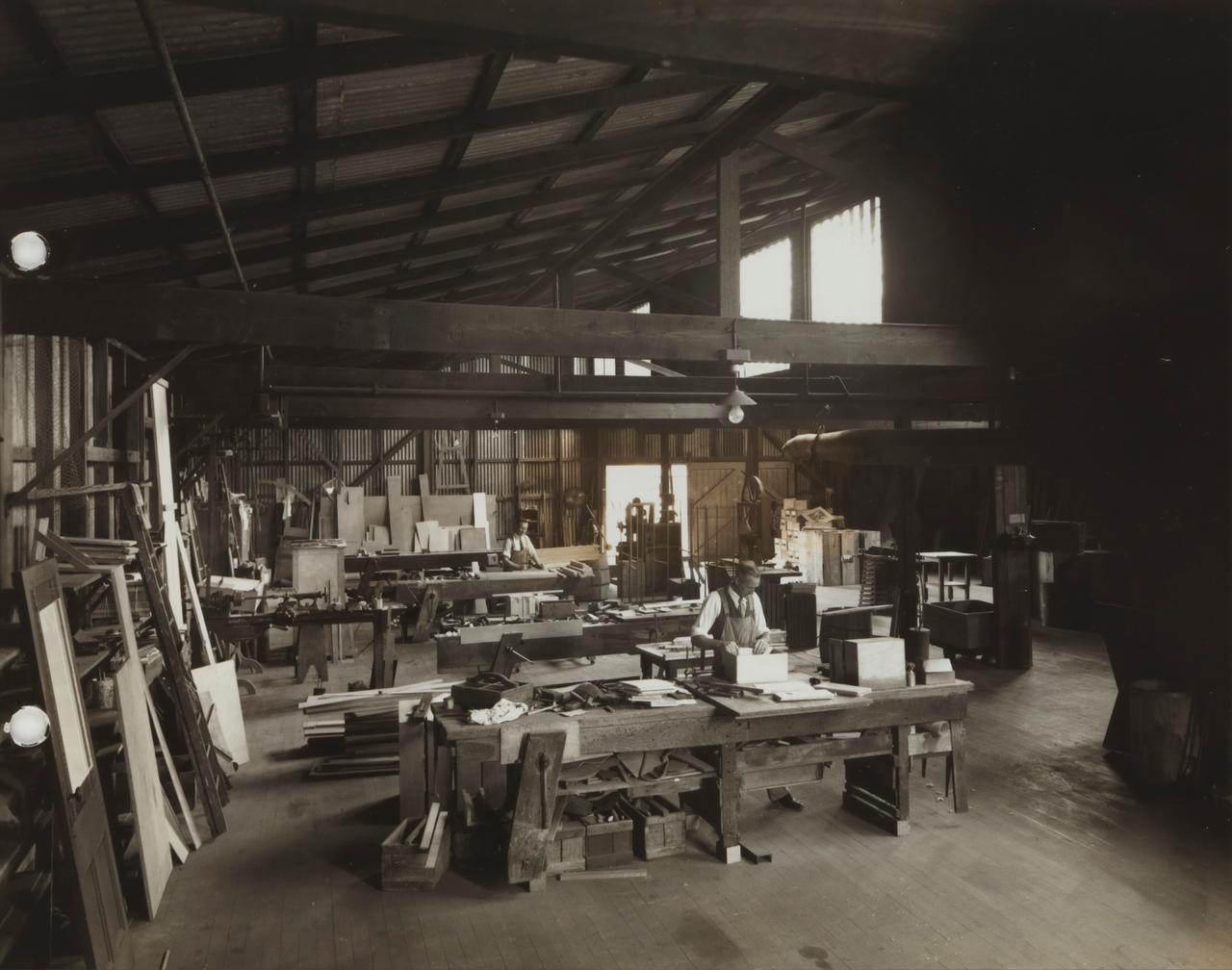
Arts and Crafts Ekolünde Atölye Çalışması (Unsplash, Museums Victoria)
Although the Arts and Crafts and Bauhaus movements emerged in different historical periods and contexts, both represent significant forces that transformed architecture and design. They offer notable distinctions in how they redefined the relationship between art, craft, and industry.
The Arts and Crafts movement was shaped by influential figures such as William Morris and John Ruskin, who championed craftsmanship, handwork, and local materials in opposition to the standardized production methods of the Industrial Revolution. This approach found expression in structures characterized by harmony with nature, human scale, and intricate craftsmanship. In examples such as the Red House, the architecture embraced formal simplicity without rejecting ornamentation; instead, it adopted an aesthetic that reflected the building’s character. Aesthetics were viewed not merely as formal qualities but as ethical and social responsibilities.
The Bauhaus, in contrast, was founded in Germany in 1919 under the leadership of Walter Gropius as a response to the new needs generated by modernization and technological advancement. This school sought to unify art, craft, and industry. Its pedagogical model aimed to create a common language between art and technology through foundational art education and workshop-based learning. Teachers such as Paul Klee, László Moholy-Nagy, and Josef Albers played pivotal roles in this endeavor.
In terms of architectural philosophy, Bauhaus and Arts and Crafts diverged significantly. While Arts and Crafts cultivated uniqueness through handmade materials, local forms, and detailed craftsmanship, Bauhaus embraced a functional, structural, and technology-based simplicity. Bauhaus buildings are typically characterized by flat roofs, large openings, glass facades, and open-plan interiors. The principle “form follows function” is the cornerstone of its aesthetic philosophy. In this regard, Bauhaus developed a holistic design philosophy not only in architecture but also in furniture, graphic design, product design, and urban planning.
Both movements emphasized education, though with different focuses. In Arts and Crafts, this emphasis centered on training the craftsman and integrating theory with practice. In Bauhaus, it focused on constructing a modular, interdisciplinary, and modernist educational system. As a result, Bauhaus’s educational model continues to be used today in numerous architecture and design schools worldwide.
In this context, the Arts and Crafts movement developed a design philosophy rooted in historical references, emphasizing handcraftsmanship in production and the artistic quality of everyday life. The Bauhaus movement, by contrast, proposed a modern design approach that established a functional synergy between industry and art, integrating aesthetics and functionality through technological possibilities. Despite emerging in different eras, both movements developed approaches centered on the human scale and the social dimension of design. Their historical influence has led to their comparative analysis as catalysts for structural transformations in architectural and design theory.
The influence of the Arts and Crafts movement laid the groundwork for subsequent modern architectural movements such as Bauhaus, De Stijl, and the International Style. In particular, the integration of design, art, and craft, along with principles of functionality and minimalism in Bauhaus, are direct reflections of Arts and Crafts ideals.
The movement’s contemporary manifestations are evident in sustainable architecture and the ethos of local production. Trends such as the use of handmade materials, designs harmonized with the natural environment, and a return to traditional local construction techniques represent its modern counterparts. The rise of identity-driven urban regeneration projects and boutique design philosophies continues to revive Arts and Crafts principles concerning the individuality and uniqueness of space.
Arslan, Tuğçe. "Arts & Crafts Architecture and Decoration." *Eurasian Art & Humanities Journal* 13 (2020): 1–28. Accessed May 28, 2025.https://arthum.eurasianacademy.org/dergi/arts-crafts-mimari-ve-dekorasyon202012.pdf
Ilgın, İnci Deniz. Endüstri Devrimi Sonrası Mimari ve İç Mekân Etkileşimi. Master's thesis,Marmara Üniversitesi Institute of Social Sciences, Department of Interior Architecture, 1991. Istanbul. Accessed May 28, 2025.
Nurdoğan, Nazmiye. "Mimarlık Bilgisinin Temsil Tasarım Araçları Üzerinden Dönüştürülmesi." Transformation of Architectural Knowledge via Representation and Design Tools. Doğuş Üniversitesi. Accessed May 28, 2025.Accessed adresi
Suyabatmaz, Ebra, and Aytar Sever, İldem. "Tasarımda Formun 20. Yüzyıl Mimari Akımlar Üzerinden İncelenmesi." *ART/icle: Sanat ve Tasarım Dergisi* 4, no. 3 (December 2024): 249–277. Accessed May 28, 2025.https://dergipark.org.tr/en/download/article-file/3815225
Unsplash. “grayscale photo of people sitting on chair inside building JPG.” Accessed May 28, 2025.https://unsplash.com/photos/grayscale-photo-of-people-sitting-on-chair-inside-building-U01ptiZV3Uo

No Discussion Added Yet
Start discussion for "Arts and Crafts Movement" article
Historical Background and Theoretical Foundations
Arts and Crafts Approach in Architecture
Arts and Crafts and Bauhaus Comparison
Contemporary Influences of the Arts and Crafts Movement