


This article was automatically translated from the original Turkish version.

In recent years, artificial intelligence and machine learning have become among the most discussed topics in healthcare. Artificial intelligence applications have entered our lives across numerous fields, from image analysis systems used in cancer screening to algorithms that predict risks in intensive care unitsartificial intelligence applications. Some studies have shown that artificial intelligence can achieve accuracy rates close to those of expert physicians in diagnosing certain diseases【1】 【2】.
However, these advancements have brought forth two contrasting perspectives. One group views artificial intelligence as a revolutionary solution in medicine, while another sees it as a potential threat capable of replacing physicians. So what is the truth? Is artificial intelligence a problem or a solution in medicine?
Artificial intelligence systems possess the ability to rapidly analyze large datasets, particularly in the fields of pathology and radiology. For instance, AI systems developed for breast cancer screening can detect small abnormalities in images, contributing to earlier diagnosis and detection【3】.
Some algorithms used in intensive care units can analyze patients’ laboratory values and vital signs to detect high-risk conditions early【4】. The key point here is that these systems are not designed to replace physicians but to support them. This enables earlier detection of diseases while simultaneously reducing the workload of medical professionals.
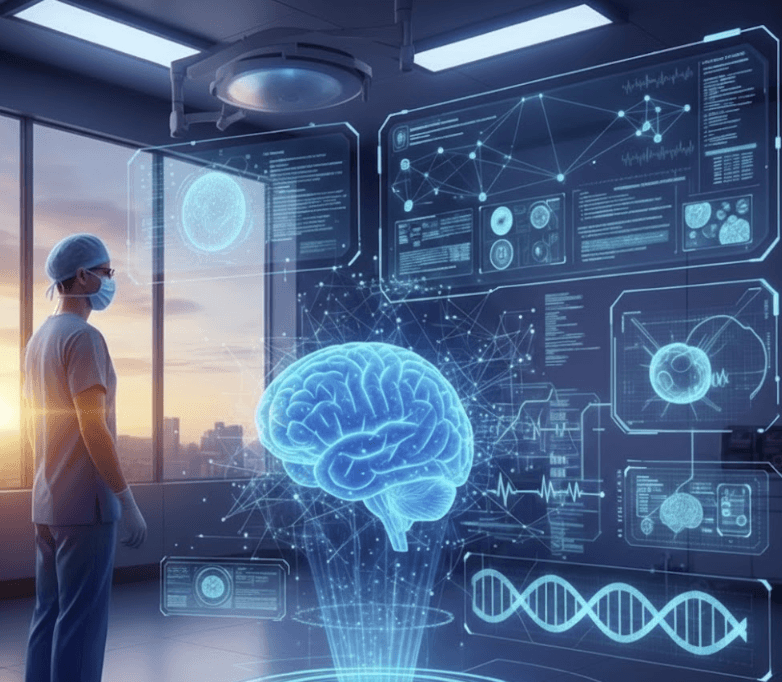
Use of Artificial Intelligence in Medicine (Generated by Artificial Intelligence)
Artificial intelligence is only as strong as the data it is trained on. If training data is limited or represents only a specific population, the system may produce inaccurate results for other groups. This can exacerbate the risk of healthcare inequality 【5】.
The decision-making processes of some advanced algorithms are not transparent. This can create trust issues for both physicians and patients.
In real-world practice, patients are not defined by a single test result. A physician’s decision-making process integrates the patient’s symptoms, physical examination findings, laboratory results, imaging data, medical history, and most importantly, clinical experience. However, most current artificial intelligence systems typically focus on only one type of data (e.g., images alone).
Another concept widely used in medicine but difficult to fully codify into formal rules is “clinical intuition.”
Clinical intuition refers to non-numerical knowledge acquired by physicians through years of experience. Sometimes a physician may sense a serious condition from a patient’s facial expression or manner of speaking. This information is often non-numerical and rooted in experience.
Artificial intelligence systems, by contrast, are primarily trained on numerical and structured data. Therefore, for artificial intelligence to be truly effective, certain transformations are required:
Decision-making processes must be documented and experiential feedback must be integrated into algorithms. The intuitive judgments made by physicians during patient assessments should be transferred to artificial intelligence systems through appropriate methods, and errors arising from machine learning should be minimized.
In conclusion, artificial intelligence is neither a miraculous solution nor a threat capable of replacing physicians. The issue lies not in the technology itself but in how it is developed and with whom it is trained. An artificial intelligence system that is trained on authentic clinical data, capable of multi-layered analysis, and developed with the input of experienced physicians is a vital collaborative partner in healthcare.
The medicine of the future will be built on a model where human intuition and machine analysis work together, not compete.
Esteva, Andre, Brett Kuprel, Roberto Novoa, et al. “Dermatologist-Level Classification of Skin Cancer with Deep Neural Networks.” *Nature* 542 (2017): 115–118. Accessed February 27, 2026. https://doi.org/10.1038/nature21056
McKinney, S. M., M. Sieniek, V. Godbole, et al. “Addendum: International Evaluation of an AI System for Breast Cancer Screening.” *Nature* 586 (2020): E19. Accessed February 27, 2026. https://doi.org/10.1038/s41586-020-2679-9
Obermeyer, Ziad, Brian Powers, Christine Vogeli, and Sendhil Mullainathan. “Dissecting Racial Bias in an Algorithm Used to Manage the Health of Populations.” *Science* 366, no. 6464 (2019): 447–453. Accessed February 27, 2026. https://doi.org/10.1126/science.aax2342
Rajkomar, Alvin, Jeffrey Dean, and Isaac Kohane. “Machine Learning in Medicine.” *New England Journal of Medicine* 380, no. 14 (2019): 1347–1358. Accessed February 27, 2026. https://doi.org/10.1056/NEJMra1814259
[1]
Andre Esteva, Brett Kuprel, Roberto Novoa, et al., “Dermatologist-Level Classification of Skin Cancer with Deep Neural Networks,” Nature 542, no. 7639 (2017): 115–118, https://doi.org/10.1038/nature21056.
[2]
S. M. McKinney, M. Sieniek, V. Godbole et al., “International Evaluation of an AI System for Breast Cancer Screening,” Nature 577, no. 7788 (2020): 89–94, https://doi.org/10.1038/s41586-019-1799-6.
[3]
S. M. McKinney, M. Sieniek, V. Godbole et al., “International Evaluation of an AI System for Breast Cancer Screening,” Nature 577, no. 7788 (2020): 89–94, https://doi.org/10.1038/s41586-019-1799-6.
[4]
Alvin Rajkomar, Jeffrey Dean, and Isaac Kohane, “Machine Learning in Medicine,” New England Journal of Medicine 380, no. 14 (2019): 1347–1358, https://doi.org/10.1056/NEJMra1814259.
[5]
Ziad Obermeyer, Brian Powers, Christine Vogeli, and Sendhil Mullainathan, “Dissecting Racial Bias in an Algorithm Used to Manage the Health of Populations,” Science 366, no. 6464 (2019): 447–453, https://doi.org/10.1126/science.aax2342.
Main Areas of Artificial Intelligence Use in Medicine
Early and Accurate Diagnosis
Clinical Decision Support
Limitations and Risks of Artificial Intelligence
Data Issues
The “Black Box” Problem
The Complexity of Clinical Reality
Clinical Intuition and Artificial Intelligence