


This article was automatically translated from the original Turkish version.
The metaverse is a virtual universe composed of three-dimensional and persistent digital environments in which users interact through avatars. It is envisioned as an evolution of the internet, shaped by the integration of technologies such as virtual reality, augmented reality, artificial intelligence, blockchain, and Web 3.0, and encompasses permanent, collectively experienced digital spaces independent of the physical world.
In the context of architecture, the metaverse offers a new medium that transcends the boundaries of physical space and enables the design of entirely digital, experience-centered environments. Within these digital spaces, spatial constructs can be developed free from material and structural constraints; architectural representations, spatial perception, and user experiences are being reimagined through different scales and modes of expression. Thus, the metaverse emerges as a unique design domain that transforms the fundamental approaches to architectural thought and space production.
The term “metaverse” is formed by combining the Greek prefix “meta” meaning beyond or after, with “universe.” The concept refers to parallel digital universes created through technology, free from the constraints of time and space and independent of physical reality. The foundation of these environments is built upon components such as augmented reality AR, virtual reality VR, mixed reality MR, digital twins, artificial intelligence, and blockchain technology.
The relationship between the metaverse and architecture manifests through the transformation of how virtual spaces are experienced and designed using these technologies. For instance, augmented reality allows digital layers to be overlaid onto the physical environment, while virtual reality enables fully digital architectural experiences. Digital twins and avatars enable users to represent themselves within these digital environments. Blockchain-based NFT technologies introduce a new system of ownership and copyright for digital architectural products.
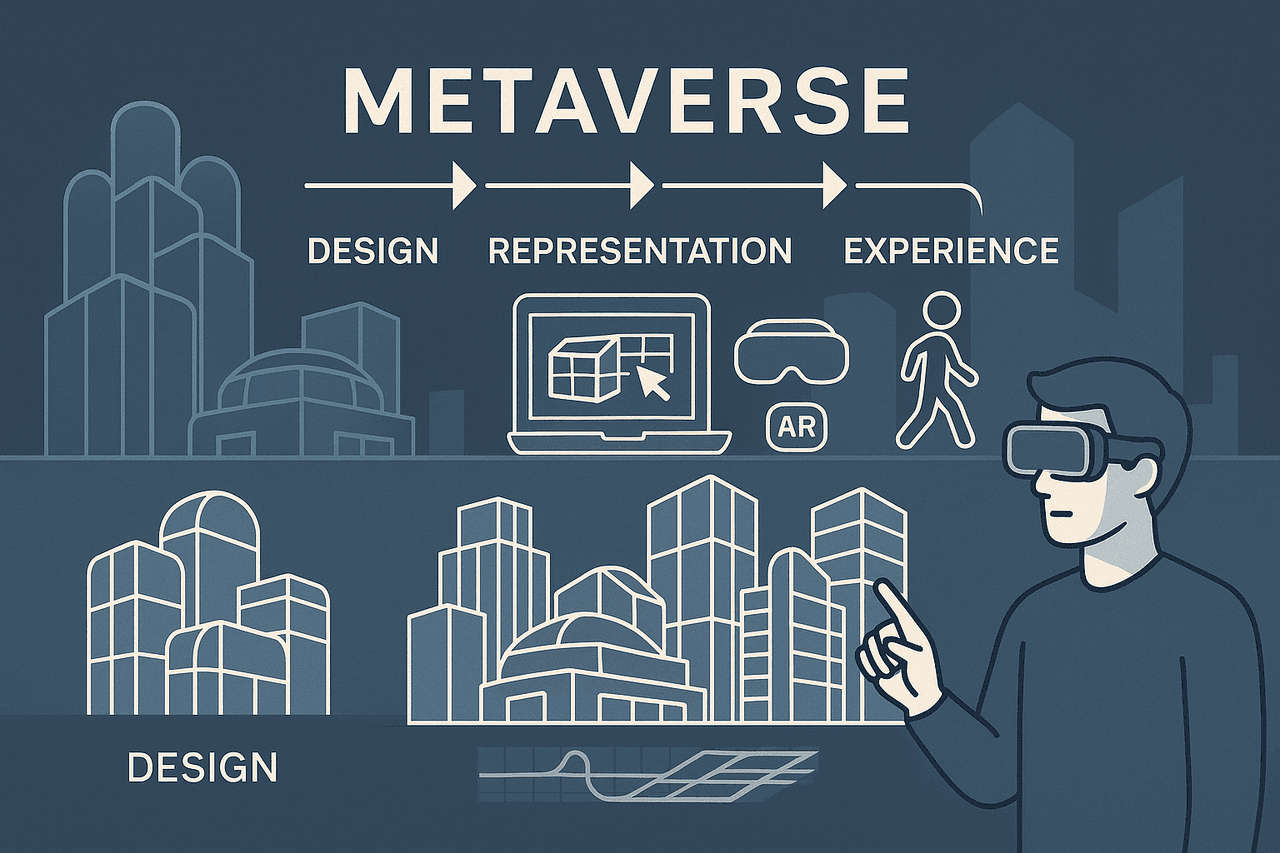
The impact of metaverse technology on architectural production processes brings about profound transformations in the dimensions of design, representation, and experience. First, design processes become liberated from the constraints of physical reality, acquiring greater freedom, abstraction, and experimental potential. In virtual environments where gravity, material strength, and statics no longer apply, architects are empowered to develop not only formal but also conceptual solutions that are more creative and innovative. Thus, the metaverse becomes not merely a digital simulation but a field of experimentation that redefines the boundaries of design thinking.
Second, transformations in representation tools are replacing traditional drawings, models, and plan presentations with digital modeling, real-time visualization, and interactive narratives. These representations, supported by technologies such as augmented reality AR, virtual reality VR, and mixed reality MR, do not merely visualize a project; they allow users to experience spatial functionality and integrate feedback into the design process. Representation in architecture has thus moved beyond being a static visual to becoming an interactive process.
Third, the understanding of architectural experience has begun to extend beyond the limits of the physical environment, being constructed through virtual identities. Users can navigate spaces via avatars, providing real-time feedback on spatial scenarios and contributing to the adaptive evolution of design. This enables a renewed interpretation and development of user-centered design approaches within metaverse environments, where built spaces are increasingly viewed as sociotechnical systems.
Kentsel Planlama ve Yönetim (Yapay Zeka İle Üretilmiştir.)
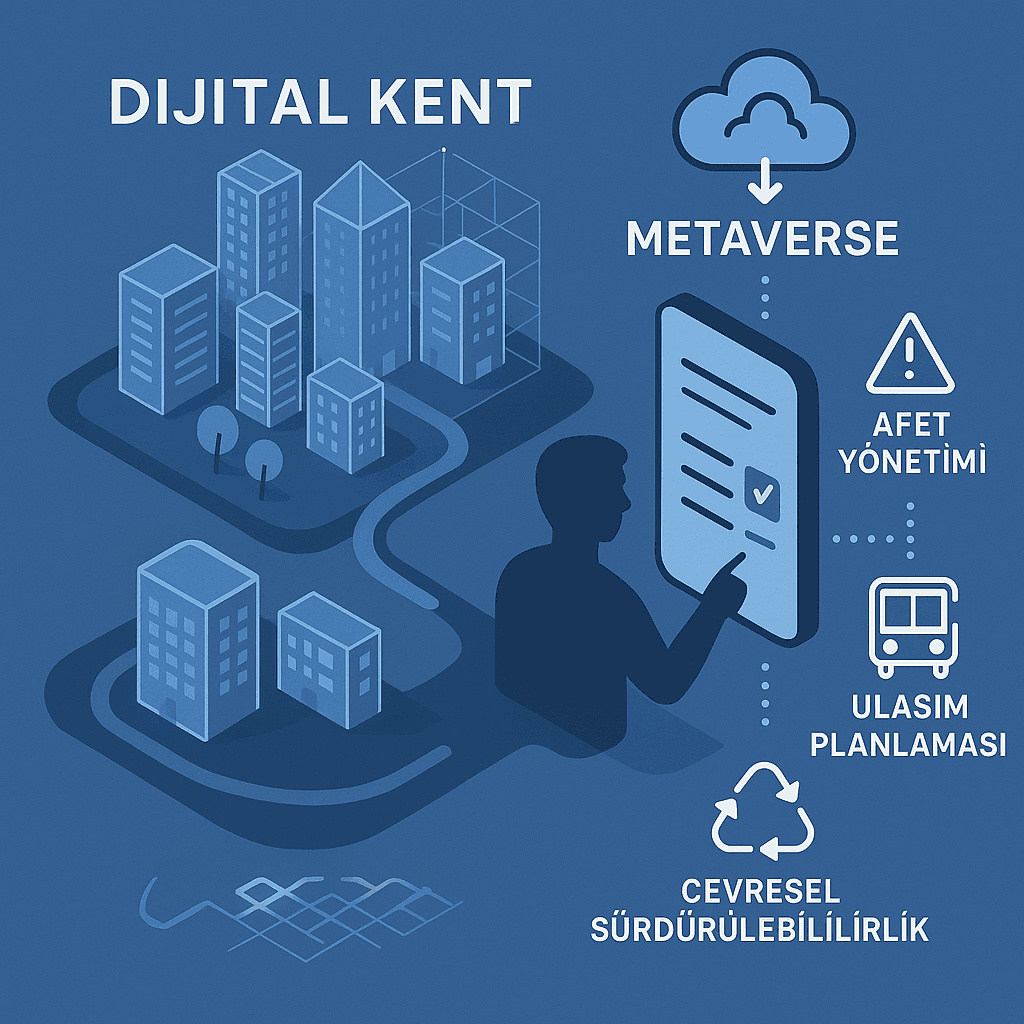
The influence of metaverse technology extends beyond the architectural scale to reshape urban planning and management processes. The concept of the digital city encompasses the recreation and monitoring of physical cities through their digital twins. These digital twins serve as essential tools for analyzing current urban conditions, simulating potential developments, and evaluating planning decisions with greater flexibility.
The emergence of cities not only as physical spaces but also as digital experience domains enables new forms of social participation. Users can engage in urban decision-making processes through virtual platforms, submit proposals, or track service access. These participatory processes must be conducted in alignment with principles of transparency, accountability, and data security. The interactive platform offered by the metaverse enables rapid testing of alternative scenarios in areas such as disaster management, transportation planning, and environmental sustainability. In this context, digital cities are regarded not merely as technical infrastructure but as models in which social organization is being reconfigured.
Kentsel Planlama ve Yönetim (Yapay Zeka İle Üretilmiştir.)
In metaverse environments, the architect’s role transcends that of a technical producer of digital forms and evolves into a spatial strategist who guides user experience, anticipates interactions, and shapes new modes of living. In virtual environments, designers must go beyond traditional principles of ergonomics and spatial organization to consider parameters such as avatar movement, behavioral patterns of virtual identities, and digital-psychological needs. In this context, ethical responsibilities—including accessibility, digital inequality, and representation issues—become integral components of the design process.
Moreover, as the metaverse becomes more widespread, architects’ responsibilities are expanding within processes of simplification, transformation, and hybridization observed in physical life. The design of virtual meeting spaces, hybrid work arrangements, and the spatial manifestations of digital culture has brought forth new typological analyses and spatial organization strategies. In this hybrid environment where the physical and digital intertwine, architects are tasked with managing the interaction between both realms in the production of space.
While the metaverse offers numerous opportunities for the discipline of architecture, it also raises critical questions and uncertainties. The digitization of the design process has led to significant transformations, particularly in educational and competition settings, through advantages such as reduced costs, accelerated prototyping, and enhanced global sharing. However, challenges persist, including infrastructural gaps, lack of platform standardization, and ambiguities surrounding digital copyright. The speculative and investment-driven use of technologies such as NFTs in architecture risks distancing spatial design from its social and ethical values.
Metaverse architecture is not merely a technical innovation but a transformative process that redefines professional roles, user-space relationships, and spatial rights within digital environments. In this context, the metaverse empowers architects to develop new modes of representation, project production strategies, and economic models, while simultaneously serving as a research domain for theoretical debates, ethical evaluations, and interdisciplinary collaboration.
The impact of the metaverse on architectural education, professional practice, and the social understanding of space is expected to be addressed more comprehensively in the coming years. The process of integrating digital environments into architectural culture is emerging as a decisive factor shaping the direction of research and practice in this field.
Akturan, Kazime Elif, and Esin Kasapoğlu. “Gelecek, Metaverse, Mimarlık ve Yapım Endüstrisi.” *Mimarlık ve Yaşam Dergisi* 9, no. 2 (2024): 259–283. Accessed May 30, 2025.https://dergipark.org.tr/en/download/article-file/3491795
Düzenli, Kerem, and Nazım Ziya Perdahçı. “Metaverse ve NFT’nin Mimarlığa Etkileri: Geleceğin Yapıları Nasıl Şekillenecek?” *Eksen: Dokuz Eylül Üniversitesi Mimarlık Fakültesi Dergisi* 4, no. 2 (2023): 165–182. Accessed May 30, 2025.https://dergipark.org.tr/en/download/article-file/3098222
Kurtuluş, Minel, and Çiğdem Tekin. “Metaverse Kronolojisi ve Ulusal Mimarlık Ortamında Metaverse.” *ART/icle: Sanat ve Tasarım Dergisi* 3, no. 2 (2023): 110–134. Accessed May 30, 2025.https://dergipark.org.tr/en/download/article-file/3286053
Seymen Aksu, Nurçin, and Özge Yalçıner Ercoşkun. “Kentlerde Dijital Dönüşüm ve Metaverse.” *Eksen: Dokuz Eylül Üniversitesi Mimarlık Fakültesi Dergisi* 3, no. 2 (2022): 108–122. Accessed May 30, 2025.https://dergipark.org.tr/en/download/article-file/2608197
Yüksel, Şen, and Sinan Yıldız. “Metaverse Dünyasında Değişen Sanal-Gerçek Mekânlar ve Tasarımcının Rolü.” *Beykent Üniversitesi, Mühendislik-Mimarlık Fakültesi*, 2023. Accessed May 30, 2025. Accessed adresi

No Discussion Added Yet
Start discussion for "Architecture and the Metaverse" article
Conceptual Development and Technological Infrastructure
Transformation in Architectural Production Processes
Urban Transformation and Digital Cities
The Designer’s New Role and Spatial Responsibilities
Future Expectations and Critiques