This article was automatically translated from the original Turkish version.
Type of Geographical İndication | Origin Name | ||||||||
|---|---|---|---|---|---|---|---|---|---|
Registration Number | 529 | ||||||||
Registration Date | 01.09.2020 | ||||||||
Product / Product Group(s) | Processed and unprocessed fruits vegetables and mushrooms | ||||||||
Province(s) | Gaziantep | ||||||||
Applicant/Registrant(s) | Araban Subprovince | ||||||||
Araban Garlic is a local garlic variety native to the Araban district of Gaziantep Province in Türkiye, scientifically classified as Allium sativum L. and officially registered under its place of origin. This product was registered as a geographical indication on 1 September 2020 and possesses distinctive characteristics in both physical properties and cultivation conditions.
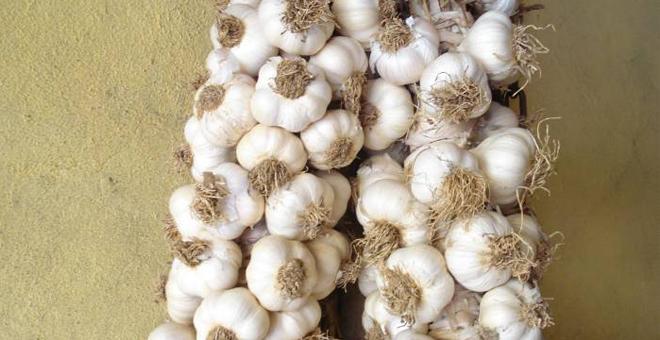
Araban garlic is notable for its large, white-skinned bulbs. The individual clove skins are white while the clove flesh is cream-yellow in color. The cross-section of the bulb is oval in transverse view and elliptical in longitudinal view. Stripes of anthocyanin are present on both clove and bulb skins. Each bulb contains an average of 10 to 15 cloves, with individual clove weights ranging from 4 to 7 grams. Bulb size can reach up to 100 grams depending on cultivation conditions, though the average weight is 40 to 60 grams. The bulb diameter typically ranges from 40 to 50 mm. The skin is easily peeled. Its pungent odor is due to its high content of allyl propyl disulfide (C₆H₁₂S₆). It is also rich in selenium, minerals, and vitamins. The dry matter content ranges between 37% and 42%, making it suitable for long-term storage.
In approximately 100 grams of Araban garlic:
The clay-loamy, humus-rich, and organically fertile soil structure of the Araban Plain is one of the fundamental factors determining the distinctive qualities of this product. The soil pH should be between 6.5 and 7; best results are obtained in near-neutral alluvial soils. Burnt farmyard manure is preferred; otherwise, root diseases may occur.
Climate zones transitioning from maritime to continental climates are suitable for Araban garlic. The plant meets its cold requirement through autumn planting, which enhances its resilience. The ideal temperature range for growth is 15–20 °C, with humidity levels between 60% and 80%. Rainfall during harvest is undesirable, as high humidity increases the risk of disease.
Planting is carried out between late autumn and November. Prior to planting, the land is deeply and superficially tilled, and phosphorus and potassium fertilizers are applied. Cloves are planted 10–12 cm apart with the root end facing downward. Nitrogen fertilizer is applied at a rate of 23–25 kg per decare. Seed cloves are selected from the previous harvest and stored under appropriate conditions in racks. Before planting, bulbs are manually or mechanically separated into cloves, with only large peripheral cloves used. A quantity of 150–200 kg of garlic bulbs is required per decare.
During cultivation, operations such as weeding, irrigation, fertilization, pest control, and leaf trimming are performed. Harvesting takes place in May; harvested garlic bulbs are dried for 5–8 days, then sorted and graded before being marketed. Yield in the Araban Plain ranges from 1500 to 2000 kg per decare.
The protection of Araban garlic under its place of origin name is coordinated by the Araban District Governorship. The monitoring board consists of the Gaziantep Provincial Directorate of Agriculture and Forestry, Araban Vocational College of Gaziantep University, Araban Chamber of Agriculture, and local producer representatives. Two annual inspections are conducted: during the planting period (September–November) and after harvest (May). Production stages, compliance with geographical boundaries, and the correct use of the origin emblem are monitored. In necessary cases, services may be obtained from public or private experts.
Turkish Patent and Trademark Office. "Araban Sarımsağı Coğrafi İşaret Tescil Belgesi." Turkish Patent and Trademark Office. Accessed October 21, 2025. https://ci.turkpatent.gov.tr/Files/GeographicalSigns/cd6681f6-b94a-4ed7-bec7-eaf80a6db7b4.pdf.
Turkish Patent and Trademark Office. "Araban Sarımsağı." Geographical Indications Portal. Accessed October 21, 2025. https://ci.turkpatent.gov.tr/cografi-isaretler/detay/130.

Type of Geographical İndication | Origin Name | ||||||||
|---|---|---|---|---|---|---|---|---|---|
Registration Number | 529 | ||||||||
Registration Date | 01.09.2020 | ||||||||
Product / Product Group(s) | Processed and unprocessed fruits vegetables and mushrooms | ||||||||
Province(s) | Gaziantep | ||||||||
Applicant/Registrant(s) | Araban Subprovince | ||||||||
Physical Characteristics
Cultivation Conditions
Production Method
Monitoring and Protection