Registration Number | 529 | ||||||||
|---|---|---|---|---|---|---|---|---|---|
Registration Date | 01.09.2020 | ||||||||
Applicant/Registrant(s) | District Governorship of Araban | ||||||||
Province(s) | Gaziantep | ||||||||
Type of Geographical Indication | Designation of Origin | ||||||||
Product / Product Group(s) | Processed and Unprocessed Fruits and Vegetables and Mushrooms | ||||||||
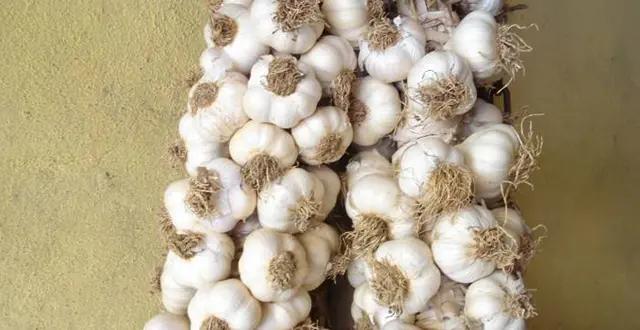
Araban Garlic, a variety of Allium sativum L., is grown in the Araban district of Gaziantep province, Türkiye, and is registered as a designation of origin (menşe adı). It was officially recognized as a designation of origin on September 1, 2020. This garlic stands out due to its physical characteristics and specific cultivation conditions.
Araban Garlic is characterized by its large, white-skinned heads, with white outer skins and creamy-yellow inner cloves. The heads have an oval cross-section and an elliptical longitudinal section. Each head contains an average of 10–15 cloves, with individual cloves weighing 4–7 grams. Depending on cultivation conditions, a head can weigh up to 100 grams, though the average is 40–60 grams, with a diameter of 40–50 mm. The skin peels easily. Its pungent aroma stems from a high allylpropyldisulfide (C₆H₁₂S₆) content. Rich in selenium, minerals, and vitamins, it has a dry matter content of 37–42%, making it suitable for long-term storage.
Nutritional composition per 100 grams of Araban Garlic includes:
The clay-loam, humus-rich, and nutrient-dense soil of the Araban Plain is ideal for Araban Garlic, shaping its distinctive qualities. The soil pH should be between 6.5 and 7, with near-neutral alluvial soils yielding optimal results. Well-rotted farmyard manure is preferred to avoid root diseases.
Climatically, Araban Garlic thrives in transitional zones between maritime and continental climates. Pre-winter planting allows the plant to meet its vernalization (cold exposure) needs, enhancing its resilience. Ideal growing conditions include temperatures of 15–20°C and humidity levels of 60–80%. Rainfall during harvest is undesirable, as high humidity can increase disease risk.
Planting occurs between late October and November. The land is prepared with deep and shallow tillage, and phosphorus and potassium fertilizers are applied. Cloves are planted 10–12 cm apart, with the root end downward. Nitrogen fertilizers are applied at 23–25 kg per decare. Seed cloves are selected from the previous harvest, stored under suitable conditions, and separated by hand or machine before planting, using only the larger outer cloves. Approximately 150–200 kg of garlic heads are needed per decare.
Cultivation involves hoeing, irrigation, fertilization, pest control, and leaf breaking. Harvesting takes place in May, followed by 5–8 days of drying. The garlic is then sorted, graded, and prepared for sale. Yields in the Araban Plain range from 1,500–2,000 kg per decare.
The protection of Araban Garlic’s origin designation is overseen by the Araban District Governor’s Office. The inspection committee includes representatives from the Gaziantep Provincial Directorate of Agriculture and Forestry, Gaziantep University Araban Vocational School, Araban Chamber of Agriculture, and local producers. Inspections occur twice annually: during planting in October–November and after harvest in May. The process verifies production stages, compliance with geographical boundaries, and proper use of the designation of origin logo. Expert support from public or private entities may be sought when needed.
Türk Patent ve Marka Kurumu. "Araban Sarımsağı Coğrafi İşaret Tescil Belgesi." Türk Patent ve Marka Kurumu. Accessed October 21, 2025. https://ci.turkpatent.gov.tr/Files/GeographicalSigns/cd6681f6-b94a-4ed7-bec7-eaf80a6db7b4.pdf.
Türk Patent ve Marka Kurumu. "Araban Sarımsağı." Coğrafi İşaretler Portalı. Accessed October 21, 2025. https://ci.turkpatent.gov.tr/cografi-isaretler/detay/130.

Registration Number | 529 | ||||||||
|---|---|---|---|---|---|---|---|---|---|
Registration Date | 01.09.2020 | ||||||||
Applicant/Registrant(s) | District Governorship of Araban | ||||||||
Province(s) | Gaziantep | ||||||||
Type of Geographical Indication | Designation of Origin | ||||||||
Product / Product Group(s) | Processed and Unprocessed Fruits and Vegetables and Mushrooms | ||||||||
Cultivation Conditions
Production Method
Inspection and Protection
This article was created with the support of artificial intelligence.