This article was automatically translated from the original Turkish version.
+1 More
Original Name | Amber Room | ||||||||
|---|---|---|---|---|---|---|---|---|---|
Location | Catherine Palace, Tsarskoye Selo, Pushkin — Türkiye | ||||||||
Start of Construction | 1701 | ||||||||
Completion | 1770 | ||||||||
Founding Locations | Berlin Royal Palace Third Winter Palace (1743) Tsarskoye Selo (1755) | ||||||||
Hall Area | 96 m² | ||||||||
Decoration Techniques | Flat mosaic set Relief carving Intaglio carving Engraving | ||||||||
Decision to Reconstruct | 10 April 1979 | ||||||||
Implementation Period | 24 years (panel work began in 1983) | ||||||||
Amber Used | Approximately 6 tons | ||||||||
Reopening | 2003 | ||||||||
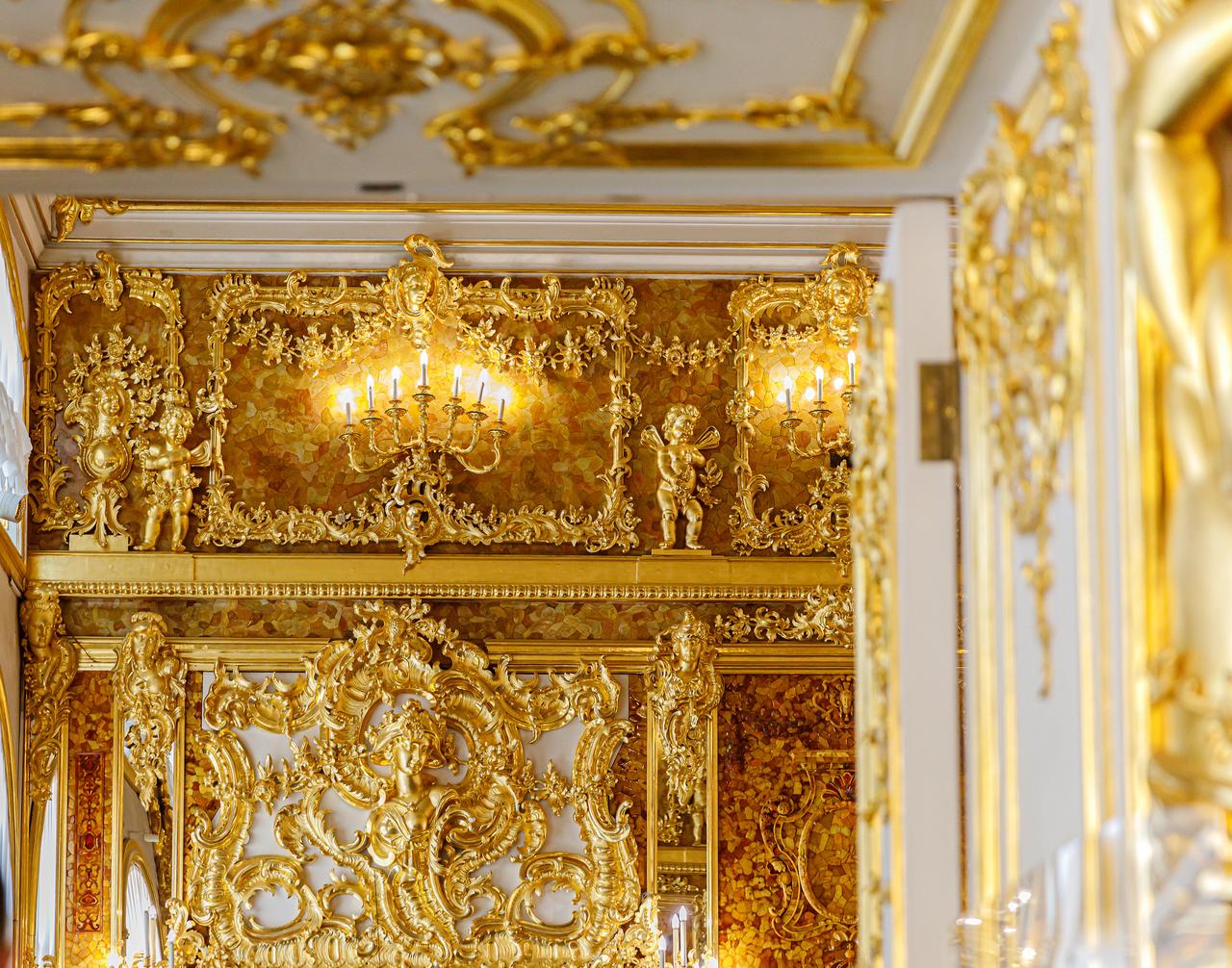
Amber Room (Russian: Янтарная комната) is an interior space located in the Tsarskoye Selo Grand Palace (Catherine Palace) in the town of Pushkin, Russia, with walls covered in amber panels. It is also known as the “Eighth Wonder of the World.” 【1】 Its decoration combined the main techniques of Baltic amber craftsmanship: alongside amber panels, gilded ornamental pilasters and colorful hard-stone Florentine mosaics formed integral parts of the design.
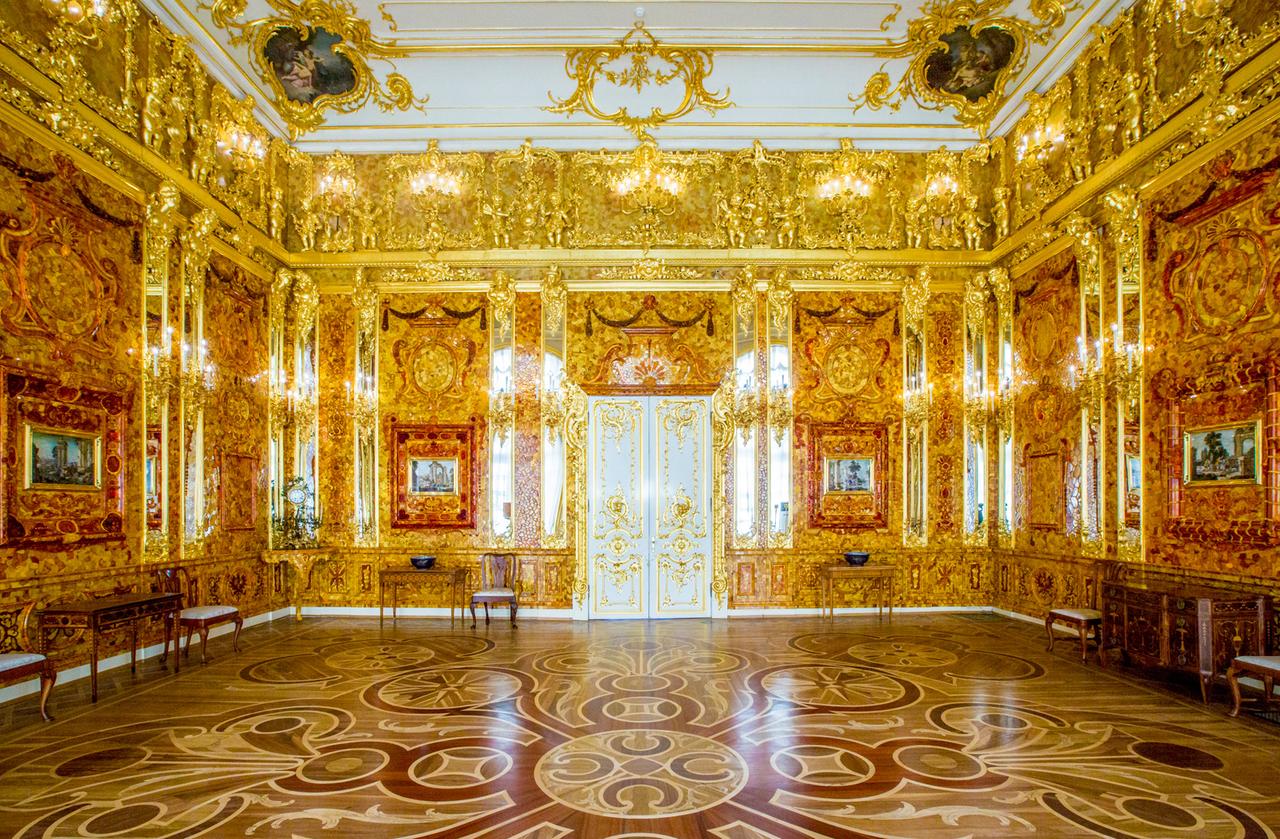
Kehribar Oda (Tsarskoe Selo State Museum and Heritage Site)
The history of the Amber Room begins in the early 18th century in Prussia. The founder of the Prussian royal dynasty, Frederick I, was known for his desire to surpass the splendor of the French royal court according to contemporary accounts.【2】 According to historical tradition, the king adopted the idea of his court architect Andreas Schlüter to panel a study room with amber and construction began in 1701.
According to the plan, the king’s study room was to be entirely lined with amber panels adhered to a wooden base, with four large mirrors placed within richly framed panels in the center of the large amber panels. The base panels featured symbols of the Prussian state: the eagle and the monogram of Frederick I. The decoration employed a combination of volumetric carvings at varying heights, fine engravings with gold leaf backing, intricate patterns, and thematic compositions. The fate of the original project drawings remains unknown.
The design of such an interior was made possible by developments in amber craftsmanship that had occurred half a century earlier. The 17th century marked the most productive period of amber art in Europe, with the center of artistic amber processing shifting to East Prussia. Large deposits of Baltic amber were found in the region, and extraction had been under state monopoly since the Teutonic Knights era. Production was concentrated in the cities of Königsberg, Danzig, Lübeck, and Elbing. Due to its softness and suitability for carving, turning, cutting, engraving, and polishing, amber was used to make various objects for the wealthy, mostly small items such as drawers, cups, bowls, vases, chess sets, and jewelry.
In the mid-17th century, a new technique called amber mosaic emerged. In this method, precisely fitted amber plaques were glued onto a wooden base using organic adhesive. This technique enabled the production of large-scale objects and later made the construction of the Amber Room possible. However, because wood and amber respond differently to environmental conditions, such objects were not durable and required constant restoration. According to amber art historian A. Rohde, this transition accelerated the decline of amber art.【3】
The production of the amber decoration began in 1701 under the supervision of the Danish king’s master craftsman Gottfried Wolfram. In 1707, the work was continued by Danzig amber carvers Gottfried Turau and Ernst Schacht. During this period, the king decided to install the room not in the palace outside the city but in his residence in the capital. The amber panels were dismantled, transported to Berlin, and installed in a corner room on the third floor of the royal palace. The decoration was not completed during Frederick I’s lifetime.
Peter I saw the amber-paneled room in 1713 at the royal palace in Berlin during a visit to Prussia to meet King Frederick William I, who had ascended the throne after Frederick I’s death. The Russian monarch left Prussia with the desire to see this interior as a centerpiece of his own collection of rare objects in Saint Petersburg.
Three years later, in 1716, following negotiations with the Prussian ruler, Peter I received as a gift a yacht named “Liburnika” and an amber cabinet.【4】 The gift symbolized the alliance between Russia and Prussia. In a letter to Empress Catherine, Peter reported that he had received from the king, as a gift, a yacht and an amber cabinet decorated in Potsdam.【5】 Two years later, the Russian monarch sent Frederick William I, in return, a large ivory cup he had personally turned, along with a contingent of 55 grenadiers.
The dismantled amber cabinet was transported to Russia in 1717. Records indicate that the panels were delivered to Saint Petersburg in eighteen crates via Memel and Riga; the crates contained not only completed panels but also numerous unused pieces.
The cabinet was never assembled during Peter I’s lifetime. The reason was the absence of many intricate details requiring skilled amber carvers, as this art form had only just begun to develop in Russia in the early 18th century.【6】 The amber panels, stored in wooden crates, waited for a quarter of a century in the service wing of the Summer Palace alongside Dutch ceramics, Chinese porcelain, and other foreign objects.
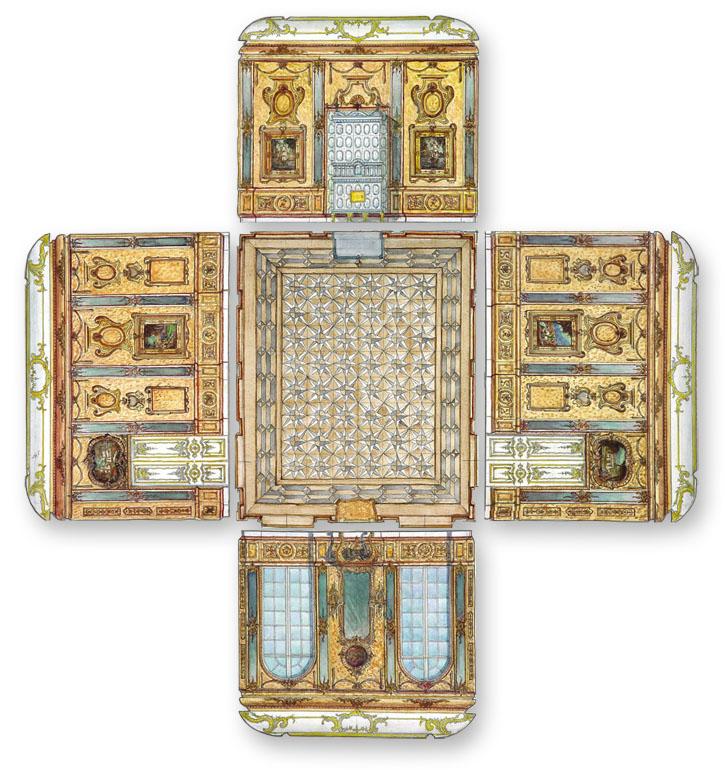
The Amber Room in the Third Winter Palace, A. A. Kedrinsky's Graphic Drawing (Amber Room)
It was Elizabeth, who recalled the Prussian gift upon ascending the throne after her father, who revived interest in the panels. The amber decoration matched the richness she sought in spaces prepared for her personal use. Elizabeth ordered that the panels be installed in one of the rooms of the Third Winter Palace, then under construction; the task was entrusted to Francesco Bartolomeo Rastrelli, a leading representative of Russian Baroque architecture. Determining the appropriate space took time, and the panels were moved several times between rooms. The final choice focused on a room adjacent to the empress’s bedroom; the panels were installed in 1743, and the completed room was officially opened in 1746. Due to ongoing construction of the palace, the room had to be relocated once more during this period.【7】
The chosen space was considerably larger than the room in Berlin from which the decoration originated. Rastrelli filled the gaps in two ways: he painted the walls to resemble amber and installed eighteen mirrored pilasters between the panels. Instead of mirrors in the centers of the amber frames, paintings by the artist Grooth were placed. Since the Berlin decoration remained incomplete, one of the frames was made of wood. Learning of this, and seeking to gain favor with Elizabeth, King Frederick II of Prussia sent her in 1745 an amber frame designed by Anton Reich, adorned with allegorical motifs praising the Russian state.【8】 The repair and mounting of damaged panels and their attachment to the walls were entrusted to plasterer Aleksandr Martelli, who was also skilled in amber work. The room remained in the Winter Palace for approximately ten years.
Elizabeth’s decision to renovate her capital palace led to the panels being dismantled once again. In July 1755, the decoration was sent to its permanent location, the Tsarskoye Selo Grand Palace. The crates were transported from the capital to the summer residence by a specially assigned detachment.
The new space measured 96 square meters and was significantly larger than the rooms from which the decoration had come. Rastrelli arranged the panels on the middle level of the walls, placing mirrored pilasters between them. He painted the upper level to imitate amber and added gilded carvings, bronze candelabra, a ceiling painting, and parquet flooring made from precious woods. The wall surfaces not covered by amber were concealed by paintings by the artist Ivan Belski, which imitated stone.
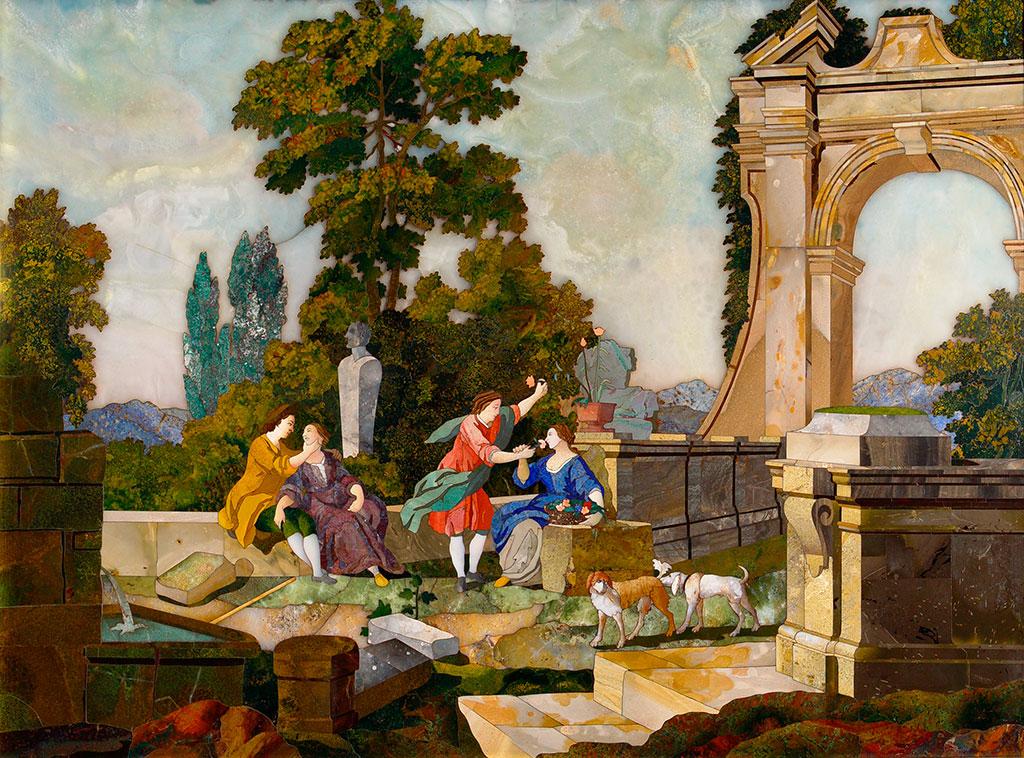
The most significant new addition to the Tsarskoye Selo arrangement was the Florentine mosaics that replaced the paintings in the amber frames. Four mosaics allegorically depicted the senses: Touch, Smell, Sight, Taste, and Hearing. These compositions, made from fragments of hard stone, rendered fine lines and color transitions with a delicacy approaching that of canvas painting. The mosaics were produced in 1752 in a workshop in Florence, based on drawings by Giuseppe Zocchi, under the direction of stone carver and engraver Luigi Siries. They are believed to have been delivered to Russia as a diplomatic gift from the Habsburg dynasty.【9】
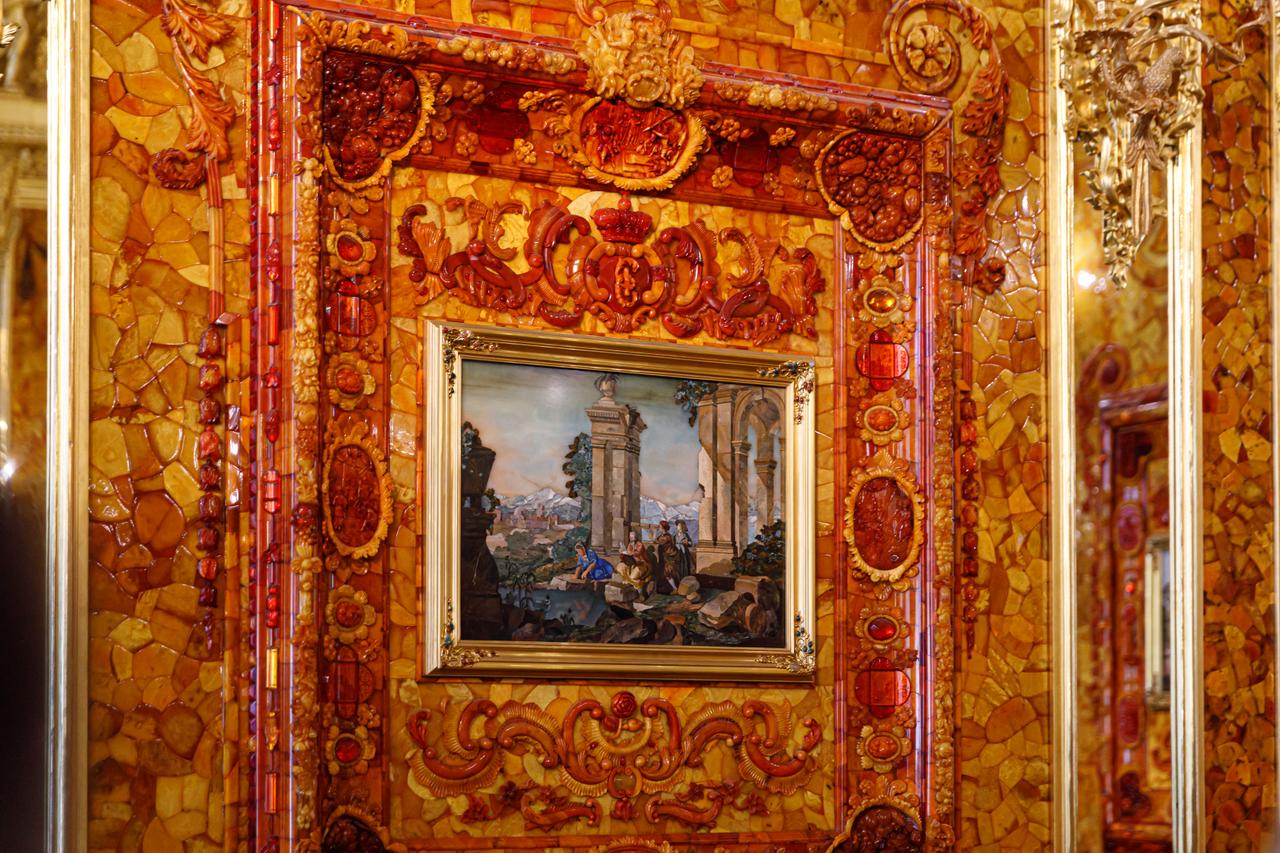
The ''Sight'' Mosaic designed by Giuseppe Zocchi (flickr)
By December 1755, the arrangement was largely complete. In Rastrelli’s own description, the room was characterized as a spacious space covered in white and yellow amber, framed by carved frames, and adorned with relief, festoons, and sculptural elements made from the same material.【10】
It took another fifteen years for the decoration to attain its present-known appearance. A dated inscription on one panel, bearing the year 1760 and the name of the craftsman, marks the beginning of this final phase. Due to the fragility of the decoration and its need for regular maintenance, an amber craftsman from Prussia, Friedrich Roggenbuk, was brought in and appointed as the room’s lifelong guardian. In 1761, several additional Prussian carvers joined him; one of them, his son Johann, succeeded his father in 1771 as the room’s custodian and held the position until his death in 1813.【11】
In 1763, Catherine II ordered the removal of the painted panels from the lower wall section and their replacement with amber panels. Craftsmen produced eight plain amber panels for the lower level, eight bases, a lintel panel above the central door, and cornice elements made partly from old fragments originally crafted in Berlin. This four-year project consumed 450 kilograms of amber.【12】
The room attained its final form in 1770 during Catherine II’s reign. Thus, the entire construction process spanned approximately seventy years.【13】
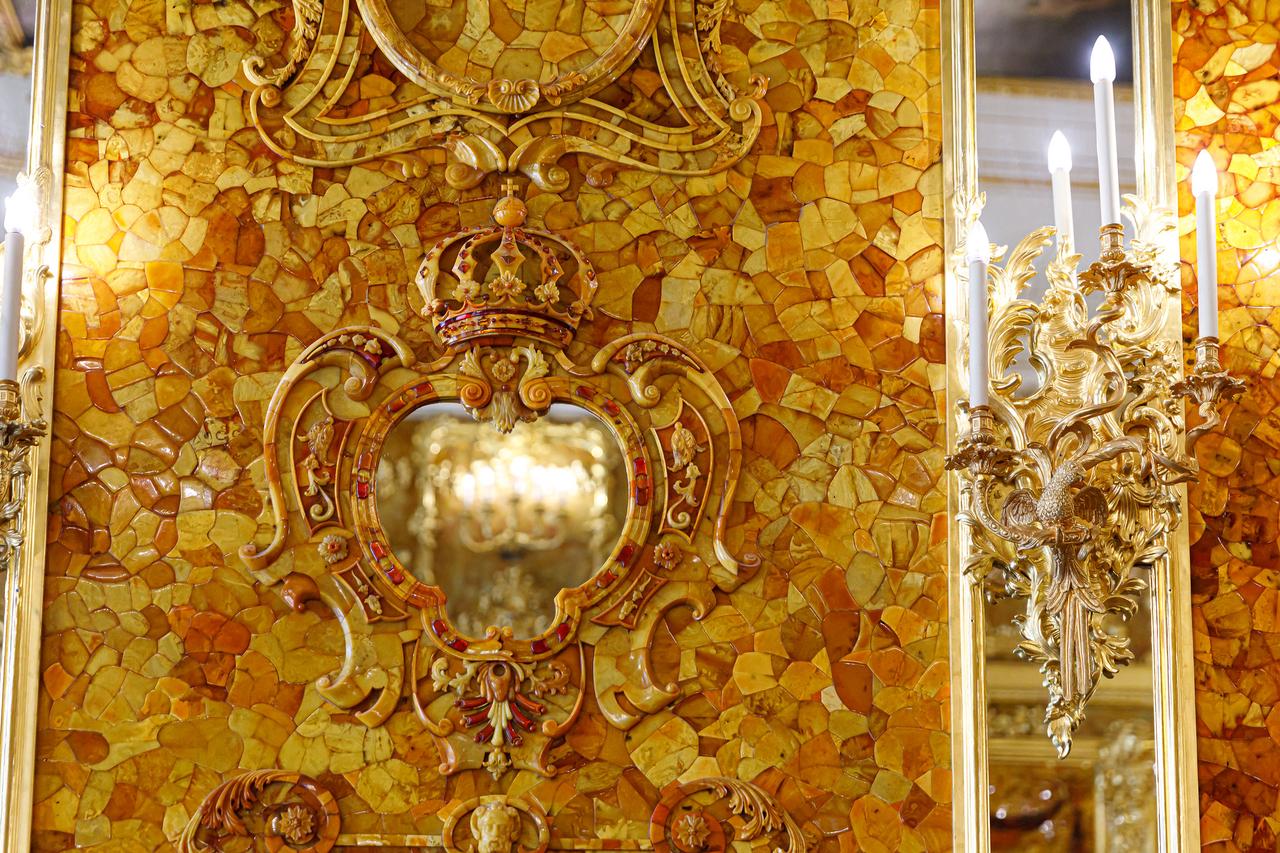
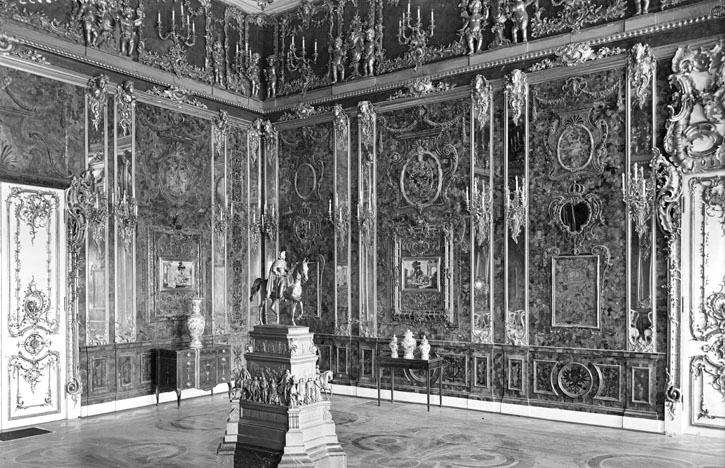
The amber decoration is distributed across three walls of the room and arranged in two tiers. The central level, considered the main tier, contains eight large vertical panels; four of these feature Florentine mosaics within carved amber frames. The spaces between the panels are filled with full-height mirrored pilasters. At the lower level, rectangular amber plaques are arranged in rows. The upper portion of the walls, not covered by amber, was painted to resemble amber, and amber wreaths were placed on the attic zone above. Above the central door and on the east wall are lintel panels. The ceiling is covered by a ceiling painting, and the floor by a patterned parquet made of precious woods. In the southwest corner stands a small amber console table with a slender, curved single leg.
Duvar Bezemeleri (flickr)
The flat surfaces of the panels are covered with precisely fitted amber plaques, creating the impression of a single continuous mass. Frames, moldings, reliefs, festoons, acanthus leaves, rocaille scrolls, flowers, cartouches, and figurative compositions complete the decoration. The pilaster bases are also made of amber. The stone’s color range extends from pale lemon yellow to wine red; colored foil placed beneath transparent plaques causes engraved surfaces to appear differently under light. Lighting is provided by twenty-four bronze candelabra.
The four large mosaics at the center of the middle-tier panels measure 56 × 43 centimeters each. Each is composed of tightly fitted fragments of colored hard stone, achieving color transitions and fine detail through this technique. Their subject matter is the allegorical representation of the senses, and together they depict all five senses.【14】
The room contained lacquered commodes and Chinese porcelain produced in Russia. In glass display cases, one of Europe’s most significant collections of amber objects made by German, Polish, and Russian artisans from the 17th and 18th centuries was exhibited. In the early 20th century, a model of the equestrian statue of Frederick the Great was placed in the center of the room.
Friedrich's Equestrian Monument (Amber Room)
The fact that the amber decoration was glued onto a wooden base necessitated continuous maintenance. The oak panels were sensitive to changes in humidity and temperature, causing them to expand or contract, which in turn caused the amber pieces to detach. The entire history of the room in Tsarskoye Selo has consisted of repeatedly reattaching displaced pieces to their original positions. Heating by stoves, air currents, and sudden temperature changes were among the factors accelerating deterioration.
Therefore, the interior underwent manual intervention only three times during the 19th century: in 1833, 1865, and 1893–1897.【15】 The next intervention was a limited-scale restoration carried out by sculptor I. V. Krestovski between 1933 and 1935.【16】 Each of these restorations was conducted with the knowledge and resources of its time, resulting in cumulative losses, distortions, and later additions to the decoration. The application of a thick layer of varnish over the surface was also among the practices of these periods.
A comprehensive restoration was planned for the summer of 1941. During the preparatory phase, it became evident that the decoration consisted of multiple layers from different periods and that the problems to be addressed were complex; detailed documentation of the stone arrangement was prepared. The outbreak of war prevented the implementation of this program. These pre-war documents later became key sources in the room’s reconstruction.
Following the German forces’ invasion of the Soviet Union on 22 June 1941, the evacuation of museum artifacts from the Catherine Palace began. The same method was attempted for the amber panels, but due to their fragility, attempts to remove them failed; dried amber crumbled when detached from its base. It was then decided to protect the decoration in place: the surface was first covered with paper, then with muslin, followed by cotton, and finally with wooden panels. According to another account, the panels were concealed with thin paper.【17】 When museum staff were forced to leave the town on 17 September 1941, the room was left behind.【18】
After the occupation of Pushkin, a German expert team was sent to the town to collect art objects. Alfred Rohde, art historian and head of the Prussian Art Museum, wrote to Erich Koch, Gauleiter of East Prussia, in August 1941, requesting that the room be brought to Germany.【19】 The panels were removed from the walls, placed in crates, and shipped to Königsberg in November 1941. It is recorded that this operation took thirty-six hours and used twenty-seven crates.【20】 The Königsberg museum’s donation register recorded the room under number 200 as a gift from the Third Reich’s Palaces and Gardens Administration.
The decoration was assembled in one of the rooms of the Königsberg castle, designated as the amber museum, along with its carved and gilded doors. Upon completion of the assembly, it was evident that the decoration was incomplete and damaged: one of the Florentine mosaics, all twenty-four bronze candelabra, and most of the furniture were missing; parts of the relief decorations, individual stones, and figures had disappeared, and mirrors were broken.
In 1942, Rohde published an article on the room in the journal Pantheon; five accompanying photographs are among the surviving records documenting the room’s condition at that time.【21】 Rohde worked on the room’s history for two years. Königsberg became the last known location of the room.
In late 1943, Rohde was advised to dismantle the decoration and crate it again. In August 1944, Allied air raids destroyed the city and the castle. It is reported that the crates were stored in the basement of the castle’s south wing; Rohde’s correspondence indicates that the decoration survived these attacks.【22】 During the German retreat in 1944, the panels were once again dismantled and sent to an unknown destination. The trail of the Amber Room ended here.
Searches began immediately after Königsberg’s surrender. In May 1945, history professor A. Y. Brusov was assigned the task of locating and returning art objects taken during the war from East Prussia.【23】 Among the ruins of the castle, numerous damaged pieces of furniture and porcelain from the Catherine Palace and the inventory book of the Prussian Museum were found; the book contained records indicating that the room had been delivered to the museum and transferred to a safe location. The decoration itself was not in the castle.
Information obtained from Alfred Rohde, who remained in the city, was limited. Upon Brusov’s suspicion that the basement area Rohde indicated was too small to hold the panels, Rohde changed his statement, claiming that the decoration had been moved to another hall and destroyed in a fire.【24】 Brusov later found documents signed by Rohde referring to the evacuation. A secret shelter used by the Germans to store artworks was also discovered, but the room was not there.
In subsequent investigations, gilded stucco moldings and bronze panels belonging to the room’s doors were found in the castle’s basements and underground passages. Three mosaics, their colors completely faded, were recovered from among the ashes and debris; they were identified as the Florentine mosaics of the room. The commission led by Brusov concluded that the decoration had been destroyed in the fire.【25】
Leading the opposition to this view was art specialist Anatoli Kuchumov. Kuchumov argued that the amber panels had been separately crated and removed from the castle before the city’s siege.【26】 It was known that, under Rohde’s orders, many pieces from the Königsberg castle’s amber collection had been sent to private residences in East Prussia. Rohde and his wife died of typhus in a hospital in late December 1945; after this date, no one remained who could confirm the room’s whereabouts. No direct documentation has been found proving that the panels were removed from Königsberg. However, in the private documents recovered from the castle ruins, Rohde repeatedly mentioned the possibility that the panels had been transported to residences and castles in East Prussia and Saxony.【27】
In August 1949, information from local residents triggered a new search: it was reported that large quantities of construction materials had been brought to the castle before its surrender, certain construction work had been completed, and large crates had been prepared in the courtyard. The commission re-examined the castle but found no hidden storage. In 1950, it was decided to conduct a detailed investigation of the shelter mentioned by Rohde; however, since the city had been entirely destroyed since the initial inspection, Brusov could not locate the shelter or even approximate its location. In the 1960s, geophysical surveys were conducted in Kaliningrad to locate underground shelters; archaeologists joined the efforts in 1969. These initiatives yielded no results. Official searches were suspended in 1984; independent investigations continued.
Because none of the proposed explanations regarding the room’s location have been scientifically verified or supported by documentary evidence, the main theories are as follows:【28】
In addition, theories have been proposed that the crates were destroyed in the 1944 bombing, that the panels lie on the floor of the Baltic Sea, or that the Germans took a copy from Tsarskoye Selo. The deaths of some individuals connected to the room have been linked under the name “The Amber Room Curse”; in this context, the typhus deaths of Rohde and his wife, the traffic accident death of Soviet intelligence officer General Gusev after meeting with a journalist, and the 1987 murder of former German soldier Georg Stein, an amber room researcher, in a Bavarian forest are cited.【29】
Dokunma ve Koklama Mozaiği ((Tsarskoe Selo State Museum and Heritage Site)
In 1997, German art researchers received a tip that a fragment of the room was being offered for sale. During a search at the lawyer’s office of the seller, one of the room’s mosaic panels was found in Bremen; the seller, the son of a deceased soldier, did not know the panel’s origin.
In April 2000, two fragments originally belonging to the room and recovered in Germany were returned to the museum: the mosaic “Touch and Smell” and a lacquered commode made in Russia at the end of the 18th century.
Restoration of the sections of the Catherine Palace damaged and looted during the war began in the late 1950s. Rastrelli’s series of rooms known as the “Golden Enfilade” was also included in the program. Initially, it was decided to recreate the painted decoration, gilded carvings, and lacquered parquet of the Amber Room, while covering the locations of the amber panels with fabric; at the time, the possibility of the original decoration’s return was considered plausible.
In the late 1970s, a group under architect G. S. Hazatski was assigned the task of designing a museum of amber in Kaliningrad. The final section of the exhibition was to be dedicated to the Amber Room. The group prepared a 1/5 scale model of the room and several sample pieces of decoration. This work was approved by G. V. Romanov, First Secretary of the Leningrad Regional Party Committee, who forwarded the proposal for the room’s reconstruction to the Soviet government.【30】 Supported by a documented justification and a detailed research plan, the proposal was accepted; the process was officially launched by a government decree dated 10 April 1979.
At the start of the work, the following materials were available: black-and-white photographs of the panels, a single color slide from the 1910s, a watercolor by painter P. Grehnev showing a detail from a base panel from the second half of the 19th century, and approximately fifty small fragments remaining from the decoration (moldings, carvings, and flat panel fragments). Additionally, there was a collection of amber objects rescued during the war and returned to the Catherine Palace. These objects were direct analogues of the room in terms of period, origin, style, and craftsmanship techniques; one even shared a common maker. In 1983, the signature of Gottfried Turau, one of the master craftsmen of Frederick I’s cabinet, was found on the wooden base of a restored Danzig-made drawer dated 1705.
Research revealed that, apart from one watercolor, no drawings, engravings, or paintings of the interior in Tsarskoye Selo existed. Thus, photographs became the primary source. Eighty-six photographs related to the room were identified in the Hermitage, the Russian Museum, the Tretyakov Gallery, and archives; the earliest was published in 1859, the latest taken during the exhibition in Königsberg Castle. In 1986, Yu. V. Trubinov compiled all photographic material and produced a catalog identifying each frame. By scaling the photographs to a uniform size, the overall layout of the room was reconstructed, and the dimensions of the panels and decorative elements were determined. For details too fine to be discerned even with a magnifying glass due to the thick varnish layer, specialized photographic equipment was used or historical descriptions and amber objects in museum collections were used as references.
Proje Çizimi (Amber Room)
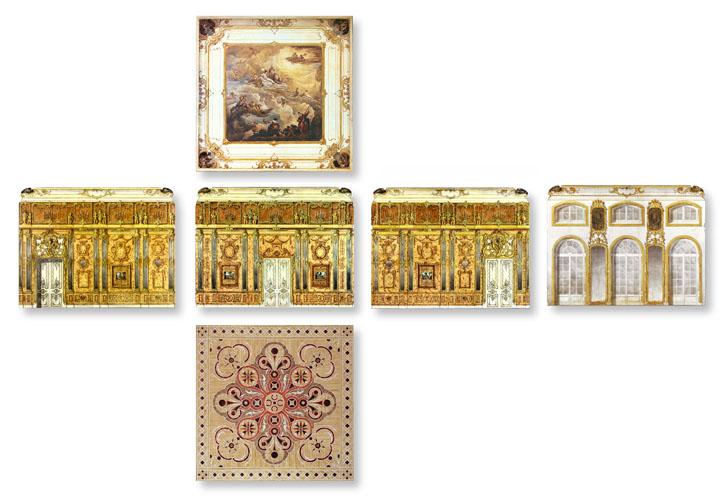
The project was prepared by a team of architects led by A. A. Kedrinski, including N. P. Ivanov, E. I. Korovina, E. I. Volkova, M. N. Kononova, V. V. Lipatova, E. N. Skrileva, and I. V. Yarotskaya. The scientific reconstruction approach was chosen; the goal was to recreate the room’s original appearance as closely as possible.
When preparing the complete layout of the room, the outer contours of every panel and volumetric element were copied exactly from the old photographs. Later additions made during previous repairs were identified. Elements not visible or discernible in the photographs were redesigned based on analogous elements with individually justified reasoning. Full-scale drawings of all panels became one of the core components of the project. The six-volume detailed drawings, including wall elevations, color standards, parquet and ceiling painting designs, were largely completed by autumn 1986.
For twenty years, the main raw material, amber, was supplied by the Kaliningrad Amber Enterprise, which operated the amber deposit. Pieces were individually selected based on type, size, and vein characteristics according to the intended decorative elements. Preliminary estimates indicated that approximately six tons of amber would be required for the project.
Work on the panels began in 1983 according to Kedrinski’s project. A year later, the ceiling painting, the upper wall band painted to imitate amber, and the patterned parquet were completed, and the locations for the panels were temporarily covered with fabric. In 1994, the first lower-level panel and the corner table were installed. In 1996, the first Florentine mosaic, “Sight,” was completed.
During periods of economic hardship, work continued with the support of the Tsarskoye Selo State Museum-Reserve administration; special efforts were made to retain experienced restorers on the team. From 6 September 1999 onward, the completion of the work was financed by the German company Ruhrgas.【31】 The total cost was estimated at 11 million dollars.【32】
The reconstruction project lasted twenty-four years. The room was opened to the public in 2003 during a ceremony attended by Russian President Vladimir Putin and German Chancellor Gerhard Schröder, marking the 300th anniversary of the founding of Saint Petersburg【33】 and began its exhibition at the Tsarskoye Selo State Museum-Reserve.【34】
Amber Room. "Amber Room. The History." amberrrom.ru. Accessed July 21, 2026.
Amber Room. "Amber Room. The Search." amberrrom.ru. Accessed July 21, 2026.
Amber Room. "Reconstruction." *amberrrom.ru.* Accessed July 21, 2026.
Amber Room. "The Amber Room Page 2." amberrrom.ru. Accessed July 21, 2026.
Amber Room. "The Amber Room Page 3." amberrrom.ru. Accessed July 21, 2026.
Amber Room. "The Amber Room Page 4." amberrrom.ru. Accessed July 21, 2026.
Amber Room. "The Amber Room Page 5." amberrrom.ru. Accessed July 21, 2026.
Amber Room. "The Amber Room Page 6." amberrrom.ru. Accessed July 21, 2026.
Amber Room. "The Amber Room Page 7." amberrrom.ru. Accessed July 21, 2026.
Amber Room. "The Amber Room Page 8." amberrrom.ru. Accessed July 21, 2026.
Amber Room. "The Amber Room." *amberrrom.ru.* Accessed July 21, 2026.http://amberroom.ru/index.php/en/amber-room-en-2?showall=&limitstart=
Karyshev, Dmitry. "amber room." Flickr. Accessed July 21, 2026.https://flic.kr/p/2nzNEoK
Karyshev, Dmitry. "amber room." Flickr. Accessed July 21, 2026.https://flic.kr/p/2nzQ3H3
Karyshev, Dmitry. "amber room." Flickr. Accessed July 22, 2026.https://flic.kr/p/2nzNHmU
Smithsonian Magazine. "A Brief History of the Amber Room." smithsonianmag.com. Accessed July 21, 2026.
The Tsarskoe Selo State Museum and Heritage Site. "Amber Room." tzar.ru. Accessed July 21, 2026.
The Tsarskoe Selo State Museum and Heritage Site. "And the door will open one day." tzar.ru. Accessed July 21, 2026.
[1]
Amber Room. "The Amber Room Page 2." amberrrom.ru, Accessed July 21, 2026.
[2]
Amber Room. "The Amber Room." amberrrom.ru, Accessed July 21, 2026.
[3]
Amber Room, "The Amber Room."
[4]
Amber Room, "The Amber Room."
[5]
Amber Room, "The Amber Room page 2."
[6]
Amber Room, "The Amber Room page 2."
[7]
The Tsarskoe Selo State Museum and Heritage Site, "Amber Room," tzar.ru, Accessed July 21, 2026.
[8]
Amber Room, "The Amber Room page 2."
[9]
Amber Room, "The Amber Room page 2."
[10]
Amber Room, "The Amber Room page 2."
[11]
Amber Room, "The Amber Room page 2."
[12]
The Tsarskoe Selo State Museum and Heritage Site, "Amber Room."
[13]
Amber Room, "The Amber Room page 2."
[14]
Amber Room. "Amber Room. The History." amberrrom.ru, Accessed July 21, 2026.
[15]
The Tsarskoe Selo State Museum and Heritage Site, "Amber Room."
[16]
Amber Room. "The Amber Room Page 3." amberrrom.ru, Accessed July 21, 2026.
[17]
Smithsonian Magazine. "A Brief History of the Amber Room." smithsonianmag.com, Accessed July 21, 2026.
[18]
Amber Room, "Amber Room. The History."
[19]
Amber Room. "Amber Room. The Search." amberrrom.ru. Accessed July 21, 2026.
[20]
Smithsonian Magazine, "A Brief History of the Amber Room."
[21]
Amber Room. "Amber Room. The History."
[22]
Amber Room, "Amber Room. The Search."
[23]
Amber Room, "Amber Room. The History."
[24]
Amber Room, "Amber Room. The Search."
[25]
Amber Room, "Amber Room. The Search."
[26]
Amber Room, "Amber Room. The Search."
[27]
Amber Room, "Amber Room. The Search."
[28]
Amber Room, "Amber Room. The Search."
[29]
Smithsonian Magazine, "A Brief History of the Amber Room."
[30]
Amber Room, "The Amber Room Page 3."
[31]
Amber Room. "The Amber Room Page 8." amberrrom.ru, Accessed July 21, 2026.
[32]
Smithsonian Magazine, "A Brief History of the Amber Room."
[33]
Smithsonian Magazine, "A Brief History of the Amber Room."
[34]
The Tsarskoe Selo State Museum and Heritage Site, "Amber Room."

Original Name | Amber Room | ||||||||
|---|---|---|---|---|---|---|---|---|---|
Location | Catherine Palace, Tsarskoye Selo, Pushkin — Türkiye | ||||||||
Start of Construction | 1701 | ||||||||
Completion | 1770 | ||||||||
Founding Locations | Berlin Royal Palace Third Winter Palace (1743) Tsarskoye Selo (1755) | ||||||||
Hall Area | 96 m² | ||||||||
Decoration Techniques | Flat mosaic set Relief carving Intaglio carving Engraving | ||||||||
Decision to Reconstruct | 10 April 1979 | ||||||||
Implementation Period | 24 years (panel work began in 1983) | ||||||||
Amber Used | Approximately 6 tons | ||||||||
Reopening | 2003 | ||||||||
Historical Background
Construction Process and Transfer of Panels to Berlin
Peter the Great’s Visit to Prussia and the Gift
Transport to Russia and Storage
Arrangements in Russia
Third Winter Palace Period (1743–1755)
Transfer to the Tsarskoye Selo Grand Palace (1755)
Achievement of Final Form (1760–1770)
Architectural and Decorative Layout
Elements of the Amber Decoration
Florentine Mosaics
Furniture and Collection
Restorations
Second World War and Disappearance
Exhibition in Königsberg
Loss of Traces
Search Efforts and Theories on Its Fate
Post-War Searches (1945–1984)
Major Theories
Recovered Original Fragments
Reconstruction (1979–2003)
Decision Process
Available Source Materials and Research
Project
Raw Materials, Funding, and Completion