


This article was automatically translated from the original Turkish version.
+1 More

Almila (Generated Using Artificial Intelligence.)
Type | Female Name | ||||||||
|---|---|---|---|---|---|---|---|---|---|
Origin | Alımla) Old Turkish (Almıla | ||||||||
Meaning | Apple Especially "Kırmızı Elma" | ||||||||
Related Concept | Nature symbols Turkish mythology Kızılelma | ||||||||
Mythological Interpretation | Indirect Symbolic Relationship with the Kızılelma Ideal | ||||||||
Almila is a word with historical, cultural, and mythological contexts, both in terms of its linguistic origin and its literary usage in Turkish. Today used as a female given name, it holds a historical place due to its etymological roots and its usage in Turkish literature.
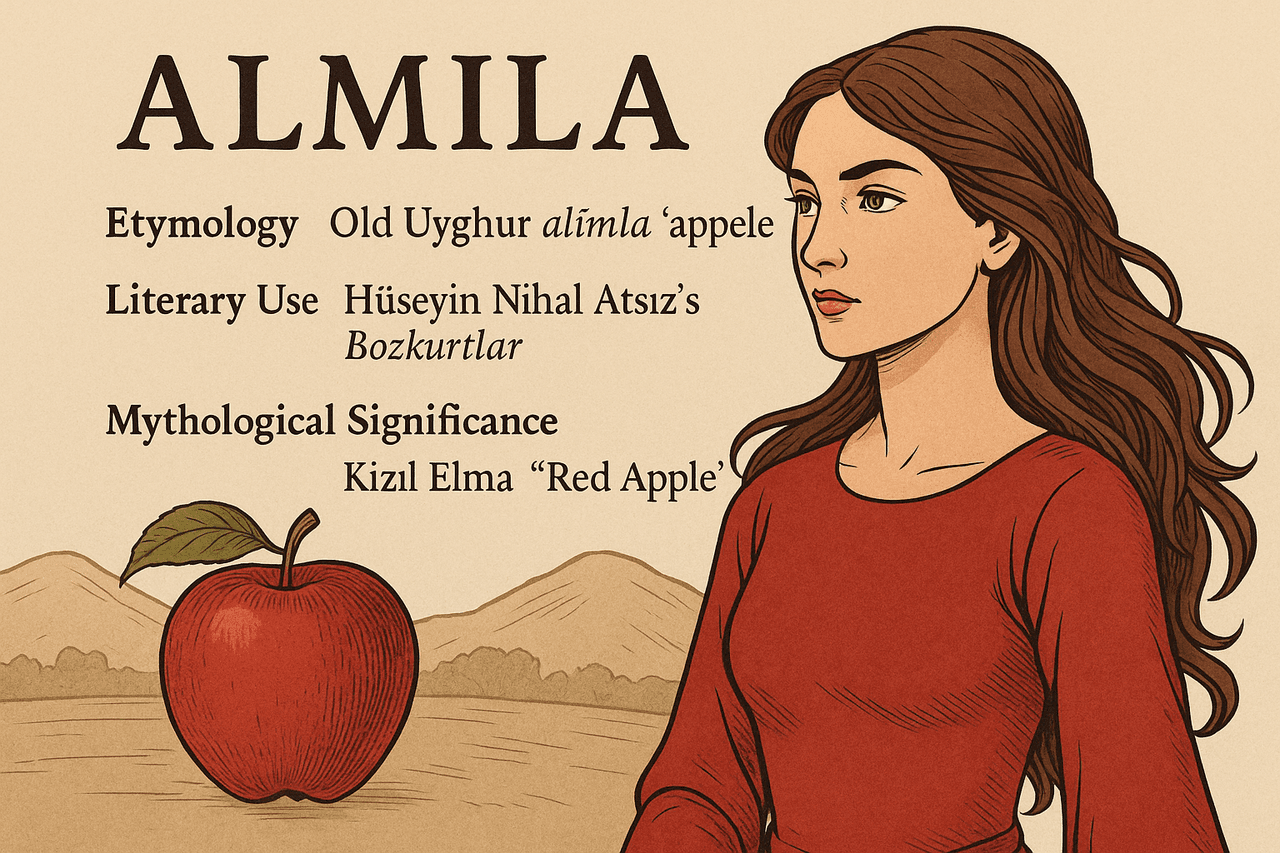
Almila (Generated by Artificial Intelligence.)
The earliest form of the word Almila is alımla, found in Old Uyghur Turkish texts. In this usage, alımla means “apple,” and the word has persisted in various forms across different Turkish dialects over time.
In Kaşgarlı Mahmud’s work Divânü Lügati’t-Türk, the word alma is given for Oghuz Turkish with the meaning “apple,” while it is noted that other Turkic tribes used almıla. However, some researchers argue that the word’s origin is Turkish and may have been transmitted to Mongolian from Turkish. The Mongolian word alima, meaning “apple,” is thought to have derived from the Turkish alımla/almıla.
The word Almıla was first used in literature by Hüseyin Nihal Atsız as the name of a female character in his novel Bozkurtlar. In Atsız’s narratives, name selection is intentional, consistent with character traits and symbolic in nature. In Bozkurtlar, Almıla is portrayed as the daughter of İşbara Alp. Her name is likely chosen to reflect her appearance—long fair hair, slanted green eyes, and a red dress—evoking the imagery of a “red apple.”
Her courage, nobility, and striking demeanor, combined with the aesthetic value of her name, suggest that she is not merely an individual figure but also an idealized symbol.
The symbolic value of the name Almila can be indirectly linked to the Turkish mythological concept of Kızılelma. In Turkish culture, Kızılelma represents a sacred goal, ideal, or utopia that is deeply desired. This myth, often visualized through a red or golden apple motif, symbolizes the journey toward a lofty objective, both individually and collectively.
In this context, the character Almıla in Bozkurtlar transforms into a figure akin to Kızılelma, through her red dress, beauty, and idealistic personality. Both her physical appearance and her role in the narrative structure indicate that she is positioned as a symbolic “value to be attained.” Such symbolic figures frequently appear in Atsız’s narratives, which aim to revive national consciousness and cultural memory.
In Turkish culture, the tradition of naming is regarded as a sacred ritual. Names given to children are selected to align with nature, society, and the expected personality traits. Within this tradition, natural elements representing beauty, strength, and nobility have often served as sources for names. In this context, the name Almila can be understood as a nature-derived, meaning-laden name.
Bulut, Mehmet. "Atsız’ın 'Bozkurtlar' Romanındaki Kişi Adları Üzerine." International Journal of Humanities and Education 6, no. 14 (2020): 1073–1084.
Keçeci, Çağdaş. "Hüseyin Nihal Atsız’ın Bozkurtların Ölümü Adlı Romanının Yapı ve İzlek Açısından Çözümlenmesi." BELGÜ Dil ve Edebiyat Dergisi 2, no. 1 (2024): 41–60.
Sertkaya, Osman Fikri. "Elma Kelimesinin Kökeni Üzerine." Türk Dili 667 (June 2014): 365–376.

Almila (Generated Using Artificial Intelligence.)
Type | Female Name | ||||||||
|---|---|---|---|---|---|---|---|---|---|
Origin | Alımla) Old Turkish (Almıla | ||||||||
Meaning | Apple Especially "Kırmızı Elma" | ||||||||
Related Concept | Nature symbols Turkish mythology Kızılelma | ||||||||
Mythological Interpretation | Indirect Symbolic Relationship with the Kızılelma Ideal | ||||||||
Origin and Etymology
Literary Usage and Layers of Meaning
Mythological Interpretation and Symbolic Value
Cultural and Sociological Context