KURE Kids Header Line
badge icon

This content was originally written in Turkish for children and is automatically translated into English using artificial intelligence.

article-image

Adoption of the Independence March

Last Updated: 03/09/2026

The Need for a National Voice

In early 1921, the War of Independence was raging across every corner of Anatolia. While the Turkish army fought a fierce battle on the front lines, there was a pressing need for a unifying anthem that would strengthen the resolve of the people and soldiers and solidify their belief in independence. To this end, the Ministry of National Education (Maarif Vekaleti) launched a competition on 18 September 1920. The terms of the competition were announced in newspapers: the winning poet would receive a prize of 500 liras. This sum was substantial for the time, enough to purchase a house.

724 Poems and Mehmet Akif’s Silence

A total of 724 poems were submitted from all parts of the country. However, the selection committee found that none of the entries fully captured the expected “national spirit.” The Minister of National Education, Hamdullah Suphi Tanrıöver, knew that only Mehmet Akif Ersoy, known as the “Poet of the Homeland,” could compose such an epic. Yet Akif had not entered the competition. His reason was deeply principled: "A poem written for the nation’s flag and freedom cannot be rewarded with money."

The Sacred Vigil at Taceddin Dergâhı

Hamdullah Suphi wrote to Akif, assuring him that his sensitivity regarding the prize would be respected, and persuaded him to participate. Mehmet Akif secluded himself in his modest residence in Ankara, the Taceddin Dergâhı. So absorbed was he in his work that when verses came to him and he could not find paper, he carved them into the walls of the dergâh. His historic address to the Turkish nation and army began with a powerful call: "Do not fear!" This word was not merely an opening—it was a declaration that the nation would never surrender.
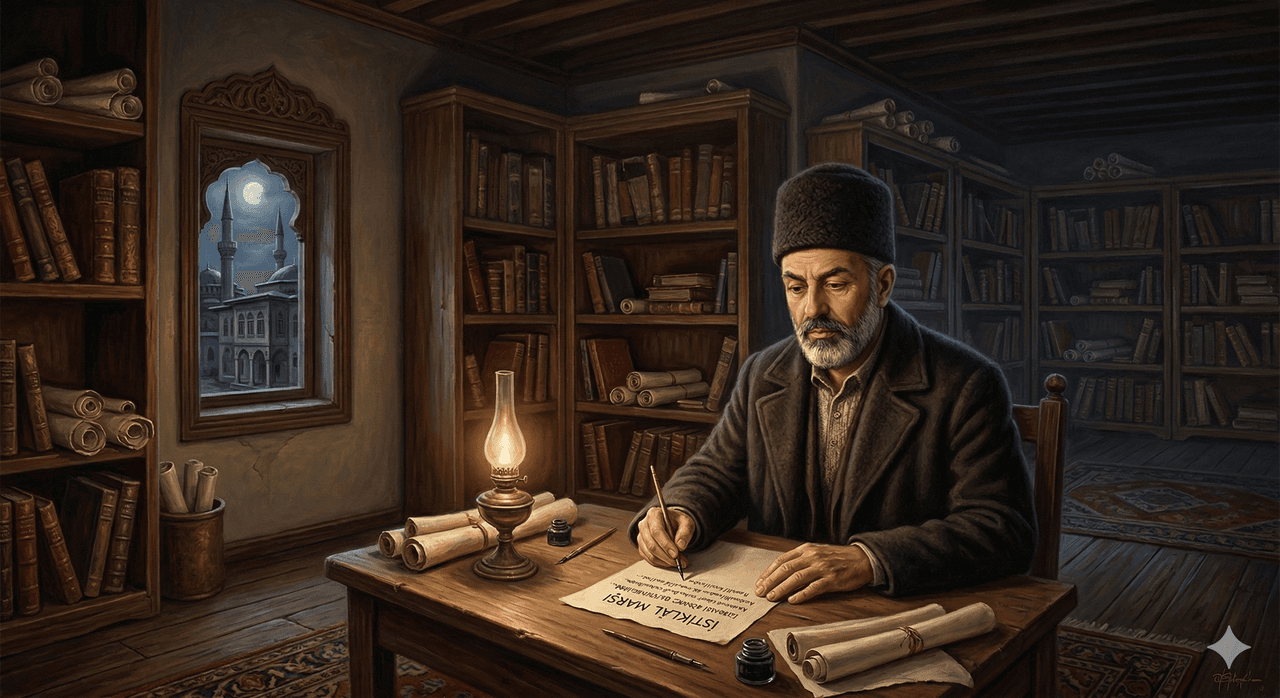

Mehmet Akif Ersoy writing the İstiklal Marşı. (Generated by artificial intelligence)


March 12, 1921: The Thunder in the Grand National Assembly

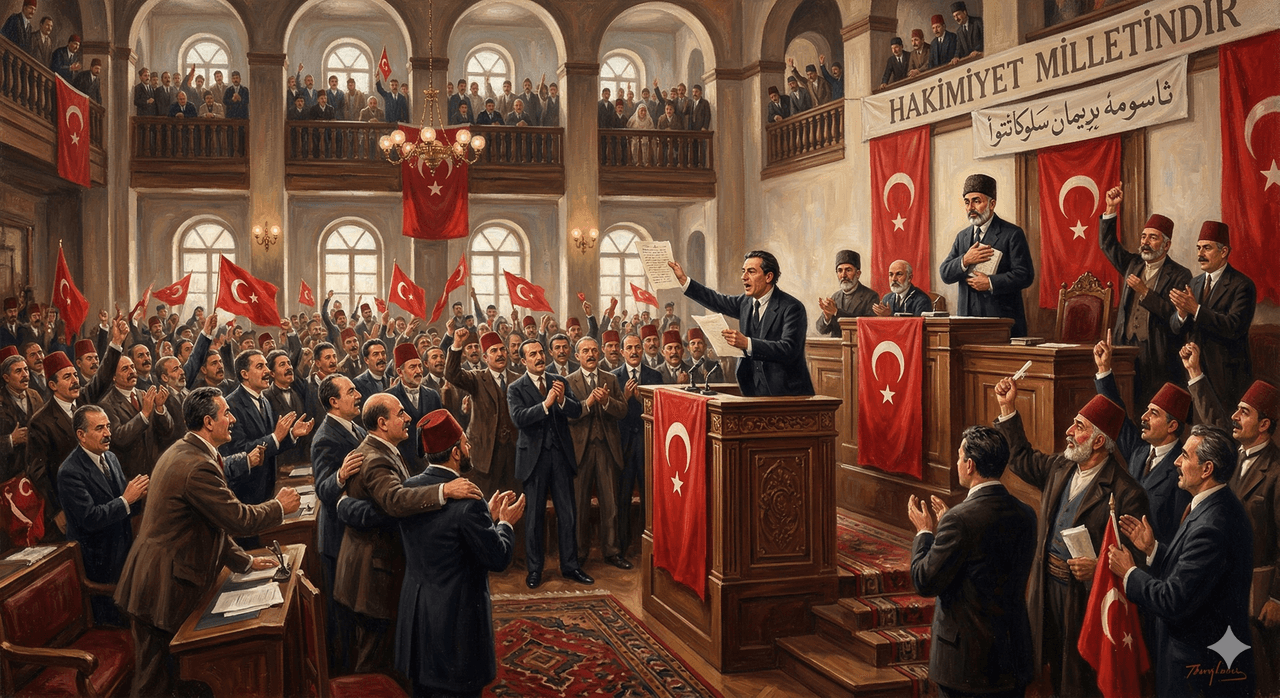
Once completed, the poem was presented to the Turkish Grand National Assembly on 12 March 1921. Hamdullah Suphi Tanrıöver recited the ten stanzas in a powerful voice from the podium. Each stanza ended to thunderous applause. Deputies enthusiastically demanded that the poem be read aloud four times in succession. Mehmet Akif’s poem was unanimously adopted as the “National Anthem.” As this great honor unfolded, Akif, overcome with humility, could not remain in the hall and left the building.
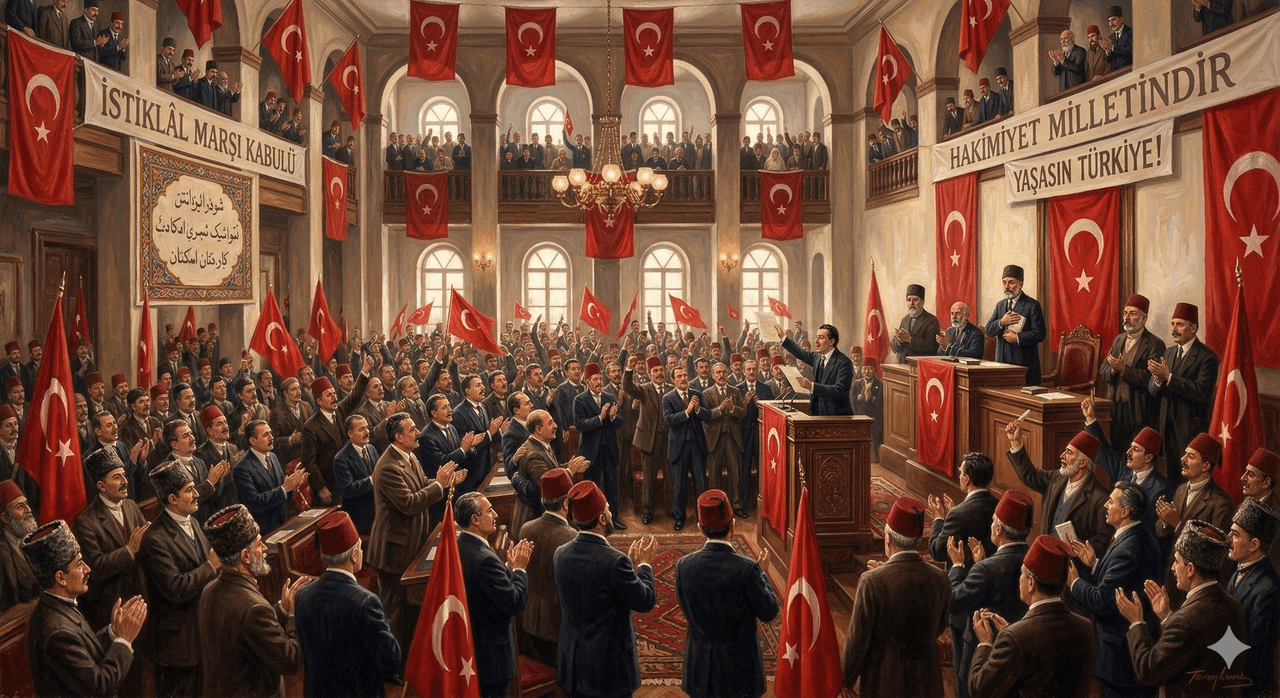

The İstiklal Marşı being recited in the Assembly. (Generated by artificial intelligence)

Love of Homeland and a Grand Sacrifice

After the competition, Akif was offered the 500-lira prize. Despite having not a single kuruş in his pocket and enduring the winter without a coat, he refused to accept it. Instead, he donated the entire sum to Darülmesai (Work House), a foundation that taught trades to poor women and children and sewed uniforms for soldiers at the front. He once again proved that the anthem he wrote could not be compensated with material gain.

An Eternal Legacy

Mehmet Akif deliberately excluded the İstiklal Marşı from his collected works in the volume Safahat. When asked why, he gave this historic reply:

"It does not belong to me, but to my nation. This is my most precious gift to my people. May God never again compel anyone to write an İstiklal Marşı!"

Don't Forget to Look at These!
Science and Technology
cat img
Natural Sciences
cat img
Art and Literature
cat img
image
Most Read
Thomas Edison
arrow
image
Last Added
Pardus
arrow
ilham-notu-bg
INSPIRATION NOTE FOR CURIOUS KIDS!

The days when the İstiklal Marşı was written show us that a nation’s greatest strength lies not in its cannons or rifles, but in its heart’s faith in freedom and unshakable unity. Mehmet Akif, even without a coat in his pocket, rejected the large reward offered to him, proving to us that honesty and love of country surpass all material value when he said, “A nation’s anthem is not written for money.”


You too should take Akif’s famous cry of “Do not fear!” as your guide; do not grow weary in the face of hardship, but boldly pursue your dreams. Remember that a single line written by a truthful pen can be a source of hope for an entire nation. With your knowledge, integrity, and diligence, you too can become a shining star of the future and fly our flag with the crescent and star higher than ever with your achievements!

Who Wrote?
Kids Writing
AuthorMustafa Cem İnciMarch 9, 2026
bottom-bg-effect-bottom
bottom-bg-effect-top

İstiklal Marşı is not merely a poem; it is a national consensus document that encapsulates the collective will of a nation to exist, its unshakable faith in independence, and its historical character. This monumental work, which begins with Akif’s cry of “Korkma!”, was like the sun rising over Anatolia during an era when despair had spread its wings.


Sincerity and Devotion: Akif did not write this anthem with the pen in his hand but with the pain and hope flowing from the soul of the nation. He was so selfless that he refused the competition prize and so deeply devoted to his homeland that he carved verses onto the walls of the Taceddin Dergâhı.

Collective Ownership: He did not regard this work as his personal property, declaring, “It is not mine, it belongs to my nation,” and thus excluded it from his collection Safahat. This attitude stands as the strongest proof of his purity from personal ego, embodying the true spirit of a “people’s intellectual.”

Moral and Theological Depth: Every line of the anthem links faith with freedom and freedom with martyrdom. While describing civilization as “a monster with only one fang,” it champions the supremacy of spiritual resistance over material power.

Legacy and Teaching: Akif’s work has left Turkish youth (“Asım’s Generation”) not merely an anthem but a “character guide.” In every stanza, he treated diligence, standing by justice, and refusing to bow to oppression as moral lessons. His final utterance, “May God never again let this nation write an İstiklal Marşı!” is the deepest testament reminding us of the severe trials and immense sacrifices that gave rise to this masterpiece.

Bibliographies

"12 March: Adoption of the Independence March and Commemoration Day of M. Akif Ersoy." Ministry of Environment, Urbanization and Climate Change, Denizli Provincial Directorate. March 12, 2024. https://denizli.csb.gov.tr/haberler/12-mart-istiklal-marsinin-kabulu-ve-m.akif-ersoy-u-anma-gunu-286685.

"İstiklal Marşı 103 Yıl Önce Bugün Kabul Edildi." Anadolu Ajansı. March 12, 2024. https://www.aa.com.tr/tr/gundem/istiklal-marsi-103-yil-once-bugun-kabul-edildi/3162487.

"İstiklal Marşı'nın Öyküsü." Milli Eğitim Bakanlığı. Accessed March 8, 2026. https://www.meb.gov.tr/istiklalmarsi/home/oyku.

ilham-notu-bg
ilham-notu-bg
ilham-notu-bg
HEYY!
Did You Know?
These?
Lamb
Lamb
Ask to Küre