

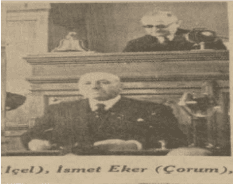
+2 More

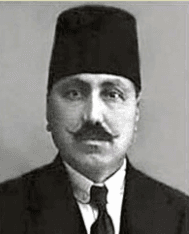
Abdullah İsmet (Eker) Bey
Personal Information | Father of five children, known as a master of methodology and recognized for his sensitivity toward state property | ||||||||
|---|---|---|---|---|---|---|---|---|---|
Contributions | Founding of the Society for the Defense of Rights in Çorum, adoption of the National Pact, presiding over the session declaring the Republic, selection of the Anıtkabir site, finance and endowment policies | ||||||||
Political Roles | Member of the Chamber of Deputies for Çorum (1914-1919), Member of the Grand National Assembly of Türkiye for Çorum (1st, 2nd, 3rd, 4th, 5th, 8th Terms), Deputy Speaker of the Grand National Assembly of Türkiye (1923) | ||||||||
Professional Roles | Çorum Defter-i Hâkani Kalemi (1899-1908), Çorum Evkaf Memurluğu (1912-1913) | ||||||||
Birth-Death | 1877, Çorum – 4 October 1962, Ankara | ||||||||
Education | Cami-i Kebir Medresesi (Arabic logic literature) hadith theology jurisprudence | ||||||||
Abdullah İsmet (Eker) Bey, born in 1877 in Çorum, served as a civil servant, politician, and statesman who participated in the National Struggle from the final years of the Ottoman Empire through the early years of the Republic. He received his religious education in Çorum, began his civil service in 1899 at the Defter-i Hâkani Kalemi, became Başkâtip in 1908 and Evkaf Memuru in 1912. In 1914 he was elected as a deputy for Çorum from the Committee of Union and Progress, and after the Armistice of Mudros he returned to Çorum where he founded the Müdafaa-i Hukuk Cemiyeti. In 1920 he played a role in the adoption of the Misak-ı Milli in the Last Ottoman Chamber of Deputies and subsequently represented Çorum in the Grand National Assembly of Türkiye (TBMM). He served as deputy in the first, second, third, fourth, fifth and eighth terms, presided over the session on 29 October 1923 when the Republic was proclaimed, and held positions on the Finance, Budget and Customs-Monopoly Commissions. He was a member of the commission that selected the site for Anıtkabir and ended his political career in 1950. Eker, father of five children, died in Ankara on 4 October 1962.
Abdullah İsmet Eker was born in 1877 in Çorum, the son of Cami-i Kebir (Ulucami) Imam and Dersiamı Enbiyazade Mehmet Nazif Efendi and Sâliha Meryem Hanım. He completed his primary and secondary education in Çorum. From his father he studied Arabic, logic, literature, theology, jurisprudence, hadith methodology and other Islamic subjects at the Cami-i Kebir Medresesi. After completing his medrese education he entered civil service.
On 13 July 1899 he began his service as a mülazım (intern) at the Çorum Livası Defter-i Hâkani Kalemi. In 1901 he was temporarily appointed as Çorum Central Land Registry Clerk. In 1903 he was promoted to Defter-i Hâkani Second Clerk and in 1908 to Başkâtip. In 1912 he was appointed to the Çorum Evkaf Memurluğu and the same year assigned to the Kereb Sancağı Evkaf Memurluğu but did not assume the post and resigned. In 1913 he was reappointed to the Çorum Evkaf Memurluğu. His civil service career ended on 2 March 1914 when he was elected as deputy for Çorum to the Chamber of Deputies.
İsmet Bey, one of the leading figures of the Committee of Union and Progress in Çorum, was elected to the Chamber of Deputies in 1914. After the signing of the Armistice of Mudros on 30 October 1918 he left Istanbul and returned to Çorum. He joined the National Struggle initiated by Mustafa Kemal Paşa on 19 May 1919. He led the establishment of the Müdafaa-i Hukuk Cemiyeti in Çorum and contributed to organizing resistance in the region. Following the Amasya Talks, he was elected as deputy for Çorum to the Last Ottoman Chamber of Deputies in 1919. He played an influential role in the secret session of 28 January 1920 that adopted the Misak-ı Milli. After the Misak was publicly announced on 17 February 1920, he went into hiding in Istanbul when the Allied Powers stormed the Chamber of Deputies. He concealed himself in the coal hold of the Yeni Dünya ship to reach Samsun and from there returned to Çorum. He sent a telegram to Mustafa Kemal Paşa requesting assistance to prevent the Çapanoğlu Rebellion from spreading to the region. After the rebellion was suppressed, he moved to Ankara.
On 22 July 1920 he began his service as deputy for Çorum in the Grand National Assembly of Türkiye (TBMM). He joined the Anatolia and Rumelia Defence of Rights Group established on 10 May 1921. On 19 March 1922 he was elected to the Group Management Board. He served on the commissions for Financial Laws, Budget, Economy, Land Registry and Foreign Affairs. After the victory of the National Struggle, he was re-elected as deputy for Çorum in the elections held on 1 April 1923. On 13 August 1923 he was appointed Second Deputy Speaker of the TBMM and presided over the session on 29 October 1923 when the Republic was proclaimed. He also served as deputy for Çorum in the third, fourth, fifth and eighth terms. At the extraordinary extraordinary congress of the Republican People’s Party held on 26 December 1938 after Atatürk’s death, he supported İsmet İnönü’s unchanging election as party leader. He was a member of the fifteen-member commission established to determine the location for Anıtkabir. He chaired the Finance, Budget and Customs-Monopoly Commissions. Drawing on his expertise in finance, he advocated that laws must be constitutional, concise, clear and fair. Based on his experience as Evkaf Memuru, he criticized the inadequate budgets of foundations. He brought Çorum’s needs to the Assembly’s agenda; for example, after two earthquakes struck Çorum in 1942 he reported the region’s condition to the Assembly. Known for his mastery of parliamentary procedure, he was referred to by colleagues as “the master of procedure”.
In an interview given by his grandson Orhan Eker to Mahmut Şener, it was noted that İsmet Bey was highly sensitive to the misuse of state property. During his tenure as Deputy Speaker he never used the automobile assigned to him for personal matters nor did he allow his family to ride in it. A reserved individual, İsmet Bey never discussed Assembly activities at home nor shared details about his relationship with Atatürk. However, Orhan Eker recalled attending the 10th Anniversary of the Republic in 1933 with his grandfather and recounted that Atatürk told him: “The Republic is a trust entrusted to you, the youth.” His son Macit Eker wrote that his father effectively managed Assembly sessions based on his experience in the Chamber of Deputies and that family members urged him to write his memoirs, but İsmet Bey refused, regarding such an act as self-praise. İsmet Bey, father of five children, ended his political career in 1950. He died in Ankara on 4 October 1962 following surgery. His funeral was held in the family cemetery in Çorum. The newspaper Ulus announced his death with the words: “İsmet Eker, deputy for Çorum from the Republican People’s Party throughout the Republican era until 1950 and a close friend of Atatürk and commanders of the War of Independence.”
Yıldırım, Hatice. “Abdullah İsmet (Eker) Bey (1877-1962).” *Atatürk Ansiklopedisi*. Accessed May 31, 2025. https://ataturkansiklopedisi.gov.tr/detay/1475/Abdullah-%C4%B0smet-(Eker)-Bey--(1877-1962).
Abdullah İsmet (Eker) Bey
Personal Information | Father of five children, known as a master of methodology and recognized for his sensitivity toward state property | ||||||||
|---|---|---|---|---|---|---|---|---|---|
Contributions | Founding of the Society for the Defense of Rights in Çorum, adoption of the National Pact, presiding over the session declaring the Republic, selection of the Anıtkabir site, finance and endowment policies | ||||||||
Political Roles | Member of the Chamber of Deputies for Çorum (1914-1919), Member of the Grand National Assembly of Türkiye for Çorum (1st, 2nd, 3rd, 4th, 5th, 8th Terms), Deputy Speaker of the Grand National Assembly of Türkiye (1923) | ||||||||
Professional Roles | Çorum Defter-i Hâkani Kalemi (1899-1908), Çorum Evkaf Memurluğu (1912-1913) | ||||||||
Birth-Death | 1877, Çorum – 4 October 1962, Ankara | ||||||||
Education | Cami-i Kebir Medresesi (Arabic logic literature) hadith theology jurisprudence | ||||||||
No Discussion Added Yet
Start discussion for "Abdullah İsmet (Eker) Bey" article
Early Life and Education
Civil Service Career
Political Career: Ottoman Period and National Struggle
Roles in the Grand National Assembly of Türkiye
Personal Traits and Later Years