This article was automatically translated from the original Turkish version.
Within the order of the universe, certain celestial bodies stand out due to their extraordinary influences. When examining the Solar System, the mass disparities between planets and their natural satellites become striking; in this context, the most remarkable balance is that established between Earth and the Moon. Due to its substantial mass, the Moon transcends the role of an ordinary satellite and exerts significant physical effects on Earth. It is not merely a passive celestial body orbiting its planet; it also plays a decisive role in Earth’s rotational motion, axial tilt, and climatic cycles.
During its early formation, Earth is estimated to have completed one rotation around its axis in approximately six hours. Today, a day—measured relative to the stars—lasts 23 hours, 56 minutes, and 4 seconds. The primary cause of this slowing is gravitational interactions between Earth and especially the Moon. The tidal forces generated by the Moon reduce Earth’s rotational speed by about 15 microseconds per year; in return, the Moon recedes from Earth by approximately 38 millimeters annually. Had the Moon not existed, Earth’s rapid rotation could have produced far more violent winds and storms in its atmosphere.
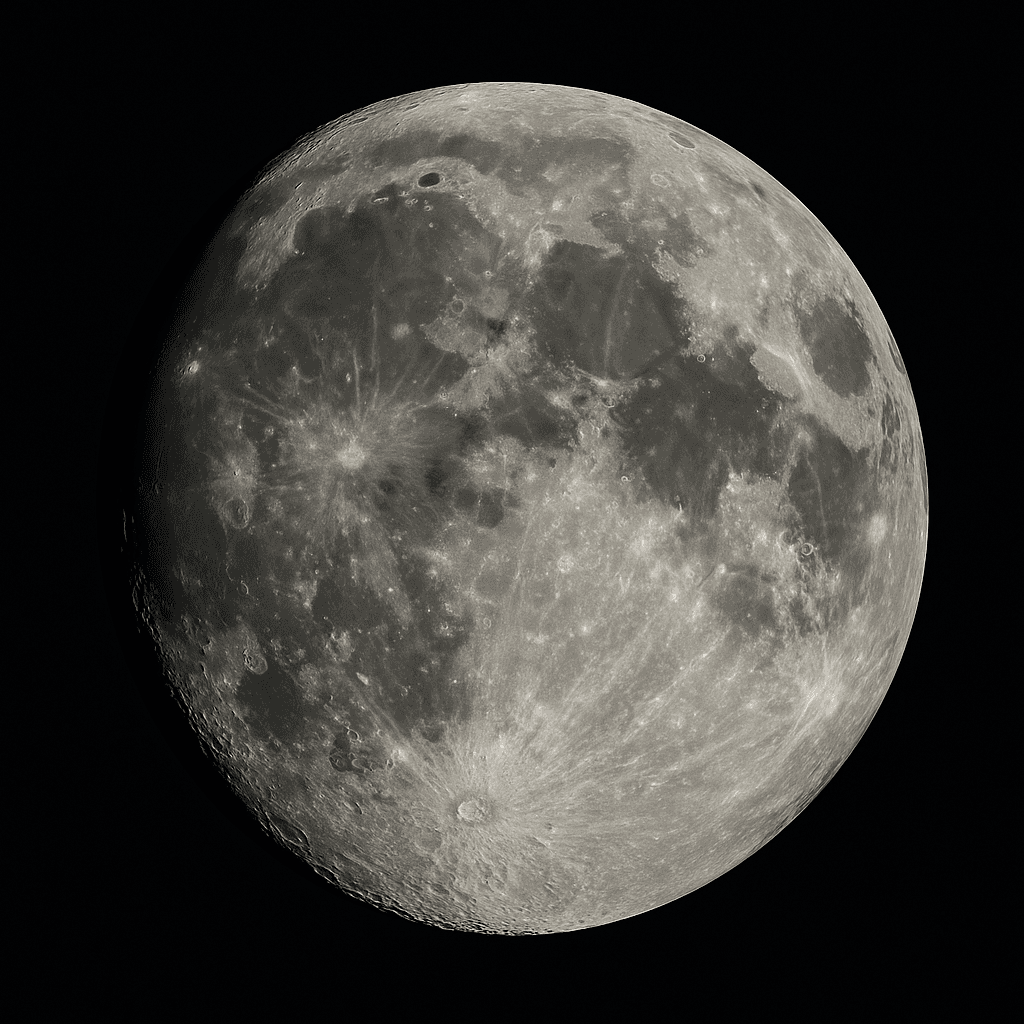
Close-up Image of the Moon (Generated by Artificial Intelligence)
There is an inclination of approximately 23 degrees and 27 minutes between Earth’s equatorial plane and its orbital plane. This axial tilt is the fundamental factor responsible for the occurrence of seasons. Although both the magnitude and direction of this tilt change over time, these variations are slow and limited, preventing major climatic shifts beyond minor shifts in seasonal dates.
Compared to other planets in the Solar System, the Moon’s stabilizing role in this regard becomes even clearer. For instance, Mercury, which lies very close to the Sun, has an axial tilt so minimal that seasonal variations are negligible. In contrast, Uranus has an axial tilt of about 97 degrees, causing one of its poles to receive prolonged sunlight while the other remains in darkness for extended periods. Mars has an axial tilt of approximately 25 degrees; however, this tilt can vary significantly over time, between 15 and 35 degrees. This variability is due to Mars lacking a large satellite like the Moon.
The Moon’s influence on Earth is decisive at this point. The Moon ensures that Earth’s axial tilt remains within a narrow range, thereby helping to preserve climatic stability. The Moon’s mass is about 1/84 that of Earth’s—a size sufficient to stabilize the axial tilt. Had the Moon not existed, Earth’s axial tilt could vary dramatically, potentially leading to the complete disappearance of seasons or the emergence of extreme climatic conditions.
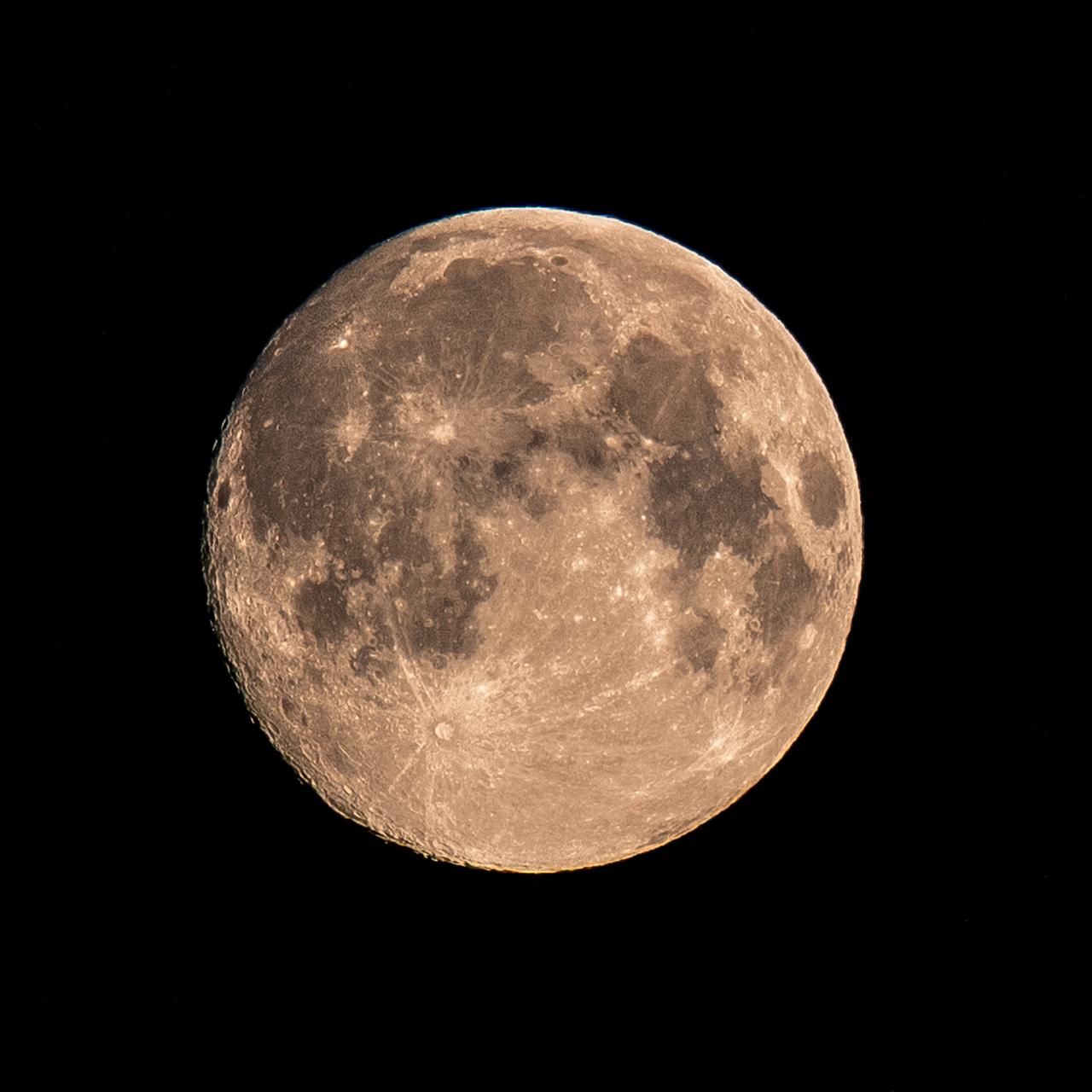
Full Moon (pixabay)
The foundation of the Moon’s stabilizing effect on Earth lies in the planet’s unique shape: flattened at the poles and bulging at the equator. This distinctive form causes the Moon’s gravitational pull to be unevenly distributed across Earth’s surface. The resulting imbalance in gravitational forces constrains Earth’s axial tilt within narrow limits. Thus, the Moon assumes a critical role not merely as a satellite in the sky, but as a vital stabilizing factor essential for the continuity of life on Earth.
The Moon is far more than Earth’s natural satellite; it plays a vital role in maintaining the planet’s physical and climatic balance. The Moon’s gravitational influence is decisive in numerous processes: the gradual slowing of Earth’s rotation, the confinement of axial tilt within stable limits, and the regular progression of seasons. Had the Moon not existed—or had it been much smaller—Earth’s climate could have diverged significantly from its current habitable conditions, potentially threatening the continuation of life. Scientific evidence strongly supports the conclusion that the existence of the Moon is largely responsible for Earth’s life-sustaining and stable structure. In conclusion, we can say that everything has been created by Allah (swt) within a system of order and balance.
Bilim Genç. "Ay Olmasaydı Ne Olmazdı?" TÜBİTAK Bilim Genç. Accessed July 21, 2025. https://bilimgenc.tubitak.gov.tr/makale/ay-olmasaydi-ne-olmazdi.
Pixabay. "Super Moon, Full Moon." Pixabay, Date Published approximately April 2020. Accessed July 21, 2025. https://pixabay.com/photos/super-moon-moon-full-moon-night-5020815/.
Topal, Selçuk. “Güneş Sistemini Tanıyalım: Ay.” *TÜBİTAK Bilim Genç*, November 27, 2023. Accessed July 21, 2025. https://bilimgenc.tubitak.gov.tr/makale/gunes-sistemini-taniyalim-ay.
The Moon’s Influence on Earth’s Rotational Speed
The Moon’s Role in Stabilizing Earth’s Axial Tilt
Climatic Consequences of Gravitational Balance