


This article was automatically translated from the original Turkish version.
+2 More
Zaytuna University is a prestigious educational institution located in Tunisia with roots extending back to the 8th century. Originally constructed as a mosque, the structure gradually became the center of scholarly activity and acquired university status in the modern era.
Construction of the Zaytuna Mosque (Jāmiʿ al-Kabīr) began in 80 AH / 699 CE by Hasan ibn Nuʿman and was completed in 114 AH / 732 CE by Ibn al-Habhab. The mosque derives its name from a traditional belief that an olive tree stood on the site where it was built. It is the second largest mosque constructed in Ifriqiya after the Uqba ibn Nafiʿ Mosque in Kairouan (50 AH).
From its foundation, the mosque functioned both as a place of worship and an educational center, where study circles were established to promote the Islamization of the local population and the learning of Arabic. Beginning around 120 AH, this education took the form of oral instruction delivered by teachers to students seated in a circle around them. Over time, the intellectual center shifted from Kairouan to Tunis, and Zaytuna replaced the Uqba ibn Nafiʿ Mosque as the leading scholarly institution in Ifriqiya. Starting in the 13th century, students from Algeria, Morocco, Sudan, and al-Andalus began coming to Zaytuna for their education.
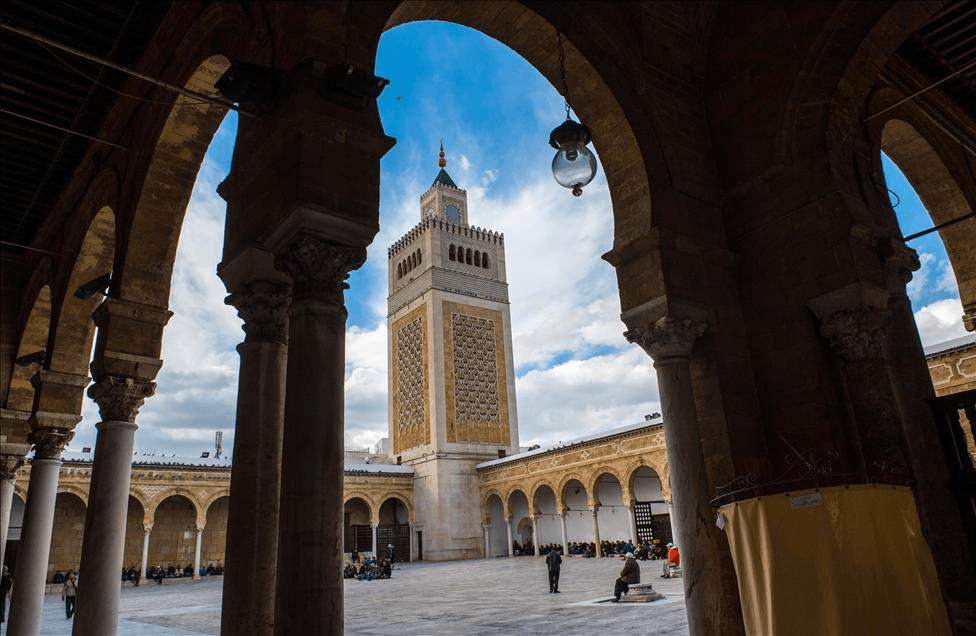
Zaytuna Mosque (AA)
Studies examining the educational history of Tunisia and Algeria identify the Zaytuna-centered madrasa system as one of three main educational streams in the region:
1- French-style schools,
2- “Franco-Arab” schools similar to Sadikiya,
3- The Zaytuna system.
The Zaytuna system represents a long-standing tradition of education within the classical mosque-madrasa framework, grounded in the Qur’an, Arabic language, and religious sciences. 【1】
The classical curriculum of Zaytuna was based on oral and text-centered lessons conducted in study circles around the mosque. Education relied heavily on memorization and teachers’ commentaries on canonical texts. Before the 19th century, this structure trained several hundred students for roles as imams, judges, and other religious-legal positions. The core disciplines included jurisprudence, hadith, Qur’anic exegesis, Arabic language, and rhetoric. This system served as a reference point for the transmission of religious authority and Islamic sciences both in Tunisia and other parts of the Maghreb. 【2】
Throughout the French protectorate period, Zaytuna continued to exist as a “traditional” yet effective channel of education within a tripartite structure alongside French schools and mixed educational institutions. Despite remaining outside the French educational network, Zaytuna retained its importance as a local center of higher education that preserved Arabic and Islamic culture for Tunisian Muslims. 【3】
Zaytuna’s modern “universitization” process was shaped by reform movements of the 19th and 20th centuries. In the late 19th century, reformist circles in Tunisia introduced changes aimed at rationalizing the content and methods of instruction at Zaytuna and its affiliated madrasas. A structured program based on specific textbooks was implemented, along with mandatory attendance and an examination system. Scientific subjects such as arithmetic, geometry, architecture, astronomy, and history-geography were added alongside classical religious sciences.
These changes transformed Zaytuna into a hybrid higher education institution that preserved its traditional mosque-madrasa identity while responding to modern educational demands. By the early 20th century, Zaytuna had become a major center of religious education not only for Tunisians but also for students from other parts of the Maghreb and sub-Saharan Africa. According to 1942 records, the institution enrolled 123 Algerians, one Moroccan, and seven Libyans, demonstrating its regional appeal. 【4】
In the pre-independence period, Zaytuna emerged as one of the primary arenas for mobilizing Islamic identity in the anti-colonial struggle. Zaytuniyya circles educated in the 1930s played active roles in both Algerian nationalism and the Tunisian independence movement. 【5】
Following Tunisia’s independence in 1956, education reforms led by Habib Bourguiba fundamentally altered Zaytuna’s institutional status. In April 1956, all traditional madrasas affiliated with the Zaytuna Mosque were incorporated into the national secondary education system, while the “university-mosque” was redefined as a public institution with legal personality under the Ministry of Education. During this process, the institution was transformed into a college offering instruction in two main fields: Arabic language and literature, and legal-religious sciences. 【6】
During this period, Zaytuna was no longer viewed as a system in its own right but was reduced to a faculty within the modern University of Tunis, intended for eventual integration. Concurrently, the narrowing of employment opportunities for its graduates led to a decline in the institution’s social prestige, prompting qualified students to turn toward modern schools. From the 1950s onward, Zaytuna’s traditional university identity clearly receded.
According to researcher Pouessel, Zaytuna was legally dissolved after independence; however, it was reestablished in 1988 shortly after Zine El Abidine Ben Ali came to power. This reestablishment is interpreted as part of the state’s policy of controlled reengagement with Islamic references. The opening of Zaytuna FM, a religious radio station, in 2007 is similarly viewed within this framework. 【7】
In the classical period, Zaytuna’s curriculum was based on a teaching system conducted in mosque study circles, heavily reliant on memorization. Students studied texts on the Qur’an, tajwid, theology, jurisprudence, Arabic language and rhetoric, prophetic biography, and ethics under the commentary of their teachers. Affiliated madrasas provided preparatory education at the secondary level to guide students toward advanced religious instruction.
With the 19th-century reforms, new subjects were introduced into the curriculum, integrating the “rationalized teaching of Islamic sciences” with disciplines considered “secular.” This transformation aimed to make Zaytuna an institution that both sustained religious authority and produced administrative and technical personnel for a modernizing Tunisian society.
After 1960, Zaytuna was incorporated into the national university system and divided into two main fields: Arabic language and literature, and legal-religious sciences. This marked the end of the classical “Zaytuna system,” with the mosque-university being restructured as a modern faculty of Islamic sciences within the University of Tunis.
In 1995, following the 1988 reestablishment of Zaytuna University, a new unit called the Institute of Tunisian High Islamic Civilization was created for foreign students. Here, the majority of students from Francophone and Anglophone Africa pursue a program focused on Islam and modern Arabic. In the 2010–2011 academic year, 137 students were enrolled, demonstrating that Zaytuna’s curriculum continues to attract international students and maintain a transnational character. 【8】
Historically, Zaytuna has exerted broad influence on the religious and intellectual life of North Africa. Its ability to attract large numbers of students from the Maghreb and sub-Saharan Africa in the first half of the 20th century, particularly Algerian students who played roles in nationalist movements of the 1930s, underscores its regional significance.
Post-independence reforms under Bourguiba weakened Zaytuna’s status, leading the institution to be described for a time as a “relic of the past.” However, its 1988 reestablishment reintegrated Zaytuna into Tunisia’s higher education system as a state-supervised institution of higher religious learning grounded in Islamic references.
Since the 1990s, the division of labor between Zaytuna University and the Institute of High Islamic Civilization has enabled Tunisian students to pursue classical theological education while allowing students from countries such as Africa, Turkey, Indonesia, and Russia to obtain undergraduate and graduate degrees in Islamic studies and Arabic. Today, Zaytuna University continues to exist as a higher education institution within the modern Tunisian university system, centered on theology and Islamic sciences, with historical roots in the Zaytuna Mosque.
This institution simultaneously represents the continuity of the mosque-madrasa tradition and participates in regional and international student mobility as part of the national university network. In this regard, it is regarded as a significant case in discussions on the educational history of the Maghreb and alternative models of university development in the Islamic world.
The institution has produced numerous scholars, thinkers, and statesmen throughout its history, including the historian and sociologist Ibn Khaldun (d. 1406), Hafsid-era scholars Ibn Urfa and Ibn Usfur al-Isbili, and in the modern period, Muhammad Taher ibn Ashur, Muhammad Fazil ibn Ashur, the historian Ibn Abi al-Diya, the poet Abu al-Qasim al-Shabbi, and the Algerian reformer Abd al-Hamid ibn Badis. 【9】
Brown, Leon Carl. "Tunisia: Education, 'Cultural Unity' and the Future." Institute of Current World Affairs, LCB-1. December 1, 1960. Accessed November 14, 2025.
Cengiz, Merve. "Camiden üniversiteye bir din eğitimi kurumu olarak Zeytûne Medresesi." *Türkiye Din Eğitimi Araştırmaları Dergisi* 18 (2024): 97-119. Accessed November 14, 2025.https://dergipark.org.tr/en/download/article-file/3896400
Hizmetli, Sabri. "Osmanlı Yönetimi Döneminde Tunus ve Cezayir’in Eğitim ve Kültür Tarihine Genel Bir Bakış." *Ankara Üniversitesi İlahiyat Fakültesi Dergisi* 32, no. 1 (1992): 1–22. Accessed November 14, 2025.https://isamveri.org/pdfdrg/D00001/1992_32/1992_c32_HIZMETLIS.pdf
Pouessel, Stéphanie. “L’islam au Nord : Jeux de frontières Afrique/Maghreb à partir des étudiants subsahariens en filière arabisante et islamique à Tunis.” *Cahiers d’études africaines*, no. 211 (2013): 571–600. Accessed November 14, 2025.https://www.jstor.org/stable/24475074
Yiğit, İsmail. "Zeytûne Camii (İlim ve Kültür Tarihindeki Yeri)." Türkiye Diyanet Vakfı İslâm Ansiklopedisi. Accessed November 14, 2025.https://islamansiklopedisi.org.tr/zeytune-camii
İzgi, Ahmet. Fotoğraf. “Kuzey Afrika’nın eğitim merkezi Zeytune.” Anadolu Ajansı, March 15, 2015. Accessed November 14, 2025.https://www.aa.com.tr/tr/pg/foto-galeri/kuzey-afrikanin-egitim-merkezi-zeytune/0
[1]
Leon Carl Brown, “Tunisia: Education, ‘Cultural Unity’ and the Future,” Institute of Current World Affairs, LCB-1 (1 Aralık 1960): 2, erişim tarihi: 15 Kasım 2025, https://www.icwa.org/wp-content/uploads/2015/09/LCB-1.pdf
[2]
Brown, “Tunisia: Education,” 14, erişim tarihi: 15 Kasım 2025, https://www.icwa.org/wp-content/uploads/2015/09/LCB-1.pdf
[3]
Brown, “Tunisia: Education,” 8, erişim tarihi: 15 Kasım 2025, https://www.icwa.org/wp-content/uploads/2015/09/LCB-1.pdf
[4]
Stéphanie Pouessel, “L’islam au Nord : Jeux de frontières Afrique/Maghreb à partir des étudiants subsahariens en filière arabisante et islamique à Tunis,” Cahiers d’études africaines, no. 211 (2013): 575, erişim tarihi: 15 Kasım 2025, https://www.jstor.org/stable/24475074
[5]
Pouessel, “L’islam au Nord,” 575, erişim tarihi: 15 Kasım 2025, https://www.jstor.org/stable/24475074
[6]
Brown, “Tunisia: Education,” 11-12, erişim tarihi: 15 Kasım 2025, https://www.icwa.org/wp-content/uploads/2015/09/LCB-1.pdf
[7]
Pouessel, “L’islam au Nord,” 576, erişim tarihi: 15 Kasım 2025, https://www.jstor.org/stable/24475074
[8]
Pouessel, “L’islam au Nord,” 576, erişim tarihi: 15 Kasım 2025, https://www.jstor.org/stable/24475074
[9]
Merve Cengiz, “Camiden üniversiteye bir din eğitimi kurumu olarak Zeytûne Medresesi,” Türkiye Din Eğitimi Araştırmaları Dergisi 18 (2024): 112-113, erişim tarihi: 15 Kasım 2025, https://dergipark.org.tr/en/download/article-file/3896400 ; İsmail Yiğit, “Zeytûne Camii (İlim ve Kültür Tarihindeki Yeri),” Türkiye Diyanet Vakfı İslâm Ansiklopedisi, c. 44 (İstanbul: Türkiye Diyanet Vakfı Yayınları, 2013), 383, erişim tarihi: 15 Kasım 2025, https://islamansiklopedisi.org.tr/zeytune-camii
.

Educational Structure During the Ottoman and Colonial Periods
University Transformation and Modern Reforms
Post-Independence Period and Restructuring
Curriculum and Historical Development
Regional Influence and Current Status
Notable Figures Educated at Zaytuna