
Birth | 27 June 1921 | ||||||||
|---|---|---|---|---|---|---|---|---|---|
Death | 9 October 1989 | ||||||||
Profession | Teacher Translator Writer | ||||||||
Literary Period | Modern Turkish Literature | ||||||||
Education | Balıkesir High School Istanbul University Turkish Language and Literature | ||||||||
Award | Yunus Nadi Novel Award (for the work Aylak Adam - 1995) | ||||||||
Yusuf Atılgan (1921–1989) is one of the pioneering novelists and short story writers of modern Turkish literature. Born in Manisa and educated at Istanbul University’s Department of Turkish Language and Literature, he examined the individual’s loneliness, alienation, communication breakdown, and inner conflicts through a modernist lens, particularly in Aylak Adam (1959) and Anayurt Oteli (1973). He left behind a significant literary legacy, including the unfinished novel Canistan.
Atılgan was born on 27 June 1921 in Manisa. His father was a farmer and his mother a homemaker. He completed primary school at Manisa Gazi Primary School and secondary school at Manisa Middle School. He later transferred to Balıkesir High School. During his high school years, his interest in literature grew and he began writing his first pieces. He graduated from Istanbul University’s Department of Turkish Language and Literature in 1944 after enrolling in 1939. During his university years, he became acquainted with literary circles and published his poems and writings in various journals.
After graduation, Atılgan worked as a teacher for a time before returning to his village of Hacırahmanlı in Manisa to engage in farming. He achieved his first literary success in 1955 when he won the Yunus Nadi Novel Prize for Aylak Adam. When the novel was published in 1959, it was recognized as one of the important works of modernist Turkish literature. Anayurt Oteli, published in 1973, generated significant反响 in literary circles and was later adapted for theater and cinema. The author is also known for his unfinished novel Canistan, as well as numerous short stories, essays, poems, and fairy tales for children.
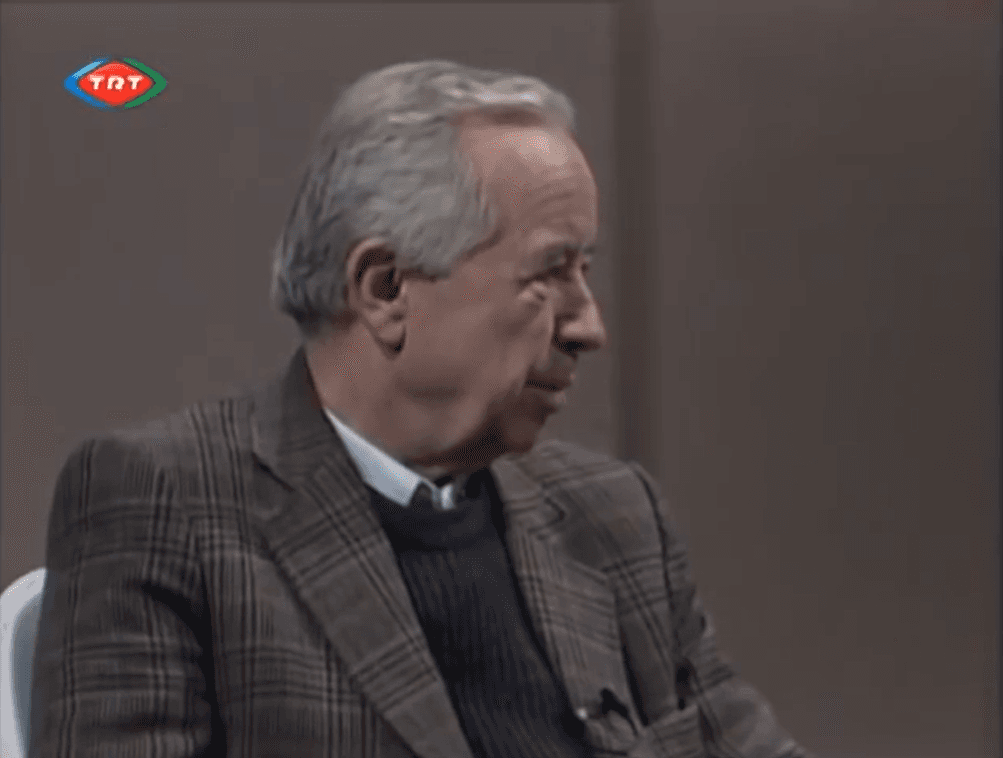
Yusuf Atılgan's Appearance on the Book World Program (Hayvanlarousse)
After university, Atılgan returned to his village and devoted himself to farming, closely observing rural life during this period. While in Istanbul, he maintained connections with literary circles. He married and had a son. The writer, who spent most of his life in Manisa and his village, was known for his quiet, observant, and introverted personality.
Atılgan’s first novel, Aylak Adam, explores the individual’s loneliness and alienation in urban life. The protagonist, C., searches for an ideal lover and the meaning of life amid crowds; alienation, the quest for love, and communication breakdown are the novel’s central themes.
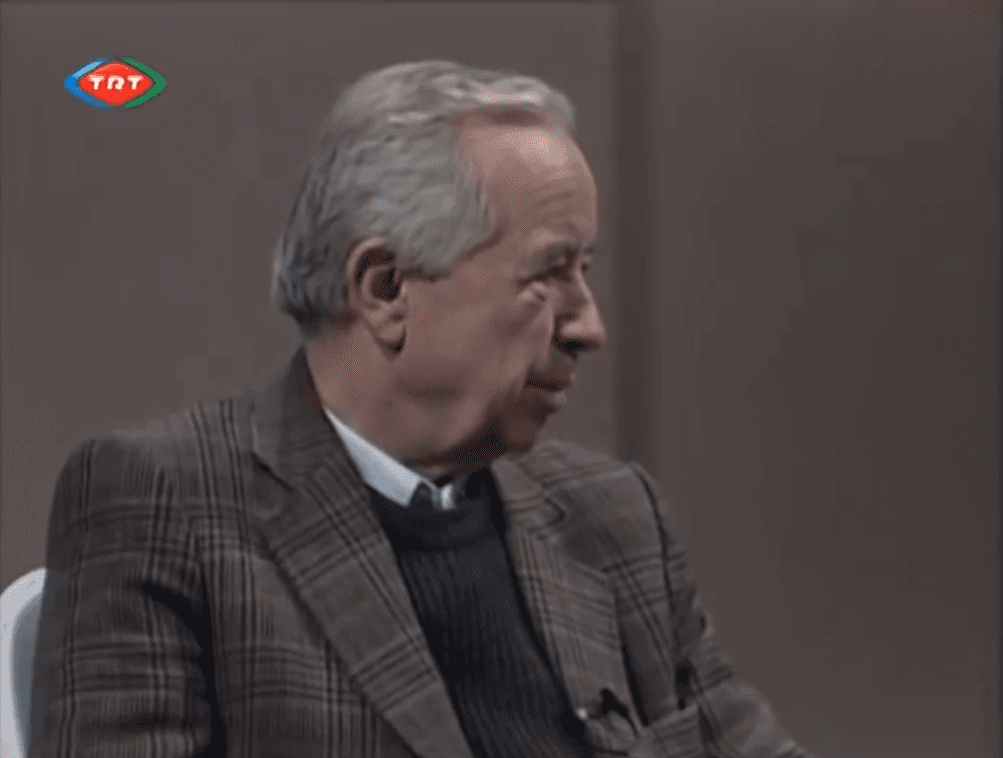
Video on Aylak Adam Novel (TRT2)
Anayurt Oteli’s protagonist, Zebercet, is a clerk at a hotel in a provincial town. His interest in a woman arriving on a delayed train disrupts his routine life. When she fails to return, Zebercet is drawn deeper into isolation and inner collapse. The novel highlights themes of alienation, communication breakdown, and suicide.
Atılgan’s short stories are collected in the volumes Bodur Minareden Öte, Eylemci, and the children’s book Ekmek Elden Süt Memeden. These stories, set in towns, villages, and cities, explore the individual’s loneliness, alienation from family and society, communication breakdown, and search for escape. The protagonists often seek salvation in love or flight, but the outcome is frequently disappointment.
In Atılgan’s literature, the individual’s inner world, loneliness, and alienation are central. His narratives employ modernist techniques such as stream of consciousness, interior monologue, psychological analysis, and flashbacks. His characters are defined more by internal conflicts than by social events. Although love is often presented as a means of escape from loneliness, it ultimately proves futile. A common theme across his narratives set in cities, villages, and towns is how modern life drives the individual into a dead end.
In the 1980s, the writer continued his literary work but was unable to complete the novel Canistan. He died of a heart attack in Istanbul on 9 October 1989.
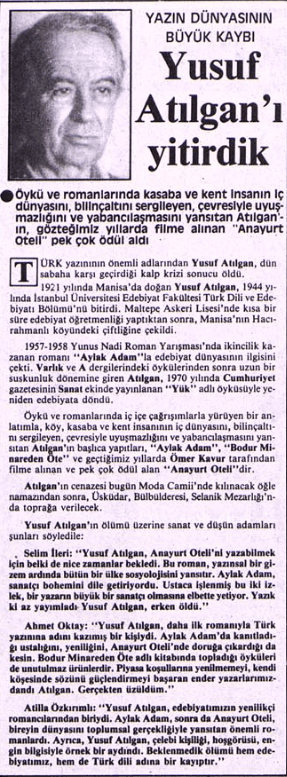
Yusuf Atılgan’s Obituary, 10 October 1989 (Milliyet Gazetesi)
Yusuf Atılgan is among the first Turkish writers to explore the inner world of the modern individual. Aylak Adam and Anayurt Oteli have left a lasting impact as pioneering novels addressing alienation and loneliness. Atılgan’s modernist techniques influenced subsequent generations of writers and contributed to the development of psychological analysis in Turkish short story and novel writing. Today, his works continue to serve as sources for academic studies and literary movements.
Ankay, Nurcan. "Yusuf Atılgan Öykülerinde Yabancılaşma." *Türkiyat Araştırmaları Enstitüsü Dergisi* 71, (Mayıs 2021): 241-255. Accessed October 8, 2025.https://dergipark.org.tr/en/pub/ataunitaed/issue/62632/941148
Audiovisual Sources
Güngör, Bilgin. "Yusuf Atılgan Üzerine." *Türk Dili* (June 2021): 42-46. Accessed October 8, 2025.https://www.tdk.gov.tr/wp-content/uploads/2021/06/Bilgin-G%C3%BCng%C3%B6r-_-YUSUF-ATILGAN-%C3%9CZER%C4%B0NE-_-5-.pdf
Güngör, Bilgin. *Yusuf Atılgan'ın Hayatı, Eserleri Ve Fikirleri (1921-1989)*. Master's thesis, Marmara Üniversitesi, Türkiyat Araştırmaları Enstitüsü, Istanbul, 2014. Accessed October 8, 2025.https://www.proquest.com/openview/84c16723cee5daa053475e121097fb17/1?cbl=2026366&diss=y&pq-origsite=gscholar
Hayvanlarousse. "Yusuf Atılgan - Kitapların Dünyası (Ocak 1989)." YouTube. Accessed October 8, 2025.https://www.youtube.com/watch?v=iV0PhNLw2E4.
Milliyet Gazetesi. "Yazın Dünyasının Büyük Kaybı Yusuf Atılgan'ı Yitirdik." Milliyet Gazete Arşivi. Accessed October 8, 2025.https://gazetearsivi.milliyet.com.tr/liste?tarih=1989.10.10.
Research Works
TRT2. "Aylak Adam Romanı | Edebî Sofralar 19. Bölüm." YouTube. Accessed October 8, 2025.https://www.youtube.com/watch?v=vmMpIAtUfME.
Özgür, Nejla. *Modernleşme ve Aydın Kavramları Çerçevesinde Edebiyat Bağlamında Aykırı Eserler Veren Romancı/Aydınlar: Ahmet Hamdi Tanpınar, Yusuf Atılgan, Oğuz Atay*. Master's thesis, İstanbul Bilgi Üniversitesi, Sosyal Bilimler Enstitüsü, Istanbul, 2010. Accessed October 8, 2025.https://tez.yok.gov.tr/UlusalTezMerkezi/TezGoster?key=zD1B0cW7zVr3VcnZjitVXrRVr5YIIDONaBGlNyz5jcVLva8FZCBGFDy6b5KHAk5P
[1]
Nejla Özgür, Modernleşme ve Aydın Kavramları Çerçevesinde Edebiyat Bağlamında Aykırı Eserler Veren Romancı/Aydınlar: Ahmet Hamdi Tanpınar, Yusuf Atılgan, Oğuz Atay. Yüksek Lisans Tezi. İstanbul Bilgi Üniversitesi, Sosyal Bilimler Enstitüsü. s. 48. Erişim Tarihi: 8 Ekim 2025. https://tez.yok.gov.tr/UlusalTezMerkezi/TezGoster?key=zD1B0cW7zVr3VcnZjitVXrRVr5YIIDONaBGlNyz5jcVLva8FZCBGFDy6b5KHAk5P
[2]
A.e., s. 48.
[3]
A.e., s. 52.
[4]
A.e. s. 52.
[5]
A.e., s. 70-71.
[6]
A.e., s. 71.
[7]
A.e., s. 78.
[8]
A.e., s. 74.
[9]
A.e., s. 74
[10]
A.e., s. 64.

Birth | 27 June 1921 | ||||||||
|---|---|---|---|---|---|---|---|---|---|
Death | 9 October 1989 | ||||||||
Profession | Teacher Translator Writer | ||||||||
Literary Period | Modern Turkish Literature | ||||||||
Education | Balıkesir High School Istanbul University Turkish Language and Literature | ||||||||
Award | Yunus Nadi Novel Award (for the work Aylak Adam - 1995) | ||||||||
Childhood and Youth
Career and Achievements
Personal Life
Works
Aylak Adam
Anayurt Oteli
Short Stories
Literary Approach
Final Years and Death
Legacy
Critics’ and Writers’ Views on Yusuf Atılgan